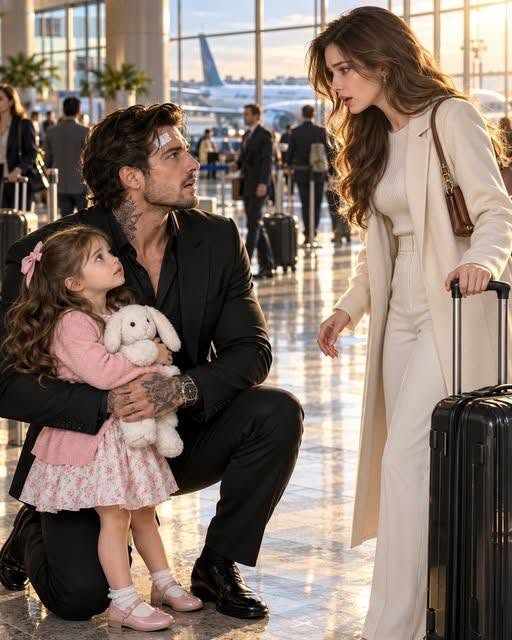
We moved into the lake house in Winnetka on a Friday, in three unmarked cars, like a small embarrassed country relocating its government.
It was Vincent's house — of course it was; everything with a lake view within forty miles seemed to be — but he did not live in it with us. That was my condition, stated once, in his office, the morning after the photograph: "You protect her from a distance. That's your penance, and your limit." And Vincent Moretti, who had overridden governments of men, accepted my terms without negotiation, installed his people in the gatehouse and the grounds, put Dom in the guest cottage like a gargoyle with a phone, and went back to the city to hunt Dario Castellano.
He came on Sundays. Sundays were what I allowed him, and I told myself it was strategy — let the child stop flinching at strangers with cameras before she had to flinch at the concept of a father — but the truth was simpler and uglier: I needed to watch him with her before I could survive it.
Lily, who had been told nothing except that the sad man from the airport was "an old friend of Mommy's who is helping us stay safe," assessed Vincent with the total lack of mercy of the very young. In the first ten minutes of his first Sunday she asked him why his hair had "white in it like Grandpa's," informed him that his shoes were too shiny, and assigned him to be the dragon in a game whose rules existed only in her head and changed without notice.
He played the dragon for two hours. On his knees. In the suit.
I stood at the kitchen window with a dish towel in my hands that I had stopped drying anything with, and I watched the most feared man in Chicago die theatrically, eleven times, clutching his chest and begging a four-year-old in a paper crown for mercy, and I felt something in my chest that I had spent five years and considerable discipline killing, stir in its grave.
"She has your laugh," he said at the door that evening, quiet, not presuming. "I never knew what my laugh sounded like from the outside."
"She has a lot of things of yours," I said. "She's had them all along. You just weren't there to inventory them."
He took it. He always took it. That was the arrangement, though neither of us ever said it aloud: I was allowed to wound him with the truth as often as I needed, and he was required to stand there and bleed accurately.
Emma arrived on the second Sunday with two suitcases, a garment bag, and the particular fury of a woman who has flown six hours to manage a crisis she was not consulted about. She hugged Lily until Lily squeaked, hugged my mother — installed in the lake house's ground-floor suite with her bell, ruling it like a dowager — and then she took me out onto the terrace with two glasses of wine and the face she had worn in my bathroom five years before, holding a pregnancy test like a live wire.
"There's something I never told you," she said. "And before you pour that over my head, know that I have rehearsed this on the plane and there is no version where I come out of it well."
Three years ago, at the lowest point of Vincent's search — when his men had turned over two states and a private investigator in Detroit had produced a photograph of a woman who was not me, and Vincent had sat in Dom's office and put his head in his hands in a way Dom had never seen in thirty years — Emma had done the thing she had sworn on my bathroom floor she would never do.
She had sent one message. No name, no place, no photograph. Eight words, through a channel Dom still won't describe to me:
She is alive. She is well. Stop looking.
"It went quiet after that," Emma said. "The investigators vanished. The Detroit man got paid off and disappeared. I told myself I'd bought you peace, Claire. That's what I told myself for three years. But sitting on that plane today, I finally admitted the other half. He was dying of it. Not performing dying — actually doing it, in installments. And I couldn't—" Her voice went ragged. "You were my person. You are my person. But I couldn't watch a man dig his own grave with a photograph of a stranger, either. I'm sorry. I will be sorry in whatever direction you need me to be."
I looked at my oldest friend, who had held my hair and my secrets and my daughter, in that order, for fifteen years.
"You kept the only promise that mattered," I said finally. "You never told him where. You never told him about her. You told a drowning man the water wasn't empty. If I can't forgive that, Emma, then grief has made me into something I don't want Lily raised by."
She cried. Emma, who negotiates with studio heads the way other people order lunch, cried into her wine on my terrace, and I held her hand and let her, because that is the other half of fifteen years.
That night I found Vincent in the library. He wasn't supposed to be in the library — Sundays ended at seven, and it was nearly nine — but Lily had fallen asleep on the rug in front of the fireplace halfway through being read a story, and he had not been able to make himself leave a room containing her sleeping. He was sitting on the floor beside the rug, his back against the couch, the storybook still open on his knee, watching her breathe with an expression I can only describe as a man memorizing a coastline he expects to be exiled from at dawn.
"I didn't want to wake her moving her," he said softly.
"You'll learn. She sleeps like a felled tree. You could march a band through."
"I don't want to learn it from a distance of one day a week, Claire." He said it without demand — a fact laid down like a card. "But I'll take what I'm given and I'll be grateful in writing if you want it."
Lily stirred, and in her sleep reached out one small hand and found, unerringly, the cuff of his shirt, and held it. I watched him look down at those four small fingers curled into expensive wool like it was the only solid thing in the world.
"Daddy used to be far away," Lily murmured, not waking, dreaming her four-year-old dreams out loud. "Now Daddy is here."
Vincent Moretti closed his eyes.
I want to tell you that my heart hardened at the sound of it — that the actress, the divorcée, the woman who had survived the parked car kept her armor polished. It would be a better story and it would be a lie, and I had promised myself, in a bathroom five years ago, which lies I was finished with.
What I felt, standing in that doorway, was the floor of the world quietly changing its mind about what shape it was.
"Mommy," Lily said at breakfast the next morning, drawing a purple dragon with three heads in a coloring book while the lake did its gray morning arithmetic outside the windows, "the sad man isn't sad when he's the dragon."
"No, baby," I said. "He isn't."
"Then he should be the dragon all the time."
From the mouths of four-year-olds: the entire case for and against my life, in eleven words.
Vincent called that evening — the number from the white card, which I had taken out of the kitchen drawer on the second day and put into my own phone, a fact I had confessed to no one, including myself, in any detail.
"Dom found the photographer," he said. "A freelancer. Paid in cash through two cutouts. But he kept the original memory card, Claire, because men like that always keep the card. There were other photographs on it. Older ones."
"How old?"
"Five years." A pause with weather in it. "Your premiere. The Glass Hour. He's been sitting on pictures of you from the night they tried to kill you — which means he was there. Which means Dario has had eyes in rooms I believed were clean for longer than I want to say out loud." His voice hardened into the register I remembered from the bad years. "I'm ending this. Not managing it. Ending it. But I need one thing from you, and I have no right to ask it, so I'll ask it as the man on the porch, not the man in the office."
"Ask."
"The hospital foundation gala is in nine days. Every name in Chicago will be in that room, and every rumor with it. If Lily and I appear in that story separately — a hidden child, a secret — Dario keeps the initiative. If we end the secrecy, publicly, on our ground, with federal marshals' wives in the front row and the Tribune's cameras at the door, he has nothing left to price." A breath. "I'm asking you to stand next to me at that gala, Claire. As her parents. In the light."
It was, strategically, impeccable. It was also the exact shape of every nightmare I had packed into two suitcases five years before.
"I'll think about it," I said.
"That's more than I had this morning," said Vincent, and hung up before he could ruin it by hoping out loud.
I stood in the dark kitchen of the lake house, listening to my daughter breathe through the monitor, my mother sleep, my best friend sleep, and the lake keep its own counsel against the shore — and I thought about a man who had once hidden his treasure so deep that he had buried it in a lie, and what it cost a man like that to ask, at last, to stand in the light.
The third Sunday, he taught her to skip stones.
The lake at Winnetka is not generous to beginners — it was cold and choppy and the stones were the wrong shape — but Vincent had the patience of a man defusing the past, down on one knee in the wet sand in trousers that cost more than my first car, sorting flat stones into a pile for a four-year-old's inspection like a jeweler laying out stones for a queen. Lily rejected four. She launched five. Four sank with the blunt finality of small anvils, and the fifth — the fifth skipped twice, a hop and a kiss on the gray water — and she turned to him with a face like sunrise and he turned to her with the same face, built forty years apart out of the same bones, and I stood on the terrace steps with my arms crossed against the wind and understood that I was not watching a man meet his daughter. I was watching two people recognize each other, which is a different and much more dangerous event.
"You knew she'd be like this," he said that evening, at the door, at seven, obedient as a parishioner. "When you were carrying her. Did you know?"
"I knew she'd be stubborn," I said. "The crooked stones get rejected at a level I can only describe as inherited." I held the door, and didn't close it, and the pause became a conversation neither of us had scheduled. "She asked me yesterday if the dragon has a house. I said yes. She asked if the dragon is lonely in it. I said—" I stopped.
"What did you say?"
"I said dragons who are lonely should say so out loud." I looked at him steadily. "She's four and she's already better at my terms than you are, Vincent. Term one applies to you too. If something is coming, it comes to my face. If you are something — sad, or sorry, or drowning — it also comes to my face. That's not romance. That's the new filing system."
"The new filing system," he repeated gravely, and I saw him file it, in whatever vault he kept for holy things. "Then, in compliance: I am lonely in the house. I have been lonely in it for five years, in advance, the whole time I was building it around an absence. And I am not asking it to change tonight. I am filing it."
He drove away at seven-oh-four, four minutes into his own loneliness, on the schedule my daughter's peace required — and I went inside and found, stuck to the refrigerator under a magnet shaped like a strawberry, a new crayon document: two figures on a shore, one tall and black, one small and red, holding hands under an enormous sun, and between them on the water, drawn in wobbly triumph, two small circles.
Ripples. She had drawn the skip.
I left it on the refrigerator where an empire's worth of intelligence photographs had never once managed to reach, and I went up to run her bath, and all the way up the stairs I could feel the future arriving — not the gala, not Dario, just the ordinary terrifying future, in which my daughter's heart had already voted and mine was still counting ballots.