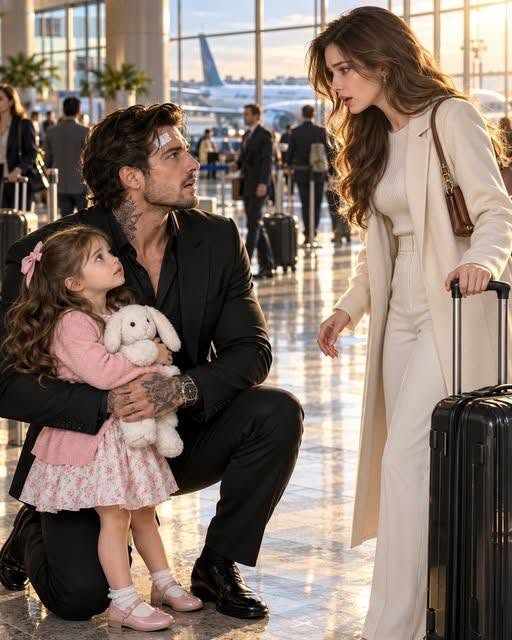
Vincent was in the hospital for nine days, and by the third day the floor had become a small nation.
His men rotated through the corridor in soft shoes. Dom ran an empire and a war-crimes tribunal's worth of federal gratitude from a chair outside the door — Dario Castellano, alive and talking, was trading five years of his father's sins for a cell with a window, and the last gray corners of the Moretti map were being signed over to daylight in rooms I did not enter and no longer needed described. My mother held court from the family lounge with her bell and her crossword. Emma moved Lily's entire small civilization — the purple dragon coloring book, the rabbit, the paper crown — into the hospital's family room, and the nurses, who had begun the week terrified of the name on the door, ended it bringing my daughter extra pudding cups and calling her father "Mr. M."
Lily visited the bedside every day. She supervised the bandage. She interrogated the surgeon with the seriousness of a building inspector — "Is the dragon's wing fixed?" — and informed Vincent that whistling lessons would resume "when your ouch is closed," a medical standard of her own invention that the entire surgical team adopted without a vote.
On the fifth day, I came in with coffee to find her asleep at last in the chair beside his bed, and Vincent awake, watching her with that coastline-memorizing look, his good hand resting on the blanket between them like a country respecting a border.
"Dom told me the plea is done," he said quietly. "Dario signed this morning. Italy wants what's left of him after Illinois is finished. It's over, Claire. The war, the Castellanos, all of it. It's finally, actually over."
"Good," I said. "Then hear my terms, because I have spent five days writing them in my head on this floor, and they are not a negotiation, Vincent. They are what staying looks like."
He folded his attention to me the way he had once folded it to maps. "Say them."
"One. There is no version of this family that runs on managed truth. Not for her safety, not for my peace, not for any arithmetic eleven men in a room can do. If something is coming for us, it comes to my face first, and we decide together. You break that once and I will take her so far that five more years of searching will read like a warm-up."
"Agreed."
"Two. You finish what you started in those federal rooms. The docks, the clubs, the legitimate empire — I don't care what it costs or how long the lawyers bill. Lily Moretti —" The name landed between us, spoken aloud by me for the first time, and I watched it hit him. "— does not inherit a whisper. She inherits a name that's only a name."
"Agreed. It's already half done. Dom calls it my retirement. I call it—" he searched, and found something wry and tired and real, "— tuition."
"Three." I sat down in the chair my daughter had vacated, and took the coffee to have something to hold. "She decides the pace of you. Not me, not you, not your mother's hopes or this city's story. If she wants Sundays, it's Sundays, until she wants more. You will be exactly as much father as she invites, and you will never — ever — make her feel the size of what you're not being given. She didn't choose any of this. She's the only one of us who didn't."
"Agreed," he said, and his voice was wrecked and steady at once. "I had four years stolen by my own arithmetic, Claire. I'm not going to steal one day of hers making up for it."
"And four," I said, "is mine. I'm going back to work. Not this year — she's four, and we've had a spring. But my career is not a room in your house that you're generously not entering. It's mine. It was mine when I was waiting tables and it's mine now. A director named Park has been sending Emma a script for six months and Emma has been too loyal to tell me. Tell Dom to stop frightening the mail."
At that, the ghost of the old smile — the one from the diner on Thursdays, before empires. "Consider the mail officially unfrightened."
"Then we're agreed," I said.
"Then we're agreed." He looked at our sleeping daughter, and the room went quiet around the two of us and the border-respecting hand on the blanket. "Claire. What she called me. In her sleep, at the lake house. I never asked whether I was allowed to— keep that. Whether it was a door or just a dream talking."
"I heard her," I said. "It was a door. Walk through it at her pace, like everything else."
His mother came on the seventh day.
Giulia Moretti was eighty-one years old, small as a bird and twice as dangerous-looking, and she had opposed my marriage for its first two years and then loved me with the ferocious completeness of a woman who had decided, and I had not seen her since the week of the divorce, when she had stood in the mansion's hall watching my suitcases and said nothing at all.
She came into the hospital room alone and stood looking at her son — bandaged, diminished, alive — and then she turned to me, and Giulia Moretti, who had buried a husband and a son and outlived two police commissioners' ambitions, bowed her head.
"I approved it," she said. "The priest's terms. Dom's plan. My son sat in my kitchen and told me he would have to say those words to you, and I told him a Moretti wife was a soldier or a liability, and that you had been given every chance to be a soldier. I have had five years to rehearse hating myself at the correct volume, Claire. I knew you were pregnant."
The room stopped.
"Not then. Later. A woman in the Michigan town — a midwife's receptionist with a brother who owed us. Four years ago, a whisper: a little girl, dark eyes, a mother who taught children's theater. I did the arithmetic my son did in that airport in three seconds, and I—" Her voice, for the first time in my knowledge of her, failed. "I said nothing. To him. To you. Because the lie was load-bearing by then, and I told myself the child was safer as a secret than as my granddaughter. I protected the family from its own heir. That is the sentence I will die with, and I came to say it to your face before I do."
I stood up. I want it understood that I did not do what the scene wanted. I did not forgive her in a wash of violins, and I did not strike her with the words she had plainly come to be struck with. She was eighty-one, and she had carried it four years, and her son was in the bed between us with a bullet hole in him shaped exactly like the cost of the family's way of loving people.
"You'll tell Lily stories about her grandfather when she's old enough to ask," I said. "True ones. That's your penance, Nonna. It's a long one. I expect you to live to serve all of it."
She laughed — startled, wet-eyed, entirely undone. "Nonna," she repeated, like a woman trying a key in a door she'd built herself out of. "Yes. Yes, I can serve that."
On the ninth day, before they discharged him, I drove across the city alone, to a small diner on Fulton Street.
Rosa Delgado had a son of five now — Enzo, named for his father, all knees and questions — and a lease with her own name on it, because Vincent had signed the diner over to her the year the war ended and had never once come back to be thanked at a volume she was comfortable with. She knew who I was before I sat down. A famous face is a hard thing to aim at a counter, and besides, she had been expecting me for five years, in the way you expect weather you can smell.
"He never touched me," she said, setting coffee in front of me like a verdict. "I want you to hear it from the actual woman and not from his confession, because men confess prettily when it serves them. He carried plates. He paid my landlord in cash and my hospital in full and he sat in that booth—" she pointed, third from the window, "—eating pie he didn't want so the neighborhood would see him there at closing, standing between my boy and the street. And the whole time, Mrs. Moretti, the whole time, he was looking at the door like it had stolen something from him. It had. It was me who told him once — you should hear this too — I told him, 'Whatever woman thinks you're doing this for me is a fool, because you look at me like a duty and you look at that door like a grave.' He said, 'She's not a fool. She's the only true thing I ever said no to.'"
I sat in the third booth from the window with my coffee going cold and cried for the first time since the airport — not the breaking kind, the release kind, the kind that empties a room so something else can be built in it.
"Thank you," I said. "For the plates. For all of it."
"Take care of the door," she said, and refilled my cup like we were ordinary women. "It waited long enough."
I drove back to the hospital as the light went down, and in the elevator I rehearsed nothing at all — the first honest performance of my life, no lines, no marks, no plan — and I walked into Vincent's room where my daughter was teaching her father to whistle around a hospital straw, badly, both of them helpless with it, and I stood in the doorway and let myself want the future for the first time in five years.
On the eighth night, Dom came to the hospital room carrying a bundle wrapped in a gray cloth, which he set on the tray table with the care of a man handling either explosives or communion.
"He never authorized this," Dom said. "I am disobeying an order of five years' standing, and I find I no longer care, which at my age is either senility or growth. These were in the desk at the mansion. Every year, on the same date. He wrote them knowing they could never be sent — a sent letter was a thread, and threads were what we had agreed to burn. So he wrote them to a woman who didn't exist anymore, in a house he'd emptied of her, and he put them in a drawer, because in our world, Mrs.—" he caught himself, and something almost like a smile crossed the old stone of his face, "—because in our world, Claire, unsent is not the same as unwritten. I thought the record should be complete. I have become devoted, late, to complete records."
There were five letters. I read them all that night in the corridor outside my sleeping ex-husband's room, under the hospital's kind fluorescent hum, with my back against the wall and my shoes off like a teenager.
The first was dated the anniversary of the divorce, one year out. It was three pages long and it said, among other things: Rosa's boy was born in March. He is loud. I stood in the hospital corridor there too, with cigars I was not allowed to smoke, and I understood that I had built my life into a corridor outside other people's joy, and that this was correct, and that correct was the coldest word in any language I speak. It said: You would have laughed at me today. I cleared a table for a woman whose husband died doing my job and an old man in the diner told his wife, that one's a goner for her. He was right about the shape of it and wrong about every fact, and I let him be wrong, because being wrong was keeping you alive in a town in Michigan I am not allowed to know the name of. (Dom had appended a note in pencil, in a clerk's hand: The town was known by year two. He never asked. I never offered. It was the only order of his I ever softened.)
The fifth letter was dated ten weeks before a little girl chased a snow globe through Terminal 3. It said: I am told I am winning the peace. There is no one left to make war on, which my father would call the definition of victory and I call the discovery that an empire is just a waiting room with better furniture. If I ever stand in front of you again I will not ask for anything. I rehearsed asking for years and I have given it up as a bad production. I will only tell you the whole of it, in daylight, and then I will accept your verdict at whatever volume you choose to deliver it. You once promised to let me go if I loved someone else. I have spent five years learning the exact size of the room that promise built. Letting go is what cowards call it when they mean hiding. I hid. You went. The difference between us, Claire, is that everything you did was brave.
I folded the letters back into their gray cloth with hands that shook only a little, and I went into his room, where the machines were drawing their green mountains and my daughter was asleep in the family chair with her mouth open, and I sat down in the chair on the other side of the bed, between my whole past and my whole future, and I took Vincent Moretti's hand — the one that had caught our daughter falling through the dark — and I held it until the nurses changed shifts and the sun came up over the lake like it had been drawn there by a child who believed in giving people weather.