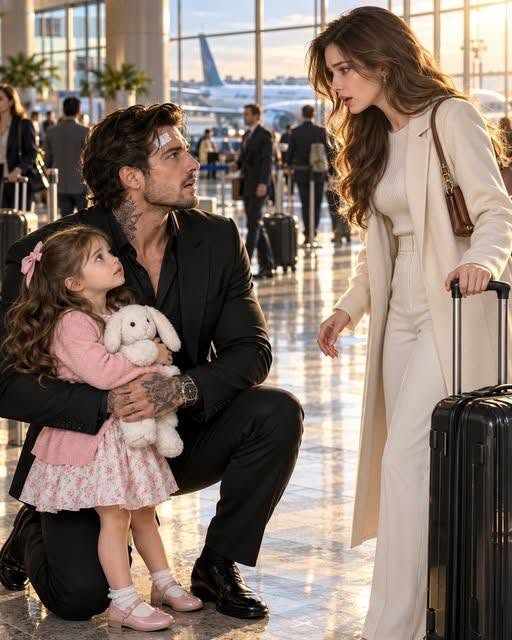
I said yes.
I said it to the mirror first, practicing, the way I used to practice acceptance speeches in the Lakeview diner bathroom — and then I said it to Vincent on the phone, in the plainest voice I owned: "I'll stand next to you. For her. Don't make me regret the geography of that sentence."
The Moretti name had dressed me for a decade, and the machinery remembered me. A gown arrived — deep green, nothing like a costume, everything like armor. Emma flew the stylist in from Los Angeles and fired her twice before lunch on principle. My mother, from her suite, delivered the only review that mattered: "You look like a woman walking into a room she owns. Try to remember that you do."
Lily stayed at the lake house. That was never in question — the gala was about ending her secrecy, not exhibiting her. She stayed with Emma and my mother and a rotation of men who pretended to be furniture, and she was furious about the entire arrangement because the dragon had promised, for Sunday, to teach her how to whistle.
"Tell the dragon the gala is boring and he owes me two whistles," she instructed me at the door, in her pajamas, with the gravity of a head of state.
"I'll tell him, baby."
The gala was in the grand ballroom of a hotel on Michigan Avenue that the Morettis had laundered money through in another century and now merely endowed. There were marshals' wives in the front rows of the silent auction, as Vincent had promised, and two Tribune photographers at the door, and a string quartet sawing bravely under the chandeliers, and into that room, at nine o'clock on a Saturday night, walked Vincent Moretti with his divorced wife on his arm, five years after the most public romantic execution in Chicago society — and the room did what rooms do. It turned. All of it. Like wheat.
"Smile," Vincent murmured, his hand warm over mine on his arm. "You're the only person here they believe."
"Smile yourself. You're the one they fear."
"I am smiling."
"That's your indictment face, Vincent."
The corner of his mouth moved — a fraction, a fault line — and the photographers got it, and by morning it would be on every screen in Illinois: the ice king of Chicago, caught mid-something by the woman who had left him. I did my job. I laughed at the mayor's jokes. I let the hospital's director kiss my cheek and tell me my return was the gala's miracle. I stood in the light, as agreed, as a mother and a fact and a wall made of headlines between my daughter and the dark.
At ten forty, I saw Dom cross the ballroom at the wrong speed.
Men like Dom never hurry in public. Hurrying is information. He was at Vincent's shoulder in seconds, his face arranged in the pleasant mask of a man delivering a toast note, and I watched Vincent read whatever was in Dom's eyes and go the color of paper under ballroom light.
I was already moving. I have been an actress since I was nineteen; I know what a face does a half-second before it speaks.
"The lake house," Dom said, for my ears as much as Vincent's. "Power cut at ten thirty-one. The garden contractor — hired three weeks ago, vetted by a firm that's been dead for a year. Claire." He stopped pretending the mask existed. "They took her out through the service gate in the landscaping van. Emma's with the medics. She's alive. She fought. The man on the bench took a round in the shoulder keeping the gate in sight long enough to read the plate."
My daughter. Was in a van. In the dark. With Dario Castellano's men.
I did not scream. I want that understood, the way I have wanted things understood at every hinge of this story. The ballroom glittered on around us — quartet, champagne, the mayor — and I stood in my green armor and felt my soul go to a place with no furniture in it at all, and I said, very quietly, "Where is he taking her?"
And Vincent — whose face I had watched survive raids, funerals, and the arithmetic in an airport — turned to me with the look of a man who has just understood that his cleverness had been used as the murder weapon. "The gala was my idea," he said. "He read it in the papers like everyone else. He knew I'd empty the house of everyone who matters and put us both in a room with cameras. Claire — I did this. I built the window and he climbed through it."
"Then unbuild it," I said. "Now. Where?"
The call came at eleven fifteen, to Vincent's phone, as we stood in the hotel's service corridor with Dom and four silent men and a federal agent named Okafor who had, it turned out, been Dom's insurance policy for months — because Dom, who had built one ruinous lie in his life, had sworn a private oath about second ones, and had kept a federal task force warm on Dario Castellano all spring without telling even Vincent how warm.
Dario's voice came through the speaker, young and shaking with triumph. Victor Castellano's youngest son, raised on a story about a stolen empire, had his enemy's whole heart in a landscaping van. The terms were not money. Men like Dario never want money. He wanted Vincent at the old Castellano cold-storage warehouse on the South Side — the building where the war had effectively ended, where Victor had signed away his docks five years ago with Vincent across the table. He wanted Vincent there alone at one a.m. He wanted to hand back a daughter and take a signature — territories, names, the Morettis' surrender read aloud — and he wanted, most of all, an audience of one man's face while he decided which of those things to actually do.
"He'll trade," Okafor said, afterward, clipped and certain. "His profile needs the win more than the child. But our snipers need him in the open and we can't guarantee—"
"I'll go in alone," Vincent said.
"No," I said.
The corridor looked at me.
"He has spent five years," I said, "pricing a rumor. Tonight he priced wrong — she isn't a rumor, she's a little girl who thinks whistling is a Sunday sacrament, and she is terrified, and the voice she needs to hear in that warehouse is not a negotiator's and it is not a soldier's. It's her mother's. He won't expect me. I'm the soft thing in his story — the discarded actress. Let him think the soft thing wandered in." I looked at Vincent. "You hid me for five years to keep me out of your war. I'm done being hidden. She's my daughter too. I go in the front, talking, like a stupid frightened mother who drove herself because nobody could stop her — which has the advantage of being completely true — and while he's busy being underestimated by me, you come through the cold rooms with Agent Okafor's people. That's the plan. Argue with me in the car."
Nobody argued with me in the car.
The warehouse was a cathedral of refrigeration and rot, lit by work lamps Dario's people had strung like a parody of a film set. He stood on the loading platform where the trucks used to back in — six feet above the floor, a fact my body registered before my mind did — with four men and, at his side, in her pajamas, barefoot, clutching the stuffed rabbit she was not supposed to still need at four and absolutely still needed, my daughter.
She saw me before anyone announced me.
"Mommy!" It came out of her with her whole body, and Dario's hand came down on her shoulder — not rough, worse than rough: proprietary — and she went still under it the way small animals go still.
I walked into the light with my hands open and my famous face doing the only work it was ever really for.
"Dario," I said, and I gave him the performance of my life — not the actress, the mother, grief and reason poured into one vessel, every note pitched at the nineteen-year-old boy under the revenge. "Look at me. Not at them — at me. I know what was taken from you. I had twelve years with a man this city fears and I lost him in a parked car to a lie, so I know what a stolen life feels like from the inside, and I am telling you: there is no version of tonight where this little girl is the currency that buys your father's name back. She's four. She can't whistle yet. That's the whole of her crimes. Let the debt be between the men who made it."
"Pretty speech." His voice cracked on the second word, and his eyes kept flicking to the shadows where he was wise enough to know Vincent would be. "He sends the actress to do his begging. The great Moretti, hiding behind—"
"I don't hide," Vincent said, from the dark at the side of the platform, stepping into the lamplight with his hands raised and empty, alone, exactly the picture Dario had ordered. "Not anymore. You wanted my face, Dario. Here it is. Let the child walk to her mother and I'll sign anything you put in front of me — docks, names, the whole rotten map. You've won the thing you actually came for."
What happened next happened in the grammar of accidents, the way all true violence does. Lily — who had been still under that hand for what must have been a year of her small life — heard her father's voice promise her the walk to her mother, and she took it as permission, the way children take every promise as already kept. She twisted out from under Dario's hand and ran for the platform's edge, toward me, toward the drop, in the dark, in bare feet.
Dario lunged for her — to grab her back, not to harm her; I will believe that to my grave, because the alternative has no door back to the world — and she flinched from his reaching hand and her foot found the slick edge of the platform and went out from under her.
She fell from six feet up, in her pajamas, in the dark.
And Vincent Moretti caught her.
One-handed. From a dead run, off-balance, his body twisted under her weight to take the fall into his own shoulder and side — I heard the crack of him hitting the concrete with her folded safe against his chest, and I heard the shot at the same instant, Dario's startled hand, a weapon fired at a movement nobody had planned — and the bullet that should have gone anywhere in that warehouse went into the shoulder Vincent had just turned into a wall between the world and his daughter.
He did not let go of her. On the concrete, bleeding through his shirt in the work-lamp light, with federal agents coming through every door like weather and Dario Castellano going down under four men screaming about his father, Vincent Moretti held my daughter against his unbroken side and said, quite clearly, to the small girl whose face was buried in his neck: "Careful, sweetheart. I've got you. I've got you."
At the hospital, an hour later, with Lily asleep in a chair between Emma and my mother — both of them transported there by Dom like royalty of a small fierce nation — a surgeon told me the bullet had missed everything that mattered by margins he described with professional awe. Shoulder. Muscle. Bone chipped, not broken through. He'd keep the arm. He'd keep everything.
I went in to see him before the anesthesia took the rest of him. He was pale as paper and his eyes found me the way they had across the terminal, across five years, across every room we had ever been in together.
"You caught her," I said.
"I always will," Vincent said, with the last of his strength, and his eyes closed, and the machines beeped their steady ordinary music.
I stood there a long time. And then — because she had asked, and because a four-year-old's instructions outrank empires — I leaned down and told him what I owed.
"The dragon owes her two whistles," I said. "She kept the receipt."
I swear, sedated and half gone, the man smiled.