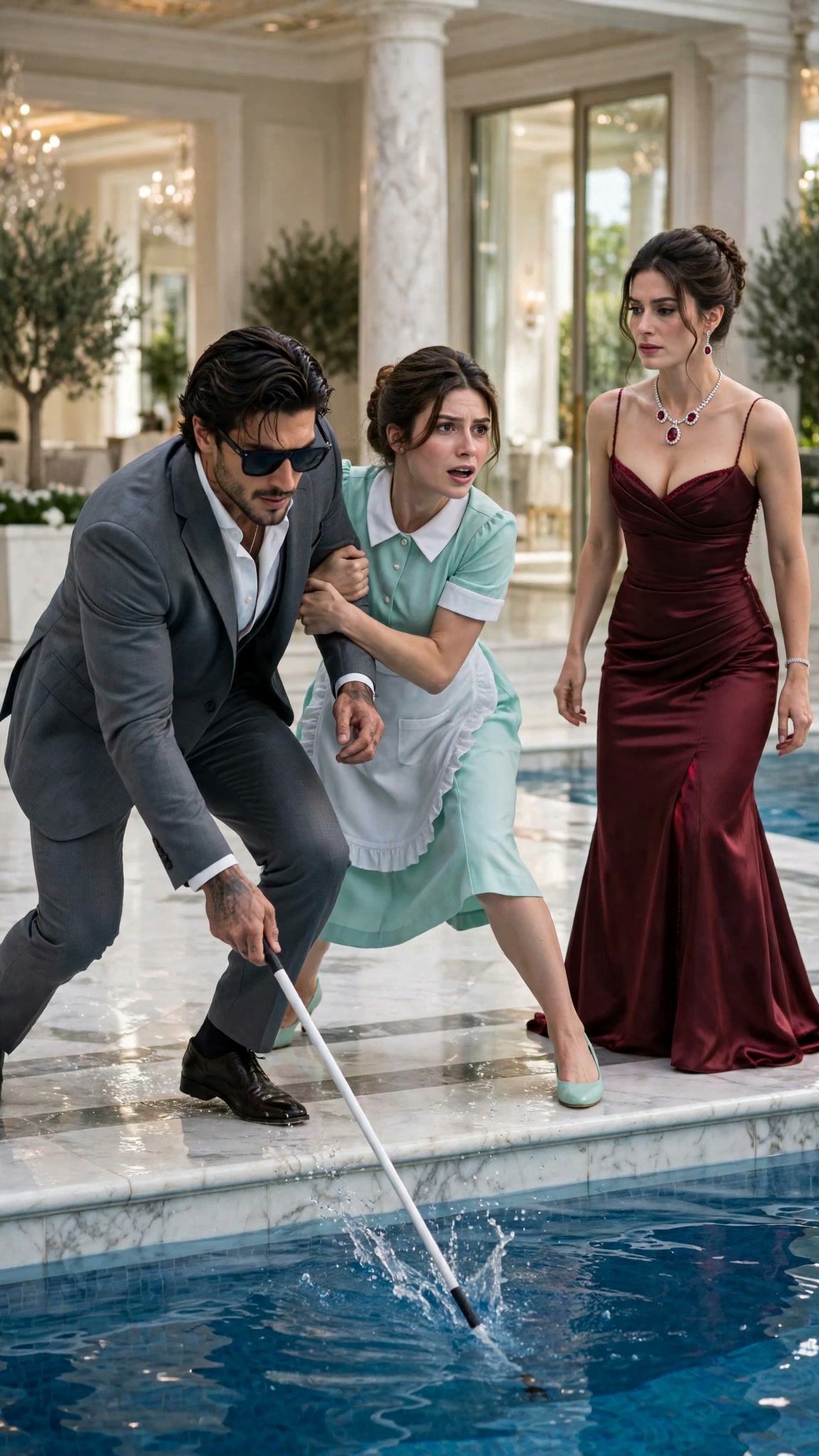
Anna Reed spent six hours in a holding cell, and when Rachel walked her out of the station at three in the morning, she was composed in the way of people who have decided that composure is a form of armor and intend to wear it until it is pried off them.
Daniel was waiting by the car. He had not slept. He had, in fact, spent the night in Rachel's office drinking coffee that tasted of cardboard and reading the examiner's preliminary report on the device until the words stopped arranging themselves into sense. What the report said, in its careful technical language, was simple enough: the device from Anna's locker was a perfect functional clone of Rachel's secure authenticator, manufactured from a registered second unit — and registered second units did not walk out of a law firm by themselves. Somebody with a name and a signature had signed for it.
"You didn't have to come," Anna said, stopping a careful distance from him, in the rain-wet street outside the station. "It photographs badly, I imagine. The blind— the Mr. Blackwood, collecting his maid from jail at three a.m."
"I've been photographed badly by better people than these," Daniel said. "Get in the car, Anna."
"I haven't decided if I'm getting in the car." She folded her arms. Her hair had come down. She looked, he thought, exactly as she had on the terrace: like the only honest object in a room full of reproductions. "In there, a detective asked me whether you were paying me for anything besides cleaning. He asked it kindly. That's the new story, isn't it? Not that I'm a thief. That I'm the kind of woman who—" She stopped. "If I get in that car, I'm her forever. The maid from the gala. In every headline."
"If you don't get in the car," Daniel said, "you're a woman alone outside a police station at three in the morning, in a city where someone has already photographed you once. Headlines I can survive, Anna. I've had practice. Get in the car and let me be useful to you for once. It's a short list of people who've been useful to me this year, and you're most of it."
She got in the car.
Rachel's audit landed at nine that morning, and it landed like a body.
Peter Voss had signed out the firm's second authentication unit on the eleventh of February — three days after Daniel's sight began to return, eleven days before the forged authorization was executed — under a work order for a "client systems audit" that did not exist. He had returned it nine days later. In between, someone had used it to build a twin.
His office phone had called Ethan Cole's office eleven times. And a consulting firm registered to his brother-in-law had received, in March, a payment of forty thousand dollars from an account in the Cole Meridian chain — for services the firm could not describe, at an address that was a mailbox.
And on the night of the gala, Peter Voss had been in the house. Not as a guest. As Rachel's working staff — the firm ran a compliance desk for the auction, in the small office off the study corridor. From eight to nine that night, the compliance desk was Peter Voss's post. At 8:40, somebody used the study extension to call in the tip that destroyed Anna's name.
The study extension was twenty feet from the compliance desk.
"His own lawyer is with him now," Rachel said, in Daniel's study, with the audit in a black folder and two sleepless nights in her face. "He wants to talk before the arrest warrant finishes printing. Shaw is bringing him up through the service entrance in twenty minutes. I advise you — as your counsel — not to be in the room."
"I'll be in the room," Daniel said.
"Daniel."
"Fourteen years you've told me what judges need," he said. "Today I need something. Let me have it."
Voss came in without the suit jacket, in shirtsleeves, with his lawyer murmuring beside him and his wedding ring turning and turning around his finger. He did not sit until Rachel told him to, and then he sat like a man in a chair that had been placed over a trapdoor.
"The device," he said. "Yes. I signed it out. I built the clone for Ethan — he told me it was for a demonstration, a proof of concept for a client security pitch, and I wanted to believe him because he was paying me forty thousand dollars to believe him." A laugh with nothing in it. "By the time the authorization went through on the transfer, I knew. I knew and I did nothing, because doing something meant saying the first part out loud."
"The locker," Daniel said. "The gala."
Voss's ring stopped turning. "Ethan called me that afternoon. He said the maid was the problem — that she'd seen the folder, that she'd written a statement, that if her statement stood, the injunction stood and Friday died. He said Clara wanted her discredited before the hearing. I had the second clone — the one from the locker was a third build, Ethan had it made from mine. I carried it in during setup, in a catering crate. At eight-forty I called the precinct tip line from the study phone." He looked, finally, at Daniel. "I thought she'd be questioned and released. I thought a maid would just… go away. People like her go away. That's what I told myself."
"People like her," Daniel said quietly, "pull men out of swimming pools."
"I'm sorry," Voss said. "I know it isn't—"
"Who is behind Cole Meridian?" Rachel cut in, before the apology could become a performance. "The buyer, Peter. The two million in escrow. Whose money is it?"
And Voss, who had confessed to everything else with the exhausted relief of a man setting down a weight, hesitated for the first time.
"Ethan is a front," he said. "He always was. The money is Cross Development's. Julian Cross has wanted the Blackwood estate for six years, Mr. Blackwood — the house sits on the last undeveloped headland in the county, and his resort plans die without it. He couldn't buy it from you. So he decided to buy it from your wife." He swallowed. "Clara was promised thirty percent of the spread and a clean divorce. Ethan was promised the development contract. I was promised a partnership." The ring turned once more, slowly. "Everybody was promised. That's how he does it. Julian Cross never touches anything. He just makes promises at people until they touch it for him."
The room was quiet. Outside, beyond the study windows, the gardeners were at work in the morning sun, in the ordinary world.
"The accident," Daniel said. "Fourteen months ago. My car, on the coast road, in the rain. Was that Cross too?"
Voss shook his head slowly. "I don't know anything about a car," he said, and Daniel, who had spent eight months learning to hear the exact pitch of a lie, believed him. "I swear to you. I came in February. Whatever happened to you before that — that was already done."
After Voss was taken down the service stairs to the waiting car and the warrant that had finished printing, Daniel stood alone in the study for a long time. Then he went and found Anna in the kitchen garden, where she had gone because kitchens and gardens were the two places in that house where nobody performed anything.
"You asked me once," he said, "why I kept pretending. By the pool. I gave you half an answer." He sat down across from her at the weathered table, in the herb smell and the sun, and he told her the rest.
Fourteen months ago. The coast road, rain coming in sheets off the water, the headlights of his own car swinging through it. He had been driving himself — he had always driven himself, it was the last vanity of a man who employed drivers. The brake pedal went to the floor on the descent above the marina, soft as a sponge, and the world became the sound of guardrail and the smell of hot metal, and then nothing at all for six days.
He woke in the hospital to a dark that had hands. Retinal damage, the specialists said. Perhaps permanent. Probably permanent. Clara wept at his bedside with a sincerity that filled the room — and on the fourth day, half-dozing, he heard her in the corridor outside his door, laughing softly at something, and heard a man's voice answer her, a voice that knew her laugh well enough to aim for it.
"I couldn't see him," Daniel said. "I never saw him. But I heard my wife laugh in a hospital corridor while I lay blind four rooms away, and I understood that whatever had happened to my brakes, my marriage had happened first." He turned his hands over on the table, looking at them. "The police called the crash an accident — a line failure, wear and tear. I let them. And in February, when the light came back — first gray, then shapes, then, one morning, the blue of the sky through my own window like a message — I sat in the dark I'd learned to live in and I made a decision. Whoever cut my brakes believed I was finished. Whoever was selling my house believed I couldn't see the pen. I decided to let them all keep believing it, until they were careless enough to show me their hands."
"That's a long time to live in the dark on purpose," Anna said.
"It got longer when I realized Clara's hands weren't the only ones." He met her eyes. "I am sorry, Anna. I watched you clean my study for months. I watched you talk to the portrait of my grandfather when you thought the room was empty — you told him the roses needed cutting back. I watched you, and I let you go on believing I was helpless, because my war needed the whole house deceived. You saved a man who had been lying to you every day since February. I've been trying to find the shape of an apology that isn't an insult, and I don't think there is one. There's just the truth, late."
Anna was quiet for a while. A bee worked the lavender at the end of the table with total professional indifference.
"You know what I did, the first month?" she said at last. "I described rooms to you. Out loud, while I cleaned — where I'd put things, what the light was doing. Nobody asked me to. You never once said thank you." She smiled, briefly and without cruelty. "Now I know you were memorizing me being kind so you'd have one true thing in the house. That's not an apology either, Daniel. But it's a start we can both stand on." She stood up and brushed the garden off her skirt. "Voss. The arrest. Tell me what happens now."
"Now," Daniel said, "Friday happens. The hearing. And after Friday—"
His phone rang in his pocket. A number with no name. He almost didn't answer it, and then something — the timing, the audacity of it — made him put it on speaker on the garden table between them.
"Mr. Blackwood." The voice was smooth, amused, golden even through a phone speaker. "Ethan Cole. I understand congratulations are in order. Your eyes, your lawyer, your witness — quite a week you're having." A pause, precisely weighted. "I'd like to meet. Tonight. Just you and me, no counsel, no recorders — a conversation between men who both know what Clara is. I'll give you the buyer, the money trail, the promises — everything your injunction needs to become a prosecution. In exchange, I walk, with a number we agree on. Forty-eight hours from now my usefulness expires and so does my generosity."
"Why would you sell her?" Daniel asked. "You kissed her in my corridor in March."
"Because, Daniel—" and the amusement went out of the voice like a light being switched off in a house "—Clara was only ever promised a cut. Ask her who really ordered the pool. Ask her what was supposed to happen after you were declared incompetent, in a private facility, on medication, signing whatever was put in front of you. She thinks she hired an accident. She never asked what she actually bought."
The line went dead.
Anna looked at the phone, and then at him. "You're not seriously going to meet him."
"Oh," Daniel said, "I'm going to meet him." He stood up, and the garden sun was warm, and Friday was coming like weather. "But not alone, and not unrecorded, and not as the man he thinks I am. Whatever Ethan Cole is selling tonight — I intend to be the only bidder."