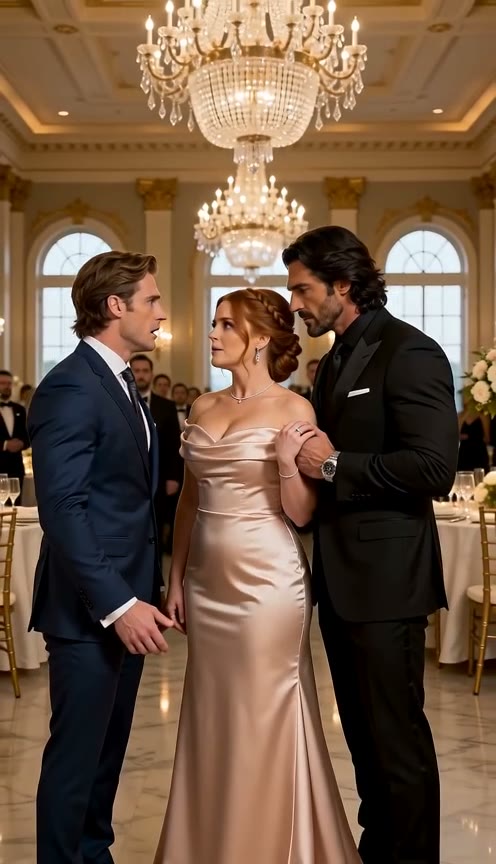
New York did not care about Penelope Hart's broken heart, and that was the kindest thing the city could have done for her.
She arrived with two suitcases, a degree, and a junior position at a catering company in Queens that a Wexford alumna ran out of a converted warehouse. The work was brutal and unglamorous — seating charts at midnight, floral emergencies at dawn, brides weeping into her shoulder over napkin colors — and Penelope was magnificent at it. She had a gift that could not be taught: she could walk into a room full of panicking people and make every single one of them feel that the evening was already saved. By twenty-four she was running the company's largest weddings. By twenty-six she had been poached by The Meridian, the most storied independent hotel on the Upper East Side, as a senior events coordinator. By twenty-eight she was the Director of Events, the youngest in the hotel's history, and the name whispered by every society hostess in Manhattan who wanted a night to go flawlessly: Get Penelope. Penelope will handle it.
What she did not handle, ever, was her own heart. It was not that men didn't ask. It was that Penelope had organized her life the way she organized ballrooms — every element in its place, every risk assessed, every exit marked — and there was no column in the plan for hope. She kept the apartment small and the hours long. She sent money home to her mother. She volunteered at the Wexford alumni mentorship program and told nervous scholarship girls, with total sincerity, that they belonged in every room they had earned their way into. She believed it for them. Believing it for herself was a longer project.
She did not follow Bradley Farnsworth's career. She did not have to. It pursued her in headlines — Farnsworth Capital's golden son, the London years, the engagement to Vanessa Cole announced and dissolved in the same glossy year, the return to New York, the profile pieces. New York's money world was a village, and her village kept delivering her news of him like weather reports. She read none of it twice. She had built a self out of the wreckage he left, and the self was load-bearing. She was not going to lean on it.
It had not been a straight line. It never is, in the honest versions.
There had been the winter of the warehouse apartment with the radiator that clanked like a dropped tray, and the year she worked three weddings a weekend and slept in her car between the ceremony and the reception with an alarm set for twenty minutes, and the boss at the catering company who put his hand where it didn't belong and learned — in front of his whole kitchen staff, from a twenty-three-year-old with a seating chart in one hand — that she had already emailed the board, the venue, and his wife a factual account of his management style, timed to arrive before he finished the sentence he was fired in. There had been the night the pipes burst over a senator's daughter's reception and Penelope had moved four hundred guests, a string quartet, and a six-tier cake across a flooded hotel in eleven minutes without a single guest getting wet shoes or knowing why the room had changed. The senator's wife had sent her a note afterward, on paper so thick it felt like a legal document: I don't know what happened. I know it was you. It became her professional obituary and her professional epitaph, in advance: no one knew what happened; everyone knew it was Penelope.
At The Meridian, she inherited a department running on habit and fear and rebuilt it the way she rebuilt everything — quietly, completely, starting with the people at the bottom. She learned the names of the dishwashers' children. She promoted a coat-check girl with a gift for logistics into an assistantship the girl's family framed the offer letter from. She instituted the rule that made her famous among the staff and faintly notorious among the guests: no one who works an event eats last and standing up. Under Penelope, the staff ate first, seated, like people whose dignity was load-bearing. "A room can tell," she told her captains, "whether the people holding the trays have been treated like furniture. It changes the air. Fix the air and the evening fixes itself."
Hostesses began requesting her the way they requested vintages. One of them — a grande dame of the Upper East Side with a voice like a closing door — had opened their first meeting by appraising Penelope's figure with undisguised doubt and asking whether the hotel had "someone more senior." Eleven months later, after Penelope had saved her golden anniversary from a blizzard, a blackout, and the groom-side grandfather's heart medication being locked in a car in Connecticut, the same woman took Penelope's hand at the end of the night and said, "My dear. I was a fool about you in October. I am rarely a fool twice," which from her was a papal blessing.
Penelope kept that note too. She kept them all, in a drawer with the senator's wife's, a private archive of the truth about herself, for the 3 a.m. hours when the old voice — borrowed, she knew now, from a boy by a fountain — tried to do the room's math and found her wanting.
The night everything changed began as an emergency.
The Meridian was hosting the winter board dinner of Russo Holdings — forty guests, one sitting, the kind of evening where a single failure would be repeated in boardrooms for a decade. Ninety minutes before service, Penelope's executive chef took a call, went white, and informed her that the fish course — flown in that morning — had been condemned by a health inspector over a paperwork error at the supplier. Forty of the most powerful people in the city's quiet economy were arriving in an hour and a half, and the centerpiece of a seven-course menu had just become a legal liability.
Penelope did not panic. Penelope, in fact, became very calm, in the way that deep water is calm. She called in favors from three kitchens across two boroughs, restructured the menu around a veal course her chef could execute blindfolded, had the printed menus re-struck and re-embossed in forty minutes by a stationer who owed her his business, and when the guests sat down, the evening flowed like poured silk. No one knew. That was the point of Penelope. No one ever knew.
Except, halfway through the evening, she felt it — the particular stillness that enters a room when a person of consequence is paying attention. She looked up from the service door and found a pair of dark eyes fixed on her across the candlelit table.
She had coordinated a hundred events where dangerous men were guests; Manhattan was full of power wearing different costumes. But this was something else. The man at the head of the table was in his late thirties, built like the door of a vault, with thick dark hair swept back, a rugged jaw shadowed with a short beard, and a stillness about him that the whole room unconsciously orbited. He had not been watching the evening. He had been watching the seams of the evening — the places where it should have failed — and he had found her standing in every one of them, holding it together.
"Who is that?" she asked her floor captain, under her breath.
The captain did not look up from his tray. "That's Damian Russo," he said, "and if he's looking at you like that, ma'am, you should probably just keep doing exactly whatever you're doing."
She did. The dinner ended to the kind of applause that board dinners do not usually produce. And at 11:40 that night, as Penelope stood in the empty ballroom with her shoes in her hand and her tablet dead against her chest, congratulating herself on invisibility, the ballroom doors opened and Damian Russo walked in — alone — holding two glasses of the Barolo that had been served at his own table.
"You fixed the menu," he said. It was not a question. His voice was low and unhurried, with the faintest Italian warmth under the New York edges. "The veal was supposed to be fish. My grandfather's company is one of your suppliers' oldest clients. I knew before the soup course."
Penelope's stomach dropped through the marble. "Mr. Russo, I apologize, the documentation—"
"You replaced a condemned course for forty people in under an hour and not one of my directors suspected." He held out a glass. She took it because her hands needed something to do. "I have men on my payroll whose only job is solving problems. None of them would have solved it as quietly as you did." His eyes held hers, dark and direct and entirely without the flirtation she was braced for. It was worse than flirtation. It was regard. "How long have you been invisible here, Penelope?"
He knew her name. Of course he knew her name. She understood, in that moment, that Damian Russo was a man who arrived everywhere already knowing everything — and that he had walked into an empty ballroom at midnight to tell a woman he had never spoken to that he had seen her.
"I'm not invisible," she said, with more defiance than she felt. "I'm staff. It's different."
"No," he said. "It isn't. Not for you."
He asked — he did not summon, he asked — whether she would oversee the Russo Foundation's annual gala in the spring, the largest charitable event the family held, previously run by an outside firm. The fee he named made her blink. The responsibility made her straighten. She should have said she would consider it. She said yes with the doors of the ballroom still open and the Barolo untouched in her hand.
She called her mother on the drive home — a thing she did reflexively in any crisis, professional or otherwise, the way other people checked the weather.
"He knew about the fish," she said, by way of hello.
"Who knew about the fish, baby?"
"The client. The — the head of the whole company. He knew before the soup. He watched the entire dinner knowing, and afterward he brought me a glass of wine and offered me his foundation's gala and told me I wasn't invisible." A cab cut her off; she let it. "Mom. He looked at me like—" She searched for the sentence and found it was embarrassingly simple. "Like I was the main event. I plan main events. Nobody's ever—"
"Penelope Hart," her mother said, in the voice that had gotten a scholarship girl out of Ohio, "a man noticing that you're extraordinary is not an emergency. It's a weather report. You've just been standing in a climate that couldn't see you." A pause, warm with forty years of knowing her daughter. "Now. Are you going to take the gala?"
"I already said yes."
"Of course you did," her mother said. "You said yes to the work. The rest of it, you'll say yes to when it's earned. Get some sleep."
She did not sleep that night. At 3 a.m., at her kitchen table, she did what she had refused to do for any man in eight years of careful architecture. She looked him up.
The search results were a palimpsest: legitimate empire on the surface — shipping, hospitality, real estate, a foundation beloved by hospital boards. And underneath, in the careful language of journalists who valued their safety, the other thing. Old family. Old country roots. Territory. A grandfather who had arrived with nothing and a name that, in certain rooms in this city, ended conversations.
Penelope closed the laptop. Her heart was beating very fast, and not entirely with fear.
Because the truth she had never said out loud — not to her mother, not to the girls she mentored, not to herself at 3 a.m. — was that she was tired of being easy to overlook. And the man with the vault-door build and the midnight regard had looked at her, the invisible woman holding up the seams of his evening, like she was the only fixed point in the room.
"Walk with me," he had said, at the end, setting his empty glass on a tray with the care of a man who never broke anything by accident. "Tomorrow. The foundation offices. I want to hear how you'd run my gala."
Tomorrow, Penelope thought, staring at the ceiling in the dark. She had a feeling her life had just been quietly, permanently re-planned — by the one man in New York who planned things the way she did.
Only better.