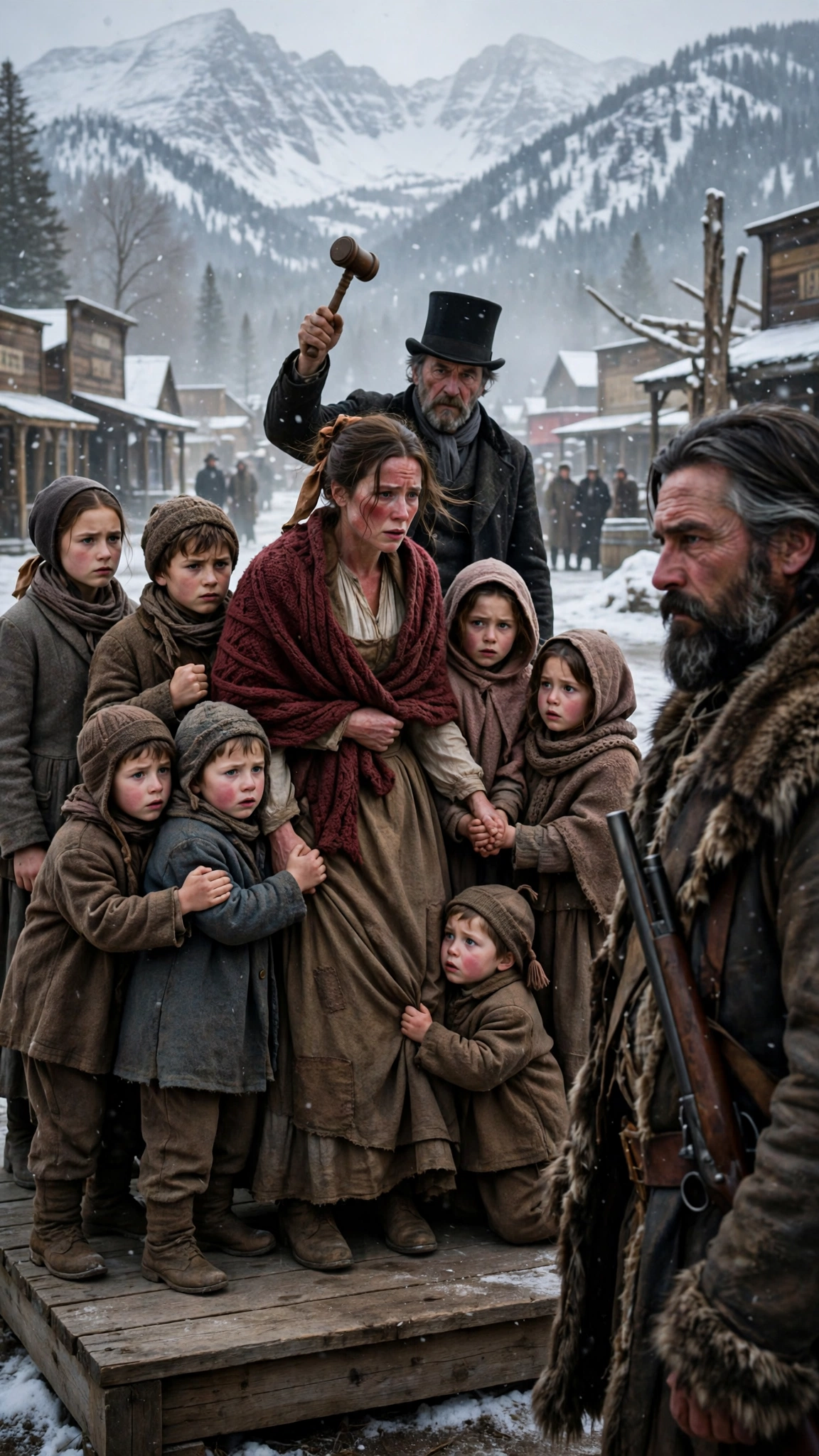
The cold had settled over Covenant Creek like a hand closing around a throat, and by midafternoon the square was full of people who had come to watch a woman be sold.
Snow lay in deep drifts against the storefronts. It capped the roofs of the mercantile and the assay office and the little clapboard church, and it powdered the shoulders of every man and woman standing in the square. The Rocky Mountains rose behind the town in a white wall, and the wind came down off them in gusts that lifted the snow from the rooftops and threw it sideways across the platform where Eleanor Hayes stood with her seven children.
The platform was rough timber, built for this purpose and no other, with a railing of unpainted pine and a podium at its center. Behind the podium stood the auctioneer, an older man in a black top hat and a dark formal coat, his gloved hands resting on the wood. He held a gavel. He had been holding it for some time, as if he were waiting for the town to grow quiet enough to hear what he had to say.
Eleanor pulled Edward closer. He was three years old and he had not let go of her skirt since they had climbed the steps. His small face was pressed against the brown wool of her dress, and his breath came in short, frightened puffs that fogged in the air. Sarah stood at her right shoulder, thirteen years old and doing her best to look composed, though her hands were shaking where she held them folded in front of her. Thomas stood at her left, eleven, his fists clenched at his sides, his jaw set in the way his father used to set it when he was trying to look brave. James and William stood close together behind Sarah, their eyes narrow with suspicion. Margaret and Catherine held each other's hands so tightly that their knuckles had gone white.
Seven children. All of them cold. All of them frightened. All of them watching the crowd the way small animals watch a fence, waiting to see which way the dogs will come through.
The auctioneer lifted his gavel, and his voice rolled out across the square, loud and practiced, the voice of a man who had sold horses and mining claims and now, with no change in his tone at all, was selling a woman.
"Seven children, fifty dollars. No buyer. The children go to custody."
The words fell on the square like stones dropped into still water. Eleanor felt them go through her, one by one. Fifty dollars. That was what she was worth now. Fifty dollars for a woman of thirty-two with seven mouths to feed, and if no man in Covenant Creek would pay it, the territorial officials would take her children away and scatter them to orphanages and work farms across the territory, and she would never see any of them again.
She turned toward the officials. Two of them stood at the foot of the platform with papers in their hands, and beside them stood Mrs. Cromwell of the Bride Society Office, stern and straight in her dark Victorian dress, her black bonnet tied tight beneath her chin, her leather gloves folded over the documents she carried. Mrs. Cromwell's face was the face of a woman who had done this many times before and had never once lost sleep over it.
Sarah's eyes filled with tears. Thomas's fists tightened until his knuckles went white. Eleanor felt Edward's small hands clutch harder at her skirt, and she bent her head toward the officials and spoke in a voice so quiet that the wind nearly took it before it reached them.
"No, please."
She did not cry. She had decided, standing on those steps in the cold with the whole town watching, that she would not cry. She had cried in Philadelphia, in the weeks after Daniel died, and crying had not paid a single debt and had not kept a single roof over her children's heads. She would not cry here. She would stand and watch them take her children, and she would not cry, because the children were watching her, and if she broke, they would break too.
The auctioneer raised his gavel higher. The crowd had gone still. The wind moved through the square, lifting snow off the rooftops, and somewhere behind the platform a horse stamped in the cold.
"Going twice."
The gavel began to descend. Eleanor closed her eyes. She felt Edward trembling against her leg. She felt Sarah's hand find hers, cold and small, and squeeze once, hard. She thought of the little house in Philadelphia with the cracked window in the kitchen, and of Daniel sitting at the table in the lamplight with his ledgers, and of the morning she had found him cold in their bed, and she thought that she had survived all of that only to stand here, in a town she had never seen before, and lose everything anyway.
And then a voice came from the crowd. A deep voice, rough as gravel, slow and certain, and it cut through the silence of the square like an axe through pine.
"I'll take her."
The auctioneer's gavel froze in midair. The crowd turned. Eleanor opened her eyes and looked down from the platform, and the people of Covenant Creek were parting, stepping back, making a path through the snow, and a man was coming through them, slow and massive, his boots crunching in the packed snow.
He was the largest man Eleanor had ever seen. He wore a heavy fur-lined mountain coat that made his shoulders look as broad as a doorway, and his dark hair hung to his shoulders, streaked through with gray, and his beard was thick and dark with gray in it too. His face was weathered by wind and sun until it looked like carved wood. His eyes were pale, the pale blue of a winter sky, and they were fixed on the auctioneer. A weathered rifle was secured along his back, its barrel rising above his shoulder. He did not reach for it. He did not need to.
A man in the crowd whispered, so quietly that Eleanor almost missed it, and the whisper went through the people around him like a shiver.
"Caleb Roar."
The auctioneer stared down at him. The auctioneer's professional calm had cracked, and beneath it Eleanor could see something she had not expected to see on that man's face: fear. Not fear of Caleb, exactly. Fear of what Caleb's presence meant for the orderly business of the afternoon.
"She has seven children." The auctioneer said it slowly, as if he were hoping the number itself might change the man's mind.
Caleb stopped at the foot of the platform. He looked up at Eleanor, and then at the children gathered around her, and then back at the auctioneer, and when he spoke his voice was low and flat and final, the voice of a man who did not repeat himself.
"All seven."
A murmur went through the crowd. Eleanor felt Sarah's hand tighten around hers. She looked at Caleb Roar, at his scarred face and his pale eyes, and she felt two things at once, so strongly that she could hardly tell them apart: a wild, desperate relief, and a fear colder than the wind coming off the mountains. This man had saved her children. She did not know what his protection would cost.
The auctioneer glanced at Mrs. Cromwell. Mrs. Cromwell's mouth was a thin line. She lowered her documents, just slightly, and the auctioneer cleared his throat and tried to recover the shape of the afternoon.
"Fifty dollars," he said.
Caleb did not look at him. He was still looking up at Eleanor, and his pale eyes did not waver.
"Three hundred."
The entire square fell silent. Three hundred dollars. It was more money than most men in Covenant Creek saw in a year. It was more than Eleanor had ever held in her hands in her life. The auctioneer stared at Caleb, stunned, his mouth slightly open, the gavel forgotten in his hand. Mrs. Cromwell's documents hung at her side. The officials at the foot of the platform looked at each other.
Then the auctioneer brought the gavel down. The crack of it against the podium echoed through the square, sharp as a rifle shot, and the wind carried it up toward the mountains. It had happened so fast that later Eleanor would remember the whole exchange as a single breath — "Fifty dollars, three hundred." — the price of her family, tripled in the time it took a gavel to fall.
Caleb climbed the steps of the platform. The wood creaked under his weight. He stopped a few feet from Eleanor, and she could see him properly now: the lines cut deep around his eyes, the scar that ran through his left eyebrow, the gray in his beard, the way his huge gloved hands hung still at his sides. He looked at her the way a man looks at a map he is trying to memorize, and then he looked at the children, one by one, taking them in, and his voice, when it came, was low and controlled, and it was not a question.
"Your children stay together."
Eleanor studied his scarred face. She studied his pale eyes. She thought of the officials and their papers, and of the orphanages, and of the work farms, and of the long road that had brought her here from Philadelphia, and she heard her own voice come out of her, barely audible, the voice of a woman who had learned not to hope for anything and could not stop herself from hoping now.
"All seven?"
Caleb Roar did not blink. He did not smile. He stood in the snow in his fur-lined coat with his rifle on his back, and he answered her with two words that would change everything.
"Every one."
Edward clutched at her skirt. Eleanor looked toward the officials holding the orphanage documents, and then back at the intimidating stranger standing in front of her, and her expression shifted from relief to uncertainty, because she understood, in that moment, that the mysterious man had saved her children, and she had no idea what his protection was going to cost.
The winter wind rose. The snow moved sideways across the platform. And Eleanor Hayes, who had come west with seven children and nothing else in the world, stood in the cold of Covenant Creek and waited for the stranger to tell her what happened next.
—
It had not begun in Covenant Creek. It had begun a year and a half earlier, in Philadelphia, in a small brick house on a narrow street where the laundry lines crossed overhead and the church bells rang on Sunday mornings and Eleanor Hayes had believed, for ten years, that her life was settled and safe.
She had married Daniel Hayes when she was twenty-one, and he had been a clerk in a shipping office on the Delaware, a careful man with ink on his cuffs and a laugh that surprised people who only knew him from his ledgers. He was not rich and he was not ambitious, and Eleanor had loved him for exactly that: for the way he came home every evening at the same hour, for the way he taught Sarah to read by lamplight, for the way he carried Edward on his shoulders through the market on Saturdays, for the way he looked at her across the dinner table as if she were the best decision he had ever made.
They had seven children in ten years, and the little house had been full of noise and washing and mending and the smell of bread, and Eleanor had thought that was what the rest of her life would be. She had been wrong.
It began with a cough. Daniel came home from the shipping office one wet October evening with a cough he could not shake, and by the end of the week he could not climb the stairs without stopping to catch his breath, and by the end of the month the doctor was standing in their bedroom with his bag in his hand and his face carefully arranged into the expression doctors wear when there is nothing left to do.
Pneumonia, the doctor said. Rest, the doctor said, and broth, and keep him warm. Eleanor did all of it. She sat beside the bed and spooned broth between his lips and changed the damp cloth on his forehead and read to him from the newspaper when he was awake enough to listen, and she watched him grow thinner and weaker day by day until one gray morning in November she woke to find his hand cold in hers and his chest still, and she understood that she was a widow at thirty-one with seven children and a house she did not own and a husband's wages that had stopped the moment his heart had.
The funeral was small. The shipping office sent a wreath and a letter of condolence and nothing else. Daniel's employer, a man named Mr. Aldous Crane, who owned the shipping office and half the warehouses along the river, sent no wreath at all. Instead, three days after the funeral, a man in a black coat came to the door with a ledger under his arm, and he showed Eleanor the pages where Daniel's name was written, and the numbers beside it, and he explained, in a voice that was polite and entirely without mercy, that Daniel had borrowed money against his wages to pay for the doctor and the medicine and the coal to keep the house warm through Daniel's illness, and that the debt had passed to her, and that Mr. Crane expected it to be repaid.
The number was more than Eleanor had ever seen written down in one place. It was more than Daniel had earned in two years. She stared at it until the figures blurred, and the man in the black coat waited patiently, and then he told her what would happen if she did not pay: the house would be taken, the furniture would be taken, and the children, if she could not feed them, would be taken by the parish and placed where the parish saw fit.
Eleanor thanked him. She closed the door. She went into the kitchen and sat down at the table, and Sarah, who was twelve then, came and stood beside her, and Eleanor looked up at her daughter's face and understood that Sarah had heard every word through the thin wall, and that Sarah was waiting to see whether her mother would break.
"I am not going to break," Eleanor said, and she was surprised by how steady her voice sounded. "We are going to find a way."
She sold what could be sold. The good chairs went first, and then the brass clock, and then her mother's silver spoons, and then Daniel's books, one by one, until the shelves stood empty. She took in mending and washing. She sewed shirts for the sailors' wives until her fingers bled. It was not enough. The debt did not shrink. It grew, the way debts grow when a man like Mr. Crane holds the paper, a little more each month, interest upon interest, until the number in the ledger was a wall she could not climb.
And then, in the spring, a woman from the church brought her a pamphlet. It was printed on cheap paper, and it smelled of ink, and on its front was a drawing of mountains and a wagon, and inside it said that the Bride Society Office was arranging marriages for widows in the Wyoming Territory, where there were more men than women and where a woman with a strong back and a willing heart could make a new life. The pamphlet did not say what happened to a woman who arrived with seven children. Eleanor read it three times, and then she folded it and put it in her apron pocket, and she did not tell the children about it for a week.
When she finally told them, it was Sarah who spoke first. Sarah, who was twelve and trying so hard to be grown that it broke Eleanor's heart to look at her.
"Will we be together?" Sarah asked.
"Yes," Eleanor said. "Whatever happens, we stay together. That is the one thing I promise you. We stay together."
She wrote to the Bride Society. She waited. The reply came in June, in a letter with an official seal, and it said that a widow with seven children was a difficult placement, but that the territory needed women and the Society would do its best, and that she should present herself in Covenant Creek in January, when the territorial auctions were held, and that she should bring the children, and that she should be prepared for the possibility that the children might be placed separately if no man would take the whole family.
Eleanor read the letter twice. Then she burned it in the kitchen stove, because she did not want the children to see the words "placed separately," and she began to pack.
They left Philadelphia in September, on a wagon train bound for the West, and the journey took four months, and by the time they reached Covenant Creek the snow was deep and the wind was hard and Eleanor had sold the last of her good clothes to buy food for the children, and she was wearing her burgundy-red shawl because it was the warmest thing she owned, and she was standing on a wooden platform in front of a whole town, listening to an auctioneer sell her for fifty dollars, and praying, with everything she had left, that someone would take all seven.