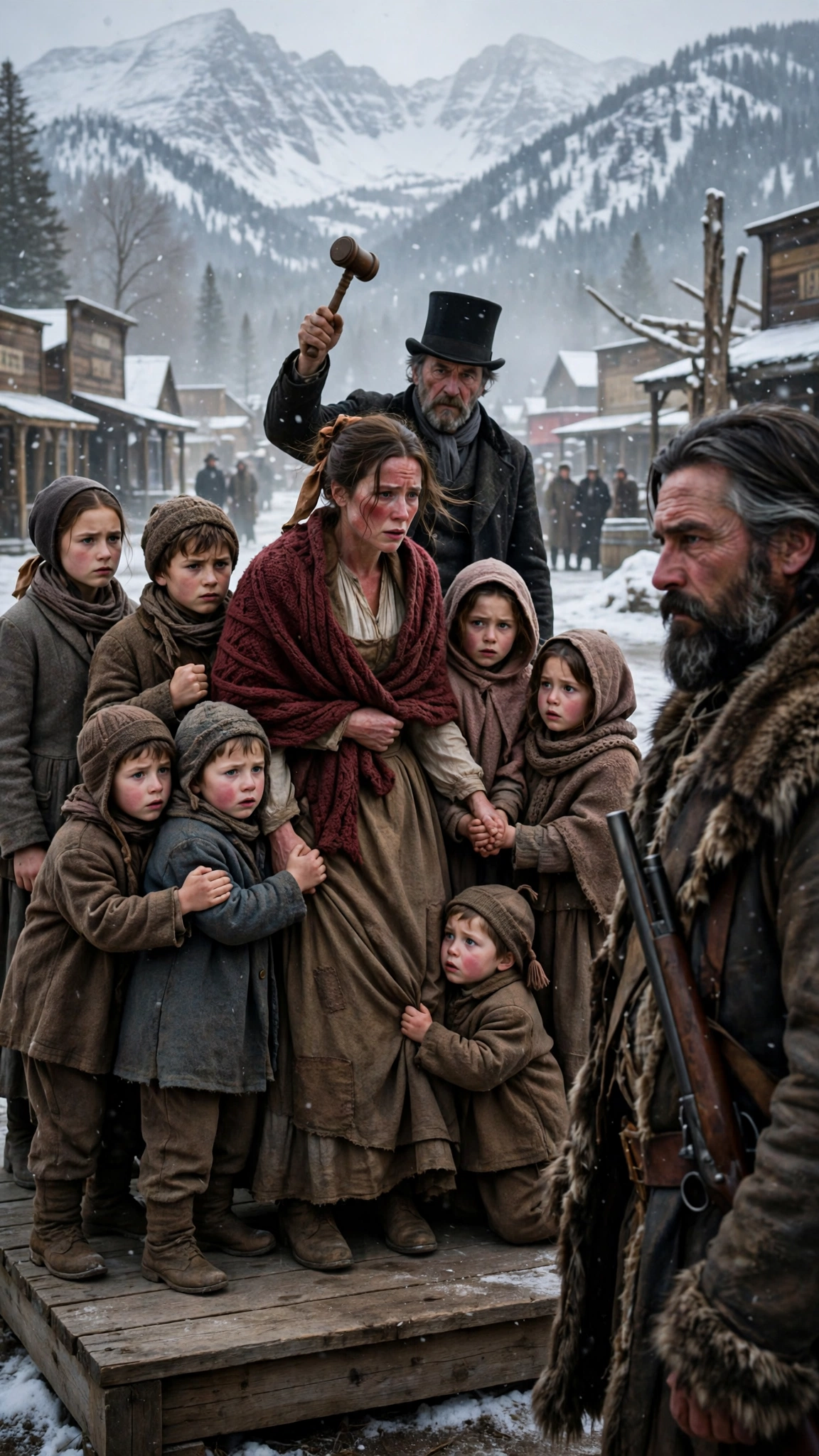
Autumn came to the mountain in a rush of gold and red, and the aspens on the lower slopes turned the color of fire, and the air grew sharp in the mornings, and Eleanor stood on the porch of the cabin one cold, clear October morning and looked out at the world her family had made, and she could hardly believe it was theirs.
The garden had given them more food than they could eat. The root cellar was full. The woodpile was stacked high against the winter, enough to last three winters, because Caleb cut wood the way other men breathed — steadily, and without stopping, and always with an eye on the weather. The children had grown. Sarah was fourteen now, and taller, and she had begun to carry herself like a young woman, and Thomas was twelve, and his shoulders were broadening, and he could split a log with a single clean stroke, and James and William had taken to following Caleb on his trap lines, and Margaret and Catherine had learned to bake bread that rose high and golden, and Edward, who was four, could count to twenty and knew all the letters of his name, and he carried his wooden horse everywhere he went, and the horse had been joined by a whole carved menagerie — a dog, a bear, a deer, a mule — each one whittled by Caleb's huge hands on long winter evenings, each one placed on Edward's plate at breakfast as if it had simply appeared there overnight.
And Anna's room — the room that had been locked for twenty years — was no longer a shrine. Sarah had moved into it in the summer, with Caleb's blessing, and she had made it her own: her books on the shelf beside Anna's, her dresses in the dresser, her hairbrush beside Anna's on the washstand. The bluebell shawl hung on a peg by the door, and Sarah wore it sometimes, on cold mornings, and Eleanor had seen Caleb look at her when she wore it, and she had seen something in his face that was not grief, and not pain, but peace — the peace of a man who has finally understood that the dead do not ask the living to stop living.
It was on that October morning, with the aspens burning gold on the slopes and the air sharp as a knife, that Caleb came to Eleanor where she stood on the porch, and he stood beside her, and he did not speak for a long time, and then he said, in his low, rough voice, "Eleanor. I have something to ask you."
She turned to look at him. He was not looking at her. He was looking out at the mountains, at the white peaks rising behind the town, and his hands were clasped behind his back, and his jaw was set, the way a man's jaw sets when he is about to do something that frightens him.
"I bought you," he said. "On a platform, in front of a whole town, for three hundred dollars. That was a contract. A piece of paper. It was not a marriage. Not a real one. It was a bargain, and I have kept my end of it, and you have kept yours, and the children are safe, and the debt is paid, and no one can take them from us now."
He stopped. He took a breath. He turned to face her, and his pale eyes were steady, and they were open, and they were — for the first time since she had met him — afraid.
"But a contract is not enough," he said. "Not for me. Not anymore. I have lived in this cabin for twenty years, alone, and I thought that was what I wanted. I was wrong. These last months — you, and the children, and the noise in the house, and the bread in the mornings, and the sound of your voice reading to them at night — I have come to understand that a house is not a home because it has walls and a roof. It is a home because of the people in it. And I would like — if you are willing — for this to be a real marriage. Not a contract. Not a bargain. A marriage. Of choice. Yours, and mine. Together."
Eleanor stood on the porch in the cold October morning, with the aspens burning gold on the slopes and the mountains white behind the town, and she looked at Caleb Roar — at his weathered face, his gray-streaked hair, his huge, work-worn hands, his pale winter-blue eyes — and she thought of Daniel, who had loved her for ten years and died too young, and she thought of the little house in Philadelphia, and of the trail, and of the platform in the square, and of the locked door, and of Anna, whose room was full of sunlight now, and she thought of the promise she had made to herself, that she would never love again, that loving a man had cost her everything once and she would not pay that price again.
And then she thought of the man standing in front of her, who had paid three hundred dollars for a family he did not know, and who had spent twenty years of gold to keep his word, and who had opened a door he had kept locked for half his life, and who was standing on his own porch, in front of his own cabin, asking her — not telling her, asking her — if she would stay.
She took his hand. It was large and rough, and it was warm, and it closed around hers, gently, the way it had closed around Edward's small hand on the first day, when he had lifted the boy into the wagon.
"Yes," she said. "Yes, Caleb. I will marry you. Not because of the contract. Because of you. Because of the man you are. Because you kept your word when no one else would. Because you opened the door."
He did not smile — Caleb Roar did not smile easily — but something in his face changed, the way the light changes when the sun comes over the mountains in the morning, and he lifted her hand to his lips, and he kissed it, gently, and he said, "Thank you, Eleanor."
They were married in November, in the little clapboard church in Covenant Creek, with the whole town in attendance — because the whole town had been in the square that January day, and the whole town had watched a mountain man pay three hundred dollars for a widow and her seven children, and the whole town wanted to see how the story ended. Mrs. Cromwell was there, in her dark Victorian dress and her black bonnet, and she sat in the front pew, and she wept, quietly, into a handkerchief, and afterward she came to Eleanor and took her hands, and she said, "Mrs. Hayes — Mrs. Roar — I was wrong about you. And I was wrong about him. The Society will hear of this. I will make certain of it."
Sarah stood beside her mother as maid of honor, wearing the bluebell shawl, and Thomas stood beside Caleb as best man, straight and proud in a new coat, and James and William carried the rings, and Margaret and Catherine scattered dried flowers down the aisle, and Edward, who was four, carried his wooden horse down the aisle with great solemnity, and set it on the altar, as if it were the most important part of the ceremony.
The minister — a kind-faced man with white hair, who had married half the town — looked out at the congregation, and then at Eleanor and Caleb, standing together at the altar, and he said, "We are gathered here today to witness the marriage of Eleanor Hayes and Caleb Roar. And I will tell you something I do not often say from this pulpit. I have married many couples in this church. I have married them for love, and for land, and for convenience, and for all the reasons people marry. But I have never — not once — married a couple whose love I watched being built, day by day, out of keeping a promise. And that, my friends, is the truest kind of love there is."
After the ceremony, they rode back up the mountain road in the wagon, all nine of them, with the autumn sun low and golden on the slopes, and the children sang the hymns Eleanor had taught them on the trail, their voices rising thin and sweet in the cold air, and Caleb drove the mules, and Eleanor sat beside him, with Edward on her lap, and she looked at her family — Sarah, Thomas, James, William, Margaret, Catherine, Edward, and the man beside her — and she thought of the platform in the square, and of the auctioneer's voice, and of the gavel falling, and of the words that had changed everything.
December came, and with it the first real snow of the winter, and the cabin became a small warm world of its own. The children built a snowman in the yard with a carrot nose and a hat borrowed from Caleb, and they laughed until their cheeks were red, and Edward's wooden menagerie stood guard on the windowsill, watching the snow fall. Inside, Eleanor hung pine boughs over the fireplace, and Sarah read aloud from Anna's books in the evenings, and Thomas carved beside Caleb by the fire, his hands growing steadier week by week, and the smell of bread and woodsmoke filled every corner of the house.
On Christmas Eve, Caleb gave Eleanor a gift. It was a small wooden box, carved from pine, with a lid that fit so tightly it made a soft sound when it opened, and inside it, folded carefully, was a new shawl — deep burgundy-red, knitted in a pattern of small diamonds, the work of months of evenings by the fire, made by hands that had never knitted anything before and had learned, stitch by stitch, because he had wanted to give her something of his own making.
"I made it myself," he said, gruffly, as if daring her to laugh. "It is not as fine as your mother's. But it is warm. And it is yours."
Eleanor lifted the shawl from the box and wrapped it around her shoulders, and it was warm, and it smelled of pine and woodsmoke and him, and she looked at him — at this huge, weathered, silent man who had learned to knit so that his wife would not be cold — and she laughed, and she cried, both at once, and she kissed him, there in front of the fire, with the children pretending not to watch from the loft, and the snow falling outside, and the whole mountain quiet around them.
"Your children stay together."
"All seven?"
"Every one."
"Your children stay together."
"All seven?"
"Every one."
She had come west with seven children and nothing else in the world. She had stood on a platform in front of a whole town and listened to a man sell her for fifty dollars. And now she was riding up a mountain road toward a cabin with a stone chimney and a woodpile stacked high against the winter, with a husband who had kept his word, and seven children who were safe, and a home that was hers — not because a contract said so, but because she had chosen it, and because he had chosen her, and because they had chosen each other.
That night, after the children were asleep in the loft, and the fire was banked low, and the wind was moving through the pines outside, Eleanor stood in the doorway of the cabin and looked out at the mountains, white and silent under the stars, and Caleb came and stood beside her, and he put his arm around her shoulders, and they stood together in the cold, watching the snow begin to fall — soft, slow flakes, drifting down onto the roof, onto the yard, onto the woodpile, onto the mountains — and Eleanor thought of the long road from Philadelphia, and of all the things she had lost, and of all the things she had found, and she knew, with a certainty as deep and still as the mountains themselves, that she was home.
All seven. Every one. Together, at last.