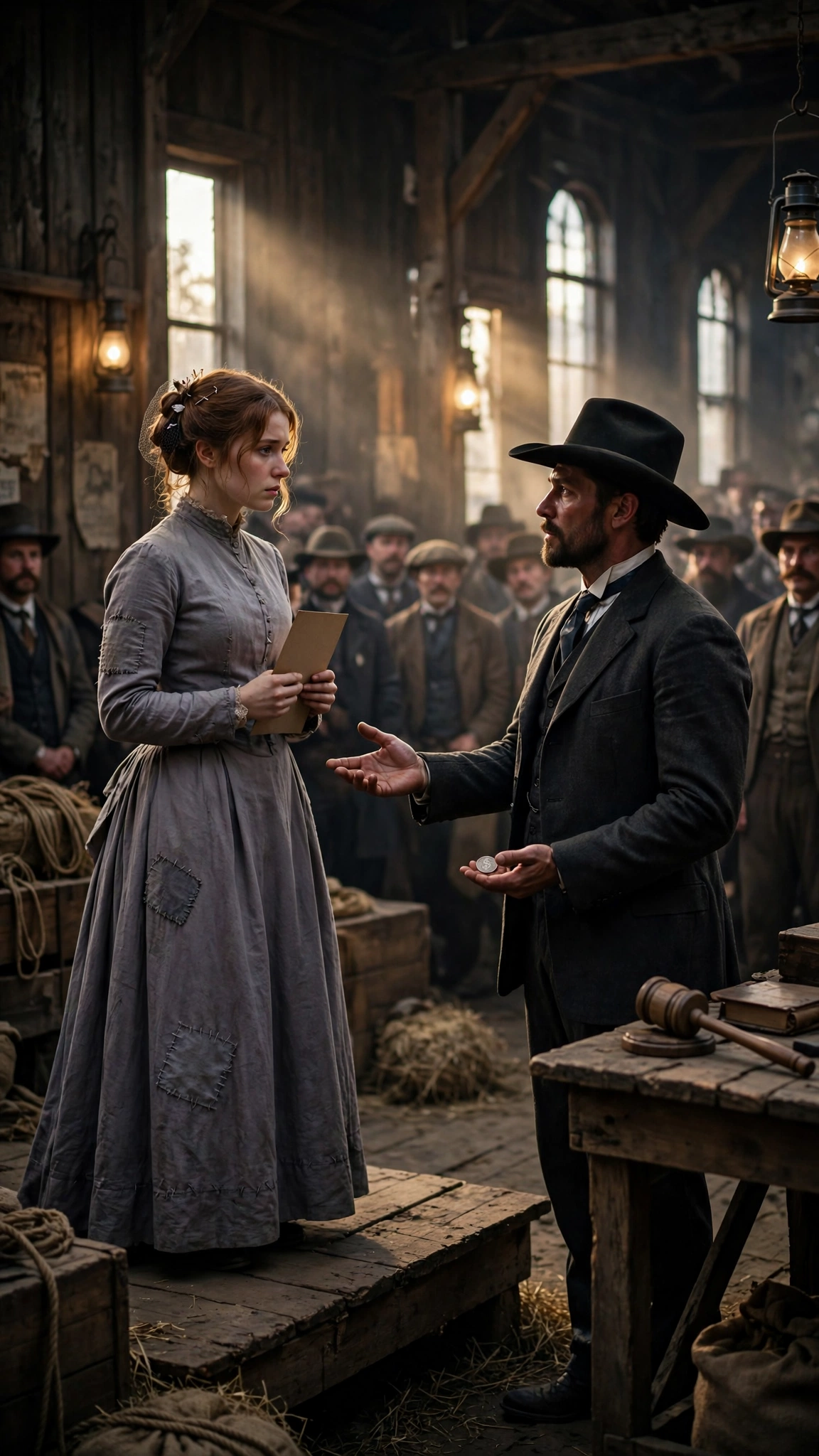
The winter came early that year, and it came hard.
By November, the snow lay deep on the grasslands, and the wind came down from the north in a white wall, and the cattle huddled in the lee of the hills, and the ranch house stood alone in the whiteness like a ship at sea. The hands moved into the bunkhouse for the winter, and the work slowed to feeding and mending and waiting, and the house settled into its winter rhythm: up before dawn, breakfast by lamplight, lessons at the kitchen table, supper at six, and the long evenings in the library, with the fire burning and the wind crying around the eaves.
Evelyn loved the winter. She had expected to dread it — the cold, the isolation, the long dark evenings — but instead she found that the winter gave her something the summer never had: time. Time to teach Thomas and Ruth their letters. Time to mend the curtains and the tablecloths. Time to sit beside Silas in the library and read aloud, the way Thomas had once read to her, while the fire burned low and the snow piled against the windows.
Thomas was nine by then, and quick, with a memory like a trap. He learned his letters in a month and his numbers in two, and by Christmas he could read the primer all the way through, and he read it to Ruth at night, in the bed they shared, sounding out the hard words with his finger on the page. Ruth was seven, and slower, and more careful, and she learned by watching: she watched Evelyn knead bread, and she kneaded beside her; she watched Evelyn mend, and she mended beside her; she watched Evelyn hold her head up, and she held her own head up, too, with a seriousness that made Dutch laugh and Mrs. O'Leary wipe her eyes with her apron.
Silas thawed slowly, the way the plains thaw in spring — a little at a time, and then all at once. In the autumn he had been polite and distant, a man who came home after dark and ate his supper and went to the library and read alone. By December, he was coming home before dark. By January, he was sitting at the kitchen table while Thomas did his lessons, pretending to mend a bridle, listening to the boy read. By February, he was the one who read aloud in the evenings, his deep voice filling the library, while Evelyn sewed and the children lay on the rug with their chins on their hands, listening.
"You read well," Evelyn told him one night, after the children had gone to bed.
"My father taught me," Silas said. "He said a man who can't read is a man who can be cheated. He said the same thing to me every winter, until I could recite it in my sleep."
"Thomas used to say that a child who can't read is a child who can't dream," Evelyn said. "He taught the miller's boy to read, and the boy's father came to the school and thanked him, and Thomas said it was the best day of his life."
Silas was quiet for a moment. Then he said, "Your Thomas sounds like he was a good teacher."
"He was," Evelyn said. "And you are a good reader. The children listen to you the way they used to listen to him."
It was the first time she had spoken of Thomas without the grief catching in her throat, and she noticed it, and Silas noticed it too, and neither of them said anything about it, because some things are better left unspoken.
The worst night of the winter came in the middle of January, when a blizzard swept down from the north and buried the fences and turned the whole world white. Silas had ridden out to the north range that morning with two of the hands, to bring the cattle in before the storm, and by dark he had not come home. Evelyn stood at the kitchen window with a lamp, watching the snow come down in sideways sheets, and she listened to the wind tear at the shutters, and she thought about the hill behind the house, and about the stone under which Silas's father lay, thrown from a horse on the north range, and her hands went cold around the lamp.
Mrs. O'Leary put the children to bed and came back downstairs, and she sat with Evelyn at the kitchen table, and she did not say anything foolish, like "he'll be fine," because both of them knew that men died in blizzards on the Nebraska plains every winter. They sat together, and they waited, and the clock ticked, and the wind screamed, and Evelyn thought about the warehouse, and about the hand she had almost touched, and about how little time she had been given with this man, and how much she already stood to lose.
At midnight, the door opened, and Silas came in half-frozen, with snow in his beard and ice on his coat, and Dutch behind him, stamping the snow from his boots. The cattle were in, Silas said. They had got them in. One hand had a frostbitten ear, and one horse had gone lame, but they were all alive, and they were all home.
Evelyn did not say anything. She went to him, and she took his frozen hands in hers, and she held them against her face until the feeling came back into them, and Silas looked down at her, and he said, in a voice rough with cold, "You were waiting up."
"Of course I was waiting up," Evelyn said. "This is my house. You are my husband. Where else would I be?"
And Silas, who had not been waited for in twelve years, stood in his own kitchen with the snow melting off his coat, and he looked at his wife, and at the lamp in the window, and at the house that had kept a light burning for him, and he understood, all at once, what it meant to have a home.
The next morning, Thomas learned to write his name. Evelyn sat him at the kitchen table with a pencil and a slate, and she showed him the letters one by one — T, H, O, M, A, S — and he copied them, slowly, with his tongue between his teeth, and when he had finished, he held the slate up, and he said, "Look, Mrs. Redmond. That's me."
"It is you," Evelyn said. "And do you know what your name means? It means 'twin.' It means you are never alone."
Thomas looked at the slate for a long time. Then he said, "Then I'm glad my name is Thomas. Because I was alone, and now I'm not."
But the winter was not all peace. In January, Evelyn began to hope, and hope, she was learning, was the most dangerous thing a woman in her position could feel.
It started with a missed monthly course. She had kept count for years, the way women do, and she had never missed one. She told herself it was the cold, or the change of diet, or the long winter nights. She told herself not to think about it. But she thought about it anyway, in the mornings, while she dressed, and at night, while she lay awake listening to the wind.
By February, she was certain enough to be afraid. She was sick in the mornings, quietly, so that no one would notice. Her dresses grew tight at the waist. She caught herself, more than once, with her hand resting on her belly, the way women do when they are carrying a child, and she would snatch her hand away, angry at herself for hoping.
She did not tell Silas. She could not bear to tell him, because if she told him and it was not true, she would have given him a hope and then taken it away, and that seemed crueller than saying nothing at all. She did not tell Mrs. O'Leary, or Dutch, or anyone. She carried the hope alone, the way she had carried everything alone since Thomas died, and she waited.
In the third week of February, the hope ended. She woke in the morning, and she knew, the way a woman knows, that it was over. She sat on the edge of the bed with her hands folded in her lap, and she listened to the wind, and she cried — quietly, so that no one would hear, the way she had cried on the day they buried Thomas.
She had been wrong. The doctor had been right. The scarring, the fever, the damage — it was all true, and she would never bear a child, and the hope she had carried for a month had been nothing but a cruelty her own body had played on her.
Silas found her there, sitting on the edge of the bed with her face in her hands, and he sat beside her, and he did not ask what was wrong, because he could see it in her face. He only put his arm around her, and held her, while she cried, and the wind cried around the eaves, and the house was quiet.
"I thought," she said at last, when the crying had stopped, "I thought I might be —"
"I know," Silas said.
"You knew?"
"I've been watching you for a month," he said. "The way you held your hand. The way you went quiet in the mornings. I didn't say anything, because I didn't want to hope either. And then this morning, when you didn't come down to breakfast, I knew."
"I'm sorry," Evelyn said. "I'm sorry I can't give you a child of your own blood. You deserve that. A man with eighteen thousand acres deserves a son."
Silas was quiet for a long time. Then he said, "Evelyn. Look at me."
She looked at him.
"Upstairs," he said, "there are two children asleep. They are not of my blood. They are not of yours. But they are ours, because we chose them, and they chose us, and that is a kind of blood, too. It's the kind that matters. I didn't marry you for children. I married you because you held your head up in a warehouse full of men who wanted you to bow it. And I will not have you apologising to me for something the doctor said in a back bedroom two years ago. Do you understand?"
She nodded, and she wiped her eyes, and she said, "I understand."
"Good," Silas said. "Now come down to breakfast. Mrs. O'Leary made flapjacks, and Thomas has been asking for you."
And they went down to breakfast, and Thomas read his lessons, and Ruth kneaded bread, and the winter went on, and Evelyn carried the grief of that February morning quietly, the way she carried everything, and she told herself that it was enough. She had a husband. She had two children. She had a home. It was enough.
But in March, when the snow began to melt, a letter came.
It came by post rider, in a heavy envelope sealed with red wax, and it was addressed to Silas Redmond, Redmond Ranch, Nebraska, in a clerk's careful hand. Silas opened it at the kitchen table, and he read it twice, and his face went still, the way it had gone still in the warehouse when Grady had spoken.
"What is it?" Evelyn asked.
Silas handed her the letter. It was from a lawyer in Council Bluffs, acting for Amos Grady, and it said, in the careful language lawyers use when they mean to frighten you, that Mr. Grady intended to challenge the validity of the Redmond marriage in the county court. That a marriage contracted at a public auction, for the sum of one dollar, was not a lawful marriage under the statutes of the State of Iowa. That the union was a sham, a transaction, and void from the beginning. That if the court agreed, Evelyn Mercer would have no legal standing as Mrs. Redmond, no claim to the ranch, no claim to the children, and no claim to anything at all.
Evelyn read the letter twice. Then she folded it carefully, and she laid it on the table, and she said, in a voice as steady as the day she had stood on the auction stage, "Then we will go to court, and we will tell them the truth."
"What truth?" Silas asked.
"That he offered me one dollar," Evelyn said, "and I accepted him. Not the dollar. Him. And that a marriage is not made by the price, Mr. Redmond. It is made by the promise. And we made ours in front of God and Dutch and a justice of the peace, and no lawyer in Council Bluffs can unmake it."
Silas looked at her for a long moment. Then he took her hand, and he said, "All right, Evelyn. We go to court."
Outside, the snow was melting, and the grass was beginning to show through in patches of brown and green, and the cattle were moving out onto the range, and the world was waking up after the long winter. Inside the ranch house, Evelyn folded the lawyer's letter and put it in the drawer with the number card, and she went back to the kitchen, and she taught Thomas his letters, and Ruth her bread, and she waited for the spring — and for the day she would have to stand in a courtroom and defend the life she had built, one dollar at a time.