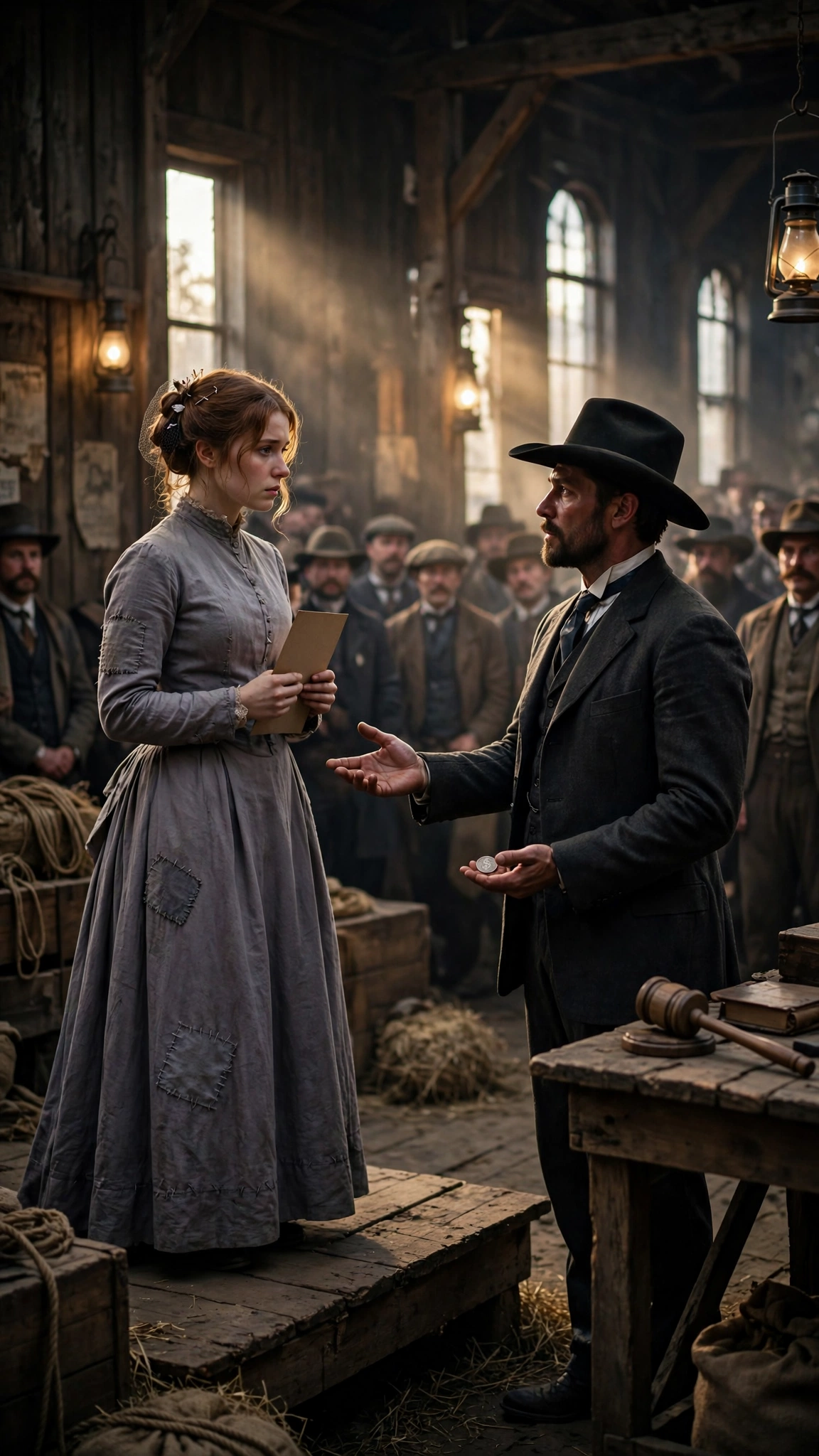
The courthouse in Council Bluffs was a brick building with white columns and a clock that had not worked in five years, and on the morning of the hearing, the whole town seemed to have gathered on its steps. Evelyn had expected a crowd. She had not expected the whole county.
She wore the lavender-grey dress, washed and pressed, and she pinned her hair up the way she had worn it on her wedding day, and she walked up the courthouse steps beside Silas with her back straight and her chin level, the way she had practised it all the way from the boarding house, all those months ago. Dutch walked behind them, in his best shirt, with his hat in his hands. Mrs. O'Leary had stayed at the ranch with Thomas and Ruth, and Evelyn was glad of it, because she did not want the children to see this.
Inside, the courtroom was full. Amos Grady sat at the front with his lawyer, a thin man from Des Moines with a thin voice, and his son Caleb sat beside him, smirking. The judge was an old man named Harlan — no relation to the doctor, though Evelyn wished, for one wild moment, that the name meant something else — with white hair and a face like a cliff, and he looked at the crowded courtroom over his spectacles and said, "This court will come to order," in a voice that made the whole room go still.
Grady's lawyer stood up first. He was a careful man, with careful language, and he laid out his case the way a man lays out tools on a bench: one by one, and in order.
A marriage, he said, was a contract, and a contract required lawful consideration. A public auction of a woman, for the sum of one dollar, was not a lawful marriage. It was a sale. It was a transaction. It was, in the eyes of the law, void from the beginning. Mrs. Mercer — for she was not Mrs. Redmond, he said, and he said it with a small, satisfied smile — had no legal standing as a wife, no claim to the Redmond ranch, no claim to the Miller children, and no claim to anything at all.
He called his witnesses. He called the auctioneer, who came to the stand with his hat in his hands and his collar damp, the way it had been damp in the warehouse, and who confirmed, in a nervous voice, that yes, the woman had been sold at auction, and yes, the price had been one dollar, and yes, the whole thing had been most irregular.
He called Dr. Harlan, who came to the stand with his black bag and his cold hands and his careful voice, and who confirmed that he had examined Mrs. Mercer, and that she was barren, and that any man who married her in the hope of children had been deceived.
He called Amos Grady himself, who took the stand and said, in his loud voice, that he had only the good of the county at heart, and that a man who bought his wife at auction for a dollar was a disgrace to the territory, and that the court ought to put a stop to it before every ranch hand in Nebraska got the same idea.
Then it was Silas's turn.
Silas's lawyer was a young man from Omaha named Whitfield, who had a loud voice and a louder laugh, and who had taken the case for the price of a horse, because he had liked the look of it. He stood up, and he called his first witness, and the whole courtroom leaned forward to see who it would be.
It was Dutch Kellerman.
Dutch came to the stand in his best shirt, and he took the oath, and he told the court, in his plain, slow voice, what he had seen in the warehouse that day: that Silas Redmond had not bought a woman, but had offered his hand to one; that the dollar had been a token, not a price; that the woman had been free to refuse, and had chosen to accept; and that in the year since, he had watched the two of them build a home, and raise two children, and become, in every way that mattered, a family.
"Mr. Kellerman," Grady's lawyer said, rising to cross-examine, "is it not true that your employer paid one dollar for this woman?"
"It is true that he offered one dollar," Dutch said. "And it is true that she accepted him. Not the dollar. Him. There's a difference, and if you can't see it, I pity you."
The courtroom murmured. The judge rapped his gavel.
Then Whitfield called Silas himself.
Silas took the stand, and he stood there in his charcoal suit, with his black hat in his hands, and he told the court, in his quiet, steady voice, that he had gone to the warehouse to buy horses; that he had seen a woman being humiliated in front of a hundred men; that he had offered her his hand because she was not livestock; and that he had married her three days later, before a justice of the peace, with Dutch as witness, and that he would do it again tomorrow, and the day after, and every day for the rest of his life.
"Mr. Redmond," Grady's lawyer said, "did you or did you not pay one dollar for your wife?"
"I offered one dollar," Silas said. "As a token. The way a man offers a ring. The ring is not the marriage, sir. The promise is."
"And the children?" the lawyer said. "The Miller children, who are not yours by blood?"
"They are mine by choice," Silas said. "And I would thank you not to speak of them as if they were a point of law."
The courtroom was silent. The judge looked at Silas for a long moment over his spectacles. Then he said, "Mrs. Redmond. Would you like to speak?"
Evelyn stood up.
She had not planned to speak. Whitfield had told her she did not have to. But as she walked to the stand, past the rows of watching faces, past Amos Grady and his son, past the auctioneer with his damp collar, she understood that this was the moment the story would be decided — not by lawyers, but by her. By whether she held her head up, one more time, in front of a room full of men who wanted her to bow it.
She took the oath, and she sat down, and she folded her hands in her lap, and she looked at the judge, and she spoke in a voice that was quiet, and that carried to the back of the courtroom.
"Your Honour," she said, "I was a widow with no money and no family, and I went to the warehouse because I had nowhere else to go. The men there laughed at me. One of them shouted that I could not have children. And then Mr. Redmond stepped out of the shadows, and he offered me one dollar, and he told me I was not livestock, and he asked me if I accepted."
She paused, and the courtroom held its breath.
"I accepted him," she said. "Not the dollar. Him. I accepted a man who stood beside me when the whole town stood against me. I accepted a man who took in two orphaned children and called them his own. I accepted a man who sat beside me on the night I cried for a child I thought I could never have, and who told me that love was a kind of blood, too. That is my marriage, Your Honour. It was not bought. It was chosen. And I choose it again, here, in front of this court."
The courtroom was silent. The judge looked at her for a long time. Then he looked at Grady's lawyer, and at Amos Grady, and at the auctioneer, and at Dr. Harlan with his cold hands, and he said, "This court finds that the marriage of Silas Redmond and Evelyn Mercer, solemnised before a justice of the peace with a lawful witness, is valid and binding. The sum of one dollar, offered as a token, does not void a marriage entered into freely by both parties. Case dismissed."
The gavel came down. It sounded, Evelyn thought, exactly like the gavel in the warehouse — and entirely different. The first time, it had been the sound of a woman being sold. This time, it was the sound of a woman being set free.
Outside, on the courthouse steps, the crowd parted for them. Some of the women nodded. One of them — a stout woman with flour on her apron, whose name Evelyn did not know — took her hand and squeezed it, and said, "Well spoken, Mrs. Redmond." And Evelyn squeezed back, and thanked her, and walked down the steps beside Silas with her back straight and her chin level, and Dutch behind them, grinning like a boy.
They drove home in the late afternoon, with the grasslands opening up ahead, and Evelyn sat beside Silas, and she thought about the year that had passed since the warehouse, and about Thomas and Ruth, and about the house that was now a home, and about the man beside her, who had offered her one dollar and given her everything.
And then, three weeks later, in the month of June, she missed her monthly course again.
She did not tell Silas. She did not tell anyone. She waited, the way she had waited in February, with her hand resting on her belly when she thought no one was looking, and her heart beating too fast in the mornings. But this time, the sickness did not come and go. This time, her dresses grew tight, and stayed tight. This time, when she woke in the morning, she knew — not with hope, but with certainty — that something had changed.
She sent for a doctor. Not Dr. Harlan. A different doctor, from Omaha — a younger man named Dr. Whitaker, who had studied in Chicago and who had a kind face and warm hands. He came to the ranch, and he examined her in the back bedroom with the curtains drawn, and when he was finished, he sat down, and he looked at her, and he said, "Mrs. Redmond. You are with child. About three months gone, by my reckoning."
Evelyn sat on the edge of the bed with her hands folded in her lap, and she listened to the words go through her like warm light.
"But Dr. Harlan said —"
"Dr. Harlan examined you too soon after your fever," Dr. Whitaker said, gently. "The inflammation he saw was temporary. It healed. He mistook a passing shadow for a permanent scar. It was an honest error, Mrs. Redmond — but it was an error. You were never barren. You were only ever waiting."
Evelyn walked him to the door, and she stood at the window, and she watched him climb into his buggy and drive away down the track. Then she went to the kitchen, where Ruth was kneading bread, and Thomas was doing his lessons, and Silas was standing by the stove with his coffee, and she looked at them all — her husband, her children, her home — and she said, in a voice that did not tremble at all, "Silas. We are going to have a baby."
Silas set his coffee down. He looked at her. He looked at the children. He looked back at her, and his pale grey eyes filled, and he crossed the kitchen in two strides, and he took her in his arms, and he held her, while Thomas and Ruth cheered, and Mrs. O'Leary wept into her apron, and Dutch, who had come in from the yard, took off his hat and held it over his heart, the way a man does in church.
That night, Evelyn took the primer out of her Bible — the spelling primer with the list of names on the back, in Thomas's neat hand, with Rose and Abigail added in pencil underneath — and she laid it on the table, and she looked at the names, and she thought about the doctor's word, and about how it had followed her for two years, from town to town, like a shadow.
And she thought about how shadows disappear when the sun comes up.
"Samuel," she said, touching the first name. "Grace. Joseph. Clara. Rose. Abigail."
"Six names," Silas said, looking over her shoulder. "And we already have Thomas and Ruth."
"Eight names," Evelyn said. "For seven children, perhaps. Or for however many God sends us. We will see."
And she folded the primer, and she put it back in her Bible, and she went to bed, and she slept, with her hand resting on her belly, and with the future taking shape around her, one small day at a time.