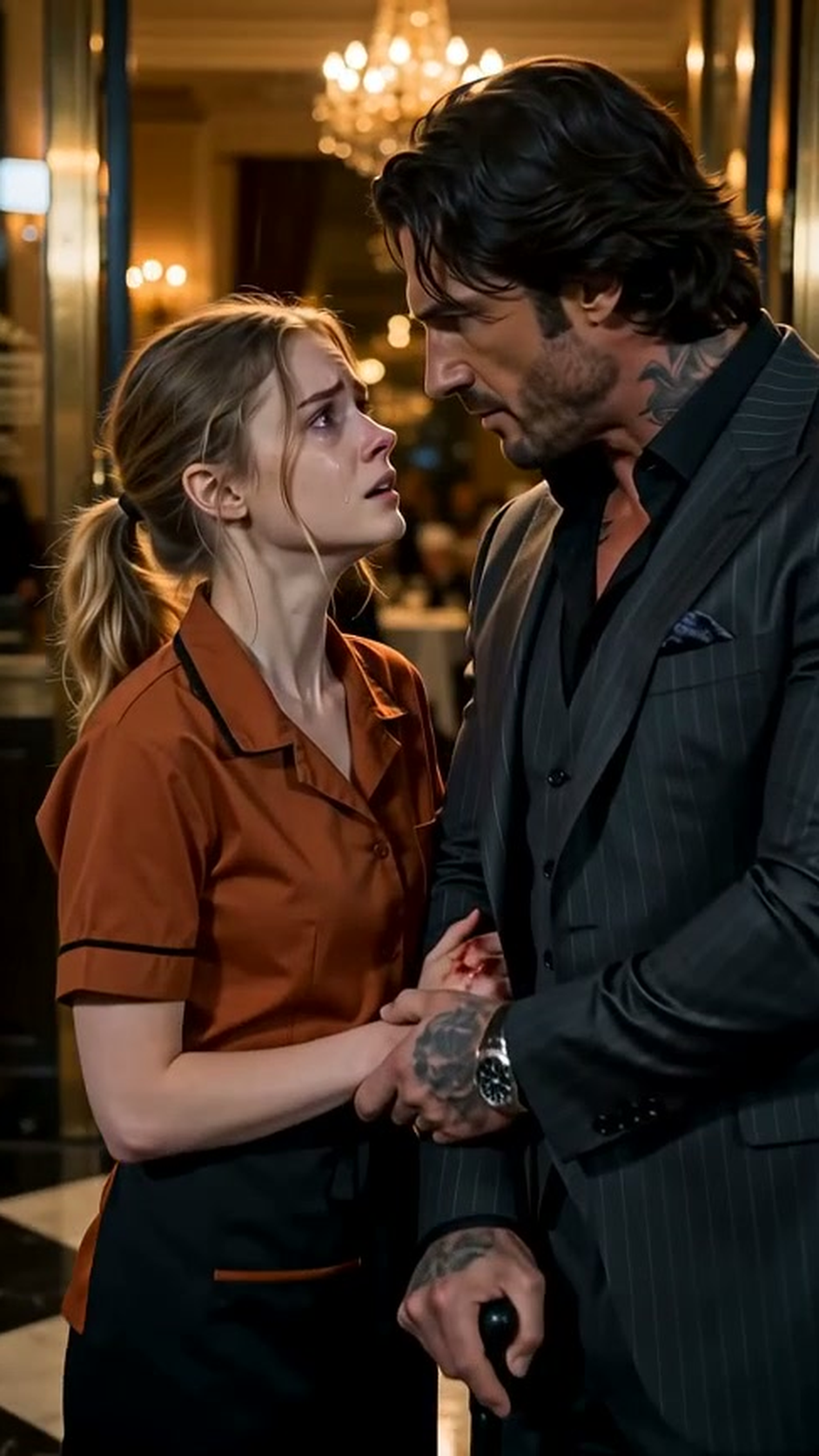
The thing Naen would remember, afterward, was not the men. It was the tea going cold.
Two cups on the counter, steam long gone, because Roman had stayed. He'd stayed past the medicine and the doctor, past every sane hour, sitting in her kitchen chair that was too small for him like a king on a child's throne, arguing — gently, immovably — that she would not be going back to an empty building and an unguarded door, and she had argued back, standing at her own sink, that she was not a package to be managed. It was the first real fight of whatever they were, and it was almost — almost — ordinary. Two people, a kitchen, a sleeping child, a disagreement about safety that was secretly about trust, and about the terrifying arithmetic of letting another person matter.
"I had a life before today, Roman. A hard one, but mine. You don't get to—"
Leo stirred on the couch, and the fight — if it had ever really been a fight — stopped dead, the way all fights in that apartment stopped dead, outranked. "S'cold," he mumbled, half in and half out of sleep, and Roman, without missing a beat, without asking anyone's permission, took the blanket from the arm of the couch and covered the boy to the chin with a care that his hands had clearly never practiced and his whole soul had clearly rehearsed. "I'm hot now," Leo informed the ceiling, eyes already closing. "Giant. Tell the stick story."
"The stick story," Roman repeated, at a loss for the first time since she'd met him.
"He invented it in the pharmacy. You have an owie and a stick, therefore you're a knight. Knights have stick stories. Those are the rules." Naen folded her arms. "Tell him, Sir Roman."
And the boss of the Castellano family, sitting in a kitchen chair built for smaller humans in a one-and-a-half-room apartment in Astoria, gravely told a feverish five-year-old a story about a knight whose sword was a stick, who had been wounded defending a bridge and had been saved by a lady with magic hands who could stop any bleeding in the world just by holding on and saying breathe with me — and whose whole job, after that, forever, was making sure nobody ever, ever made the lady hold anything alone again. "And the knight," Roman finished, "kept the bridge. And the lady kept the knight. And the boy kept them both, and was extremely bossy, and they all lived—"
"—the end," Leo sighed, asleep in the middle of his own review, one hand still fisted around two of his mother's fingers where she'd sat down beside him without deciding to.
Roman looked at the small hand on hers, and then at her, and the look on his face was not the face in the doorway at Laura, nor the face in the alley. It was younger than both, and it frightened her more than either, because it was the look of a man discovering, at thirty-eight, that the thing he'd organized his entire life to be able to afford was not a thing money had ever been able to buy, and it was asleep on a couch in Astoria with its fist around two fingers.
The apartment did its small evening sounds around them. Rain worrying the fire escape. The refrigerator's hum. Somewhere below, Mrs. Delgado's television murmuring through the floorboards, the whole building breathing in its sleep, none of it knowing. Naen looked at the cane hooked over the back of the kitchen chair, where he had left it like any man's umbrella, and at his shoes set neat by her door, and thought — with the calm, treacherous clarity that visits women at the worst possible moments — that her apartment had already made room for him in a dozen places she had never once decided on.
"I had a life before today, Roman," she whispered, so as not to wake him. "A hard one, but mine. You don't get to—"
The lights went out.
Not the apartment's lights. The building's. The whole stairwell, the hallway bulb she'd complained about for a month, the blue TV glow from 3A — all of it, at once, cut like a throat. And in the black, Leo made a small sound in his sleep, and Naen heard, with the hunter's hearing that poverty and motherhood had grown in her, the sound that didn't belong:
A key. In her lock. Turning slowly. A key that was not hers, in a lock she had paid to have changed when Thomas died, because Mrs. Delgado said a widow alone should.
The dark rearranged itself. Roman was already standing — she never heard the chair. His cane was not a cane anymore; it was in his hand like a club, and his other hand found her in the blackness with terrifying accuracy and moved her — placed her — behind the kitchen counter, low, the way you'd place something precious out of a fall zone.
"Leo," she breathed.
"Get him. Stay down. Whatever you hear — stay down." A pause. His hand, for one second, pressed flat between her shoulder blades, warm through her blouse. "Naen. I keep what is mine."
She crawled. She crawled across her own floor in the dark, past the couch, and got her arms around her son and his blanket and dragged them both, silently, into the bathroom — the one room with a lock that worked — and sat with her back against the tub and her boy clutched to her chest, his fever-warm face against her neck, and listened to her whole life happen on the other side of a hollow door.
The front door opened. Softly. Professionally.
What followed took less than two minutes and she would spend years assembling it: the entry, unhurried — the sound of men who expected an empty apartment and a sleeping woman. A voice, low, surprised, in an accent: "Lights are—" and then the world changed key. The particular, ugly music of a large man with a wounded leg refusing, absolutely, to be moved. Furniture going over. Her kitchen chair — the king's throne — shattering against something. A sound like a sack of wet cement hitting the floor, which she understood, with a clarity she hated, was a body. A second body. Glass. The cane, cracking like a bat — once, twice, a third time with a different note to it, the note of something giving. Someone screaming once, short, and then making the wet noises of a man who has stopped screaming.
In the bathroom Naen had her hand clamped over Leo's ear and her mouth against the other one, whispering nothing, pure rhythm, the shush-shush-shush of every mother since the world began, and her mind — traitor, accountant — was doing sums in the dark: two of them, Marco had said the alley took two, two in the alley and now the apartment, and Roman already bled dry once today, and the gun. Where was the gun. Every professional carried the gun. She had watched the paramedics work, she had watched crime shows in break rooms for four years, she knew the last sound of every story like this one was the gun, and she pressed her son's head into her neck and willed it, begged it, ordered it in the silent language she'd used on a wound at noon: don't. Don't you fire. Hold. Hold— And then — the sound that stopped her heart in her chest like a hand — a gunshot, flat and enormous in the small rooms, and Leo jerked awake in her arms wailing, and she thought: this is it, this is the sound of the world ending, this is what it costs to be seen by men like this—
And a voice. Roman's voice. Not loud. Threaded with something she had never heard in it, something that scared her more than the gunshot. Pain, held down under iron.
"Marco. Now. And an ambulance. She's—" A breath. "They're fine. The boy's fine. Get here."
Silence, then. Real silence, apartment silence, the rain coming back into it through the walls like the city resuming. And through the bathroom door, Naen heard her front door's broken lock click once, uselessly, and heard the cane — tap. Tap. Tap — crossing her floor, slowly, unevenly, toward the bathroom, and she was up off the floor with Leo still in her arms, she had the door wrenched open before the third tap—
—and Roman Castellano was standing in her hallway in the emergency-light gloom from the stairwell door, with her kitchen in wreckage behind him and two men on the floor in positions that bodies don't choose, and his charcoal suit was black on one side, black and wet and spreading, from a hole under his ribs that hadn't been there at dinner.
He looked at her. He looked at Leo, wide-eyed and silent now, staring over her shoulder. And Roman smiled — actually smiled, gray-faced and swaying — and said, "See, Leo? I told you. Owies," — and his leg, the good one, folded, and the leg with the bandage folded under it, and the most dangerous man in New York went down on the floor of a fourth-floor walk-up in Astoria like a cathedral going over.
She caught his head. That was all she could catch. She got her hands under his head before it hit the floorboards, and then she was down on her knees with Leo pressed between them screaming and Roman's blood coming through her fingers for the second time in one day — the second time, the SAME blood, the same hands — and she was shouting, at Leo, at the stairwell, at God:
"Call 911! Somebody call 911! Mrs. Delgado — CALL —"
"Naen." His hand came up. It took a long time. It closed around her wrist, weakly now, so weakly — the same grip that had held on in the alley, an echo with the strength burned out of it. His eyes opened, barely, and found hers, and held, and she watched him make himself speak through the gray creeping over his face, word by word, like a man spending his last money carefully:
"Boy… safe?"
"Safe," she sobbed. "He's safe, Roman, he's right here, he's safe—"
"Then… it worked." His eyes slipped closed. The hand around her wrist went slack. "Worth… the leg."
"Don't you dare," Naen Walker said, and got both her hands onto the wound under his ribs and bore down with everything she had, the way she'd done at noon, the way you do when the person under your hands is not allowed to die. "Don't you DARE. In — out — in — you listen to me, Roman Castellano, you owe me a debt, remember? Debts get paid. Breathe with me. BREATHE WITH ME—"
Leo, who had stopped screaming the way children do — all at once, hiccuping, watching — crawled out of her lap on some errand of his own and came back dragging his dinosaur by the tail, the big one, the good one, the one that slept on his pillow. With enormous care he laid it on Roman's chest, out of the way of her hands, out of the way of the blood, in the exact spot a five-year-old's whole medical science said a guardian belonged. "For the owie," he told the unconscious man, very seriously. "He watches. You can borrow him till you're better. But he's mine, so you have to get better, that's the rule."
"That's the rule," Naen whispered, with her hands full of his life, feeling the pulse under her palms go on, and on, and on, refusing every invitation to stop. "You hear that, Roman? Rules are rules. In — out — in —"
The stairwell door banged. Marco's voice, and others, and Mrs. Delgado's voice riding over all of them like a cavalry bugle — "Fourth floor, here, HERE, the lady is here, move, señor, I will move you myself—" and then the hallway was full of people, and hands she trusted were taking over the pressure in the practiced relay of people who do this for a living, and someone was lifting Leo, and someone was saying an ambulance, ninety seconds out, and Naen sat back on her heels in the wreckage of her kitchen with her hands dripping and her son's dinosaur standing guard on a mafia boss's chest, and she laughed — one cracked, impossible laugh, right there in front of everyone — because the world was ending and beginning at the same time and there was no other sound available.
And somewhere far below, rising through the rain toward the fourth floor, came the first wail of the sirens.