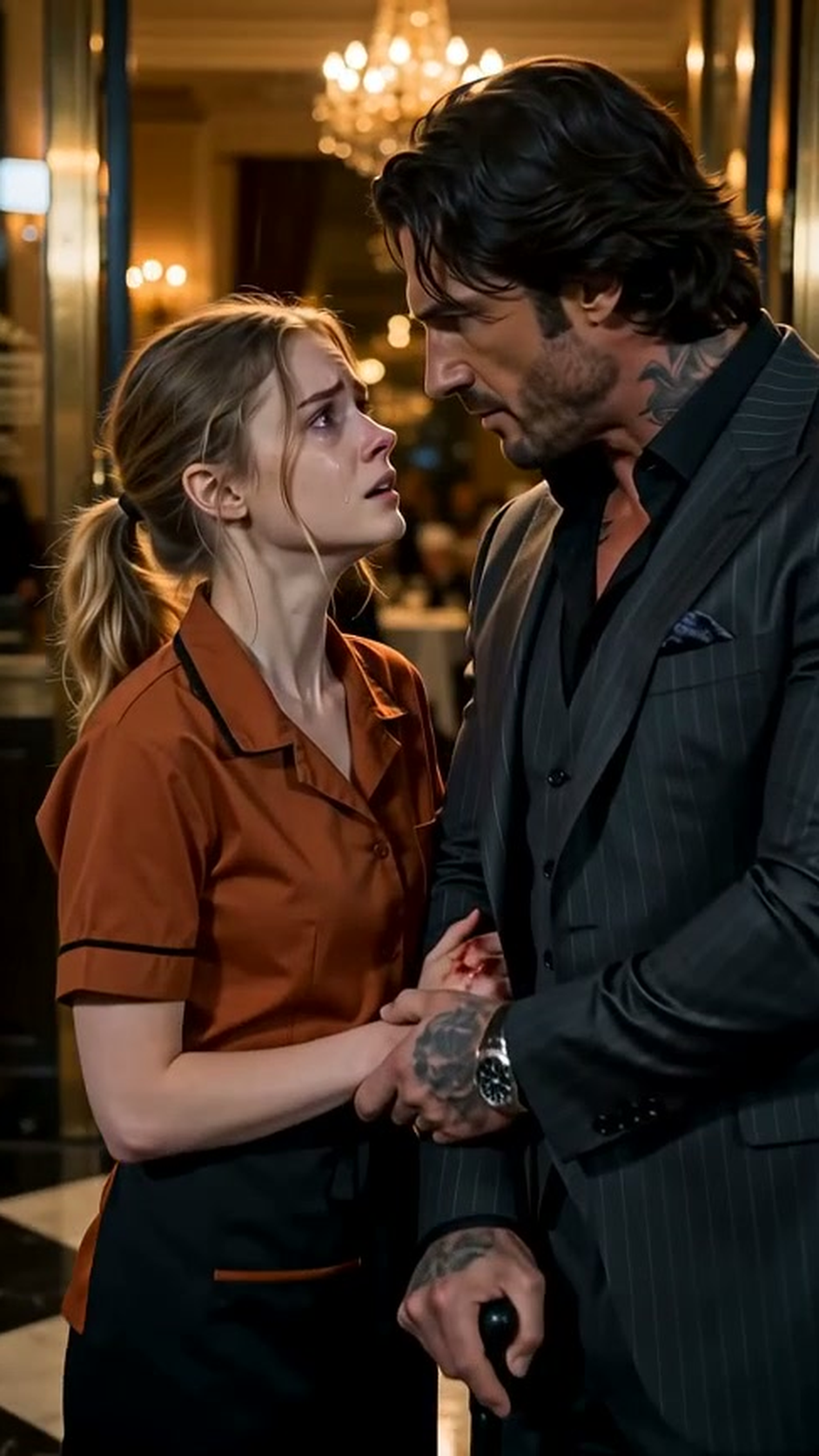
He knocked.
That was the thing she'd tell Leo, years later, when the story had become the family's founding myth and got told at Thanksgiving in its full and improving glory: the most dangerous man in New York, who could have had her door removed from its hinges by professionals in eleven seconds, stood in a fourth-floor hallway in Astoria with his cane in one hand and a bunch of bodega roses in the other, sweating through his shirt from four flights of stairs, and knocked, because she had told him once — in a fight, in a kitchen, over cold tea — that a person knocks.
Naen opened the door before the second knock had finished happening.
"You climbed," she said.
"I climbed."
"Your leg—"
"My leg—" Roman shifted his weight onto the cane, and the roses, slightly crushed from being a shield the whole way up, bobbed between them, "—has one job today. So does the rest of me. May I come in, Naen?"
She stood aside. Leo, who had been building a tower of blocks specifically engineered to fall on a villain, assessed the situation at the speed of five and arrived, as usual, at the heart of it before either adult: "GIANT. You gots flowers. Flowers is for marrying. Are you marrying my mom?"
"Leo!"
"I'm asking her," Roman said, with great dignity, lowering himself — slowly, carefully, and in the end entirely successfully — onto one knee on the floor of the apartment, which put him approximately at eye level with a five-year-old and a four-foot tower. "That's the question I carried up the stairs. But a man asks the mother first, and he asks properly, and if the answer is not today, then the answer is: he waits, and he keeps the medicine cabinet full, and he learns to make the soup. So." The gray eyes found hers over Leo's head, and everything he had ever hidden — the pain in the doorway, the arithmetic of his whole cold world — was simply not hidden, and it nearly took her knees out from under her. "Naen Walker. You held my life together with your hands when I was nobody to you. Let me spend mine holding yours. Marry me."
"Roman." Her voice was wrecked. "You don't have to— this isn't a debt, you can't marry a debt—"
"It stopped being a debt in a pharmacy on Ditmars Boulevard," he said, "somewhere between the inhalers and the thermometer. Everything after that was just me being too injured to say it in the right order." He reached out, palm up, the tattooed hand that had gripped her wrist in an alley and a hallway, offered now instead of holding on. "Say yes, and I spend my life making sure you never count nickels again. Say not yet, and I spend it exactly the same way, just from the kitchen chair, making tea wrong. There is no version of this where I leave. I keep what is mine — and you, Naen, are the only thing I've ever wanted to keep."
"YES," said Leo, at top volume, and knocked the tower onto the villain with both hands. "The answer is YES. I decided. Mommy, say the yes part."
And Naen Walker — who had run through the rain for this boy, who had held a stranger's life closed with her hands for eleven minutes with her whole future bleeding out by the minute, who had never once, in four years of doing everything alone, let anyone at all carry anything for her — Naen went down on her knees on the floor of her own kitchen, into the wreckage of the blocks and the crushed roses, and took the offered hand in both of hers, and said the yes part.
The ring had belonged to his grandmother, who had run the docks' books through two wars and, by family legend, one actual gunfight, and who had told her grandson on her deathbed that it was to go to a woman who could hold pressure on a wound without flinching, because such women were the only kind worth the name Castellano. Leo examined it on his mother's finger with a jeweler's squint. "It's not a dinosaur," he said at last, with the air of a man delivering a verdict he expects to be unpopular. "But it's shiny. You can keep it."
"Your approval," Roman said gravely, from the floor, where he was somehow still kneeling, "was the whole negotiation."
"Now the dog," Leo said. "For the yard. Knights have dogs."
"We'll discuss the dog with the queen."
"I'm the queen now," said Naen, from somewhere inside a laugh that kept wanting to be a sob instead, "and the queen says the dog is a yes, and somebody has to help her up off this floor, because her knees have been through a war today, and so have his."
Roman got them both up, cane and all, one arm around each of them — and if he held on a moment longer than balance required, and if his face, buried briefly in her hair, was not entirely composed, then Leo, aged five and a connoisseur of giants, was kind enough to pretend to be very interested in the blocks.
There was a wedding in the spring, in the garden of a house on Long Island that Roman bought outright because Leo, consulted on the matter, said a family should have a yard for a dog and a tree for a fort. The Castellano family filled one side of it and behaved, per Marco's personal guarantee, like a chamber of commerce. Mrs. Delgado cried through the entire ceremony and told everyone within earshot that she had always known, which was not true, and that the soup had done it, which was. Leo carried the rings on a cushion with the gravity of a head of state, and announced to the assembled guests — mafia princes, dock lawyers, one (1) pediatrician — that the giant now had a stick AND a wife, and got a laugh that Roman, at the altar, had to turn into a cough.
The house on Long Island had a kitchen with actual windows, and on the first Sunday in it, Mrs. Delgado — installed in the guest room "for the weekend," a weekend that everyone understood was permanent in every way that mattered — stood over Roman Castellano with a wooden spoon and the expression of a woman defusing ordnance, teaching him the soup. The soup was Leo's soup, the one that stretched one chicken into a week, the one Naen had made on the worst nights of the worst year, and the boss of the Castellanos was learning it the way he learned everything, totally, in silence, with his sleeves rolled over the tattoos and his whole attention bent to the pot like a treaty negotiation. "More salt," said Mrs. Delgado. "You are afraid of the salt. A man who is afraid of salt is afraid of life. Again."
"Yes, ma'am," said Roman Castellano, and added salt.
Leo, at the counter with his feet swinging, was whittling nothing with a butter knife under the supervision of Marco, who had come for Sunday dinner with a bottle of wine and stayed to be taught, by a five-year-old, the complete rules of dinosaurs. Through the window the yard went down to a fence and a tree that had been promised, and a dog — the dog was a rescue mutt named Pickles, enormous, deranged with joy, currently asleep on Roman's discarded jacket — snored in the sun. Naen stood in the doorway with a dish towel in her hands and watched her whole life being ridiculous and safe at the same time, a combination she had no practice with, and Roman looked up from the soup and caught her at it.
"What," he said.
"Nothing," she said. "Everything. The soup needs—"
"It needs salt. It's been established. By command." He tasted, considered, and — with the gravity of a man signing a dock over — nodded. "Tell me the truth. Is it the soup?"
"It's the soup," she lied, and he knew, and she knew he knew, and the kitchen was full of steam and garlic and a snoring dog and it was, she understood, the exact photograph of the thing she had whispered to a thermometer at four in the morning in another life: a family, fed, in a warm room, with medicine in the cabinet and tomorrow not a threat. She had held the pressure on the whole world for four years. The world, it turned out, had only been waiting for a second pair of hands.
And Laura — Laura got its new manager, and its new manager got, within a month, a reputation that moved through the New York restaurant world the way weather moves: the place where the staff got two days off in a row, where the single parents worked the lunch shift if they needed to and the dinner shift if they wanted to, where the schedule had a line in it, printed in the office in Naen Walker's own hand, that read simply: Personal problems are not a scheduling choice. Family is the schedule. Plan accordingly.
The proof of it came on a rainy Friday in October, because it was always going to come on a rainy Friday. A new waiter — Danny, twenty-four, hired off the street in the spring with a résumé printed at the library and a three-month-old daughter in a carrier, in a configuration Naen had found familiar enough to make her eyes sting at the interview — came through the staff entrance at 5:19 with his uniform half-soaked and his face already braced for the firing, the baby having spiked a fever at the sitter's, the crosstown bus having done what crosstown buses do. The whole floor saw it. The whole floor, who remembered a different manager and a different doorway, went quiet in the same way, all at once, the way a field goes quiet.
Naen looked at her watch. She looked at his hands, which were shaking. She thought about how some moments in a life are not moments but doors, and how you can spend years finding out which side of them you stand on.
"Danny," she said. "Section twelve. The Ashworths are asking for you by name." They weren't; they would be. "And tomorrow you're on lunch — the baby's clinic is mornings, I remember. Jenna—" Jenna materialized, because Jenna always materialized now, lieutenant of the new regime, "—cover his first seating, and somebody put the kettle on in the break room, he looks half-drowned. Nineteen minutes." She said it to the room, pleasantly, at exactly the volume David used to use, and in every other respect its perfect opposite: "At Laura, we hold the pressure for each other. That's the whole job. The rest is just carrying plates."
The waiters loved her with a ferocity that bordered on religion. The forty tables never found out her name. That was fine. She knew it.
On the first anniversary of the Friday it rained, because of course it rained, Roman found her at closing time standing in the golden doorway of the restaurant, under the awning, watching it come down on the marble steps — the doorway where her life had ended and begun in the same five minutes. His cane tapped behind her — he still had it, though the leg had healed enough that the doctors had begun, carefully, to use the word cane-optional, a word he ignored, because some things a man keeps as a reminder — and his arm came around her shoulders with the weight of a fortress wall, exactly as it had the first time.
"You're fired," he said softly, into her hair. "Get out. That's how it started. I've thought about it for a year. Worst manager I ever employed, and the best thing that ever happened to this restaurant."
"It started in the alley," Naen said, leaning her whole weight into him without a second's hesitation, a thing she had once not known how to do. "It started with you bleeding on my clean apron."
"It started," Roman said, "with a girl who didn't run." He covered her hand with his, warm and steady, in the doorway, in the rain-gold light. "You saved my life, Naen."
"I know," she said, and turned her face up to him, and smiled the smile that Leo had and Thomas had loved and she had thought was gone from the world forever. "And then you saved mine right back. We're even, Castellano. Forever. That's the deal."
"Forever," he agreed, and kissed her in the doorway of Laura, in the rain, while the city went home around them. "That's the deal."
THE END