The music reached the sitting room the way perfume reaches a corridor — softened, expensive, and impossible to escape. Beyond the closed doors, three hundred guests were drinking champagne beneath the chandeliers of the Blackwell ballroom, and every one of them believed this house was the safest place in the city.
Kate Bennett was hiding behind the antique sofa with a serving tray in her good hand and her broken arm tucked behind her apron, and she was trying very hard not to cry on the silver.
She had almost made it. Two more minutes and the tray would have been delivered, the door would have closed behind her, and she would have been back in the service corridor where nobody looked at the staff long enough to see anything at all. But the tray was heavy, her left hand was not trained for it, and when the crystal glasses chimed against each other she shifted her weight — and her right elbow struck the back of the sofa with a soft, sickening knock.
The sound she made was not a scream. It was worse. It was the small, animal whimper of a person who has used up all her screams somewhere private.
"Don't move."
The voice came from the shadows by the fireplace, and Kate's blood turned to winter.
Damon Blackwell rose from the leather chair where he had been sitting in the dark like something the room itself had grown. Thirty-four years old, six feet four of tailored black and ink, with gray threading his temples and tattoos swallowing both forearms to the elbow. The most dangerous man in the city. Her employer. The one person in this house she had sworn, three days ago, would never, ever see.
"Kate." He crossed the room without hurrying, and that was the terrible thing about him — he never hurried, because the world had learned to wait for him. "What are you hiding?"
"Nothing, sir. I — the tray, I was just—"
She stepped back. Her right arm swung, useless, behind the white lace of her apron, and his tattooed hand came up — not fast, not cruel, simply certain — and stopped it.
Stopped her.
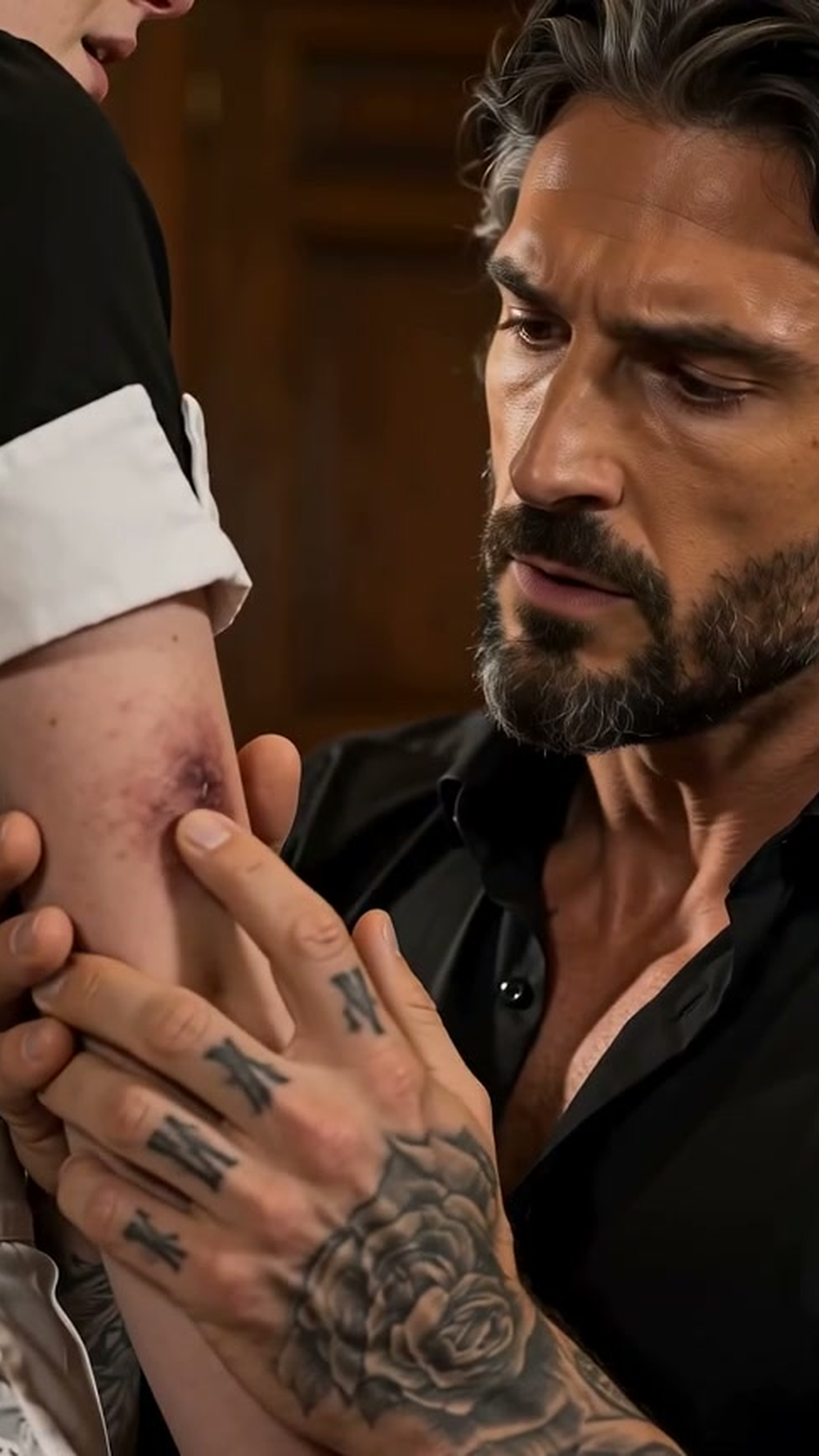
For one suspended second, neither of them breathed. His fingers had closed around her forearm through the sleeve of her uniform with the gentleness of a man handling blown glass, and Kate watched his face change as he felt what was underneath: the swelling. The heat. The wrongness of the angle beneath the skin.
Very slowly, without letting go, he rolled her sleeve back with his thumb.
The bruises went from her wrist to her elbow like a handprint made of storm clouds — violet, black, and yellowing green at the edges, three days old and still furious. And above her elbow, where the sleeve ended, four perfect finger-shaped marks and one thumb, pressed into her upper arm by someone who had wanted her to remember the shape of his hand.
The ballroom music played on. Somewhere beyond the doors, somebody laughed.
Damon Blackwell looked at her arm for a long time. When he finally lifted his eyes to her face, his expression had gone completely, frighteningly still — the stillness of deep water a moment before something enormous moves beneath it.
"Who broke your arm?"
His voice was low. Alarmingly calm. The calm of a man choosing where the lightning will strike.
Kate's whole body shook. "Please," she whispered. Tears she had held back for three days stood in her eyes and made the room swim. "Please… I can't lose this job."
He did not raise his voice. He did not let go of her arm. With his free hand he drew the antique sofa's chair closer with two fingers, guided her down onto its edge as if she were made of porcelain, and knelt — actually knelt, the king of the city's underworld on one knee on his own carpet — so that his eyes were level with hers.
"Look at me, Kate."
She looked. She had no choice; nobody had ever had a choice about anything once Damon Blackwell decided it. But what she found in his face was not the contempt she had rehearsed for in the mirror. It was something steadier. Something that, if she had not known whose face it was, she might have called kindness.
"You're not losing your job," he said. "Not tonight. Not for this. Not ever, while I own the roof over it. Do you understand me?"
A tear escaped and ran down her cheek. She nodded because her voice was gone.
"Then give me the only thing I am asking for." His thumb rested, feather-light, beside the worst of the bruising. "A name."
Her eyes flicked — she could not stop them — toward the closed ballroom doors. Toward the music, and the laughter, and the three hundred guests. Toward the man who was, at that very moment, standing among them with a glass of Damon's champagne in his hand.
"Kate."
She swallowed. The word came out of her barely louder than breath, and it cost her everything she had.
"Preston Caldwell."
The room changed temperature.
Nothing moved. Damon Blackwell did not blink, did not curse, did not so much as tighten his grip — if anything, his hold on her shattered arm grew gentler, as if his hands had made a decision his face refused to announce. But Kate, who had learned in three days of terror exactly what male stillness could mean, felt the hair rise on the back of her neck.
From the medical kit the housekeeper kept in the sitting room — because in this house, even tenderness was organized — he took the black orthopedic brace, and he fitted it around her forearm strap by strap, with the concentration of a jeweler setting a stone. His tattooed fingers, which half the city feared more than weapons, adjusted each strap twice, checking that nothing pressed where it should not.
"He'll never touch you again," he said quietly, not looking up. "That is not a threat, Kate. Threats are for men who negotiate. It is a schedule."
Then he rose, took out his phone, and turned toward the ballroom doors — toward the music, the gold light, and the man who did not yet know the evening had ended for him.
"Matteo," Damon said. "I want every name before sunrise."
* * *
Three months earlier, Kate Bennett had stood at the service gate of the Blackwell estate with a borrowed suitcase, a uniform two sizes too honest about her weight, and exactly forty-one dollars to her name.
The agency woman had walked her through the rules twice. The Blackwell house paid triple the going rate for live-in staff, and it paid in cash, weekly, no questions — and in exchange, the house demanded three things. Loyalty. Silence. And the understanding that you would see things in that house that you would take to your grave, because the alternative to taking them to your grave was considerably less metaphorical.
Kate had signed everything they put in front of her. She would have signed in blood. Because triple wages, in cash, weekly, spelled the only sentence that mattered in her life: her mother Eleanor's heart surgery — the deposit, the specialist, the aftercare — was no longer a fantasy. One year at Blackwell. One year of scrubbing the marble of a man rumored to have buried rivals in three states, and her mother would live.
It was, she had decided, the best bargain she would ever make.
She first saw Damon Blackwell on her fourth day, from the top of a ladder, where she was dusting a chandelier with a cloth and a prayer. He came through the great hall below with six men around him and a phone at his ear, and the whole house — she would learn this was simply physics — rearranged itself around his passing. Maids flattened to walls. The butler appeared with a coat. A man Kate would come to know as Matteo, the boss's younger brother, all sharp smiles and sharper eyes, fell into step and said something that made the others laugh and Damon not laugh, which was somehow more frightening.
From the ladder, Kate looked down at the top of his head — the gray at his temples, the ink at his cuffs — and thought, with perfect clarity: Stay invisible. That is the whole job. Rich girls get noticed in houses like this. Girls like you get buried.
She was very good at invisible. For eleven weeks, she was a ghost with a feather duster. She learned the house: which floorboards sang, which doors stayed locked, which corridor the men used after midnight and the staff never used at all. She learned that the boss took his coffee black at six, that he read actual paper books in the library no one else was allowed to dust, that once — once — she had come around a corner with a laundry basket and found him standing at the tall window with a photograph in his hand and an expression on his face like a man at a graveside, and she had backed away so silently that she was down the whole corridor before she remembered to breathe.
She sent every spare dollar to St. Aurelia's Hospital. She called her mother on Sundays and lied beautifully about how well she was eating. "The food here, Mama, you wouldn't believe it. Cooks throw away better than restaurants serve." And her mother, thin-voiced from the ward with the machine breathing beside her, would laugh and say, "Then eat, Katherine. A girl cannot dust on air," and Kate would promise, and go down to the staff kitchen and make tea she drank standing up, because sitting down in the middle of a shift felt like theft from the woman in the bed.
The house tested her the way deep water tests a swimmer — constantly, and without malice, and without pause. There were the midnight deliveries that no one explained and she did not ask about. There was the east wing door that stayed locked and the two men who were always, somehow, awake. There was the night she carried a tray of coffee into the library at 2 a.m. and found the boss alone with his sleeves rolled and his tattoos out and a map — an actual map, ports and coastlines — weighted down with a pistol at one corner and a teacup at the other, and he had looked up at her entrance not with anger but with the flat assessment of a man deciding whether she was a person or a piece of weather, and had said, "Leave it by the door, Kate," — her name, known, filed, from a roster he had no business memorizing — "and get some sleep. You look like the house is eating you."
She had set the tray down and gone, and had not been able to decide, all the way back down the corridor, whether she had been threatened or mothered. She was, in the bleak arithmetic of her life, winning.
And then, three weeks before the gala, the house hosted a dinner for twelve — bankers, shipping men, a judge — and Kate, because two senior girls were down with flu and fate has a sense of humor, was pulled from the laundry to serve.
The dining room that night was all candlelight and crystal and men who spoke about money the way other men spoke about weather. Kate moved among them like a shadow with a wine bottle, pouring, clearing, vanishing. She was so focused on the choreography of invisibility that she did not notice the man in the third seat watching her.
Preston Caldwell. Forty-six, silver-blond, with a yachtsman's tan and a smile that had clearly been purchased from the same place as his watch. Caldwell Shipping. Old money, new appetites. She knew his name because the housekeeper, Mrs. Whitmore, had recited the guest list with the special reverence reserved for men who could buy the house and everyone in it.
She noticed him at dessert, when she leaned to pour his coffee and found his hand already waiting — not for the cup. For her wrist. His fingers closed around it, warm and proprietary, and he looked up at her with the unhurried confidence of a man who has never once been told no by anyone whose no mattered.
"What's your name, sweetheart?"
"Let go of me, please, sir." She said it quietly. She said it correctly, the way the agency trained: please, sir, no scene, never a scene in front of the guests.
He smiled wider, and let go — slowly, one finger at a time, like a man setting down something he fully intended to pick up again later.
Kate finished the service with her hands shaking so hard she had to carry the cups two at a time.
She told herself it was nothing. Rich men at dinners, hands, smiles — the world was full of it, and she had a mother's surgery riding on her silence. She told herself he would forget her by morning.
She served breakfast the next day, and the day after, and the day after that, and the house rolled on toward the gala, and for almost three weeks nothing happened at all.
It was on the Thursday before the gala — three days before Damon Blackwell would kneel on his own carpet and ask his question — that Preston Caldwell came back to the estate, alone, in the middle of the afternoon, on business that could not wait.
And Kate, carrying a stack of pressed linens through the east service corridor, heard the door at the far end open.
And close.
And lock.