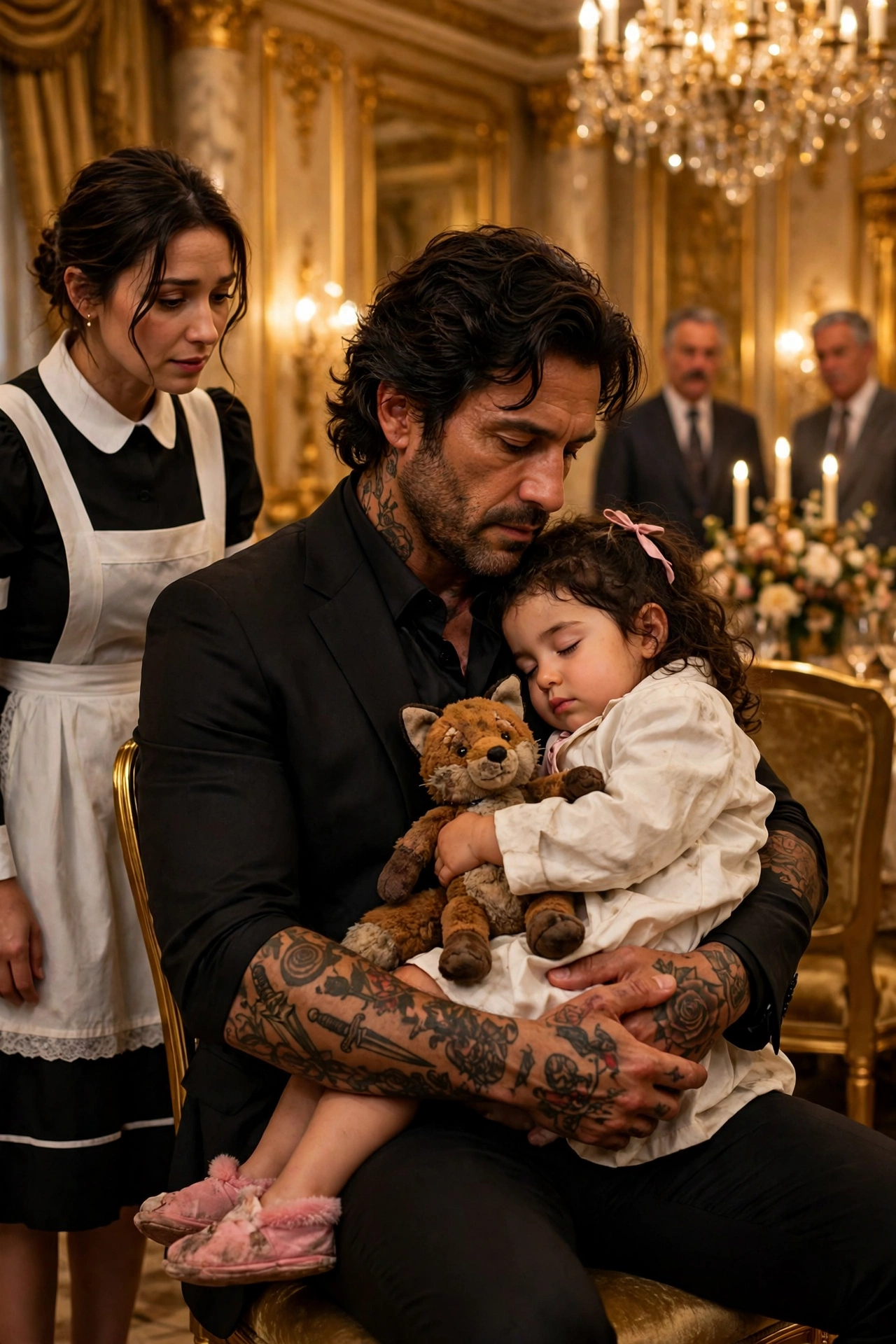
I did not sleep that night. I sat in the chair beside the guest room bed and watched a three-year-old girl breathe.
She had fallen asleep in my arms in the conference room, and I had carried her myself, because no one else in that house was going to touch her while I was still trying to understand what had just happened. Her stuffed fox was tucked under her chin. Her dark curls had come loose from the ribbon. Her pink slippers were on the floor beside the bed, neatly side by side, as if someone small had tried very hard to be tidy.
Outside the door, two of my men stood guard. Not because she was a prisoner. Because I did not know yet who in my own house could be trusted, and I was not going to take a chance with a child who had said my brother's name in her sleep.
Renzo.
I kept hearing it. Not loud. Not clear, the way a grown person says a name. Just soft, the way a child says a word she has heard in a lullaby. Renzo. And then, when I asked who taught her, she said Matty.
Matty was what Matteo called himself when we were children. He was six and I was nine, and he could not say Matteo properly yet, so he shortened it and then refused to give it up. Our mother laughed about it. Our father pretended to be annoyed and then used it himself when no one else was listening. After Matteo died, I made sure no one used Renzo again either. It was not a rule I announced. It was a rule people learned by watching my face.
And now a maid's little girl, who was not supposed to be anywhere near my estate, let alone my conference room, had said both names in one evening.
I stood up quietly when the first gray light came through the curtains. The girl did not wake. Her mother was asleep in the chair on the other side of the room, her head tipped back, her maid's uniform still on, her hands folded in her lap like she was afraid to relax even in sleep. I did not wake her. I did not know her name yet, and that shamed me. She had worked in my house, and I had never asked.
Salvatore was waiting for me in the hallway. He looked like he had not slept either. His tie was loose. His eyes were red. He held a thin folder against his chest as if it might bite him.
"Lorenzo," he said, very quietly, "we need to talk before Vittorio wakes up."
I nodded toward my study. We walked without speaking. The house was still quiet in that early way it gets before the staff starts moving. The conference room door was closed. Someone had cleaned up the broken glass from Vittorio's drink, but I could still see the faint wet mark on the rug where it had fallen.
Salvatore closed the study door behind us and set the folder on my desk. He did not open it right away.
"I have been thinking about what Matteo said to you," he said. "The night before he died."
I sat down slowly. "He said, Renzo, if anything happens to me, don't trust the people who call themselves family."
Salvatore nodded. "He said it to you alone, in this room. You told me the next morning, after the funeral arrangements had started, because you did not know what else to do with it. I have remembered it every day since. I just never had a reason to say it out loud again."
"And now you do?" I asked.
"Now a child has said his name, and Vittorio dropped his glass," Salvatore said. "That is a reason."
I leaned back. "Vittorio has an alibi for the night Matteo died. He has always had one. He was in Naples. He had dinner with two men from the port. He called me from there the next morning to tell me what had happened, before anyone else in the family knew."
"I know what he said," Salvatore said. "I am the one who wrote it down."
He opened the folder. Inside were copies of old notes, in his own handwriting, and a few pages of travel records he had pulled from our files during the night. He pushed one page toward me.
"Vittorio said he left Rome at seven in the evening and arrived in Naples at ten. He said his driver took him straight to the hotel. But the driver's log from that night says something different."
I looked at the page. It was a simple log, times and places, the kind of thing drivers keep because they are paid by the hour. The entry for that night showed a stop I did not recognize, a small town halfway between Rome and Naples, at eight forty-five. The driver had written a single word beside it: waiting.
"Waiting for what?" I asked.
"That is the question," Salvatore said. "The driver is dead now. A car accident, two years ago. Convenient, if you want a story to stay simple."
I did not answer right away. I was thinking about Matteo, about the way he had looked the night before he died. He had come to my study late, after everyone else had gone to bed. He was restless. He kept checking the window. He told me he had found something he did not like, something about money moving in the wrong direction, and about a shipment that was supposed to be lost but was not lost at all.
I had told him to be careful. I had told him to wait until morning and we would look at it together. He had smiled at me, the way younger brothers smile when they think you are being too serious, and he had said, "Renzo, if anything happens to me, don't trust the people who call themselves family."
I had thought he was being dramatic. I had thought he was tired. The next morning, he was dead, and the story we were given was simple: a rival family, a bad meeting, a wrong place at the wrong time. The Falcone name was mentioned, as it always was when we needed someone to blame. We accepted it because grief does not leave much room for questions, and because Vittorio was the one who told us the story first, calmly, like a man who had already made his peace with it.
"Vittorio was the first person to call you that morning," Salvatore said, as if he were reading my thoughts. "Before the police. Before the hospital. He said he had heard it from a friend in Naples. How would a friend in Naples know before we did?"
My hands were very still on the desk. That was the kind of detail you miss when you are grieving. You hear a voice you trust, and you hold on to it, because the alternative is to stand alone in a room full of people who might be lying to you.
"There is more," Salvatore said, and he looked unhappy about it, the way a loyal man looks when he has to tell his boss something that will hurt him. "I spoke to one of the men who was at dinner with Vittorio in Naples. Last night, after the meeting, I called him. He remembered the dinner, but he said Vittorio arrived late. Not at ten. Closer to midnight. And he left early, before dessert. He said Vittorio kept checking his phone."
"That does not prove murder," I said, because I needed to hear myself say it. I needed to be fair, even to a man I was beginning to suspect. "It proves he lied about the time. Men lie about times for many reasons."
"I know," Salvatore said. "But it is a crack. And cracks are how you find the rest of a wall."
Before I could answer, there was a knock at the study door. One of my men stepped in, his face tight.
"Carmine Falcone is asking for a meeting," he said. "Today. He says the shipments cannot wait, and he says your house is distracted."
I almost laughed. Distracted. A child had walked into my meeting and said my dead brother's name, and Falcone thought that was a distraction. He did not know that it was the first clear thing I had seen in three years.
"Tell him I will meet him tomorrow, not today," I said. "And tell him the shipments will be discussed when I am ready, not when he is impatient."
The man nodded and left. Salvatore watched me.
"You are going to make Falcone angry," he said.
"Falcone is always angry," I said. "Let him be angry tomorrow."
After Salvatore left to make the calls, I went back to the guest room. The little girl was awake now, sitting up in bed, rubbing her eyes with her fists. Her mother was awake too, smoothing the blanket, whispering something soft. When the girl saw me in the doorway, she smiled, as if seeing me was the most normal thing in the world.
"Mister," she said, "did I sleep good?"
"You slept very well," I said.
She held up her fox. "Foxy slept good too."
I knelt down beside the bed, the way I had knelt in the conference room. I kept my voice low, so I would not frighten her.
"Can you tell me about Matty?" I asked. "Is Matty a friend?"
She thought about it very seriously, the way three-year-olds do when you ask them a grown-up question. "Matty tells Mommy not to cry," she said. "He says, shh, little one, shh. And he gives me Foxy."
Her mother went very still. She did not look at me. She looked at her hands.
"When did Matty give you Foxy?" I asked gently.
"A long time," the girl said. "Before the big house. Before Mommy worked here."
Before the big house. Before her mother worked here. That meant Matteo had known them before he died. That meant my brother, who I thought had lived only in my world of meetings and shipments and family dinners, had a second life I knew nothing about, a life where he comforted a crying mother and gave a little girl a stuffed fox.
I did not press the child further. She was three. She did not need to be a witness. She needed breakfast, and a warm room, and a mother who was not afraid.
But as I stood up, I understood something clearly for the first time since Matteo's funeral. His warning had not been about strangers. It had not been about the Falcone family, or about rivals, or about men with guns. It had been about family. About the people who sit at your table and call themselves yours, and who know exactly where you will be on a given night, and exactly what story you will believe when you are too tired and too sad to ask for proof.
Vittorio was still asleep upstairs. Or he was awake and pretending to sleep, listening for footsteps in the hallway. I did not know which, and I did not go to see him yet. I was not ready to look him in the eye and ask him where he really was on the night my brother died, because once I asked that question out loud, there would be no way to take it back.
Instead, I went to the window in my study and looked out at the grounds. The estate was quiet. The guards were at their posts. The garden was still wet from the night. Somewhere in this house, a little girl was eating toast with jam on it, and her mother was watching her as if she might disappear.
Matteo had told me not to trust family. He had not told me not to trust anyone. There was a difference, and I was going to hold on to that difference.
Salvatore came back an hour later with another piece of paper. It was not proof. It was not a confession. It was a receipt for a car repair, dated the week after Matteo died, for Vittorio's car. The front bumper had been replaced. The mechanic had noted damage consistent with a collision, but the owner had paid in cash and asked for no report.
Salvatore set it down without a word. He did not need to say what we were both thinking. A man who had been in Naples all night, at a quiet dinner, should not have needed a new bumper the next week.
I folded the receipt and put it in my desk drawer, next to Matteo's last note to me, which I had kept for three years and never shown to anyone.
"Keep watching Vittorio," I said to Salvatore. "Quietly. No questions to his face yet. I want to know who he calls, where he goes, and who he meets. And keep Falcone away from this house until I say otherwise."
Salvatore nodded. "And the girl? And her mother?"
"They stay here," I said. "In this house, under my protection, where I can see them. No one takes them anywhere without my word. Not Vittorio. Not Falcone. Not anyone who calls himself family."
That night, when the girl was back in bed, I sat in the chair again for a little while. She was already half asleep when she whispered, without opening her eyes, "Renzo."
This time I did not flinch. I just said, very quietly, so only she could hear, "I am here."
She sighed and slept. And I thought about Matteo, and about the warning he had left me, and about how a three-year-old girl had walked into my meeting and, without knowing it, had given me back the one thing I had lost three years ago: a reason to ask questions again.
TITLE: A three-year-old maid's daughter walked into my private mafia meeting, climbed into my arms, and called me by a name nobody had dared speak since my brother's murder