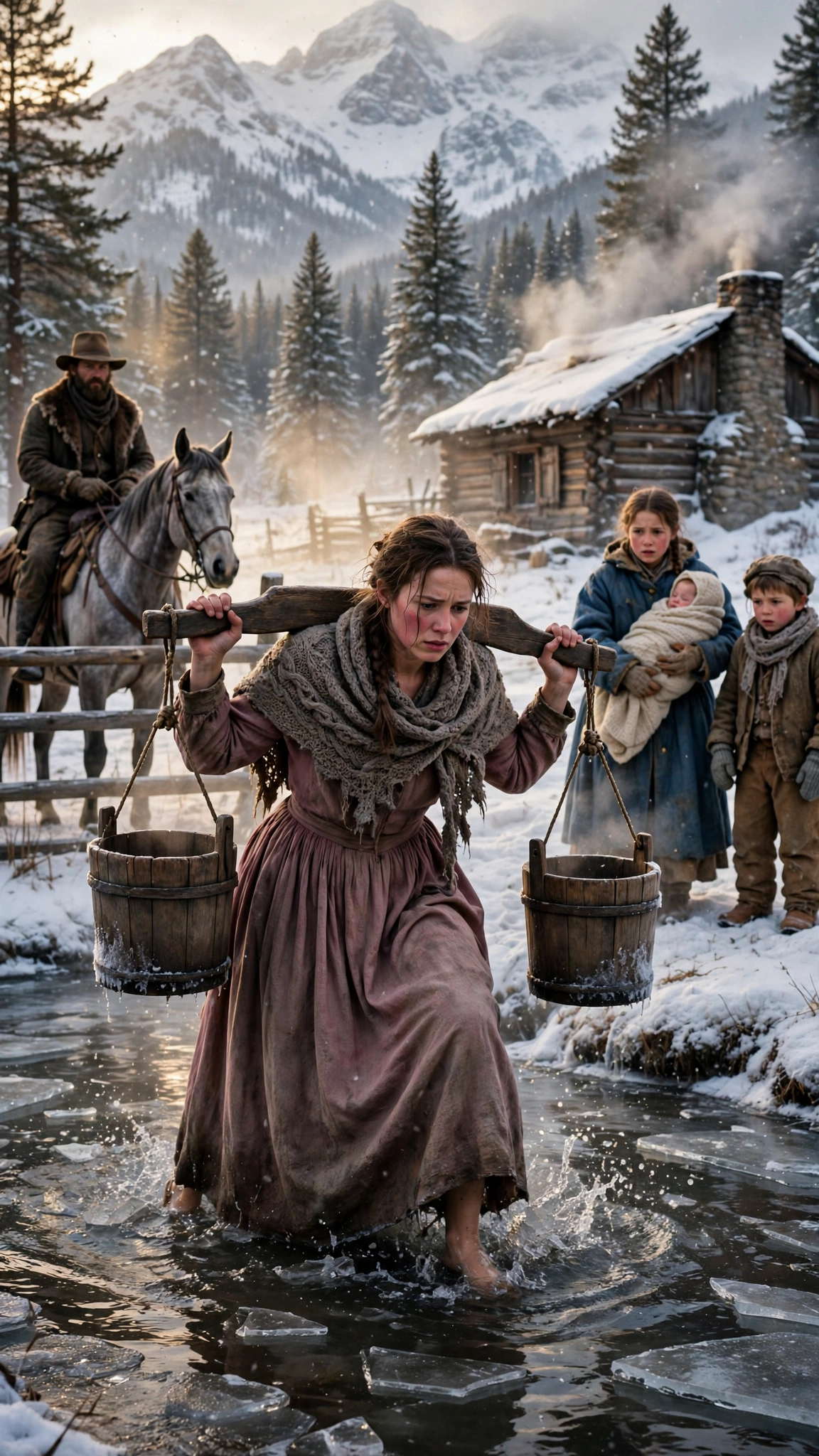
The ice broke under her foot with a sound like a plate cracking, and the cold went up her leg like a knife.
Adelaide Marsh stood knee-deep in Stillwater Creek with a wooden yoke across her shoulders and two buckets hanging from it, and the water was so cold it had stopped feeling like water at all. It felt like broken glass. It felt like fire. Her bare foot found the creek bed, slipped on a stone, and found it again, and the thin skin over her heel split on the ice. A faint pink stain curled into the swirling water around her ankle and was gone.
She did not cry out. She had learned, in the two months since Henry died, that crying out spent breath she could not spare.
From the snowy bank above her, Clara's voice came thin and sharp through the wind.
"Momma, your feet!"
Addie tightened her grip on the bucket ropes. The buckets were heavy — forty pounds of water apiece, sloshing over the rims, soaking the hem of her dress until the faded rose-colored fabric hung against her legs like wet canvas. The yoke dug into her shoulders through the worn knitted shawl. Her breath came in short, sharp pulls that hurt her chest.
"We need water."
It was the truest thing she knew, and she said it flatly, without pleading, because pleading had never filled a bucket. The creek was the only water they had. The well had frozen solid in the first week of January, the rope stiff as iron in the bucket, and the snow they melted in the kettle tasted of smoke and left them thirstier than before. Anna was burning with fever in Clara's arms, and a feverish baby needed water more than anything in the world. So Addie walked into the creek barefoot, because she had no boots left to wear, and she carried the water home on her shoulders because there was no one else to carry it.
Behind her, on the bank, Clara stood in her oversized blue coat with baby Anna wrapped in the cream blanket against her chest, and Peter clung to his sister's coat with both hands, his gray scarf whipping in the wind. The cabin stood behind them with snow piled to the eaves and a thin ribbon of smoke rising from the stone chimney. Beyond the fence, the Rockies stood white and indifferent against a pale sky, and the wind came down off them in gusts that stung Addie's cheeks raw.
Clara looked at her mother, and then at the cabin, and then at the road that led down toward Helena, and her voice dropped to something smaller than a question.
"Will they take us Friday?"
Addie froze in the middle of the creek. The water moved around her calves, and the cold climbed higher, and for a moment she could not feel her feet at all. She looked at her three children standing in the snow — Clara with the baby, Peter with his face buried in Clara's coat — and she thought of the paper nailed to the cabin door, and the words written on it in Luther Bane's careful hand, and the wagon that would come up the road on Friday morning with room in the back for three children.
"Not if I can help it."
Her voice carried exhaustion rather than melodrama. She had no drama left in her. She had only the next step, and then the next, and then the bank.
She lifted one numb foot out of the creek and set it down in the snow. Water poured from both buckets. Her dress dragged through the freezing water. She took another step, and the snow blew across the narrow path in white sheets, and the cabin roof was buried so deep that only the chimney showed where the house ended and the sky began.
And then she heard it — distant, muffled by the wind, but unmistakable.
Horse hooves, crunching through snow.
A tall dapple-gray horse emerged from the blowing snowfall beyond the fence, moving slowly toward the property, and the man on its back sat straight in the saddle with his dark leather coat dusted white. He had a brown wide-brimmed hat pulled low and a wool scarf wrapped high around his face, and he slowed his horse when he saw the cabin, and slowed it more when he saw the children, and then his gaze found Addie in the creek, and he stopped altogether.
He did not speak. He only watched, and the watching was worse than shouting would have been, because Addie could see his eyes move from her face to the yoke to the buckets to her feet, and she saw the moment he understood what he was looking at.
She stepped onto the creek bank. Her injured heel pressed into fresh white snow, and a faint red stain bloomed beneath her footprint. She took another painful step, and another footprint stayed behind her, marked the same way, and her hands trembled as the bucket ropes pulled against her shoulders.
Behind her, slightly out of focus through the falling snow, the rancher swung down from his gray horse. His boots crunched into the snow. He took two steps toward the creek and then stopped, and his gaze dropped to the trail of barefoot prints she had left behind her, and he stood there looking at them for a long time.
"Barefoot?" he said, under his breath.
Addie kept walking toward the cabin. She had not heard him, or she had heard him and chose not to hear, because there was nothing to say to it. Barefoot was a fact, like the cold and the debt and Friday. Facts did not need discussing.
But the rancher followed the trail of footprints through the snow, moving slowly from the fence toward the creek, and when he reached the place where her heel had bled into the snow he went down on one knee. He brushed away the loose snow with his gloved hand, and the small red stain showed against the white, and his expression changed — from curiosity to something else, something harder and quieter, that Addie could not read from where she stood.
In the background, at the cabin steps, she nearly lost her balance beneath the heavy buckets. Clara rushed toward her, and Peter stood silently beside the wooden railing, and baby Anna rested weakly against Clara's shoulder, her small face flushed with fever.
The rancher looked from the footprints to the exhausted mother and her children, and then he rose slowly from the snow, and his gray horse stood quietly beside the fence, its breath forming white clouds in the air.
Addie finally noticed him watching her. She pulled the wooden yoke closer to her body, as if it could shield her, and her expression shifted from exhaustion to fear. She glanced toward her children, and then back at the stranger, and her heart beat so hard she could feel it in her throat.
The rancher looked down once more at her bare, bleeding feet. Then toward the cabin. Then back into her frightened eyes.
"Where are your boots, ma'am?" he asked, quietly.
Addie swallowed. Her lips trembled from the cold, and from something colder than the cold — shame, which she had thought she had used up weeks ago, and which turned out to have a bottomless supply.
"I sold them."
A brief silence followed. The wind moved through the pines. The horse stamped once, and the sound was very loud in the quiet.
The rancher's expression tightened. He took one careful step toward her, and his eyes moved from the footprints to the frightened children, and then back to her face.
"For what?" he asked, softly.
Addie looked toward her feverish baby in Clara's arms. She thought of the two days' walk to Helena in the snow, and the cobbler's shop, and the coins in her palm, and the little brown bottle the doctor had given her in exchange, and the way Anna's breathing had eased for one blessed night after the first spoonful.
"Medicine."
She whispered it, barely louder than the wind, and her eyes never left her baby's face. His gloved hand rose slowly, and drifted toward the saddlebag on his gray horse, and Addie watched him, uncertain whether to trust him, uncertain whether trust was a luxury she could still afford.
And that was where the morning stopped — on the edge of an answer she did not yet have.
—
It had begun, as most disasters do, with something ordinary: a tree.
Henry Marsh had gone out on the third of November to cut firewood before the deep cold set in, the way he did every year, with his axe over his shoulder and his breath making clouds in the morning air. He had kissed Addie at the door and told Clara to mind the fire and told Peter that a man came home when his work was done, and he had walked down to the stand of pines below the cabin where the good straight trunks grew.
The pine he chose was a tall one, and it did not want to fall. It leaned against its neighbor and hung there, groaning, and Henry did what any man who needed firewood before winter would do — he went under it with his axe to cut the hinge free. The tree kicked back. The trunk came down across his leg and pinned him to the frozen ground, and by the time Peter, sent to fetch him for dinner, found him and ran screaming back to the cabin, the leg was already broken in two places and the cold had done its work on the rest of him.
Addie got him home on a drag made of pine boughs, with Clara pulling one side and Addie the other, and she set the leg as best she knew how, splinting it with barrel staves and binding it tight. For two days Henry joked about it, calling himself a cripple and a burden, and asking Clara to read to him from the Bible. On the third day the leg went hot and red and the fever came, and on the sixth day he died in their bed with Addie's hand in his and the children asleep on the floor beside him because none of them would leave the room.
She buried him on the rise behind the cabin under a pine cross, and she did it herself, because there was no money for a preacher to come out from Helena and no man in the valley to help her dig. The ground was already half frozen. It took her two days. Clara dug beside her with a spade that was taller than she was, and did not cry until the last shovelful was in place, and then she cried without making a sound, the way children cry when they have learned that sound does not change anything.
That was November. December came down on them like a door closing.
The cabin had forty acres and a mortgage, and the mortgage had a holder, and the holder was Luther Bane of Helena, who owned the mercantile on Main Street and half the notes in Lewis and Clark County besides. Henry had borrowed ninety dollars from Bane in the spring, for seed and a plow share and flour to get them through to harvest. It had seemed a small thing at the time — ninety dollars against forty acres and a good crop and a man in his prime. Then the crop came in thin, and the winter came in hard, and the man in his prime died under a pine tree, and the ninety dollars grew.
Bane came himself, a week after the funeral, riding up the road in a black coat with a fur collar, and he stood in Addie's doorway and took off his hat and expressed his condolences in the smooth voice of a man who has expressed condolences many times and means none of them. Then he opened his ledger and showed her the figures: the ninety dollars, plus interest, plus a fee for the collection, plus the store account — flour and salt pork and coffee and, in the last entry, eighteen dollars and forty cents for Dr. Hollis's visits and the fever medicine for Anna, who had taken ill the week Henry died and had not truly recovered since.
One hundred and forty-seven dollars and thirty-two cents.
Addie stared at the figure until the numbers stopped meaning anything. She had three dollars and eleven cents in the coffee tin on the mantel, and a milk cow named Bess, and six hens, and a cabin with a roof that leaked when the snow melted. She had no money. She had never had money. Henry had been the one who understood money, and Henry was under a pine cross on the rise.
Bane was patient. Bane was reasonable. Bane explained, in that same smooth voice, that he was a businessman and not a monster, and that he would give her until Friday, the nineteenth of January, to pay the full sum. If she could not pay, the cabin and the forty acres would pass to him, as the mortgage allowed, and the county would take charge of the children, as the law required, and the Sisters of Charity in Helena would see them fed and schooled and raised proper.
He said it the way a man says something kind. He put his hat back on and rode away down the road, and Addie stood in the doorway for a long time after he was gone, holding the paper he had left nailed to the doorpost, and listening to Anna cough in her cradle.
She did not tell the children, not at first. But Clara was ten, and ten is old enough to read a paper nailed to a doorpost, and old enough to understand the word orphanage even when she pretended not to. Three days later, Clara asked her mother, in the careful voice of a child trying not to frighten her parent, what would happen on Friday. Addie told her the truth, because lies would have been crueler, and Clara nodded, and went out to split kindling, and did not speak of it again.
Except that she did speak of it. She spoke of it every time she looked at the road. She spoke of it when Anna coughed in the night. She spoke of it in the creek, with the water freezing around her mother's ankles, in a voice so small the wind nearly took it.
"Will they take us Friday?"
The medicine had cost almost everything. Anna's fever had come back the week before Christmas, worse than before, and Dr. Hollis had ridden out from Helena and left a little brown bottle and a bill, and the bill had gone onto Bane's ledger, and the bottle had run out in four days. Addie had wrapped Anna in the cream blanket and walked the two days to Helena in the snow, carrying the baby and leaving Clara in charge of Peter and the cabin, and she had gone to the cobbler's shop on Main Street and taken off her boots — good boots, Henry's gift the Christmas before he died, the only boots she owned — and laid them on the counter.
The cobbler had given her two dollars for them. She had taken the two dollars to Dr. Hollis and bought another bottle of the fever drops, and walked the two days home in her stockings, and by the time she reached the cabin her feet were raw and her stockings were in rags, and she had cut the stockings off with the kitchen shears and thrown them in the fire.
That was how she came to be barefoot in January, in nine degrees below zero, with a yoke across her shoulders and forty pounds of water in each bucket, and a heel that bled faintly pink into Stillwater Creek, and three children waiting on the bank, and a stranger on a gray horse watching her from the fence.
She had sold her boots for medicine. She had sold the last thing she owned that could be sold, except the cow and the hens and the cabin itself, and Bane already owned the cabin in all but name.
She stood in the snow with the stranger's eyes on her, and the water dripping from her buckets, and her children's breath making small white clouds in the cold air, and she waited to find out what kind of man he was.
That was the morning of Tuesday, the sixteenth of January, eighteen eighty-three. Friday was three days away.