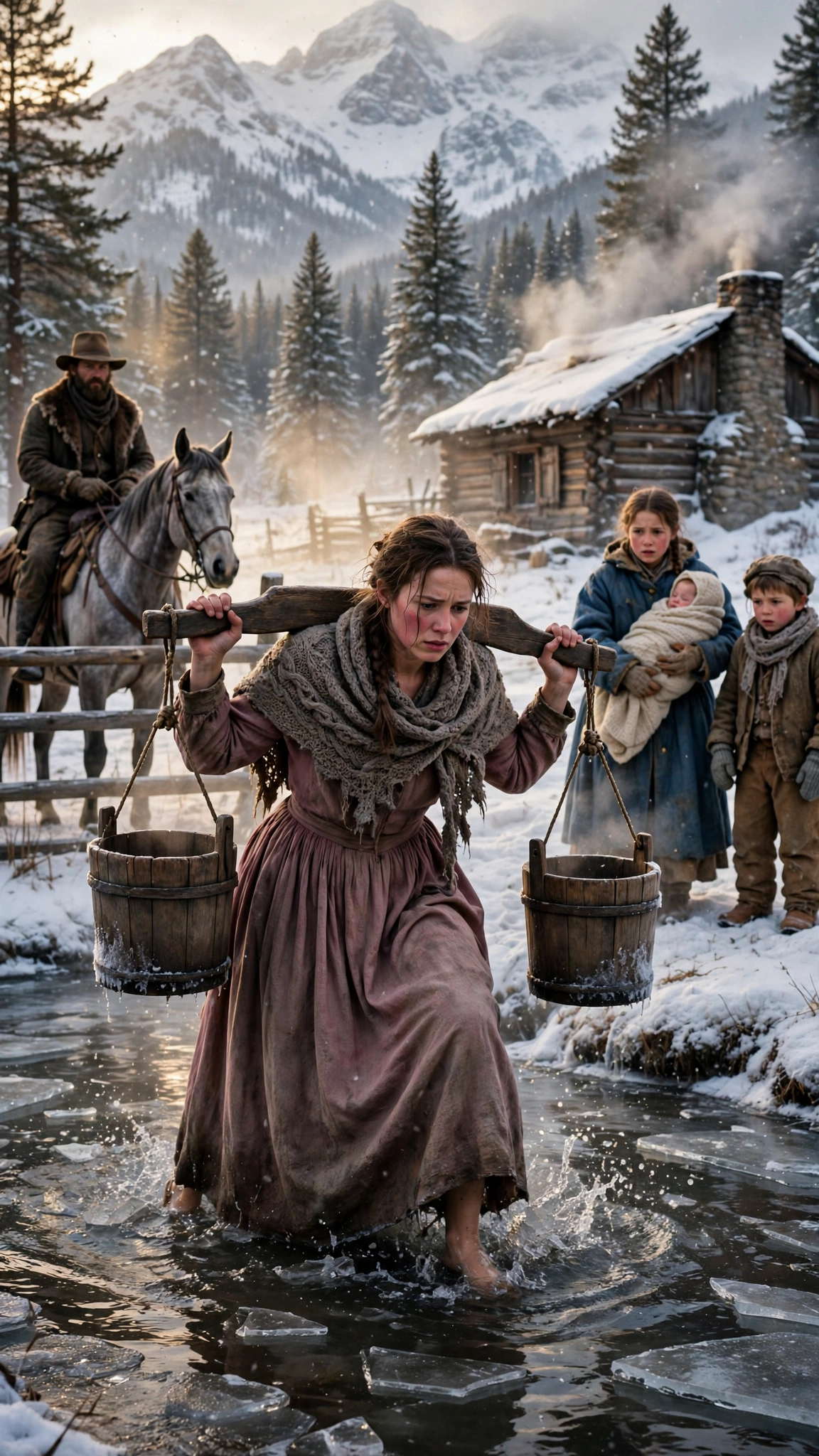
Jonas Reed had not meant to stop at the cabin.
He had meant to ride straight through to Helena, the way he did twice a month, with his list in his coat pocket and his horse moving steady under him and his mind on his own business. He had a ranch to run and cattle to feed and a house that had been empty for seven years, and he had learned, in those seven years, that a man got through life best by minding his own road and not stopping at other people's trouble. Other people's trouble had a way of becoming your trouble, and he had trouble enough of his own.
But the footprints had stopped him.
He had seen them from the saddle — a trail of bare prints in the snow, leading down from the cabin to the creek, small and narrow, a woman's feet, and the faint red stain at the heel of each one. He had ridden this valley for fifteen years, and he had seen a great deal of hardship in it, but he had never seen a woman walk barefoot to a frozen creek in January. And so he had reined in his horse, and he had watched, and he had gotten down from the saddle, and he had knelt in the snow beside a footprint, and now he was standing in front of a barefoot widow with a yoke across her shoulders, and she had just told him she sold her boots for medicine, and his hand was halfway to his saddlebag, and he did not know what to do next.
He knew what was in the saddlebag. That was the trouble.
In the saddlebag, wrapped in oilcloth, was a leather medicine case — quinine, willow-bark tincture, and a vial of Dr. Hollis's fever drops — that he had picked up in Helena the day before, on his way out of town, for the O'Rourke place twelve miles north, where a ranch hand's little girl lay burning with the same fever that was burning in the baby in the blue-coated girl's arms. He had promised the O'Rourkes he would bring it. He had given his word. And a man's word, out here, was the only currency that mattered.
But the baby in the girl's arms was coughing — a small, wet, rattling cough that Jonas had heard before, and knew the sound of, and had not forgotten in seven years.
He stood there with his hand on the saddlebag and the widow watching him, and he thought about Sarah.
Sarah Reed had been twenty-six when the fever took her, and their son — born three days before, small and red and perfect — had followed her two days later, and Jonas had buried them both on the same gray afternoon in February of 1876, in the little plot behind the ranch house on Cottonwood Creek, and he had ridden home from the burying and walked into a house that was suddenly too big and too quiet, and he had not known how to live in it since.
He had tried. He had worked. He had built the herd up from forty head to four hundred, and he had hired hands and paid them fair and kept the roof sound and the fences mended, and he had become, in the valley's estimation, a solid man. A man you could count on. A man who kept his word.
But the house stayed empty. He ate alone at a table built for a family. He slept alone in a bed built for two. He had stopped going to church in Helena because the hymns made him think of Sarah's voice, and he had stopped taking the road past the schoolhouse because the sound of children made him think of the son he had never gotten to name.
He had not spoken to a child in years. He had not held a baby in seven years. And now here was a baby, feverish and weak in a blue-coated girl's arms, coughing the same cough, and a widow standing barefoot in the snow, and his hand on a saddlebag full of medicine that he had promised to someone else.
Addie watched him, and she did not know any of this. What she saw was a big man in a leather coat with a beard going gray at the chin, standing beside a gray horse, with his hand frozen halfway to his saddlebag and an expression on his face that she could not read. She had seen that expression before, on Bane's face in her doorway — the look of a man doing arithmetic. She braced herself for the sum.
"How long has the baby been feverish?" Jonas asked.
It was not the question she had expected. She had expected questions about the debt, or the cabin, or the boots. She had expected him to ask how much she owed, and to whom, the way every man in the valley eventually asked.
"Three weeks," she said. "It comes and goes. Dr. Hollis says it is the lungs. He gave me drops, but the bottle is empty, and the drops cost more than I have."
"Dr. Hollis," Jonas said. "From Helena."
"Yes, sir."
Jonas nodded, slowly, and his hand finished its journey to the saddlebag. He unbuckled the flap and drew out the oilcloth bundle, and he unwrapped it right there in the snow, and Addie saw the leather case inside, and the little brown bottles nestled in it, and her breath caught in her throat.
"I was carrying this to the O'Rourke place," he said. "Their little girl has the same fever. But the O'Rourkes have a roof and a fire and a mother with boots on her feet. You have none of those things." He paused, and his voice dropped. "I will ride on to the O'Rourkes after, and tell them the truth, and bring them more from town tomorrow. A day will not kill their girl. But a day might kill yours."
He knelt in the snow — a big man, folding himself down with effort — and he opened the case and took out the vial of fever drops, and he held it up, and Clara came forward with the baby, and Jonas put two drops on his fingertip and touched them to Anna's lips, gently, the way a man touches something breakable.
Anna coughed, and swallowed, and her small face screwed up at the bitterness, and then she sighed, and her breathing eased, just a little, and Clara looked at Jonas with an expression that Addie had not seen on her daughter's face in two months — something like hope, trying very hard not to be hope.
"She needs a warm room and clean water and these drops every four hours," Jonas said, closing the case and pressing it into Addie's hands. "And she needs her mother to have boots on her feet, because a mother who freezes to death in a creek is no use to any child."
Addie held the medicine case as if it might vanish. "I cannot pay you, sir. I have nothing. I have three dollars and eleven cents, and a cow, and six hens."
"I am not asking you to pay me," Jonas said.
"Then why?" Addie asked, and the question came out sharper than she meant it to, because in her experience, men did not give things for nothing, and when they seemed to, there was always a price that came due later, and the price was always worse than the gift.
Jonas looked at her for a long moment, and then he looked at the cabin, and then at the children, and then at the pine cross on the rise behind the house, and his face did something complicated that Addie could not follow.
"Because I once stood where you are standing," he said, finally, "and no one stopped."
He did not explain. He rose to his feet and brushed the snow from his knees, and he looked at the paper nailed to the doorpost — Bane's notice, its edges curling in the cold — and he read it without asking permission, because a man who has just handed you medicine has earned the right to read your door.
"One hundred and forty-seven dollars and thirty-two cents," he said, quietly. "By Friday."
"Yes, sir."
"And if you do not pay?"
"Mr. Bane takes the cabin and the land," Addie said. Her voice was steady, which surprised her. "And the county takes the children to the Sisters in Helena."
Jonas was quiet for a long time. The horse stamped, and the wind moved through the pines, and Anna coughed again, softer this time.
"How much did your husband borrow?" he asked.
"Ninety dollars," Addie said. "In the spring. For seed and a plow share and flour."
Jonas nodded, slowly, the way a man nods when a number does not add up. "Ninety dollars," he repeated. "And now it is a hundred and forty-seven."
"Mr. Bane showed me the ledger," Addie said. "Interest, and fees, and the doctor's bill."
"A ledger can show anything a man wants it to show," Jonas said. "I am going to Helena tomorrow. I will look at the mortgage myself, at the county clerk's office. A mortgage is a public record, ma'am. Any man can read it."
"You would do that?" Addie asked. "For strangers?"
"I would do it for the baby," Jonas said. "And for the girl holding her, and the boy hiding behind her. And for you, ma'am, because you walked into a frozen creek barefoot rather than let your children go thirsty, and that is a kind of courage I have not seen in a long time."
He swung himself up into the saddle, and Smoke shifted beneath him, and Jonas looked down at Addie from the height of the horse, and for the first time since he had arrived, he smiled — a small, tired, honest smile.
"Keep the baby warm," he said. "Give her the drops every four hours, two drops, no more. I will be back the day after tomorrow, and I will tell you what the clerk's book says."
"Mr.—" Addie began, and then stopped, because she did not know his name.
"Reed," he said. "Jonas Reed. Cottonwood Creek, twelve miles north. If you need me before then, send the girl. She has her father's boots and her mother's spine, and she will make the walk."
He touched his hat, and turned Smoke toward the road, and rode away through the blowing snow, and Addie stood in her yard with a leather medicine case in her hands and her bare feet going numb in the snow, and watched him until he was gone.
That night, after the children were asleep — Clara curled around Anna in the bed, Peter tucked against Clara's back, all three of them under every blanket the cabin owned — Addie sat by the fire with the medicine case open on her lap, and she gave Anna her drops, and she watched the baby's breathing ease, and she thought about Jonas Reed.
She thought about the way he had knelt in the snow beside her footprint. She thought about the way he had touched the fever drops to Anna's lips, gently, as if the baby were made of glass. She thought about what he had said — because I once stood where you are standing, and no one stopped — and she wondered what kind of loss could make a man's voice go flat and far away like that.
She did not trust him. She had no reason to trust him. Bane had been kind, too, in his way, and Bane's kindness had a price tag nailed to her door.
But she had the medicine, and Anna was breathing easier, and for the first time in two months, Addie Marsh went to sleep without counting the days until Friday.
That night the fire burned lower than usual, because the woodpile was buried under snow and Addie had not wanted to wake the children by going out for more. She sat beside the hearth with Anna in her arms and listened to the wind move around the cabin and the creek running under its skin of ice, and she thought about the boots she had sold and the road to Helena and the way Jonas Reed had knelt in the snow beside her footprint, as if a footprint were a thing worth kneeling for. Clara slept curled around Peter in the bed, and the baby's breathing was steady and deep, and for a little while Addie let herself imagine a different kind of winter, one in which a knock at the door meant a neighbor and not a notice, and in which Friday was only a day of the week.
She counted them anyway, in her dreams. Three days. Three days until the wagon came up the road.
She woke before dawn, as always, and gave Anna her drops, and built up the fire, and looked out the window at the road to Helena, and waited for a man she had known for less than an hour to keep a promise he had no reason to keep.