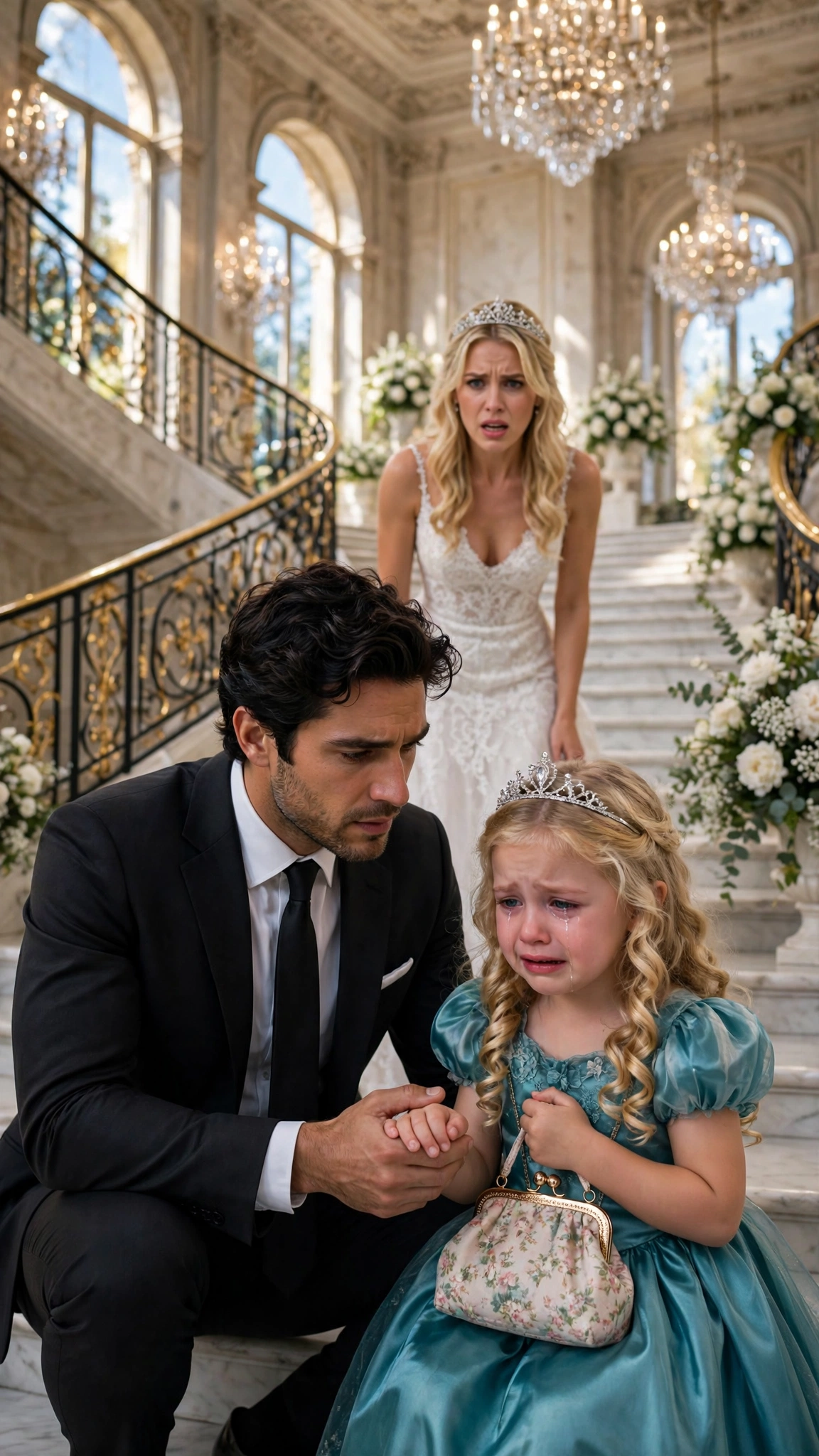
The grand staircase hall of the Moretti mansion was full of daylight. It poured through the tall arched windows in wide white bars, it shone on the white marble stairs, it caught the gold in the black railings and the crystal of the chandeliers, and it made the white flower arrangements along the balustrade look as if they were glowing. It was the morning of the rehearsal, two days before the wedding, and the house was dressed for a celebration.
Lily Moretti stood at the foot of the stairs and cried.
She was five years old, and she wore her teal satin princess dress with the puffed sleeves and the layered tulle skirt, and her cream shoes, and on her head, bright against her long blonde curls, sat a small silver tiara. She clutched a little floral handbag to her chest with both hands — a small purse printed with pink roses, its gold clasp held tight under her fingers — and tears ran down her cheeks, and her whole small body shook with the effort of not wailing out loud.
"Daddy, don't let her throw me out!"
Her voice cracked on the last word, and it echoed up the marble stairs, and the wedding planner, a thin woman with a clipboard, froze halfway up the steps. The florist, arranging white roses by the newel post, stopped with her hands full of stems. Everyone in the great hall stopped, because a five-year-old girl was crying in the middle of a wedding rehearsal, and everyone knew, in the wordless way people know such things, that something had gone very wrong.
Daniel Moretti came down the stairs toward her.
He was a tall man, a broad man, a man other men stepped aside for in restaurants and boardrooms, and he moved fast, his black suit sharp against the white marble, his black tie neat, his white pocket square catching the light. His dark wavy hair was combed back. His gray-brown eyes were fixed on his daughter. He reached her in six strides, and he crouched down to her height, and he put one hand on her shoulder, and with the other he gently wiped the tears from her cheek with his thumb.
"Lily," he said quietly. "Sweetheart. What are you talking about?"
On the stairs behind them, Victoria stood very still in her wedding gown. The white lace caught the daylight. The thin straps showed her bare shoulders. Her blonde hair was swept up, a small tiara glittering in it, and her face — her beautiful, composed face — was pale. She did not move toward them. She did not speak. She simply watched, and her stillness was its own kind of answer.
Daniel looked up at her. "Victoria, what did you say to her?"
Victoria's hands tightened on the railing. "She's making a scene, Daniel."
Daniel turned back to Lily. He took her small hand in his, and he held it, and his voice went soft, the way it only ever went soft for her. "Nobody is sending you away, sweetheart."
Lily's fingers tightened around his. She pressed the floral handbag closer to her chest, as if it were the only solid thing in the world, and she looked up at him with her blue eyes wide and wet, and she whispered, "She said I have to go away. She said when you marry her, I won't be your little girl anymore."
Daniel's whole body went still in the way it went still before he made a decision that would change a man's life.
And then he noticed the bag.
He had seen it a hundred times — the little floral purse, always in Lily's hands, always clutched tight — but he had never really looked at it. He looked at it now. He looked at the way her small fingers were wrapped around the gold clasp, white-knuckled, desperate, the way a person holds on to something they are afraid of losing. And he looked at Victoria, standing on the stairs, her eyes fixed not on Lily's face but on the little floral bag in Lily's hands.
"Why does she want your bag?" Daniel asked.
Victoria came down two steps. Her voice was sharp. "Daniel, don't open it!"
Daniel looked at her. He looked at the bag. He looked at his daughter, crying, clutching her mother's purse to her chest, and he said, very quietly, "Lily, show Daddy what's inside."
Lily's small fingers moved toward the gold clasp. Victoria took another step down, her gown rustling, her hand reaching out, her voice rising.
"Please, don't—"
And then — because this is where the story truly begins, two years before that bright morning, in a house that had forgotten how to be warm — let us go back.
Two years earlier, the Moretti mansion had been a different house. It was the same marble and the same chandeliers, the same grand staircase and the same tall windows, but the air in it was different. Isabella Moretti was alive then, and where Isabella went, warmth followed. She was not a loud woman. She was a steady one. She sang while she folded laundry. She read to Lily in the nursery every night, her voice low and unhurried, one hand resting on the small curve of her daughter's back. She had a way of standing in a doorway and making the whole room feel like it had been waiting for her.
Daniel had loved her for eleven years, since the night she had walked into a charity gala in a borrowed dress and told him, to his face, that he was the most feared man in Chicago and the worst dancer she had ever seen. He had married her six months later. He had never once regretted it. In a life built on fear and leverage and men who obeyed him because they were afraid not to, Isabella had been the one person who obeyed no one, and loved him anyway.
When Lily was born, Isabella wept and laughed at the same time, and Daniel — Daniel Moretti, who had never once cried in front of another living soul — had stood at the hospital window with his forehead pressed to the glass and cried like a boy.
Lily was three when Isabella got sick. It was not dramatic at first. A tiredness that would not lift. A cough that came back. A doctor's appointment, then another, then a hospital room with white walls and a window that looked out over a parking lot, and Isabella holding Lily's hand and telling her that Mommy was going to sleep for a little while, and that Daddy would take very good care of her.
Isabella died on a Tuesday in October, while the rain was coming down outside in thin gray sheets. Lily was asleep in the nursery, her small fist curled around the stuffed rabbit her mother had sewn for her. Daniel sat beside the hospital bed long after the machines had gone quiet, holding his wife's hand, and when the nurse came to tell him it was time, he said, "Five more minutes," in a voice that did not sound like his own.
He buried her on a Friday. The funeral was large and quiet and full of men in dark suits who did not know what to say to a grieving mafia boss. Lily wore a black dress that was too big for her, and she held her father's hand the whole time, because there was no one else to hold it, and her father could not stop shaking long enough to hold it himself.
After that, the house went cold. Not all at once. Cold came into the Moretti mansion the way winter comes into a house with a broken window — slowly, and then all at once, and then it was simply the way things were.
Daniel threw himself into work. It was the only thing he knew how to do with grief. He left before Lily woke and came home after she slept, and in between there were meetings and phone calls and men in suits who needed decisions. He told himself he was providing. He told himself Lily was safe, that the nannies would take care of her, that a little girl of three, then four, then five, did not need her father to sit on the floor and play with dolls. He told himself these things because the alternative was to sit in the nursery and look at the empty rocking chair where Isabella used to read, and he could not do that. He could face any man in Chicago. He could not face that chair.
The nannies came and went. They were kind women, most of them, but they were not Isabella, and Lily knew it, and after the third one left, Lily stopped learning their names. She learned instead to take care of herself, in the small ways a little girl can. She learned to pour her own cereal. She learned to tie her own shoes, badly. She learned to carry her mother's things with her, because her mother's things were the only warm things left in the house.
The floral handbag had been Isabella's. It was a small purse, printed with pink roses, its gold clasp worn smooth from years of use, and Isabella had carried it to church every Sunday. After she died, Lily found it in her mother's closet, and she took it, and she never put it down. She carried it to breakfast. She carried it to the garden. She carried it to bed, and she put it on the pillow beside her, and she slept with one hand on its clasp, as if it were her mother's hand, still holding hers.
The silver tiara had been Isabella's too. She had worn it on her wedding day, a delicate thing, bright as frost, and afterward she had kept it in a velvet box in her drawer. Lily found the box one afternoon, and she opened it, and she lifted the tiara out with both hands, and she set it on her own head, and she stood in front of her mother's mirror, and she looked at herself — a small girl in a big house, wearing her mother's crown — and she whispered, "I'm a princess, Mommy. Like you."
She kept the tiara in the velvet box after that, taking it out only on special days, on days when she needed to feel brave. She did not know, then, that she would wear it to a wedding rehearsal, on the brightest morning of her life, while she cried at the foot of the grand staircase.
And the stuffed rabbit — the one her mother had sewn for her, with the crooked ear and the button eyes — stayed in the nursery, on her bed, waiting for her every night. It was the one thing she did not carry with her. The rabbit stayed home, and guarded the nursery, and waited. That was the rule Lily had made for herself, in the wordless way children make rules: the rabbit guards the room, the purse guards me, and the tiara makes me brave.
Lily was a quiet child. She learned to play alone, to eat without spilling, to go to bed without fuss, to never ask her father for anything he could not give. She drew pictures of her family — a tall man, a small girl, and a woman with wings, drawn in yellow crayon — and she taped them to the nursery wall where only she could see them. She waited for her father to come home, and when he did, she ran to him, and he picked her up, and for a moment the house was warm again, and then he set her down and went to his study, and the cold came back.
She was five when Victoria arrived.
It was a charity gala, the same kind of gala where Daniel had met Isabella eleven years before, and Victoria was standing near the champagne table in a white dress, beautiful and composed and entirely unafraid of him. She was twenty-nine, elegant, with blonde hair swept up and a smile like a door opening, and she looked at Daniel Moretti the way a woman looks at a door she has decided to open.
"Mr. Moretti," she said. "I've heard a great deal about you."
"Most of it is true," Daniel said.
"Then you must be very tired," Victoria said, "of being feared by everyone except the people you love."
He laughed. He had not laughed at a gala in two years. She asked about Lily, and he told her about his daughter — the quiet girl with the blonde curls and the silver tiara and the little floral bag — and Victoria listened with her head tilted, her eyes warm, and said, "A little girl should not be quiet. A little girl should be loud. She should be impossible."
Daniel took her to dinner the following week. Then again. She was charming. She was patient. She asked after Lily every time, and she sent the little girl a picture book about a brave princess, and a music box that played a lullaby, and Lily — who had not received a gift from a stranger since her mother died — carried the music box everywhere for a week.
Victoria came to the house for the first time on a Sunday afternoon in spring. Lily hid behind the staircase railing and peeked out at the beautiful woman in the white blouse and the pearl earrings.
"Hello, Lily," Victoria said, crouching down, smiling. "I'm Victoria. Your daddy talks about you all the time."
Lily said nothing. She clutched her floral handbag.
"She's shy," Daniel said gently.
"Shy is fine," Victoria said, and she reached out and touched Lily's cheek with one cool fingertip. "Shy girls grow up to be interesting women."
That night, Daniel sat on the edge of Lily's bed — something he had not done in months — and said, "What did you think of Victoria?"
Lily looked at her music box. "She is very pretty, Daddy."
"She likes you very much."
Lily nodded. She did not say what she was thinking, which was that Victoria's fingertip had been cold, and that her smile had not reached her eyes, and that when Victoria had touched her cheek, Lily had wanted to hide. She did not say it because she was five, and because she had learned to be quiet, and because her father looked happy for the first time in two years, and she did not want to take that away from him.
So she smiled. "I like her too, Daddy."
And Daniel, who could read a lie on a man's face from across a room, believed his daughter — because he wanted to, because he needed to, because the house had been cold for so long and Victoria was warm, or seemed warm, and he had forgotten what it felt like to want something for himself.
He proposed to Victoria six months later, on a rooftop in Manhattan, with a diamond solitaire so large it caught the light from three tables away. She said yes. She cried. She kissed him. She began planning the wedding the next morning — the flowers, the white roses, the guest list, the gown. And Lily, standing in the doorway of the nursery with her music box in her hands and her mother's floral handbag on her arm, watched her father's fiancée measure the windows for new curtains and understood, in the wordless way that children understand, that something in her house was about to change, and that she was not going to like it.
She was right. She simply did not know how right she was.
The morning of the rehearsal was two days before the wedding. The grand staircase hall was full of daylight. The white marble stairs shone. The black-and-gold railings gleamed. The chandeliers threw small rainbows across the ceiling. Victoria stood on the stairs in her wedding gown, radiant, composed, every inch the bride. Daniel stood near the foot of the stairs, handsome in his black suit, his black tie neat, his silver wristwatch catching the light. And Lily stood in the center of it all, in her teal princess dress, her silver tiara bright in her blonde curls, her mother's floral handbag clutched to her chest, and she said the words she had practiced a hundred times in her bedroom mirror.
"Daddy, don't let her throw me out!"
And Daniel Moretti — the most feared man in Chicago, the man who had buried his wife and raised his daughter alone and let a beautiful stranger into his house because he was tired of being cold — looked down at his little girl, and for the first time in two years, he truly saw her.
Her eyes were wide. Her cheeks were wet. Her lower lip trembled. And behind the fear, behind the tears she was not trying to hide, there was something else. Something he recognized, because he had seen it in his own mirror a thousand times.
It was the look of a person who has been hurt, and who has decided, finally, to tell the truth.