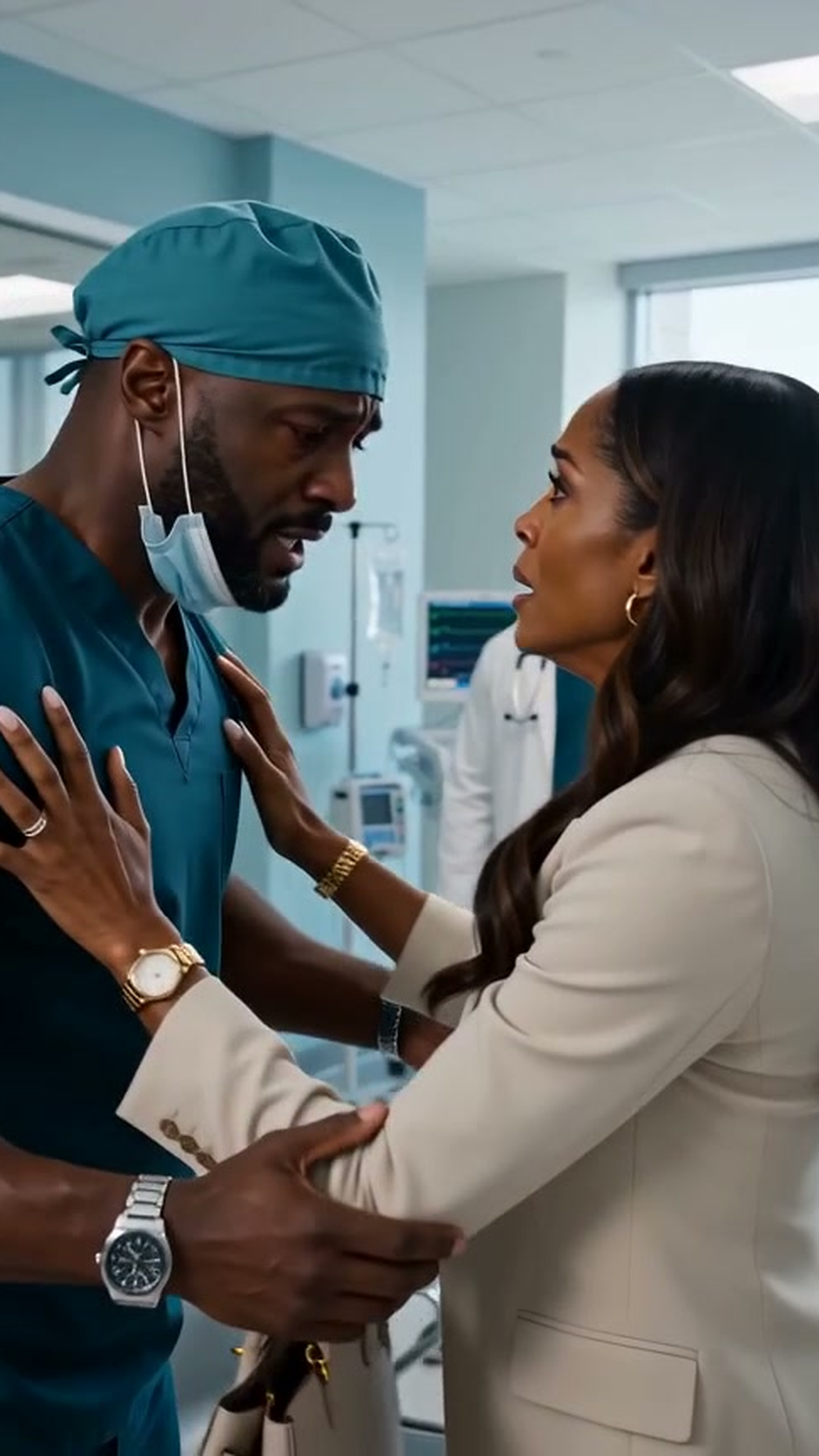
Naomi Bennett had rehearsed her smile all the way up in the elevator.
It was a good smile. It was the smile of a woman who had been married for eleven years and still, on an ordinary Thursday, packed her husband's favorite lunch — turkey on rye with the crusts left on because Marcus pretended not to care and absolutely cared, a bag of kettle chips, a slice of apple pie from the bakery on Ellison Street — and drove across town just to watch his face when he saw her standing there.
She had folded a note into the bag that morning, her handwriting slanted with tenderness: *You don't have to take care of everyone. Let me have a turn.*
The elevator doors opened onto the fourth floor of St. Aurelia General Hospital, and Naomi stepped out into the bright corridor with the brown paper bag swinging gently from her fingers, her cream handbag on her arm, her heels clicking softly on the polished floor.
She got exactly six steps.
A man in a white physician's coat stepped directly into her path.
It was David Carter. She knew David. David had eaten Christmas dinner at their table for nine years running. David had danced — badly, gloriously — at their wedding. David, who had never once in eleven years looked at her the way he was looking at her now.
His eyes were wet.
Not damp. Not tired. Wet, the way a man's eyes look when he has been holding something back for a very long time and his body has simply stopped obeying him.
Naomi stopped so abruptly that the lunch bag swung forward against her hip.
"David?" she said, and her smile was still there, confused, trying to survive. "What — is everything okay?"
David glanced toward the surgical corridor — a quick, frightened flick of his eyes — and when he looked back at her, his voice came out in a trembling whisper that she would hear in her sleep for the rest of her life.
"He hasn't told you anything, has he?"
Somewhere far down the hallway, a medical trolley struck a doorframe with a sharp metallic crash. Naomi flinched so hard the bag crumpled in her tightening fingers.
"What?" she said. "Told me what? David — told me *what*?"
But David didn't answer. He was looking past her now, and she turned and saw the two nurses at the station behind her, and understood, with a coldness that started in her stomach and climbed, that something was terribly wrong — because the nurses had gone completely silent, and when Naomi's eyes found theirs, both women looked down at their charts at the exact same moment, like children caught staring at an accident.
The whole floor knew something.
The whole floor was looking at her the way people look at the last person in the room to hear bad news.
"Where is Marcus?" Her voice came out higher than she intended. "Where is my husband?"
David reached toward her arm — then hesitated, his hand hovering, and she saw the hesitation and it terrified her more than the tears had. She pushed past him toward the surgical corridor, her heels suddenly too loud, her breathing going shallow and wrong, and a wheeled trolley burst through a swinging door directly into her path.
David caught her forearm. Caught it hard, instinctively, and yanked her back a half-step as the trolley rattled past close enough to stir the fabric of her skirt.
Her handbag swung against her hip.
And the lunch bag — the turkey on rye, the chips, the apple pie she had bought still warm that morning — slipped from her other hand.
It hit the polished floor with a soft, terrible finality. The pie container burst open and slid across the tile. The folded note — her note, her loving little joke of a note — skidded out and came to rest face-up beside a nurse's shoe.
*You don't have to take care of everyone. Let me have a turn.*
"What happened to him?" Naomi heard her own voice shaking. "David. What happened to Marcus?"
He let go of her arm like it burned him.
She didn't wait for an answer. She was already moving, past the station, past the nurses who would not meet her eyes, around the corner into the adjoining waiting corridor —
And there he was.
Marcus Bennett. Her husband. The man who had held her hand through her mother's funeral and laughed until he cried at her terrible karaoke and never — not once in eleven years — let her see him afraid.
He was sitting on a stainless-steel chair against the wall, still in his dark teal scrubs, his surgical cap on, his mask hanging beneath his chin. He was bent forward with one hand gripping his forehead, and his broad shoulders — shoulders that had carried their whole life without complaint — were trembling.
"Marcus?" It came out barely audible.
He lifted his head.
And Naomi watched her husband's face do something she had never seen it do. It did not light up. It did not soften. It collapsed — into guilt, into dread, into the expression of a man who has been rehearsing a moment for weeks and has just realized the moment has arrived before he was ready.
He wasn't surprised to see her.
He was terrified.
"Why didn't you tell me?" The words tore out of her as she crossed the floor. "Marcus — why didn't you tell me?"
He pushed himself upright so fast the metal chair scraped screaming across the tile, and he swayed — actually swayed, this man with surgeon's hands and a linebacker's build — and she caught him without thinking, both hands flying to his chest, and he caught her hand and held it there against his scrubs, over his racing heart, and for one second their eyes met and she saw six weeks of something enormous looking back at her.
Then David's voice, quiet, from behind her:
"Marcus. She deserves to know."
Marcus's jaw tightened. His eyes pleaded with David over her shoulder — a silent, desperate plea. Her handbag bumped the metal chair with a sharp crack of sound and everyone froze, and Naomi's hand flew to her mouth, and the tears came, and she watched her husband — her honest, steady, tell-me-everything husband — open his mouth to confess.
"Tell me the truth," she whispered.
Marcus swallowed. Looked at David. Looked back into her eyes. His voice broke on the first word.
"Honey… there's something I—"
★ ★ ★
SIX WEEKS EARLIER
The night Marcus Bennett came home at 2:47 in the morning, Naomi knew — in the wordless way wives know, the way you know weather in a scar — that something had happened that he was not going to tell her.
She heard the front door. Not the slam of it. The care of it. Marcus had always come home from late surgeries a little careless — keys dropped in the bowl, shoes kicked off, the refrigerator opened and shut. That night he eased the door closed like the house was a church and he was late to prayer.
She lay still in the dark and listened to him move through the kitchen. The tap ran for a long time. A cabinet opened. A glass. Then nothing. No refrigerator. No stairs.
After twenty minutes, she got up.
He was sitting at the kitchen table in his scrubs, in the dark, with a glass of water he hadn't drunk, staring at the backs of his own hands as if they belonged to a stranger he was trying to decide whether to forgive.
"Marcus?"
He looked up, and he smiled — and that was the moment, later, she would point to. Not the tears six weeks afterward in a hospital corridor. That smile. Because it was perfect, seamless, professional, and it was a lie, and some ancient instrument in her chest registered it the way a seismograph registers a tremor miles below the street.
"Hey, baby." His voice was steady. Too steady, the way a held note is steady. "Didn't mean to wake you. Long case."
"Did you lose someone?" she asked. Surgeons' wives learn to ask it plainly. She had asked it maybe a dozen times in eleven years, and he always answered plainly. *Yes. No. It was close.*
This time there was a pause — one second, perhaps two — that had never been there before.
"No," he said. "Nothing like that. Just long. Go back to bed, sweetheart. I'll be up in a minute."
She went back to bed, because she trusted him the way she trusted her own name, and because everyone is allowed one strange night.
He did not come up in a minute. When she finally fell asleep near dawn, his side of the bed was still empty, and in the morning the glass of water sat on the kitchen table exactly where he had left it — untouched, gone warm, with his wedding ring beside it, which he took off only for surgery and always, always put back on.
She made eggs she didn't eat. She set two plates out of eleven years of habit and then stood looking at the second plate until the toast went cold. At six-forty she heard the shower shut off upstairs, and then the particular, careful silence of a man dressing quietly so as not to wake a woman he believed was asleep — and something about that tenderness, aimed at a version of her that didn't exist, undid her more than shouting would have.
He came down in fresh scrubs with his hair still damp, and he stopped in the kitchen doorway, and she watched him do the math of the two plates and the cold toast and her face, and arrive, competently and incorrectly, at the belief that he could fix it with effort.
"Hey," he said. "You didn't have to get up."
"Couldn't sleep." She poured his coffee the way he liked it, because her hands needed a liturgy. "What time did you get in?"
"Around two." A beat — small, but she had been married to this man's silences for eleven years and could read them the way nurses read monitors. "Case ran long. I'm sorry I didn't call. Phone died in the OR and then it was just — one thing after another."
Every word of it was plausible. Every word of it was the sort of thing that had been true a hundred times. That was what made the cold move through her then — not that he was lying, she would not let herself use the word yet, but that she could no longer tell, and that she, Naomi, who had once been able to finish his sentences and predict his surgical schedule from the set of his shoulders at breakfast, had apparently lost the ability to tell whether her own husband was lying to her before coffee.
He kissed her forehead at the door. It was their ritual — forehead, not lips, on surgery mornings, because of some long-ago joke about coffee breath and sterile fields — and he held it a fraction longer than usual, and she understood, without understanding anything, that he was not kissing her good morning. He was kissing something goodbye, or bracing it. She stood in the doorway in her robe and watched the car back out into the gray early street, and she did not wave, and he did not look back, which he always did. Always. Eleven years of always, ended on a Wednesday in the rain-season dark, over a glass of water and a ring.
The ring was still there at seven the next morning when she came down to make coffee.
And Naomi Bennett stood in her bright kitchen, looking at her husband's wedding ring sitting beside a glass of water he had never drunk, and felt the first cold finger of the thing that would spend the next six weeks eating her marriage alive — and she picked up the ring, and held it in her fist until it warmed, and told herself, out loud, to an empty room:
"It's nothing. It's one night. It's nothing."
She was wrong. It was the first night of all of them.