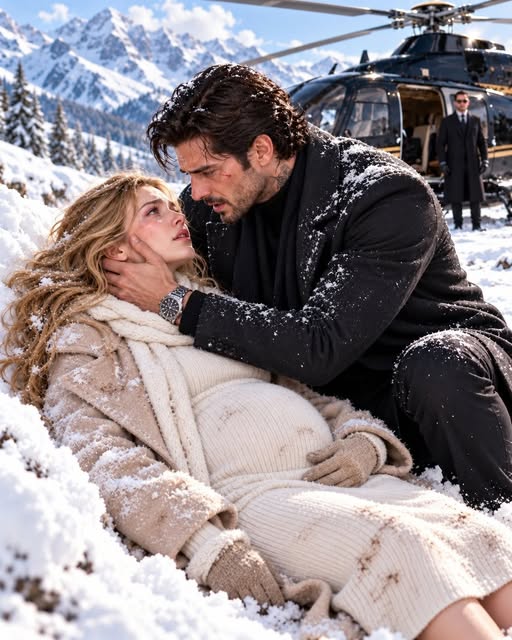
Rose arrived the way she had survived everything else: early, loudly, and entirely on her own terms.
My water broke at five in the morning on a Tuesday in May, three days before my due date, in the cottage kitchen, in the middle of making tea I would never drink. I stood in the sudden puddle with one hand on the counter and did the arithmetic — first babies are slow, the hospital is forty minutes, the pains were still ten minutes apart and lying about it — and then a contraction arrived that was not Braxton, not Hicks, not a rehearsal of anything, and I called the main house and said, "Kolya. It's time. Drive."
He was at the cottage door in four minutes with the car already running and the hospital bag — packed since April, by him, with a checklist — already in the back. He had also brought, I would learn later, a folder containing my birth plan, my insurance card, Dr. Almeida's private number, and a notarized statement authorizing him to make medical decisions if I could not, which I had signed in March and forgotten about, and which he unfolded at the admissions desk with the gravity of a man presenting a peace treaty.
"Stay," I said, when they wheeled me up and the pains were coming in earnest and the world had narrowed to a bright corridor. "You're the emergency contact. Apparently it's legally binding."
He stayed. Nikolai Sokolov, who had faced down syndicates and succession wars and a shotgun in a warehouse, stood at the head of my bed in a paper gown over his black shirt with his scarred jaw set and his tattooed hands held carefully where I could reach them, and he counted my breathing with me for six hours in a voice so steady that the midwife later asked if he had medical training. He had read three books. He had highlighted them. With tabs.
At 11:47 in the morning — I remember the clock, because nurses remember clocks — Rose Reynolds came into the world at six pounds eleven ounces with a full head of dark hair and a cry like a fire alarm, and the doctor put her on my chest, furious and slippery and perfect, and I said the thing I had said on the ledge, the first words she ever heard from me in the open air:
"Stay with me, baby. We got out."
Then they let him hold her, because I asked them to, and I watched a man who could break a door with his shoulder take six pounds eleven ounces of new human into hands that shook — actually shook, the Wolf of Brighton Beach, shaking — and look down at her with an expression I had seen exactly once before, in a photograph of my father holding a paper plate and somebody else's laughing toddler like the future was a thing you could be trusted with.
"She is so small," he whispered. "How is she so small, and the boss of everything already."
"She gets that from her grandfather," I said, and fell asleep smiling, which is a thing I recommend after being dead.
We brought her home to the cottage on the third day, to the little green room, where someone — Yuri, denying it to this day — had hung a framed photograph beside the crib: my father at the company picnic in 1994, holding a paper plate and a laughing toddler. Thomas Reynolds, standing guard in the room he'd paid for without ever knowing it. Megan camped in the front room again, this time on night-feed rotation, and on the second night I woke at three in the morning — that hour again, the hour when this family does its truest business — to find the nursery lit and Nikolai in the rocking chair with Rose against his chest in the crook of one tattooed arm, singing something low and tuneless in Russian, a song about a gray wolf, while she stared up at him with the total, drunken concentration of the newly arrived.
"She was doing the noise," he explained, with great dignity, not stopping the rocking. "The small noise. It means the blanket is wrong, or the world is wrong. I am eliminating variables."
"You're a natural," I said from the doorway, and meant every word, and went back to bed and slept like the dead never do — deeply, and without fear.
* * *
Michael's trial was in the fall, and it was short, the way avalanches are short.
Ashley testified for two days, in the gray suit, and never once looked at him. The drone footage played in a courtroom so quiet you could hear the heating system. I testified last, and I kept it to the facts, because Miriam had taught me that facts, properly arranged, are more frightening than any speech. I told them about the tea, and the tabs on the papers, and the argument, and the shove. I told them about the ledge. I told them about eleven seconds.
When the prosecutor asked if I had anything to add, I said, "He wasn't in a rage. I want the record to have that. He had done the math months before. I was a policy with a heartbeat, and my daughter was a clause. That's all I need the record to have."
The jury was out for four hours. I didn't wait at the courthouse — I was at a flower market with Rose asleep in her carrier against my chest, buying roses for the cottage table, when Megan's text came: GUILTY. ALL COUNTS. 28 YEARS. And I stood among the buckets of flowers with my daughter breathing on my heart and I cried for exactly one minute, out of pure relief, the way you cry when a fever breaks — and then I bought the roses, and an extra bunch for Eleanor, and I went home.
He will be seventy years old when they let him out. Rose will be twenty-seven. I think about that arithmetic sometimes, the way you think about weather in a country you no longer live in. It is finished. The figures have settled. My father was right: you can trust them, because they don't care about your feelings, and neither, in the end, did the law.
* * *
In the spring I went back to work — two shifts a week at the pediatric unit, because I had things to teach frightened children about stitches, and because a woman who has been dead should keep at least one foot in the land of the ordinary. My badge said S. REYNOLDS, RN, and the first day I clipped it on, in the locker room where Delia had once taught me to grieve and chart at the same time, I stood and looked at it for a full minute like it was a passport from a country I'd emigrated from and been readmitted to on compassionate grounds.
Eleanor visited in May, driven by her neighbor, screened by nobody — I had ended the lawyers on that subject in April, over Miriam's formal objection and Nikolai's raised eyebrow. She held her granddaughter on the cottage porch with the terrified reverence of a woman holding something she had nearly cost the world, and Rose, who had her mother's temper and her grandfather's chin, studied her great-grandmother for a long moment and then took hold of one of Eleanor's fingers and held on.
"She has a grip," Eleanor whispered, undone, delighted, grieving, all of it at once. "Oh, Sarah. She has such a grip."
"She comes by it honestly," I said. "On every side."
Michael had booked a ballroom in Aspen for the second Saturday in June, to marry the woman who helped him try to kill me.
We kept the date.
We changed everything else.
The wedding was in the garden of the estate, under the pines, with the mountains standing around like family. Forty people. Megan was my maid of honor and cried through the entire ceremony with the shamelessness of long practice. Yuri was his best man and wore a suit that made him look like a monument at a state funeral, and wept once, briefly, and denied it for the rest of his life. Miriam Kessler officiated — she had gotten ordained online for the purpose, she informed us, at a cost of forty dollars, and intended to expense it. Eleanor sent white roses with a card in a hand that shook: For the cottage table. Tell Rose her grandmother is proud of her mother. — E.
Nikolai had asked me in March, on the porch of the cottage, with Rose asleep inside and the snow coming off the mountains in long white banners. No ring hidden in food. No audience. A man on a porch, in the cold, saying it plainly, the way my father would have advised:
"I kept a promise about you for fifteen years, Sarah. It was a debt, and I paid it, and it is paid. What I am asking now is not a debt. I am asking to make a different promise — mine, chosen, every day on purpose. Marry me. Let me spend the ordinary years learning the fitted sheets."
I said yes before he finished, and then made him finish anyway, because the fitted sheets line had taken work and deserved an audience.
At the garden altar — which was really just the place where the lawn met the trees, with the light coming through — he took my hand, and the tattoos ran dark over his knuckles against my skin, and I thought of a ledge in a storm, and a harness buckled gently around a pregnant belly, and a stranger saying I finally found you into the teeth of the wind.
"I finally found you," he said again, in the vows, because he is a man who repeats what matters. "Fifteen years. A whole war. A mountain. I finally found you."
"You found us," I said. "And we're staying."
* * *
In October, when Rose was five months old and the aspens had turned to coins, I asked him to drive me up to the overlook.
He didn't argue. He never argues about the important things; he just goes quiet and gets the car. We drove the same switchbacks with the baby asleep in her seat and the sky going gold, and he parked at the same trailhead, and we walked the short path together — me in front, carrying my daughter against my chest in her wrap, his hand resting lightly at the small of my back, not holding. A roof, not a cage.
The railing had been repaired. The overlook had a new sign. The drop was the same drop — pine and rock and the river shining far below like a dropped ribbon — and I stood at the rail where my marriage had ended and my life had nearly ended, and I waited to feel the fear come up out of the ground into my legs.
It didn't come.
What came was the wind, and the smell of pine resin and cold stone, and my daughter's small hot weight against my heart, and a man's arm coming around us both — careful, enormous, tattooed, scarred — while the light went down over the whole enormous indifferent beautiful world.
"Good view," I said.
"The best I ever had," said Nikolai Sokolov, who had seen the world from a helicopter in a storm, "and I have been looking for it for a very long time."
A ranger came along the path while we stood there — young, sunburned, doing the evening sweep — and nodded at us the way you nod at any family watching a sunset, and asked if we'd seen the storm warning for the weekend. "We have," Nikolai said gravely, "an excellent relationship with storms." The ranger went on down the path none the wiser, and I leaned my whole weight against my husband's side, and felt his arm take it without comment, the way it had taken everything since the mountain: the grief, the paperwork, the fear, the pie.
Rose woke then, and looked out at the mountains with her grandfather's chin and her mother's temper and no fear at all, and I laughed — out loud, at the railing, in the wind, like a woman with nothing left to be taken from her — and the sound went out over the canyon and came back to me like something I had once dropped, and lost, and finally, finally found.