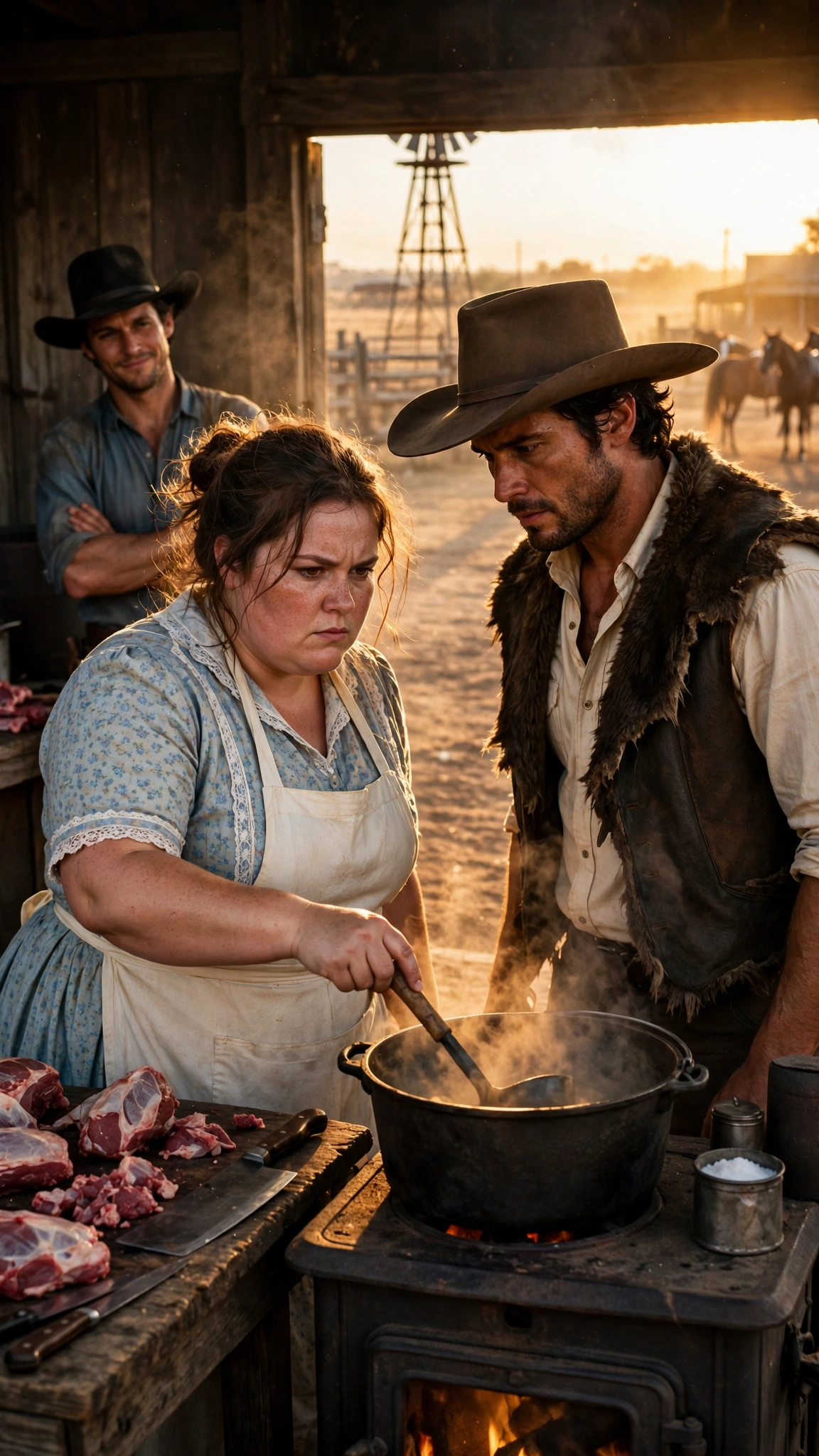
Wyatt Granger rode out of the Bar R at dawn, the way Caleb had told him to, and nobody watched him go except Caleb himself, who stood in the yard with his arms crossed until Wyatt was a speck on the horizon, and then a smaller speck, and then nothing at all.
The drive went out an hour later. Thirty men, a string of horses, a chuck wagon loaded with the food Abigail had saved from the fire — the bread, the coffee, the sugar, the salt, all packed in canvas sacks and tied down tight — and Caleb at the head of it, his brown hat pulled low against the morning sun, his fur vest dark against the pale sky. He did not look back. He did not wave. He rode out with his men, and Abigail stood in the yard with Martha beside her, and they watched until the dust of the drive had settled, and the prairie was empty again.
The ranch was quiet for ten days. Quieter than it had ever been. The bunkhouse stood empty. The pens stood empty. The cookhouse stood with its back wall burned away and its roof half gone, open to the sky, and Abigail worked in it anyway, because the work did not stop just because the men were gone. She cooked for herself and Martha. She mended the men's shirts that had been left behind. She rebuilt the back wall of the cookhouse with the help of old Pete, who had stayed behind because his leg was bad, and she laid the new boards herself, and she hammered the nails herself, and Pete said, "You swing a hammer like a man, Mrs. Thornton," and she said, "I swing a hammer like a woman who has a cookhouse to rebuild," and Pete laughed until he coughed, and then he helped her carry the boards, and they worked together until the wall was up and the roof was patched, and the cookhouse stood whole again.
On the third day, Hargrove came from the store with his ledger, and he sat at Abigail's kitchen table, and he showed her the numbers. Flour, coffee, salt, sugar — small amounts, every week, for months, all charged to the ranch account, all gone. And then he showed her the last page, where he had written, in his careful hand, "Settled in full — A. Thornton, by order of C. Reynolds." The forty-seven dollars was gone. The debt was wiped. Hargrove folded his hands on the table and said, "Mr. Reynolds paid it the morning after the fire, Mrs. Thornton. He said to tell you that a woman who carries ten days of food out of a burning cookhouse has earned more than a clean ledger. He said to tell you that."
Abigail sat at the table for a long time after Hargrove left, and she looked at the ledger page, and she thought about the number forty-seven, and about the months she had spent doing sums in her head in the dark, and about the way the number had followed her everywhere, and about the fact that it was gone now, wiped clean, because a man had decided that she was worth more than a debt.
On the fifth day, Martha's cough came back, and Abigail sat up with her through the night, and she made the bitter tea the doctor had prescribed, and she held the old woman's hand, and Martha said, in a voice thin as paper, "Girl. If that man comes back from the drive and asks you to stay, you say yes. Do you hear me? You say yes."
"Martha," Abigail said. "He has not asked me anything."
"He will," Martha said, and she closed her eyes, and she smiled, a small, tired smile. "I have lived on this ranch for forty years, and I know what a man looks like when he has found the thing he has been looking for. Caleb Reynolds has been looking for something for a long time, and he did not know what it was until you walked into his cookhouse at dawn with your mother's recipe book under your arm. So when he asks, you say yes. And you do not think about it first. You say yes, and then you think about it later, when you are already his wife."
Abigail laughed, and she cried a little, and she held Martha's hand until the old woman fell asleep, and then she went to the kitchen, and she made the tea, and she thought about what Martha had said, and she thought about Caleb, and about the way he had looked at her in the cookhouse on the night of the tasting, and about the way he had held her hand in the yard on the day of the silver dollar, and about the way he had said her name — Abigail, not Mrs. Thornton — on the night of the fire, and she thought about the fact that her heart beat faster when she thought about him, and that she had not expected it to, and that she was not sorry that it did.
On the tenth day, the drive came home.
Abigail heard them before she saw them — the sound of hooves, far off, and the lowing of cattle, and the men's voices, and the creak of the chuck wagon — and she went out into the yard with Martha, and they stood together in the late-afternoon sun, and the dust rose on the horizon, and the drive came in, tired and dirty and triumphant, and Caleb rode at the head of it, and he saw her standing in the yard, and he rode straight to her, and he got down from his horse, and he stood in front of her, and he took off his hat, and he held it in his hands, the way he had held it in his hands on the day he had brought Thomas's hat back to the cabin, a year ago, in another life.
"Abigail," he said. "I have been thinking about something for ten days, out on the trail, and I would like to say it now, before I lose my nerve."
She waited. The yard was quiet. The men were watching. Martha was watching. The windmill turned slow.
"I have run this ranch since my father died," Caleb said. "I have run it the way he ran it — hard, and cold, and alone. I thought that was the only way to run it. I thought a man who lets himself care about people is a man who will lose them. I thought that for a long time. And then you came into my cookhouse, and you stood across the table from me, and you looked me in the eye, and you said, 'Give me until sundown.' And I have not been able to think about anything else since."
He took a breath. "You saved my goats. You counted my stores. You carried ten days of food out of a burning cookhouse. You fed thirty men with nothing but goat meat and your mother's recipe, and you made them stand up and take off their hats for you. And I have spent ten days on the trail trying to think of a reason why I should not ask you what I am about to ask you, and I cannot think of one."
He looked at her, and his eyes were not cold, and they were not mocking, and they were not suspicious. They were the eyes of a man who had finally found the thing he had been looking for, and who was afraid, for the first time in his life, of losing it.
"Abigail Thornton," he said. "Will you stay on the Bar R — as my cook, and as my wife?"
The yard was silent. The men held their breath. Martha held her breath. The windmill turned. And Abigail Thornton looked at Caleb Reynolds — at the brown hat in his hands, at the fur vest, at the scarred hands, at the face that had mocked her and doubted her and defended her and believed her — and she thought about Thomas, and about the grave on the hill, and about the wooden cross with the words "He came home hungry," and she thought about her mother, standing on a stool in a kitchen in San Antonio, saying, "If it is made with care, it is enough."
And she said, "Yes."
She said it the way Martha had told her to say it — without thinking about it first, without weighing it, without counting the cost — and then she thought about it later, when she was already his wife, and she found that she did not regret it for a single moment.
The wedding was held in the yard of the Bar R, on a Sunday afternoon in June, with the sun low and the dust turned to gold, and the whole ranch came — thirty cowboys, washed and shaved and wearing their cleanest shirts, and Hargrove from the store, and the doctor from town, and the preacher from the little church by the rail line. Martha sat in the front row in her best dress, with a shawl over her shoulders, and she cried through the whole of it, and she told everybody afterward that they were happy tears, and nobody doubted her.
Abigail wore her light-blue floral dress, with the white lace at the collar that Martha had starched that morning, and her cream apron — because she had insisted on wearing the apron, and when Caleb had asked her why, she had said, "Because I am a cook, and a cook feeds people, and I am going to feed these people for the rest of my life, and I would like to begin as I mean to go on." And Caleb had laughed, and he had said, "Then wear the apron," and she had.
After the ceremony, they ate in the yard, at the long tables, under the open sky. And what they ate was goat stew — her mother's stew, ribs and shoulder braised slow with onions and dried chiles and cumin and wild garlic, with dumplings, and molasses beans, and skillet cornbread — served in the heavy cast-iron pot that Abigail had dragged out of the burning cookhouse, the pot that had survived the fire, the pot that had fed thirty men on the night of the tasting. And the men ate, and they asked for seconds, and they raised their tin cups, and Eli stood up, and he took off his hat, and he said, "To the cook of the Bar R — and to the woman who taught this ranch what a meal is supposed to taste like."
And Caleb Reynolds stood up beside his wife, and he lifted his cup, and he looked at her across the table, and he said, very quietly, so that only she could hear it, "Thank you for staying, Abigail."
And Abigail Thornton — Abigail Reynolds now — looked at him, and she smiled, and she said, "I was never going anywhere, Caleb. I was only waiting for you to notice."
The sun went down over the Bar R, and the dust in the yard turned to gold, and the windmill turned slow against a sky full of stars, and the cookhouse stood whole and warm behind them, and the smell of stew and cornbread drifted out across the prairie, and somewhere in the pens, a horse stamped, and the ranch settled into the quiet of the evening, and it was home.
It had always been home. It had only been waiting for her to claim it.
A year later, the Bar R was a different ranch. The beef herd had come back — Caleb had bought young stock with the drive money, and the pastures were full again, and the ranch account at Hargrove's store was paid up and running clear. The cookhouse had a new sign over the door, painted by Pete in his best handwriting: "Abigail's Kitchen." The men pretended to tease her about it, and then they ate three helpings of whatever she put in front of them, and nobody teased her twice.
The goat stew had become famous. Travelers on the rail line asked about it. A cattle buyer from Fort Worth ate two bowls of it and offered Caleb fifty dollars for the recipe, and Caleb laughed and said, "That recipe is not mine to sell," and Abigail laughed too, because the recipe was her mother's, and her mother's recipe was not for sale at any price.
Martha lived to see her great-grandchild born — a girl, with brown eyes and her grandmother's stubborn chin, named Rose after Abigail's mother. Martha held the baby in the cabin by the fire, and she said, "She looks like her grandmother," and Abigail said, "Which one?" and Martha said, "Both of them," and they laughed, and the baby slept, and the fire burned low.
And on quiet evenings, when the work was done and the men had gone to the bunkhouse and the yard was empty, Abigail would stand in the cookhouse doorway with Caleb beside her, and they would watch the sun go down over the prairie, and the dust would turn to gold, and the windmill would turn slow, and Caleb would say, "Goat meat for thirty cowboys," and Abigail would say, "Give me until sundown," and they would both laugh, the way people laugh at a memory that once frightened them and now belongs to them, entirely, and forever.