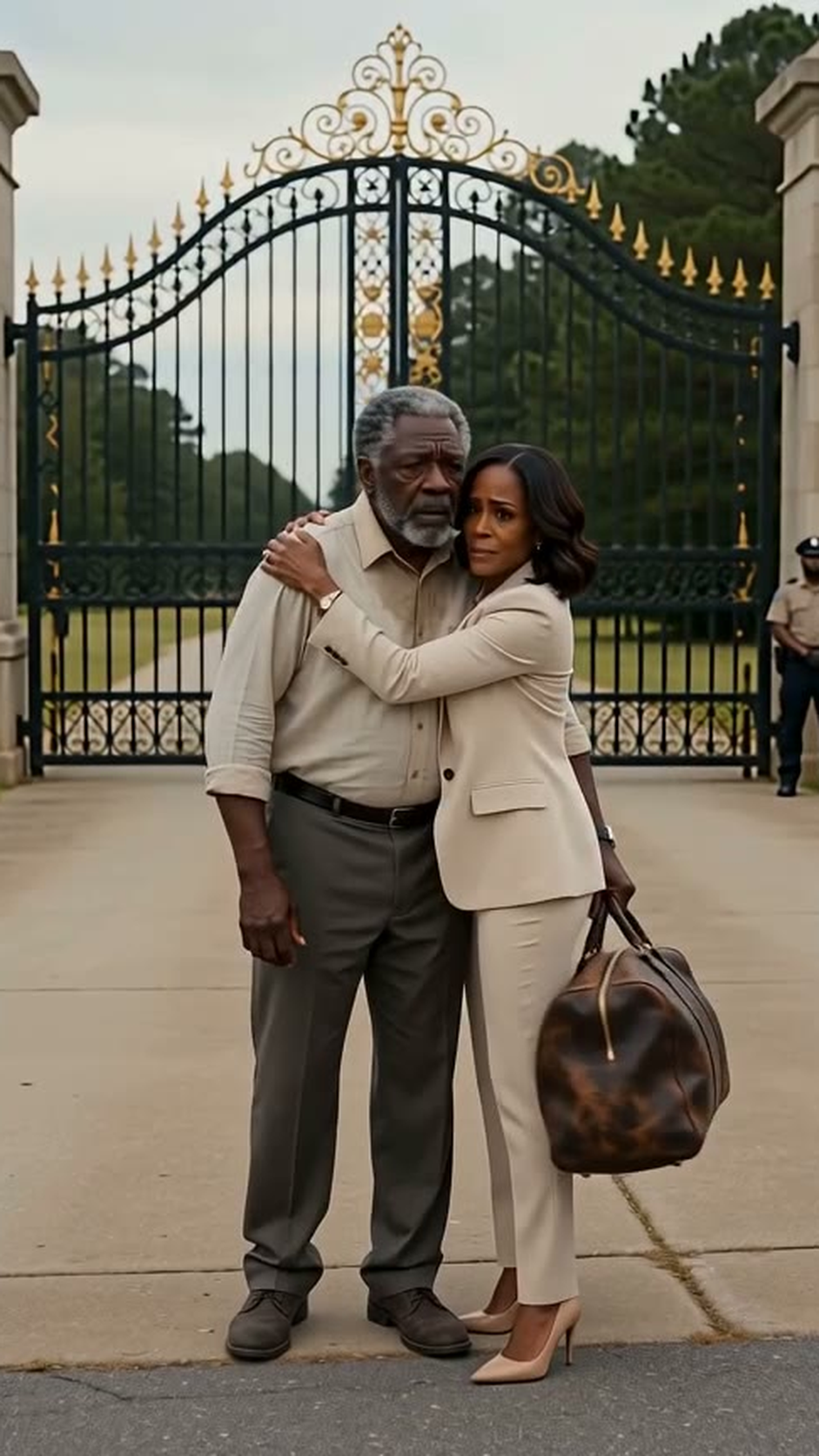
The gate was taller than Gerald Crawford remembered any gate needing to be.
It swung shut behind him with a long, oiled groan — black iron, gold finials, pretty enough for a governor's mansion — and the sound of it traveled through the concrete under his shoes and up into the bones of his ankles. Two uniformed officers stayed on the other side of it. Neither of them wished him luck. A black SUV sat parked beyond the fence with its engine running, and Gerald understood, without anyone telling him, that the SUV was not for him.
Five years. He had counted them in ceiling cracks, in meals, in the gray arithmetic of a calendar he was not allowed to keep. Five years, and it ended like this: a worn dark-brown leather bag in his hand, a faded beige shirt on his back, and an empty road.
He walked.
His shoes — the same shoes he had surrendered the day he went in, returned to him that morning in a paper sack, stiff and smelling of storage — scraped against the concrete. He kept glancing toward the curve of the road, the way a dog watches a door. Kenneth would come around that bend. Or Giselle. Kenneth drove too fast; he'd be the first one there, honking, impatient, sorry in the clumsy way of sons. Giselle would have brought flowers, maybe, and cried in a way that made her angry at herself.
The road stayed empty.
A wind moved through the pines. Somewhere behind him a radio crackled on an officer's belt. Gerald lowered his eyes to the seam of the sidewalk and made himself a promise he had practiced for months: whatever their faces looked like when they came — angry, ashamed, cold — he would not make it harder for them. He was the one who had shamed this family. A man does his penance quietly.
The release officer had given him three things at the window that morning: a check for one hundred and twelve dollars — gate money, the state called it, five years translated into a number a man could hold — a printed bus schedule, and his own belongings in a paper sack. The bus would have had him in Jackson by nightfall. He had planned it all out in his cell with great care, the way you plan a thing you dread: ride the bus, walk the last nine miles, knock on the door of his own house after dark like a salesman. He had rehearsed being refused. He had rehearsed it so many nights that refusal had worn a groove in him, and he had made his peace with walking the nine miles back in the dark, and whatever came after that.
What he had not rehearsed — what he had not permitted himself, in five years, to rehearse even once, because hope is the one contraband a man smuggles against his own good sense — was the sound of somebody running.
He was almost to the road when he heard the footsteps.
Fast. Uneven. Heels on concrete, running — actually running.
"Dad! Wait!"
The voice broke on the second word. Gerald stopped so suddenly that the heavy leather bag swung forward on its handle and thumped against his shin before settling. A hand closed around his forearm — not gripping, catching — and he turned.
Melanie.
His son's wife stood in front of him in a cream-colored pantsuit that the wind was worrying at, her dark wavy hair coming loose, her chest heaving, her eyes already full. Thirty-nine years old and she had run — in heels, on concrete, the whole length of the administration drive — the way a person runs toward a fire.
For a moment Gerald Crawford could not speak. Five years of rehearsing this moment, and every word he had prepared stood up and walked out of him.
His lips trembled. He made them work.
"Where are my children?"
He watched it happen — watched the question land on her like weather. Her face, which had been all relief a second before, changed into something she was trying very hard to hide from him. Her hand tightened on his arm. Her mouth opened, and nothing came out of it that she was willing to let him hear.
That silence told him everything the road already had.
He did not ask again. A father learns things. He glanced once more toward the empty bend in the road, and then he let his daughter-in-law pull him into an embrace, and he stood rigid inside it the way a man stands in a doorway he has not been invited through — until, slowly, one arm came up, and he held on to the only member of his family who had come.
An hour out, she made him stop at a gas station with a diner attached and sat him down in a booth and ordered him food he had not asked for, and watched him eat a sandwich with the stunned, careful attention of a man relearning a language. A family piled out of a minivan at the pumps — father, mother, three kids arguing over a bag of chips — and Gerald watched them through the window with his coffee cooling in his hand, not bitter, just looking, the way you look at weather in a country you used to live in.
"That oak by the shed," he said at last. "Does it still turn?"
"It turned red in October," Melanie said. "First thing in the yard. I took a picture. I always meant—" She stopped.
"You brought me pictures," he said gently. "Sixty of them. I had them in a row on my wall till the paint gave out." His hand drifted, without his seeming to notice, to the breast pocket of his shirt, and rested there a moment, flat, the way a man checks that a letter is still where he left it. "Some things a person carries out himself, though."
She didn't ask. She was learning, minute by minute, the shape of what he wasn't saying, and she drove on into the afternoon with it riding between them like a third passenger.
Hours later, in the passenger seat of her car, with five hundred kilometers of Mississippi unspooling under the wheels and the afternoon light coming in flat and gold through the side window, Gerald Crawford reached into his shirt pocket.
His hand hesitated there, over his heart.
He drew out a folded piece of paper — soft as cloth, worn at the creases, folded and refolded so many times it had forgotten how to be flat — and he held it out across the console without looking at her.
"Don't take me home yet," he said.
Melanie glanced down. "Dad —"
"There's an address." His voice went low and urgent, the voice of a man spending something he had saved a long time. "Before three. Don't tell Kenneth."
She took one hand off the wheel long enough to signal, pulled the car onto the shoulder, and let it roll to a stop. Gravel ticked against the undercarriage. Then she took the note in both hands and unfolded it.
An address, handwritten, in dark ink, in a hand she did not know.
And beneath it, at the bottom of the page, a name.
Her fingers tightened on the paper until it shook.
"Aaron…?"
Gerald stared straight ahead through the windshield, at nothing, his jaw tightening like a man bracing for a blow he had been expecting for five years.
—
Three weeks earlier, the letter came to the house in Jackson on a Tuesday, and it very nearly went into the trash unopened.
It lay on the polished dining table where the mail always landed — state seal, thin paper, the kind of envelope that had only ever brought this family grief — and Kenneth Crawford picked it up with two fingers, the way a man picks up something dead.
"Release notification," he said. "November twenty-seventh."
Across the table, his sister went still with her coffee halfway to her mouth.
Giselle Crawford was forty-one, elegant down to the bones, engaged for six months to Julian Pierce and terrified in a way she would rather have died than admitted. She set the cup down with great care.
"Ten days before my wedding," she said. "Ten days. Do you understand what Harlan Pierce will do if a single reporter—" She stopped. Started again, colder. "He can't be here. He can't be anywhere near this house until after the wedding. If he needs somewhere—" She pointed, one manicured finger aimed past the window, past the garden, toward the gray shape at the far end of the property. "He can sleep in the shed."
The word landed in the room and stayed there.
Melanie, who had been standing in the doorway with a dish towel in her hands, felt something rise up in her chest so fast she had to put a hand on the door frame. "Giselle. That is your father."
"That is a convicted felon the State of Mississippi is kind enough to be done with," Giselle said. "I have waited my entire life to be looked at the way people look at the Pierces. I am not spending my wedding weekend explaining him."
Melanie crossed the room and reached for the letter.
Kenneth's open palm came down on the table — hard, flat, final. The letter jumped and slid across the polished wood, and Melanie recoiled half a step before she caught herself and held his gaze across the table.
"Don't," Kenneth said. "Don't start."
"Someone has to go and get him, Kenneth."
"No one has to do anything." Her husband's voice was the voice he used on difficult clients, reasonable as a locked door. "He's a grown man. There's a bus. There is a whole system for this. The state releases him, the state points him at a bus stop, and if he has the sense God gave him, he stays quiet until December, and then—" He glanced at his sister. "Then we discuss it. As a family. When there's no wedding to protect."
"And no merger," Melanie said quietly.
Kenneth's jaw tightened. She had aimed well and they both knew it. Crawford Properties, the company Gerald had built out of a pickup truck and a reputation for paying his debts, was eleven days from signing a development merger with Pierce Holdings — a marriage of companies riding in the same carriage as the marriage of their children. Harlan Pierce, retired judge, a man who had built a fortune and a name out of never once being embarrassed in public, had been gracious about the Crawfords' "unfortunate chapter." That was the phrase. The unfortunate chapter was scheduled to walk out of a prison gate on November twenty-seventh.
Above the sideboard, in a gilt frame, Margaret Crawford looked down at all of them from twenty years ago — laughing, mid-sentence, alive — and Melanie found she could not stand in the same room with the portrait and the word shed.
She picked the letter up off the table. Nobody stopped her this time. She smoothed it flat with the heel of her hand, the way you smooth a child's drawing you intend to keep.
"Your mother visited him every week until the week she died," she said, to no one, to both of them. "Every week. She took two buses."
"Don't you dare use her," Giselle whispered.
"I'm not using her. I'm remembering her. There's a difference, and this family used to know it."
"Your mother would have wanted—" Kenneth began, and got no further.
"My mother," said Giselle, with the bright, shaking smile of a woman stepping on a rake in public, "would have wanted not to be discussed in connection with a penitentiary at her own table. She spent two years taking buses to visit him and it killed her, Kenneth, it literally—" She broke off, because Melanie had come around the table, and for a second it seemed possible the evening would become something with hands in it.
Instead Melanie only began, quietly, to clear the plates. It was the most frightening thing she could have done, and both of Gerald's children understood it: she was clearing the table of their childhood home like a woman who had stopped asking permission to be its conscience. Giselle gathered her coat with enormous dignity and let herself be walked out by her brother, and at the door she turned and fired the last shot over her shoulder, in a voice that cracked on the final word and ruined the aim entirely: "If he comes here before my wedding, there won't be one. Julian won't be given the choice. His father will make it for him."
The door closed. The house settled. On the wall, Margaret Crawford went on laughing at something twenty years gone, and Melanie stood in the wreckage of the evening and smoothed the release letter flat on the table with the heel of her hand, and folded it — once, twice — the size of a secret, and put it in her own purse.
That night, long after Kenneth had gone to bed believing the matter settled, Melanie sat up in the dark kitchen with the letter and her phone. She did the arithmetic nobody else in the house was willing to do: five hundred and thirty-eight kilometers. Six hours, if the highway was kind. She looked up the release procedures, the gate, the time. She read the words "no transportation provided" four times.
Then Melanie Crawford — who had never once, in eleven years of marriage, set out to deceive her husband — opened the calendar on her phone and marked Thursday, November twenty-seventh, with the word ERRANDS.
She set an alarm for three-thirty in the morning.
She had no idea that the man she was driving to collect was carrying a folded piece of paper in his shirt pocket, or that the name written at the bottom of it was going to tear the lid off everything her family had buried.