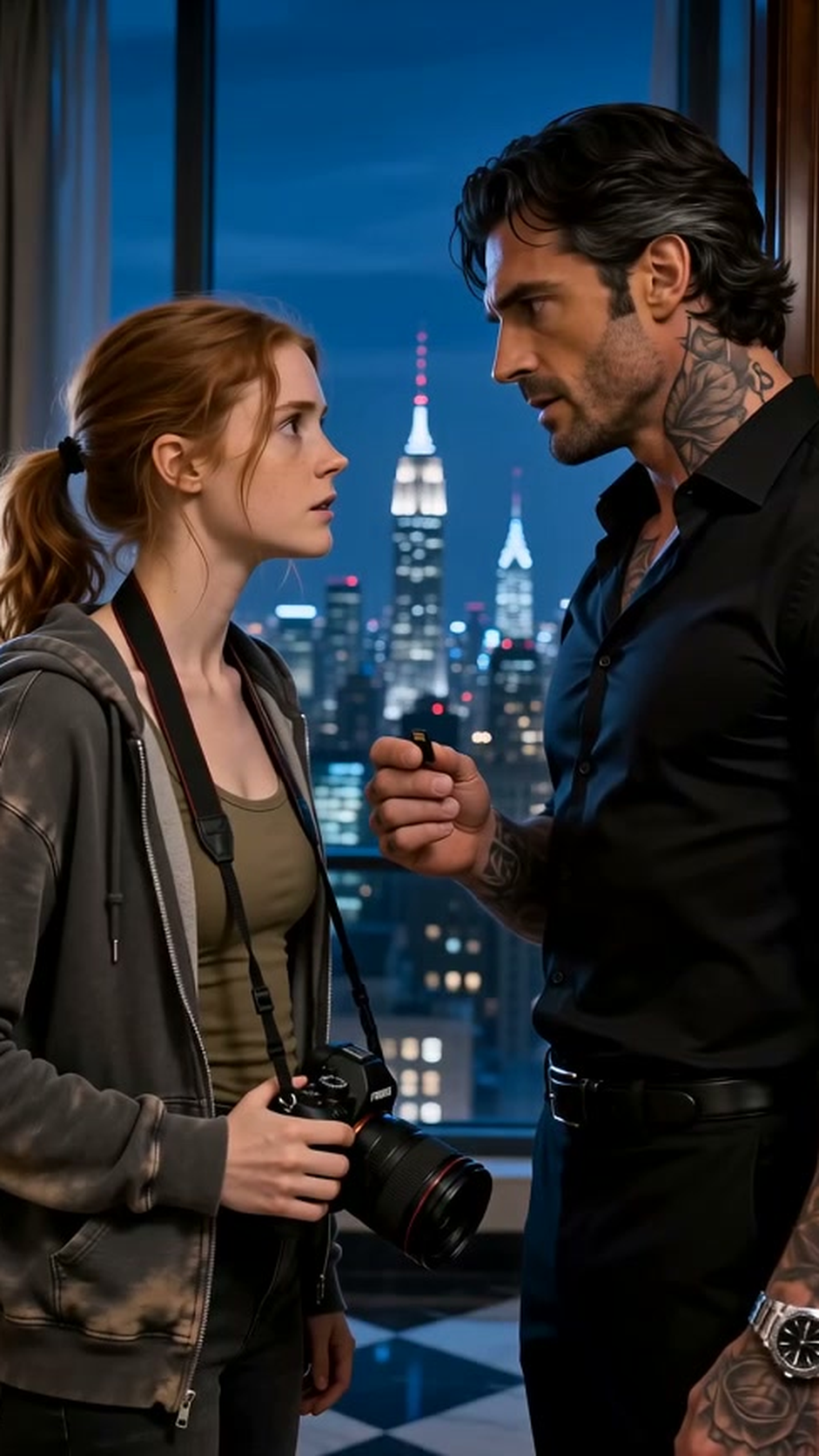
The freight elevator arrived on fourteen with its doors open and nobody in it.
Rocco had four men in the service corridor by then—men who had materialized out of the hotel's woodwork with the silence of furniture being rearranged—and they covered the empty car for a long ten seconds before anyone spoke. There was nothing in it but a smear of kitchen grease on the floor and the ghost of heat from the kitchens below.
"A probe," Rocco said at last, without lowering anything. "Somebody sent it up to watch us watch it arrive. Now they know how fast we move and from which doors." He looked at Damian. "They're not hunting blind anymore, boss. The kitchens talked. They know the card's up here. They know we have it."
"Then the play changes," Damian said. "Sal wanted a night to work in. He doesn't get the night." He turned to Lily, who had been moved—gently, immovably—into the doorway of the adjoining suite, 1411, with a broad, silent woman named Dani stationed at her elbow like a second shadow. "Miss Carr. New rules. You don't touch a window, a phone, or a door that Dani hasn't touched first. Your name isn't in this building. As of tonight, it isn't anywhere."
"My camera bag is in the staff room on twelve," Lily said. "My name is on the agency call sheet. My roommate thinks I'm coming home." Her voice was very steady, and it made it worse. "Mr. Kane, I have a life. It's small and it's mostly overdue bills, but it has my name all over it."
"I know," he said. "That's why they're going to reach for it. It's what I would do."
He said it without cruelty—as a professional courtesy, one expert briefing another—and Lily understood that the worst part of Damian Kane was not the tattoos or the men with guns. It was that he told the truth in the tone other people used for weather.
They put her in 1411 with Dani, a change of clothes that appeared from nowhere in her size (she chose not to examine that), and a room service tray she couldn't eat from. At one in the morning she gave up on the bed and knocked on the connecting door with two knuckles, and Rocco opened it on the suite side with the air of a man who had been expecting exactly that knock for an hour.
"I want my camera files," she said. "All of tonight. Nadia has the reader. If my photographs are evidence in whatever this is, I want to be the one who finds it. It's—" She searched for a word that wasn't dramatic and settled for the true one. "It's the only useful thing I am in this building."
Damian, at the desk with his sleeves rolled to the elbow and a map of the hotel's service floors under his hands, looked up and studied her for a moment with those unreadably calm eyes. "Bring her files," he said to Nadia. "Everything she shot. She reads them at this table, where I can see the screen."
"You trust me with your evidence now?"
"No," Damian said. "I trust your eyes. Nadia says the fragment is one second because Eddie set it that way—as a key, not a clip. Trust isn't the currency tonight, Miss Carr. Usefulness is. Sit down."
She sat. Nadia dropped forty minutes of Lily's professional life onto the screen in a grid—cocktail hour, donor wall, speeches, the senator asleep on his feet—and Lily went through them the way she had gone through ten thousand grids before: fast, then slow, then frame by frame through the ones her instincts flagged without asking her permission.
Eight-fifteen. The wide shot. Salvatore Kane at the bar, turning, the crested watch riding his wrist like a small moon, his hand rising toward the door.
Eight-sixteen. The woman in red entering, the room bending toward her.
Eight-seventeen. Lily zoomed, and felt her own face go still. Because there it was—the presentation shot, Sal's hand at Isabella Castellano's elbow, and this close, this sharp, medium-format sharp, you could read the watch face like a coin: a crest, a motto in miniature, the kind of bespoke engraving a man commissions once in his life and wears into his grave.
"Timestamped," Nadia said behind her. "Geotagged to the ballroom. That watch was presenting Miss Castellano at eight-fifteen on the same night it took delivery of a black case at nine-oh-five. Chain of custody, courtesy of the wedding photographer."
"I'm not a wedding photographer," Lily said, out of habit, and Damian, without looking up from the hotel map, said, "You are tonight," in a tone that ended the subject.
"Explain the rest of it to me," she said. "If I'm evidence, I want to know what I'm evidence of. Tomorrow. The table. The toast. Eddie died filming your uncle say the word toast like it was a loaded gun. Why?"
Nadia glanced at Damian—a question. Damian considered Lily for a moment, then folded the hotel map shut with care, like a man deciding that a door, once opened, might as well be opened all the way.
"Tomorrow night the captains of five families sit in this hotel for the first time in nine years," he said. "It's called the Table, and nobody photographs it, nobody records it, and men have died for suggesting either. At the end of the meal there's a rite older than anyone in it. The head of the host family drinks first, from the host decanter, poured by his consigliere's hand. It means: my house is clean, my hand is steady, what I serve you is safe. Forty men watch the head of the Kane family drink, and if he drinks and stands, the treaty holds for a generation."
"And if he doesn't stand," Lily said.
"Then the family has a new head before dessert. The consigliere pours. The consigliere has poured for this family since before I was born. It's a sacred office, which is a way of saying it's the one glass in the building nobody thinks to test." He turned the whiskey he'd never touched in a slow circle on the desk. "My uncle has been selling my routes to the Castellanos for a year—skimming the profits, feeding them my schedules, loosening every bolt on my house one quarter-turn at a time. Tomorrow, in front of five families, I was going to drink from his hand and not stand up. And Marco—Marco would grieve beautifully, and vote, in his sorrow, for the only man who could hold the family together in a crisis. The man who'd just poured."
"An accident," Lily whispered. "A heart attack. In front of forty witnesses to how natural it looked."
"In front of forty witnesses to how natural it looked," Damian agreed. "And the bride was the insurance. If I'd married Isabella Castellano this winter, the Castellanos gain a widow's claim instead of a war if anything went wrong with the wine. Either way Emilio takes my ports. Either way my uncle dies rich, in his own bed, beloved." He looked at her then—not at the photographs, not at the map—at her, steadily, as if she were a sentence he'd been avoiding reading. "Eddie Rusk figured it out with a camera and a card, because Eddie watched the watch. He died getting it to me. And then a photographer from Brooklyn picked it up off a carpet and carried it past two armed men to the one door in this hotel where it could do its work. So when you ask what you're evidence of, Miss Carr—" he nodded at the screen, at the timestamped moon of Sal's watch, "—you're evidence that it happened in the light. Men like my uncle can survive anything except being seen clearly. It's why they fear your trade more than mine."
Lily looked down at her hands, which had stopped shaking somewhere in the last hour without consulting her. "Then let's make sure they see everything," she said, and turned back to the grid.
Nine-oh-two. Ballroom level, wide shot over the speeches crowd. There—at the edge, by the service door, half-turned away—Marco Delgado in conversation with a lean young man in waiter's whites who was not carrying a tray. The young man had his phone in his hand like it was part of his hand.
Lily's finger froze on the trackpad. "That's him. The mezzanine. The one who watched the exits. He's Marco's."
"Keep going," Damian said quietly.
And then she found the one she had taken through glass.
The skyline frames. The city doing its miracle through the lounge doors, white and gold, and she almost skipped past them—they were the reason, legally, that she existed on the fourteenth floor at all—when the third frame stopped her cold. Because there, at the edge, reflected faintly in the glass with the whole glittering city shining through him like a ghost in a double exposure, stood a man in the doorway of the service stairs. Phone raised. Pointed at her.
He hadn't been searching for the card when she arrived on fourteen. He'd been waiting on the floor. And the first thing he'd done, when a girl with a camera stepped out of the elevator, was take her picture.
"I know when that was," Lily said. Her voice sounded far away to her own ears. "Nine-forty-one. That's the time stamp. He photographed me at nine-forty-one. Two hours before I knocked on your door, Mr. Kane. Before I found anything. Before I was anybody." She turned in the chair and looked up at Damian, and made herself ask it plainly. "So when you said 'not while you're with me'—you knew that already, didn't you? You knew my face was in their phones."
The suite was very quiet. Dani, at the door, was looking at the ceiling with professional intensity. Nadia's hands had stopped moving.
"I knew it was possible," Damian said. "I didn't know it was certain." He came around the desk then—slowly, the way he did everything—and he did something she would think about for a long time afterward: he crouched, so that for once she wasn't looking up at him, so that they were eye to eye like equals in a foxhole. "Listen to me. A face in a phone is a problem I can solve. I've solved worse before breakfast. But you needed to find that frame yourself, because if I'd told you, you'd have wondered what else I was keeping from you, and tonight I can't afford you wondering." His eyes were brown and tired and absolutely steady. "I keep one thing back from the people I protect, Miss Carr. Nothing. That's the arrangement. In exchange, you show me every frame. Even the ones that scare you. Especially those."
"And if a frame scares me enough that I want to run?"
"Then Dani runs with you," he said, "and she is extremely good at running."
It should not have made her laugh. It did—one startled, traitorous breath of it—and Damian Kane's mouth did something at the corner that on another man would have been a smile, and the moment stretched, warm and human and entirely out of place, until Rocco cleared his throat from the doorway with the delicacy of a man stepping on a rake in the dark.
"Call for Miss Carr," he said. "On the house line. It's her roommate."
Jess's voice, when it came, was tinny and half-asleep and the most beautiful sound in the world. "Lil? Please tell me you're still at the rich people zoo, because some guy just called the landline—an actual landline, who even are we—asking for 'the Meridian photographer.' Said he was from the agency. Said there's a problem with your invoice. At two in the morning, Lily."
Lily's eyes went to Damian. He was already shaking his head, once, slow: the agency would never. Not at 2 a.m. Not on a landline.
"Jess." Lily kept her voice in the shape of normal with an effort that hurt. "Listen to me very carefully. Don't go home after your shift. Go to your sister's in Queens. Take the car service the hospital uses, not the train. I'll explain everything tomorrow, I swear on Dad's Leica. Just—please. For me. No questions until tomorrow."
There was a silence with hospital noise in it. "You're scaring me."
"I know. Do it anyway."
"I'm going," Jess said, and then, because she was Jess: "If you get murdered by rich people I'm keeping the camera." The line clicked off.
Damian was already speaking, low, to Rocco—building address, sister's address in Queens, two men, now, the ones who don't exist. Nadia's keys were flying. And Lily sat at the desk of a mafia boss's war room with her useless hands folded, understanding that she had just spent the last of her ordinary life like the last coin in a slot machine, when her own phone—the personal one, on silent, in her bag by the door where Dani had quarantined it—lit up through the fabric with a message preview.
Dani brought it to her on an outstretched palm, like a tray.
The message was a photograph. Lily knew the peeling green paint before her brain let her know the rest: her own front door, in Brooklyn, standing open six inches onto the dark of her own hallway, with the light on inside a home she had locked at five o'clock and no living soul had a key to but Jess, who was in Queens-bound traffic by now, please God.
Below the photograph, three lines:
NICE PICTURES, PHOTOGRAPHER.
YOU HAVE SOMETHING THAT ISN'T YOURS.
BRING IT HOME.