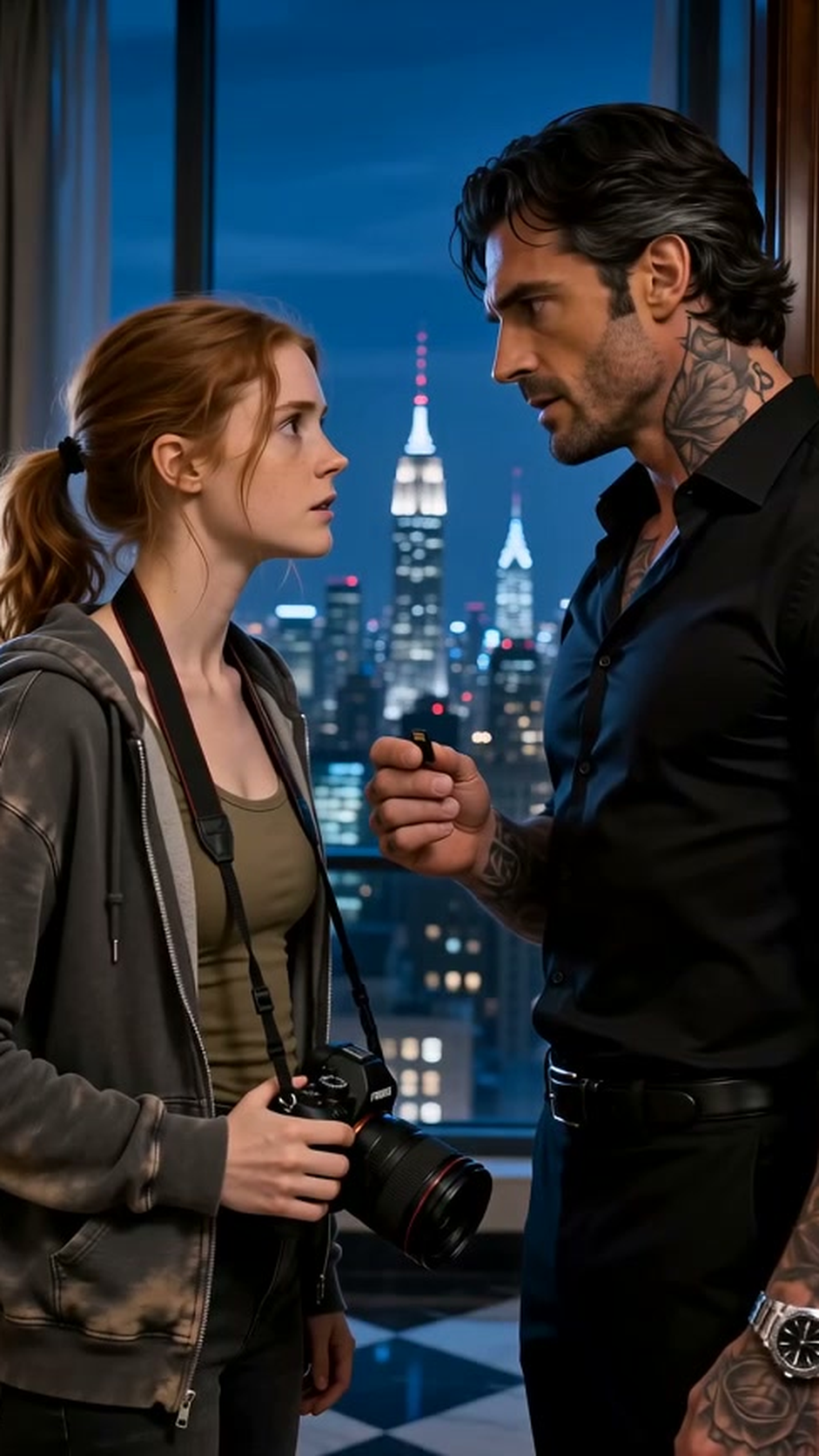
The door opened on a girl in a faded charcoal hoodie with a camera on her hip and the whole of his missing evidence held up between two fingers like a white flag, and Damian Kane's first thought—God forgive him, his first thought, in the middle of a war—was that she was terrified and had come anyway.
His second thought was arithmetic. It was eleven-oh-two. Isabella Castellano was expected. Whoever this was, she was not her, and Rocco was already turning sideways in the doorway, one hand drifting, and the girl's eyes tracked the movement with a professional's calm and did not flinch.
"I found this outside room 1407," she said. "Down the hall. On the carpet."
Damian looked at the card. He knew that card. Not the object—the shape of the catastrophe. Eddie Rusk had carried his life on cards like that; Eddie Rusk, who had something the boss needed to see with his own eyes; Eddie Rusk, whose phone had died on this floor at nine-oh-seven.
His jaw locked down on a surge of something he did not allow himself in front of witnesses. "Did you look at what's on it?"
"Just one second." The girl swallowed, and her chin stayed level, and she gave it to him straight, the way frightened people do when they've decided that lying is a luxury for the safe. "I saw two men in a hallway."
Every instinct Damian had honed across fourteen years of this life stood up at once. Because a hallway was specific. A hallway was this hallway. And because behind her, through the open door, the corridor lay in its low golden light, and at the far end near the elevator alcove a man in a dark suit had gone very still in the way of a man who has just recognized a face—
"Don't turn around."
It came out of him barely above a whisper, and the girl obeyed it the way soldiers obey things—all at once, without asking. Damian moved, putting the wall of himself between her and the corridor, and opened his hand toward the interior of the suite, toward warmth and depth and doors that locked.
"Come inside. Now."
She looked at the corridor she wasn't allowed to turn toward. She looked at him. She made the decision of an intelligent woman with no good options, and she chose the devil who was looking her in the eye.
She stepped in. Rocco brought the door shut behind her with the care of a man defusing something, and the locks engaged, and Lily Carr exhaled for the first time in what felt like an hour.
"Am I in danger?"
Damian took the card from her fingers. His closed around it—around the whole burning center of his year of leaks—and he looked at her, really looked, and the answer cost him more honesty than he'd planned to spend on a stranger.
"Not while you're with me."
It was only later—much later, when the night had finished going wrong in every way it could invent—that either of them would understand that the timeline of the disaster had turned on that exact second. Because at the moment Damian closed his hand on the card, Salvatore Kane stepped out of the suite's inner room with a coffee cup in his hand and a smile already arranged, and said, "Damian, your guest is—" and saw the girl, and saw the card, and stopped.
It was small. It was nothing. It was a heartbeat's hitch in a practiced man, gone before a normal person would have registered it. But Lily Carr was not a normal person; she was a person who read faces through a long lens for a living, and she had spent the evening photographing that man's crested watch presenting a woman in red.
Her eyes went from Sal's face to his wrist. The watch caught the lamplight.
And Damian, watching her watch his uncle, felt the temperature of the room change.
"Uncle Sal," he said pleasantly, into the silence, "this is Miss Carr. She's a photographer. She works for the foundation."
"Then she's wandered a long way upstairs," Sal said, and smiled at her with all of his teeth. "The party's below, sweetheart."
"The party sent me up," Lily said. "Skyline shots. Fourteenth-floor lounge. Director's request." She didn't look away from him. "I got lost."
Sal laughed, warmly, the beloved uncle, and set his cup down, and Damian noted that he set it down with his left hand—so that his right, his watch hand, stayed free and low and out of her sightline. Damian noted it the way he noted everything: without his face changing at all.
"Rocco," he said, "call Nadia. Tell her to bring the reader up the back way and tell no one. And put two men on the service stairs who don't exist."
Then he did the hardest thing he had done all year. He smiled at his uncle—the last man alive who had known his father, the man who had taught him to tie a tie and read a man's tells at a poker table and bury a friend without weeping where it could be used—and he said, "Sit down, Sal. Whatever Eddie Rusk died—" he corrected himself with surgical smoothness, "—whatever Eddie Rusk has been hiding from us, family hears it first in this house. That's always been the rule."
Nadia Wolfe arrived in eleven minutes through the service door with a laptop bag and no expression at all. She was thirty-one, ex-military signals, and the only person in the organization Damian trusted with anything that plugged in. She took the card with two fingers, like a woman accepting a live round, and seated herself at the desk without a word to anyone, and the room went quiet except for the soft tick of keys and the city breathing against the glass.
Lily stood where she'd been left, by the windows, with her camera strap twisted in both hands, watching a stranger dismantle her life's worst decision on a laptop screen.
"Ten files locked, one open," Nadia said. "The open one's a fragment. The locks aren't consumer-grade." She glanced up. "This is Eddie's handwriting, boss. His encryption, his naming. He pulled this off a camera in a hurry."
"A camera where?"
"Give me a minute." Keys. Silence. Then Nadia sat back, very slightly, and Damian had known her six years and had never seen her sit back from a screen like that, as if it were warm. "Corridor camera. This corridor. Camera six—the one that covers fourteen-oh-seven. Boss, the six-minute hole in the hotel feed? Somebody cut it out of the hotel system. But Eddie had set the corridor cams to mirror to his own cards. Redundancy. He told me once it was because he didn't trust—" She stopped.
"Finish it," Damian said.
"He said he didn't trust anyone in this building but you."
"Mr. Kane."
It was the girl. Her voice was low and it shook once, at the start, and then it steadied the way it had in the doorway—as if she'd decided something. Damian turned.
"They're still in the building," she said. "The men the card belongs to. Before I found it—before I picked it up—two of them came out of the service stairs and searched the carpet outside 1407 on their knees. I was behind the lounge doors. They didn't see me. One of them said—" She made herself say it exactly; he could watch her choose accuracy over comfort, the photographer's religion. "He said, 'If Kane finds that card before midnight, we're all dead men.' Then a call came and they left in a hurry. I tried to leave too. The young one was downstairs by then, watching the exits from the mezzanine. Watching faces. He's seen the gala staff list—he was reading the room like a list. I came back up because there wasn't anywhere else."
The room reassessed her in silence. Not a wandering girl, then. A witness who had navigated.
"Describe them," Rocco said, already with the tablet up.
"Young one: late twenties, lean, cologne, phone in his hand like it's part of his hand. Older one: built like a door, shaved head, carries his weight under his jacket—left side. He got down on one knee outside 1407 and his jacket pulled. He's armed. Both of them used the service stairs like they knew the codes." She hesitated. "They said the dinner's been called forward. That Sal wanted everyone in the suite tonight."
Damian did not look at his uncle. He found, in fact, that he was looking at the girl's hands—empty now, twisting her camera strap into rope—and that something unfamiliar was moving through the wreckage of his calculations: gratitude, hot and unwelcome, for a stranger in a hoodie who had run toward the armed men because the arithmetic of the exits didn't work.
"Rocco," he said. "The girl's name goes nowhere. She's a ghost. She was never on this floor." He turned his head, finally, toward the sideboard, and let his gaze rest on his uncle with all the warmth of family. "You hear that, Sal? Nobody was on this floor. Whatever Eddie was running from, it died with his phone. We're blind, and whoever's hunting that card can stop hunting."
Sal's smile softened into something almost sad, almost proud. "Smart boy," he said. "Your father would—"
"Don't," Damian said, gently, and the gentleness did what shouting couldn't: it stopped the sentence in Sal's throat like a hand. "Not tonight."
Then, because the play required it, he turned the full warmth of the performance on his uncle. "Sal. I need your face downstairs. The Castellano table is sitting in my ballroom being told their princess was stood up, and if Emilio hears it from anyone but family, tomorrow's dinner becomes a war council. Go down. Drink his wine. Tell him my regards are personal and my delay is an insult I'll pay for." He put a hand on the old man's shoulder, and felt, through the wool, how thin the muscle had gone with age. "Hold them for me. Nobody else can."
Sal looked at the girl. He looked at Nadia's dark laptop screen. He looked for one second too long at the memory card resting beside it, small and black and ordinary as a communion wafer, and Damian—watching the look—understood that his uncle had just done the same arithmetic Lily had done on the carpet: the card was here, the lock was Eddie's, and whatever was inside it was now on the other side of a door Sal was being politely, lovingly, irrevocably shown.
"Of course," Sal said. "Family." He smiled at Lily as he passed her, avuncular, almost kind. "Get some rest, sweetheart. You've had an exciting evening."
The door closed behind him. Rocco put his ear to it, counted five, and said, "Clear. And Bruno's on his tail, all the way down."
"Then we do this now," Damian said, "and we do it fast. Nadia."
The files opened one by one under her hands, grey padlocks blooming into frames, and the suite went very quiet, and Lily watched Damian Kane watch his own hallway betray him.
Nine-oh-two. The corridor, empty, brass and marble. Nine-oh-three: Eddie Rusk, heavyset, grey at the temples, a working man in a dark jacket, stepping out of the service door with a small camera in his hand and the expression of a man who has just confirmed the worst thing he knows. Nine-oh-four: Eddie looking up, directly into camera six. Eddie saying—no audio, but his mouth was clear, and Nadia read it aloud in a voice gone flat: "'Boss. Watch the watch.'"
Nine-oh-five: two men entering the frame from the stairwell. The younger one, heavyset, dark-haired, in a beautiful suit, carrying a flat black case. Marco Delgado. Damian's underboss. His right hand for eleven years. The man who had stood godfather to Damian's niece and poured the wine at his father's funeral table.
And the older man who came to meet him, silver-haired, unhurried, with the Kane crest on his watch and Salvatore Kane's face—
—turning, exactly as the first fragment Lily had seen, to take the flat black case from Marco's hands with all the tenderness of a priest receiving an offering.
Nobody in the room breathed.
On the screen, the two men spoke—nine-oh-six now—and there was no audio, but there was Sal's mouth, in merciless profile, forming words Nadia read one by one with her eyes narrowed. "'Tomorrow… the table… he drinks… to family…'" Her voice faltered once. "'…and then the family… has a new head.'"
The clip ran out at nine-oh-seven, mid-gesture, where Eddie's phone had died.
Where Eddie had died, in all likelihood, somewhere in the six minutes the building had agreed not to see.
Damian stood motionless in front of the screen with the whiskey he still hadn't touched, and in the reflection of the black glass his own face looked back at him like a stranger's. Fourteen years of building. Eleven years of Marco at his right hand. A lifetime—an entire lifetime—of Uncle Sal: of birthday money in crisp envelopes and a hand on his shoulder at the grave and you are your father's son, boy, I will keep you standing.
Betrayal, when it finally introduces itself, does not knock. It has the keys. It has always had the keys.
He was aware, distantly, that he should roar, or break something, or reach for the gun in the desk. Instead he heard his own voice come out quiet and entirely steady, and it was the voice that had made grown men cross streets to avoid him.
"Nadia. Copy it. Three places, one of them outside my organization."
"Done before you said it."
"Rocco. The men in the corridor—"
"Already being followed, boss. Lost one at the service door, kept the other. He's in the kitchens now, changing out of the suit."
Damian nodded. Then he turned, at last, to the girl in the hoodie by the windows, who had brought him the end of his world in her bare hand and stood in the wreckage of it with her camera strap twisted white-knuckled and her chin still—stubbornly, magnificently—level.
"Miss Carr," he said. "You saw the fragment. Just one second. Two men in a hallway."
"Yes."
"Did you see their faces?"
"The fragment only," she said. "One second. The watch, the case, hands. I never saw a face in it—not one I'd swear to." She held his gaze. "But I photographed that watch downstairs at eight-fifteen, on the wrist of the man presenting the woman in red, and if you put my photograph next to that one second of video, Mr. Kane, you won't need me to swear to anything."
"She's right," Nadia said quietly. "The fragment's all he knows about. It shows a watch and a handoff. It does not show his face, and it does not show his mouth planning a funeral at tomorrow's toast. As far as Sal knows, the locked files are still locked."
"As far as Sal knows," Damian repeated. He looked at the black screen, at the frozen frame of his father's brother receiving his death like an offering. "He'll go downstairs now and be charming, and somewhere between the ballroom and the kitchens he'll decide whether to run, or to finish this tonight instead of tomorrow."
Rocco's phone buzzed against his palm. He read it, and his whole body changed key.
"Boss. Bruno. Sal didn't go to the ballroom." A beat. "He went down the service stairs. Toward the kitchens. Toward our friend who's changing out of his suit."
And in the service corridor beyond the wall, very faintly, a bell chimed—as the freight elevator began, unrequested, to climb toward the fourteenth floor.