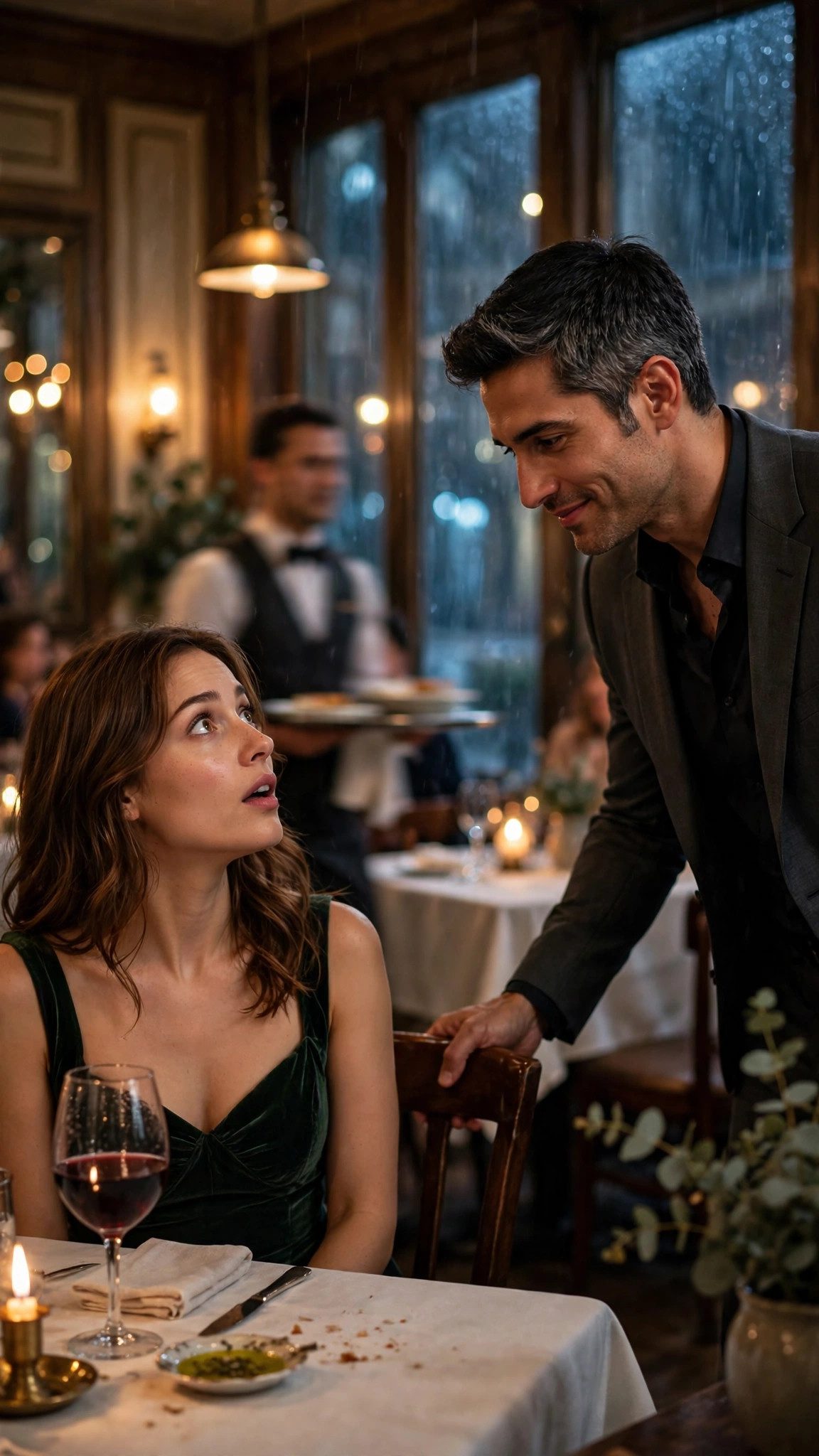
By the next morning, the whole town had woken up to the picture.
It was everywhere. On the local news page. On the facility's bulletin board, where someone had printed it out and pinned it up next to the shift schedule. On Priya's phone, which she held up the moment I walked in, her eyes as wide as saucers. It was a picture of me with my hands in his, my face turned up toward his, the chandeliers behind us like a sky full of stars. And underneath it, the caption: "Russo Family Foundation saves Meadowbrook memory-care program."
My mother called before I had even taken off my coat. "Emma Hart," she said, and I could hear the worry in her voice all the way from Greece, New York, twenty minutes up the road. "Is that you? In the paper? With that man?"
"It's me, Mom," I said.
"Emma, do you know who that is?"
"Yes, Mom. I know who that is."
"Then why is your hand in his?"
I did not have an answer for her. Not one that would fit in a phone call. Not one that would make sense to a woman who had spent her whole life in a suburb where the most dangerous thing that ever happened was a break-in at the pharmacy. So I told her I would come to dinner on Sunday and explain everything, and she said she would hold me to that, and then she hung up, and I stood in the hallway of Meadowbrook with my coat still on, listening to the sounds of the memory unit waking up, and I felt like I was living someone else's life.
Priya cornered me in the break room. "Emma. Emma. Tell me everything. Who is he? Why is he holding your hand? Why does Louise look like she just won the lottery?"
"He's Anthony Russo," I said.
Priya went pale. "The Anthony Russo? The one who—"
"Yes," I said. "That Anthony Russo."
"Emma," Priya whispered, "are you out of your mind?"
I did not know the answer to that either.
That evening, he called me. Not texted. Called. His voice on the phone was the same as it was in person, low and unhurried, and he asked me if I would have dinner with him on Saturday. Not at a restaurant. At his house. He said his mother wanted to meet me.
"Your mother wants to meet me?" I said.
"She saw the picture," he said, and I could hear the smile in his voice. "She said, and I quote, 'Anthony, if you are going to hold a girl's hand in front of the whole city, the least you can do is bring her home for dinner.' So I am bringing you home for dinner."
I said yes before I had time to talk myself out of it.
His house was on East Avenue, a great stone mansion behind iron gates, with a garden in front that was already blooming even though it was only March. A man in a dark suit opened the gate for us. Another man stood by the front door. I tried not to think about what they were, or what they carried under their jackets. I tried to think about the woman I was about to meet, and the dinner I was about to eat, and the fact that I was wearing the only good dress I owned, a navy blue one I had bought for a cousin's wedding two years ago and never worn since.
Rosa Russo was sixty-eight years old, with silver hair and Anthony's eyes, and she took one look at me and pulled me into a hug before I had even finished saying hello.
The house smelled like garlic and tomatoes and fresh bread, and the kitchen was the biggest I had ever seen, with a wooden table that could seat twelve and a stove that looked older than I was. There were photographs on the walls, dozens of them, Anthony as a boy with scraped knees, Anthony as a teenager in a suit that was too big for him, Anthony with his father, old Salvatore, a hard-faced man with the same winter-lake eyes. Rosa saw me looking at them, and she said, "He was a good boy, Emma. A good boy in a hard world. His father taught him to be strong. I taught him to be kind. And you, my dear, are the proof that I did my job right. "Emma," she said, holding me at arm's length and looking me up and down. "So you are the girl who told my son the truth when she was afraid. He has been talking about you for two years. Two years, Emma. Do you know how long it has been since my son talked about anyone?"
I did not know what to say to that, so I said, "He told you about Canandaigua?"
"He told me everything," Rosa said. "He came home that night, two years ago, and he sat at my kitchen table, and he said, 'Mama, I met a girl today who was afraid of me, and she told me the truth anyway.' And I said, 'Anthony, you let her go?' And he said, 'I let her go because she was the only honest person I had met in ten years.' And then he never mentioned her again, not once, until Friday night, when he came home and said, 'Mama, I found her.'"
Dinner was the best meal I had ever eaten in my life, and I barely tasted a word of it, because all I could think about was the fact that this man, this mafia boss, this Anthony Russo, had been carrying my face around in his head for two years. He had remembered the way I looked when I was afraid. He had remembered what I said. He had remembered me.
After dinner, he walked me through the garden. The air was cold and clean, and the city lights were coming on across Rochester, and he stopped beside a stone bench and turned to me, and I knew, before he said a word, that he was about to tell me the truth.
On the drive home that night, I kept thinking about Rosa's kitchen, and the photographs on the wall, and the way she had hugged me like I already belonged to her. I thought about the stone mansion behind the iron gates, and the men in dark suits, and the garden that was already blooming in March, and I thought about how strange it was that a house like that could feel so much like a home. Anthony drove in silence for a while, and then he reached across the seat, and he took my hand, and he held it all the way to Park Avenue, and when he walked me to my door, he did not try to kiss me. He just stood there on my little porch, under the porch light, and he said, "Goodnight, Emma. Sleep well." And I went inside, and I stood at my kitchen window, and I watched his car pull away, and I thought about how much I wanted to see him again.
"Emma," he said, "I never told you my last name on Friday night because if I had told you my last name, you would have left before the bread arrived. And I did not want you to leave. I wanted two hours with you. Just two hours, as a man, not as a name. Is that a terrible thing?"
"No," I said. "It's not a terrible thing."
"I recognized you the moment you spoke," he said. "In the restaurant. You said, 'It looks like we're both being stood up,' and I looked up, and there you were. The girl from the café. The girl who told me the truth. I have thought about you for two years, Emma. I have wondered where you were, and whether you were safe, and whether you ever thought about that day. And then there you were, sitting across the room, being stood up by a man who did not deserve to sit at your table."
"Why didn't you say something?" I asked. "On Friday. Why didn't you tell me?"
"Because I wanted you to know me first," he said. "Not the name. Not the stories. Me. The man who listens. The man who holds the umbrella. The man who tells you to text when you get home. I wanted you to meet that man before you met Anthony Russo."
I looked at him. I looked at the garden, and the city lights, and the stone bench, and I thought about everything Louise had told me, and everything I had read in the paper, and everything I knew about who he was and what he controlled. Gambling. Freight. Construction. Private security. An empire built on fear and loyalty and the kind of power that made people cross streets to avoid him.
"And what am I supposed to do with that?" I asked. "With all of it?"
"Nothing," he said. "You are supposed to do nothing. You are supposed to keep being Emma Hart, the woman who takes care of people who are losing their memories. You are supposed to let me take care of you, the way you take care of everyone else. That is all I am asking."
He showed me his world over the next two weeks, the way you show someone a house you have built with your own hands.
One afternoon, he took me to the construction site downtown, where a new building was going up, a school, and the foreman, a man named Sal with concrete dust on his boots and a voice like gravel, shook Anthony's hand and called him boss, and then he saw me, and he took off his hard hat, and he said, "Miss Hart. My daughter is in your memory unit. Her name is Grace. She is eighty-one, and she thinks I am still twelve years old, and your nurses are kind to her, and I want you to know that." I did not know what to say to that, so I took his hand, and I told him Grace was a lovely woman, and she liked her tea with two sugars, and he laughed, a big, surprised laugh, and he said, "Two sugars. That sounds like my Grace." And I understood, in that moment, why Anthony's people loved him. He had built a world where a construction foreman's mother was cared for, and where the man who poured the concrete knew the name of the woman who made the tea. The freight yard at dawn, where a hundred trucks rolled out before the sun was up, and the drivers waved at him like he was one of them. The construction site downtown, where a new building was going up, and the foreman shook his hand and called him boss, and the workers had health insurance and pensions, and I learned that Anthony Russo paid his people better than any other employer in the city. The security company, where young men and women in crisp uniforms trained in a gym he had built, and I learned that half of them were kids from the neighborhoods nobody else would hire, and he gave them jobs and discipline and a future.
"I am trying to go legitimate, Emma," he told me one afternoon, standing in the freight yard with the sun coming up behind him. "My father built this from one truck. My grandfather came over with nothing. I have spent my whole life building it bigger, and now I am spending my life trying to make it clean. Four hundred people work for me in this city, Emma. Four hundred families. I will not let them starve because I was too proud to change."
I believed him. I believed him because I had seen the way his people looked at him, not with fear, but with something that looked a lot like love.
But not everyone in his world wanted him to change. His underboss, a man named Marco Benedetti, watched me with eyes that were cold and calculating, and I learned, slowly, that Marco had been selling Anthony's freight routes to a man named Vincent Castellano, a boss from Buffalo who wanted Rochester for himself, and who had been waiting for years for Anthony to show a weakness.
I was the weakness. I knew it before anyone said it out loud. A man who has no one to lose cannot be threatened. A man who holds a woman's hand in front of the whole city has given his enemies a target.
The note came on a Thursday. It was slipped under my apartment door in the middle of the night. There was no envelope. Just a single sheet of paper, with six words written on it in block letters: STAY AWAY FROM RUSSO, OR ELSE.
I hid it from Anthony at first. I folded it up and put it in my kitchen drawer, and I told myself it was nothing, that it was a prank, that it would go away. But it did not go away. It sat in that drawer, and every time I opened the drawer to get a spoon, there it was, waiting for me, and by Sunday I could not stand it anymore, and I took it to Anthony, and I put it on his kitchen table, and I watched his face go still in a way I had never seen before.
He read it once. He folded it up. He put it in his pocket. And then he looked at me, and his voice was very quiet, and very calm, and I understood, in that moment, what it was that made people cross streets to avoid him.
"I will handle it," he said.
"Anthony—"
"I will handle it, Emma. You do not have to be afraid. Not anymore. Not ever again."
He pulled me close, and he held me, and I could feel his heart beating against my cheek, steady and strong, and I realized that I was not afraid of him. I had never been afraid of him, not really, not even in the café two years ago. What I was afraid of was losing him. What I was afraid of was that the world he lived in would take him from me before I had even had a chance to know him.
That night, I lay awake in my little apartment over the bakery, listening to the rain come down on Park Avenue, and I thought about the note in the drawer, and the man named Castellano, and the underboss with the cold eyes, and I understood, finally, what Anthony had meant when he whispered those words to me under the chandeliers.
You're safe now. He had not been making me a promise. He had been making me a vow.