I moved into Rosa's house in September. The room at the back had a window that looked out on the garden, just as Anthony had said, and Rosa had filled it with flowers from her own garden, and a quilt she had made with her own hands, and a little lamp that cast a warm, golden light. "This is your room now, Emma," she said, hugging me so hard I could barely breathe. "You are my daughter now. Do you understand? Not my son's girl. My daughter."
Sunday dinners became the best part of my week. Rosa cooked enough food for twelve people, even when there were only four of us at the table.
My first week in the house, I learned Rosa's routines. She woke at six and made coffee strong enough to strip paint. She went to morning mass on Sundays and came home with gossip from the whole parish. She kept a garden that produced more tomatoes than any four people could eat, and she gave them away to the neighbors in paper bags. She taught me to make her sauce, standing beside me at the stove with her hand over mine on the wooden spoon, saying, "Slow, Emma. Slow. The sauce cannot be hurried. Love cannot be hurried." Anthony came home every night, and some nights he was late, and I waited up, and when he walked through the door, tired and gray with the day, I would take his coat, and he would kiss my forehead, and he would say, "I'm home," and I would say, "Welcome home," and it was the simplest, happiest thing in the world. Anthony carved the roast. I set the table. And afterwards, we sat in the garden with coffee, and Rosa told me stories about Anthony as a boy, about the time he tried to fix the lawnmower and nearly set the shed on fire, about the time he came home from school with a black eye and refused to say who had given it to him, about the time he told her, when he was sixteen, that he was going to take over the family business and make it something she could be proud of.
"He has always been a good boy, Emma," Rosa said one Sunday, patting my hand. "A good boy in a hard world. And you are the best thing that has ever happened to him. Do not let him forget that."
I did not let him forget it. I told him every day, in a hundred small ways. In the coffee I made for him in the morning. In the way I straightened his tie before he left for work. In the way I waited up for him at night, even when he came home late, even when the freight yard kept him until midnight. I told him with my life, the way he had told me with his.
The proposal came on a cold evening in October, in the garden behind Meadowbrook, under the same twinkling lights where a gunman had once tried to kill us.
The week before, Rosa had taken me aside in her kitchen, flour on her hands from the bread she was kneading, and she had said, "Emma, my son is going to ask you something soon. And I want you to know that whatever you answer, you will always be my daughter. Do you understand? Always." I had hugged her, flour and all, and I had said, "I understand, Mama Rosa." And she had laughed, and she had said, "Mama Rosa. I like that. I like that very much." I went home that night and I could not sleep, because I knew what was coming, and I knew what my answer would be, and I lay awake listening to Anthony breathing beside me, thinking about how a year ago I had been a woman eating lunch alone in a break room, and now I was a woman with a family, with a mother who called me daughter, with a man who was about to ask me to be his wife. Anthony had asked Louise to close the garden for the evening. He had asked the choir director to play the piano. He had asked Rosa to make sure I wore the green dress, the one from the gala, the one I had been wearing the night he held me under those lights and whispered that I was safe.
I walked into the garden, and there he was, standing under the old oak tree, in a dark suit, holding his hands together the way he had held them in the ballroom, and he was smiling, and I knew, before he said a word, what was about to happen.
"Emma Hart," he said, and his voice was steady, but I could see his hands shaking, just a little, and that made me love him more, because Anthony Russo did not shake, not ever, not for anyone. "I never told you my last name on the night we met because I was afraid it would be the last thing you ever heard from me. I was afraid that the name would end everything before it began. And now I am asking you to take that name, and to carry it with me, and to let me spend the rest of my life making it the first thing you hear every morning."
He knelt down. He took a small box from his pocket. Inside it was a ring, simple and gold, with a single diamond that caught the twinkling lights and threw them back in a hundred directions.
"Emma Hart," he said, "will you marry me? Will you be my wife? Will you let me come home to you every night for the rest of my life?"
I said yes. I said it before he had even finished the question. I said yes, and I pulled him up, and I kissed him, and the choir director played the piano, and the twinkling lights shone down on us, and I thought about how far we had come from a Friday night in March, from a café in Canandaigua, from a question asked in a low voice across a table with blue-checked tablecloths.
Give me one reason why I shouldn't kill you.
And my answer, all those years ago, had been the truth. And the truth had saved my life. And the truth had brought me here, to this garden, to this man, to this moment.
We were married in the spring, in the garden behind Meadowbrook, under the same twinkling lights, with the old oak tree above us and the fountain singing behind us.
For our honeymoon, Anthony took me to a little lake house on Seneca Lake, in the Finger Lakes, with a dock and a rowboat and no one around for miles. We spent a week there with no phones, no meetings, no freight yards, no FBI agents, just the two of us, cooking together, walking along the water, reading in the sun. One evening, we sat on the dock with our feet in the water, and Anthony told me about his father, about the truck, about the day old Salvatore had handed him the keys and said, "It is yours now, son. Do not lose it." And I told him about my mother, and about Daniel, and about the years I had spent waiting for a life that felt like mine. And he took my hand, and he said, "It is yours now, Emma. All of it. Do not lose it." And I laughed, and I said, "I won't. I promise. It was a small wedding. Louise gave me away. Priya was my maid of honor. Rosa cried through the entire ceremony and then danced with me at the reception until her feet hurt. My mother cried too, and then she hugged Anthony, and she whispered something in his ear that made him laugh, and later he told me what she had said.
"She said, 'Take care of my girl, Anthony. She is the best thing I ever made.' And I told her, 'I will, Mrs. Hart. I promise you. I will take care of her for the rest of my life.'"
The reception was in the garden, with long tables and white cloths and candles, and the residents' choir sang, and Mrs. Alvarez danced in her wheelchair, and Mr. Kowalski cried because the music reminded him of his wife, and I danced with Anthony under the twinkling lights, and he held me close, and he whispered in my ear, "You're safe now."
Louise gave the toast. She stood up with her glass of champagne, and she looked out at the garden, and she said, "I have known Emma Hart for three years, and in three years, I have never once seen her quit on anyone. Not on a patient. Not on a family. Not on a program the whole board wanted to kill. And now she has married a man who does not quit either. So here is to the two of them. May they never quit on each other." The whole garden cheered. Priya cried. Rosa cried. My mother cried. And Anthony stood up, and he took my hand, and he said, "To Emma. The woman who told me the truth when she was afraid. The woman who taught me that a name is a promise." And then he kissed me, and the choir sang, and the twinkling lights shone down, and I thought that this was the happiest day of my life, and that nothing would ever top it.
"I'm safe now," I whispered back. "And so are you."
One year later, I stood in the garden of the new memory-care wing, watching the sun come up over Rochester, and I thought about everything that had happened. The program was thriving. The staff was full. The families were happy. Louise came in three days a week, with her clipboard and her iron spine, and she still told me what to do, and I still listened, because some things never change.
Anthony's businesses were clean now. The freight company was audited and legitimate. The construction company built schools and hospitals. The security company trained young people from the neighborhoods nobody else would hire, and gave them jobs and discipline and a future. Four hundred families depended on him, and he had not let a single one of them down.
And me. I was Emma Russo now. Emma Hart Russo. Director of the Meadowbrook memory-care program. Wife of Anthony Russo. Daughter of Rosa Russo. And I was happy. I was so happy that sometimes, in the morning, when I woke up beside him and watched him sleep, I had to pinch myself to make sure it was real.
On the first anniversary of the night we met, Anthony took me back to The Copper Lantern, to the same table, on a Friday night in March.
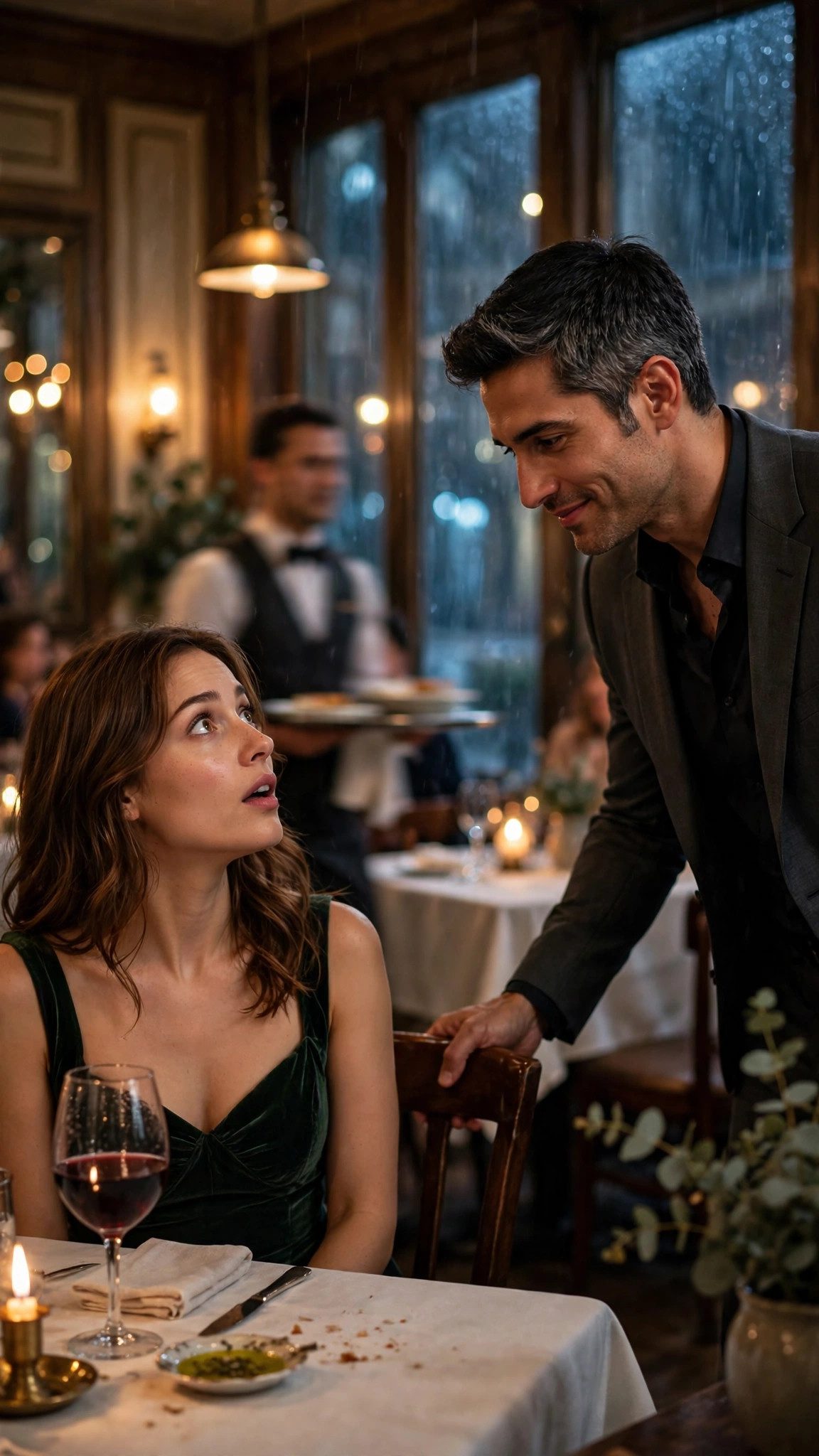
That first year of marriage passed like a dream. We settled into Rosa's house, into Sunday dinners, into the rhythm of a life shared. I ran the memory-care program, and it thrived, and the garden bloomed, and the fountain sang. Anthony's businesses grew cleaner every month, and the men who worked for him walked a little taller, because they knew their boss was a man who kept his word. Louise came in three days a week, and she still told me what to do, and I still listened. And every night, Anthony came home, and I took his coat, and he kissed my forehead, and he said, "I'm home," and I said, "Welcome home," and it was the simplest, happiest thing in the world. And on quiet evenings, when the house was still and the garden was dark, I would sit by the window and think about the girl I had been, sitting alone at a table for two, waiting for a man who never showed up, and I would think about how grateful I was that he never showed up. Because if he had, I would never have met the man across the room. I would never have met Ryan. I would never have met Anthony Russo. And I would never have known what it felt like to be safe, and loved, and home. The rain was coming down on the windows, just like it had that first night. The waiter brought us wine. And Anthony looked across the table at me, and he smiled, and he said, "It looks like we're both being stood up."
I laughed. I laughed until tears ran down my face. "No one's standing us up tonight," I said. "Not ever again."
He reached across the table and took my hand, and he held it, and he looked into my eyes, and he said the words he had said to me a hundred times, the words that had become the promise of our life together.
"You're safe now, Emma."
And I looked at him, and I smiled, and I said the words back to him, the words that were just as true, the words that were my promise to him.
"You're safe now, Anthony. You're safe now."
We sat there for two hours, just like the first time, talking and laughing, and the rain came down on the windows, and the city went on outside, and I thought about the girl I had been a year ago, sitting alone at a table for two, waiting for a man who never showed up, and I thought about the woman I had become, sitting across from the man who had shown up instead, the man who had never told me his last name, the man who had given me his name and his heart and his whole life.
He never told me his last name. Not on the first night. Not until I already loved him. And that, I understood now, was the greatest gift he could have given me. Because I fell in love with the man, not the name. And the name, when it finally came, was just the beginning of everything that followed.
My name is Emma Russo. And I am safe now. And I am loved. And I am home.
The End.
THE END