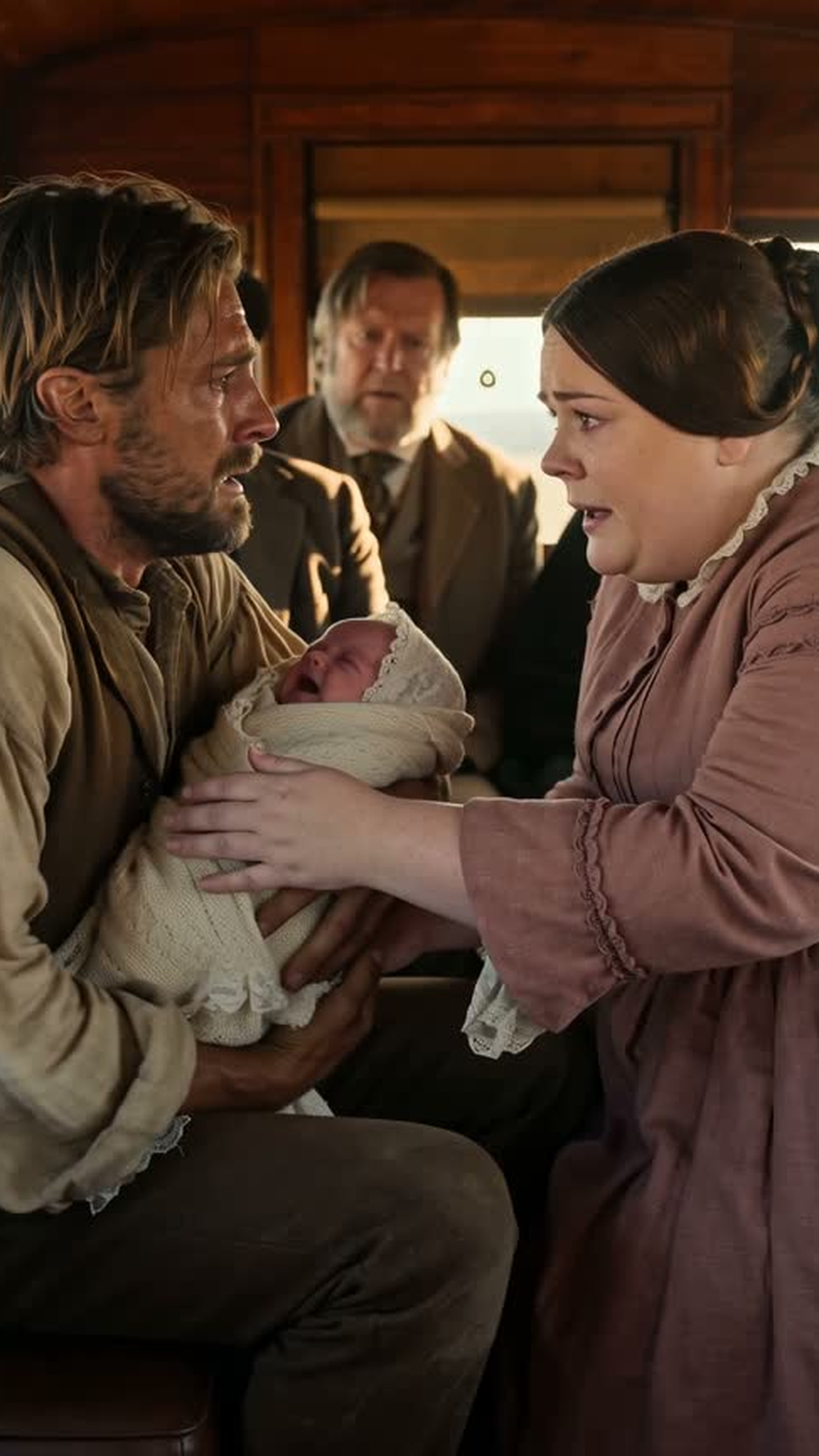
The baby was dying by inches, and everyone in the stagecoach knew it except the man holding him.
"Please, son… please."
Caleb Warren's voice broke on the word. He sat on the left-hand bench of the coach with his three-week-old son cradled against his chest, rocking with the violent sway of the wheels as the stage hammered over the rough dirt road toward Fort Collins, and his rough rancher's hands — hands that could rope a steer and mend a fence in the dark — trembled uselessly around a bundle of ivory knitted blanket.
Samuel Warren was three weeks old. He had barely fed since the previous morning, and his crying had changed over the last hour in a way that emptied the color out of his father's face. It was no longer the furious, red-faced wail of a hungry newborn. It was thinner now. Weaker. A sound like something winding down.
"Please," Caleb whispered. "Please, son. Please."
He fumbled the little glass feeding bottle up out of his coat — goat's milk, warmed against his own body for an hour — and carefully raised it to the baby's mouth. Samuel's lips touched the nipple. For one heartbeat, hope lit Caleb's exhausted face.
Then the baby turned his head away and began to cry again, feebler than before.
Across the narrow coach, the traveling salesman Pritchard exhaled through his nose and turned pointedly to the window. Beside him, old Mrs. Henderson, bolt upright in her black mourning bonnet, pressed her lips into a line of disapproval — at the noise, at the hour, at a man trying to do a woman's work in public and failing at it.
And opposite Caleb, in the dusty rose dress with lace at the sleeves, sat the woman who had not looked away from the baby in twenty minutes.
Eliza Moore was thirty years old, a big woman, close to three hundred pounds, with dark hair pinned beneath a modest bonnet and a face that had learned, very recently, how to hold itself perfectly still so that grief would not show. She watched the baby's small fists open and close. She watched the bottle, nearly untouched. She watched the movements get slower.
She leaned forward.
"When did he last feed?" she asked quietly.
Caleb looked up at her. His face — weathered, handsome under the beard and the exhaustion, wet-eyed — was the face of a man at the absolute end of himself. He swallowed before he could answer.
"Yesterday morning," he said, barely audible over the wheels. "A little."
Eliza Moore froze.
Yesterday morning. A little. She did the arithmetic that every mother in that coach was suddenly doing, and her eyes filled so fast she had to look down at her own hands. Her hands were shaking. Slowly, with the deliberate care of a woman disarming something inside her own chest, she reached up and removed her bonnet.
"I buried my daughter in Julesburg," she said softly.
The coach went utterly silent. Pritchard stopped pretending to watch the window. Mrs. Henderson's mouth opened and closed.
Eliza's eyes were on the baby. On the ivory blanket. On the little weakening fists.
"I still have milk."
Caleb stared at her. His eyes moved from her face down to his son, whose cries had thinned to something that was barely a sound at all, and back to her — disbelief and a hope so fragile it looked like terror.
Eliza Moore leaned across the swaying coach and extended both of her arms toward the child.
"Give him to me," she said, soft and firm as a hand on a shoulder.
Caleb's trembling hands tightened around the ivory blanket. Every eye in the coach was on him. The wheels rattled. The horses pounded. His son's life was going out like a lamp in a wind, and the only person on earth offering to stop it was a stranger who had just told him she buried her own baby girl two weeks ago.
He began, slowly, to move the baby toward her—
* * *
THREE WEEKS EARLIER
Margaret Warren died at dawn, and for a while, standing in the doorway of the ranch house bedroom with his newborn son screaming in the midwife's arms, Caleb could not understand what the world was asking of him.
She had been well. That was the thing nobody could explain, then or ever. The labor had been long but not terrible; the boy had come healthy and loud at midnight, with his mother's chin and a head of dark hair, and Margaret had held him and laughed — actually laughed, exhausted and shining — and said, "Samuel. He's Samuel. Look at him, Caleb, he has your temper already."
By four in the morning she was burning with fever. By five she was speaking to people who were not in the room. By dawn, with the light coming gray over the Colorado plains and the doctor still an hour's ride away, she put her hand once on the baby's head, blindly, the way you reach for something in the dark — and then her hand was still.
Caleb buried her on the hill above the ranch house, in sight of the mountains she had loved, with half the county standing in the wind. Then he walked back down the hill to a house where a three-day-old baby was screaming himself hoarse, and he picked up his son and began the education that would nearly break him.
A newborn needs a mother. This is not sentiment; it is machinery. Samuel needed feeding every two hours, day and night, and there was no woman on the Warren ranch. There was old Tomas, the hired hand, who could cook beans and shoe a horse and who looked at the baby the way a man looks at a live coal in his own bed. There was Mrs. Ada Kessler from the neighboring homestead, four miles off, who came twice a day for the first week with her own youngest still nursing — but her milk was drying, her own baby was weaning, and four miles of frozen mud road twice a day was a burden no neighbor could carry for long.
Caleb did everything else. He bought a nanny goat and milked her at hours that stopped meaning anything. He bought the little glass bottle with the rubber nipple from the catalog, and sugar, and he diluted and warmed and coaxed. Samuel took some of it, some of the time, the way a drowning man takes some air. He did not thrive. He held his weight, then he lost a little. He cried with a weariness that was new each day and older than he was.
At night Caleb walked the floor of the cold ranch house with the baby against his shoulder, past the door of the room he could not yet bring himself to open, and he talked. He told his son about Margaret. He told him about the ranch, the herd, the dog. He promised things, out loud, in the voice a man uses when the promise is the only rope he has: "You're not going anywhere, you hear me? I lost your mama. I am not losing you. You stay."
On the twelfth day, the letter came from Fort Collins.
His sister Ruth — eleven years older, married to a livery owner, mother of five — wrote in her plain, unsparing hand. A woman in Fort Collins, a Mrs. Beal, had twins in October and milk enough for three; she had nursed a neighbor's orphan already and would take another baby for pay. Fort Collins was two days by stage. If the boy was failing on goat's milk, Caleb was to bring him, and bring him now, and stop being stubborn in a graveyard direction.
Caleb read the letter four times by lamplight with Samuel asleep — finally, briefly asleep — in the crook of his other arm. Then he looked at the small, waxy, exhausted face, at the fists that had begun, that day, to open and close more slowly than they had the day before.
He packed the ivory blanket Margaret had knitted in the last month of her pregnancy, lace-edged, soft as breath. He packed the bottle and a jar of goat's milk and two changes of his own clothes he would never remember choosing. He left Tomas the herd, the dog, and instructions he wrote out twice.
And at first light on the third day of Samuel's third week of life, with the baby not fed since the morning before — because the bottle had failed all night, because the goat had gone dry-eyed and stubborn, because everything Caleb tried now turned to nothing in his hands — he climbed into the Fort Collins stagecoach at the depot, took the left-hand bench, and held his dying son against his chest as the driver shouted and the team leaned into the harness.
He did not know that the large, quiet woman settling onto the bench opposite him, arranging her dusty rose skirts in the narrow space, had buried her daughter two weeks before.
He did not know that she was the reason his sister's letter was already out of date.
He only knew the wheels had started turning, the road had fifty miles of rattling left in it, and somewhere around the second hour, his son's crying began to change.
The night before the stage, Caleb did not sleep at all, and neither, in any way that mattered, did Samuel.
He walked the floorboards from dark to dark-blue. He tried the bottle warm. He tried it cool. He tried a clean cloth dipped in the milk, the way old Tomas said his own mother had done in Texas, and Samuel sucked at it weakly and gave up, and the giving up was worse than the crying. Toward three in the morning the baby slept for twenty minutes, so still and so pale in the lamplight that Caleb put two fingers against his tiny chest and held his own breath until he felt the small heart going — fast, light, there — and then he sat down in Margaret's chair with his son in his arms and wept without sound, the way men weep who are afraid the sound will use up something they need.
He had been strong his whole life. He had held a broken fence line against a blizzard; he had carried a calf two miles in snow; he had watched his wife lowered into the ground and had not fallen down in front of the neighbors. But there is a specific helplessness that only a parent knows, and it does not care how strong you are. It comes at three in the morning when the thing you love most in the world is failing in your own hands and your hands are the problem — too rough, too clumsy, made for ropes and rails and not for this. Caleb would have traded the ranch, the herd, the land, the house, and both his arms for one ordinary woman with an ordinary gift that half the world takes for granted.
At the depot, in the cold blue morning, the station agent's wife took one look at the bundle in his arms and crossed herself — not unkindly, the way you do at weather you can see coming. The other passengers were arriving with their bags and their impatience: a drummer with sample cases, an old woman in deepest mourning black who boarded like a queen boarding a ship she disapproved of, and last of all a large woman in dusty rose, moving carefully, carrying one small carpetbag and nothing else, her face set in the particular stillness that Caleb would later learn to recognize — because for three weeks he had been wearing it himself.
The face of someone riding away from a grave.
He took the left-hand bench because it was nearest the door and he wanted the air for the baby. She took the bench opposite because it was the one that was left. Their knees nearly touched in the narrow coach. She nodded to him once, politely, a stranger's nod, and then she looked — as everyone looked, as everyone would look all day — at the bundle in his arms.
Samuel stirred in the ivory blanket, made a small, exhausted sound, and quieted.
Caleb closed his eyes and prayed the only prayer he had left: *Just get him to Fort Collins. Just get him there alive.*
The coach lurched. The wheels began to turn. And the woman opposite, who had been so careful not to stare, settled her hands in her lap and began, quietly, without knowing she was doing it, to count the baby's breaths.