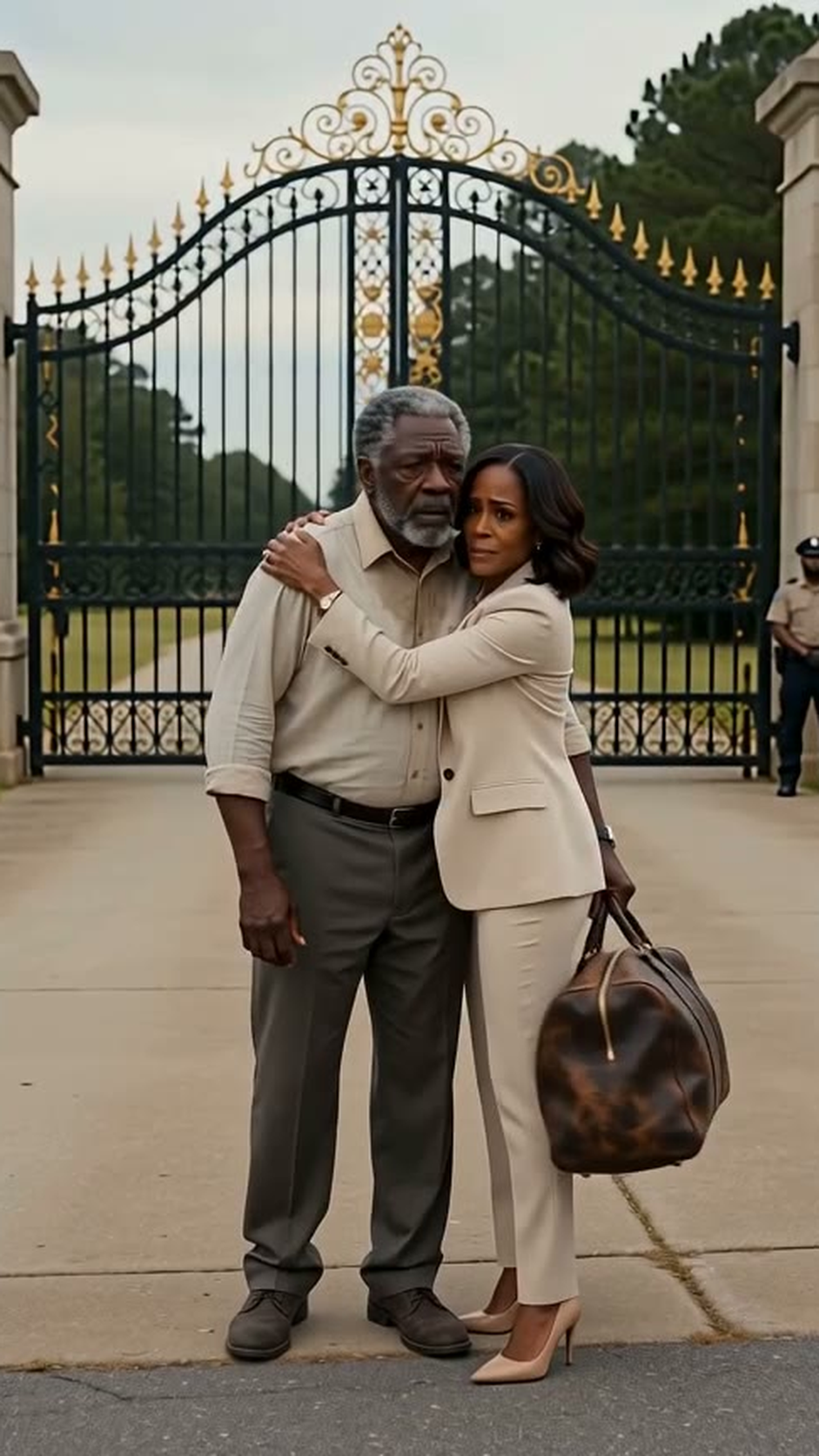
The alarm went off at three-thirty in the morning of Thursday, November twenty-seventh, and Melanie was out of the bed before the second chime, moving in the dark with the care of a woman defusing something.
She had packed the night before — not a suitcase, which would have been a statement, but a tote bag, a thermos, a phone charger, and a cashmere blanket folded into the back seat for a man who would be cold in a way that had nothing to do with weather. She dressed in the cream pantsuit she wore to things that mattered. She made coffee she didn't drink. At four-fifteen she carried her keys through the silent house toward the garage, past the dining room, past the portrait, past the table where a family had voted to put its father in a shed.
Kenneth was standing by her car.
She stopped so fast the keys rang against each other in her hand. He was fully dressed — the dark-blue business shirt, tailored trousers, a man who had clearly not slept so much as waited — and he stood in the narrow space between her open car door and the garage wall, and when she came toward him he set one hand flat against the top of the door and kept it there.
"Don't go."
"Move, Kenneth."
"I'm asking you." His voice was low and it was working hard to stay that way. "I'm asking you as your husband. Let the state handle it. Let him take the bus, let him go to a motel, let this family get through one wedding — one — and then I'll sit down with you and we'll talk about what comes next."
"The bus drops him at a gas station, Kenneth. With a paper sack. He's sixty-eight years old."
"And who's fault is—" He stopped himself, and the stopping cost him visibly. "Melanie. Please. Harlan Pierce's people have been nothing but decent about— if there's a photograph, if there's one photograph of my wife collecting a felon at a prison gate in the Jackson papers—"
"Then there will be a photograph," she said, "of a woman keeping a promise your mother made."
He didn't move. His hand stayed on the door. His shoulders were up around his ears and hers were trembling, and they stood there in the gray garage light looking at the wreckage of eleven years of never quite saying any of this out loud.
"Kenneth." She reached out and put her hand, very gently, over the hand that was holding her door. "Someone has to."
Something in his face gave way — not agreement, never that, but the knowledge of a man who has lost an argument he couldn't afford to win. He took his hand off the door. He stepped back. Melanie got in, and pulled the door toward herself, and it shut with a solid, final sound that seemed to take all the air out of the garage.
She backed out into the dark. In the mirror she saw him standing in the rectangle of light, smaller and smaller, and then the street turned and he was gone, and it was just her and the highway and five hundred and thirty-eight kilometers of everything they had not said.
She stopped once, an hour out, at an all-night station in the middle of nowhere, and bought gasoline and two bottles of water with hands that had finally stopped shaking, and stood in the fluorescent glare looking at her own reflection in the shop window — a woman in a cream suit at five in the morning, committing the most extreme act of her marriage — and said out loud, to no one, the thing that had decided her at the dining table three weeks before:
"He sat at our table for thirty years. He doesn't sleep in the shed."
Then she got back in the car and drove north into the getting-light.
The highway unspooled in the dark ahead of her, white line and black fields, and somewhere past the river bridge the sky began its slow change from black to the color of wet slate. She drove with the window cracked an inch, the cold air keeping her honest, and rehearsed nothing at all — for once in her careful life, Melanie Crawford had no script, only a promise and a full tank of gasoline and a man waiting behind a gate.
—
She drove the way she had driven to the prison sixty times: steady, both hands placed, radio off. The calls started at six. KENNETH lit the console screen while she was crossing the delta flats, again at seven, again at eight, and she watched each one burn itself out unanswered, and hated herself with a clean, uncomplicated hatred, and did not call back. Whatever waited at the end of this road could not be carried by both of them over a phone line. She would bring it home in the car with her or she would not bring it home at all.
The penitentiary appeared the way it always did — first the water tower, then the wire, then the walls the color of old bone, then the gate, tall and black and absurdly beautiful, a rich man's gate doing a poor job's work, and she parked in the visitors' lot and sat for one whole minute with her hands still on the wheel.
She had imagined this moment on sixty drives home. She had never once imagined having to lie to him in it.
There was a form, of course. There is always a form; the state does not release a human being the way you release a held breath. In a beige office that smelled of toner, a clerk with kind eyes and a wedding ring pushed a clipboard across a counter — acknowledgment of custody, the printed words said, as if Gerald were a package being signed for — and asked, without looking up, "Relation?"
Melanie wrote it in her best handwriting. Daughter-in-law. Then, after a second's thought, she added the sentence that had been building in her for three weeks, in the space marked notes, where no one would ever read it and where it mattered most: Only family coming.
She was still holding the clipboard when the buzzer went, and the guard by the inner door jerked his chin at her in the universal gesture of it's time.
They brought him out at ten minutes past ten.
She saw the gate begin to move and she was out of the car before she knew she was moving. He came through it alone — the bag, the shirt, the shoes she knew too well — and he stopped on the concrete and looked up and down that empty road with an expression she had five years to memorize and had never seen from this side: the look of a man checking, one last time, whether anybody at all had come to claim him.
Her heels hit the concrete. "Dad! WAIT—"
She caught his arm. The bag swung. He turned — and Melanie watched five years of composure crack straight down the middle of the face she loved best in his whole family.
"Melanie?" he said. Then, hoarse, not loud, the question he'd plainly been holding the way you hold a coal: "Where are my children?"
Here it was. She had rehearsed this too, on sixty drives, a dozen soft constructions — Giselle's stuck at the venue, Kenneth's in a closing, traffic, timing, anything — and standing there with her hand on his arm and his eyes wet and searching her face, she found she could not build a single one of them. What came out was the truth cut down to the size of mercy:
"They couldn't come, Dad. The wedding's in ten days and — everyone's upside down. I came. I came for all of us."
It wasn't a lie, exactly. It was a bridge made of one plank, and she watched him decide to walk across it because the alternative was the ditch. His shoulders came down. He let out a breath she'd been holding alongside him.
"Course," he said. "Course. Giselle's wedding." And he nodded at the empty road as if it had explained itself, and let her take the bag — he let her take the bag, which nobody who knew Gerald Crawford would have believed — and fold him into the car like something precious and breakable that she was in charge of now.
—
In the first hour he asked questions with the starved delicacy of a man at a well. Was the company sound? — it was; Kenneth had a gift for it, whatever else. Was Julian Pierce decent to Giselle when nobody was watching? — he was; Melanie had checked the way you check the weather of a beloved country. Did the house still get the good light in the kitchen in the mornings? It did. Did anybody — he stopped, and she watched him choose the smaller question, the survivable one — did anybody still cook in it on Sundays?
"Not like she did," Melanie said. "I try at Christmas. Kenneth says the greens are right. Giselle won't eat collards from anybody else's pot, so mostly we just let the day be a day."
"Margaret's greens took two days," he said, "and a ham hock she'd argue with the butcher about for twenty minutes." The ghost of the smile again, there and gone. "Woman could argue a stone into soup." He was quiet a while. "She die still believing I'd come home and fix this family like a fence?"
Melanie kept her eyes on the road, because the answer deserved her full honesty and she could not give it to his face at seventy miles an hour. "She died believing in you, Dad. The rest of it she left to us."
He nodded slowly, and turned to the window, and did not ask about the children again. The questions stopped; the miles didn't; and that, she understood later, was when he began making the decision about the pocket — turning it over and over the way he'd turn a key he wasn't sure he was allowed to use.
The note came two and a half hours later, at twelve forty-five, with the delta long behind them and the dashboard clock ticking its small red numbers toward an afternoon she thought she understood.
She'd known about the shirt pocket for a while by then. A man riding quietly will touch the things he's carrying, and Gerald had touched his pocket a dozen times since the gate — a flat, checking pat, over the heart. When he finally drew the paper out and said Don't take me home yet, she pulled onto the shoulder the way the urgency in his voice instructed her body to, and she took the folded program with both hands while the engine ticked and a logging truck went past close enough to rock the car.
An address in Ellery she half-recognized — St. Mark's, the church with the food pantry, she'd driven past it a hundred times on this very road.
And beneath it, in her father-in-law's own shaking capitals:
AARON CRAWFORD.
"Aaron…?" The name came out of her barely audible, in a voice she didn't know she had. Her fingers tightened on the paper until it trembled against the wheel. "Dad. Dad, what is this. Aaron is—" She couldn't finish. Five years the whole world had agreed on the end of Aaron's story and the ending had a rest stop and an abandoned car in it.
Gerald stared straight ahead through the windshield. His jaw worked. When he spoke, it was with the care of a man setting down something made of glass he'd carried across an ocean.
"He's alive, Melanie. He's been alive all this time, three hours from that place, working under another name, waiting to see if his father would come for him before he disappears for good." The old man's eyes found hers, and they were not pleading — they were begging, which is a different thing entirely, and she had never seen it on him. "The hall closes at three. There's a bus after. If I miss him, baby-girl, I lose him for the rest of my life. And there are things about that year — things about my case — that you don't know, because I made sure nobody knew."
The dashboard clock said 12:47.
"Drive," Gerald Crawford said quietly. "Please. I'll tell you the rest on the way."