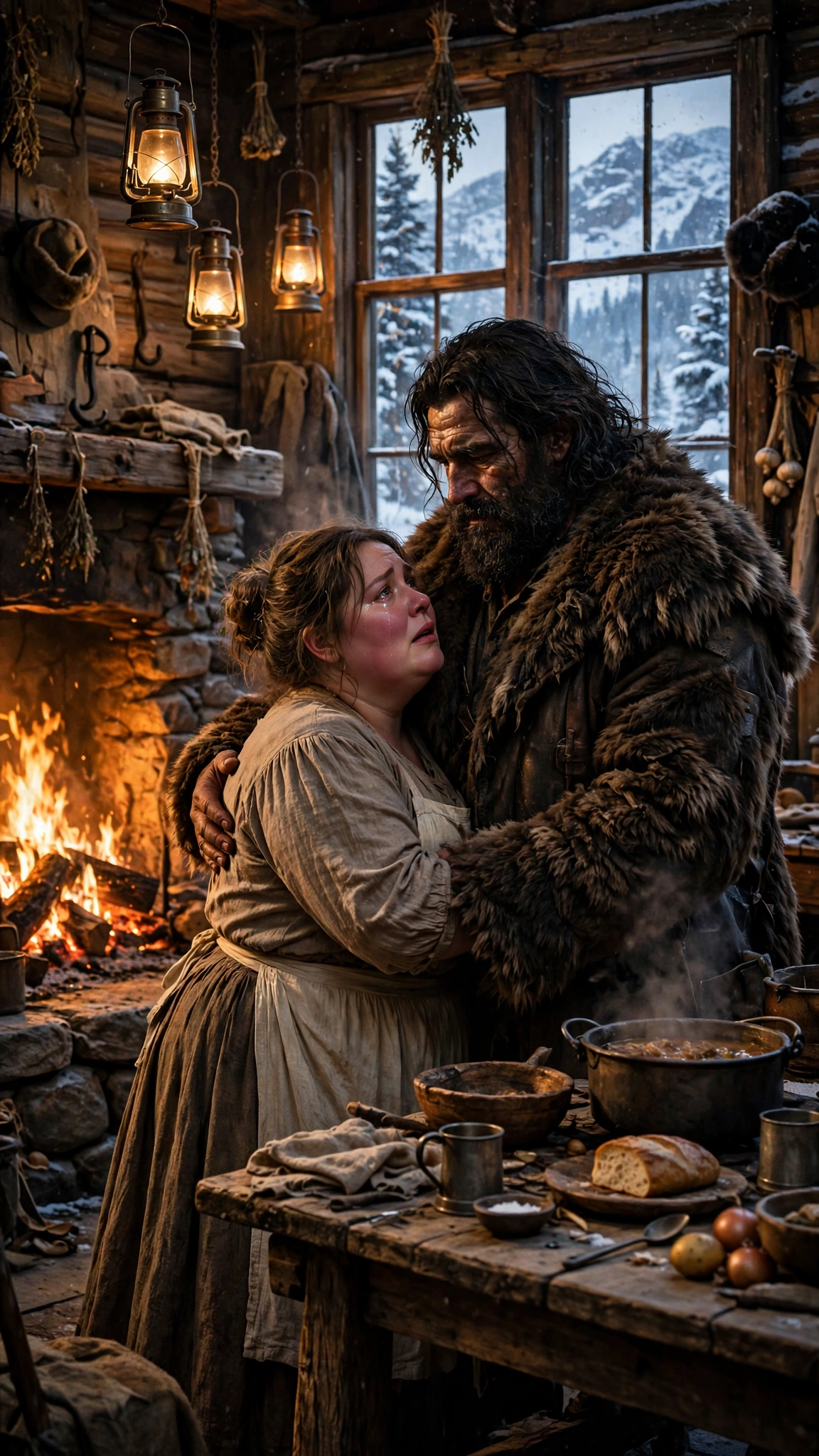
The storm lasted three days.
For three days the snow fell without stopping, and the wind piled it against the doors and windows until the house was half-buried, and the men took turns digging out the barn and feeding the horses, and Matilda cooked from dawn until dark — stew and bread and beans and coffee, pot after pot, for men who came in shaking snow from their shoulders and stamped their feet and held their hands out to the fire. Jedodiah Boon was everywhere: splitting wood with an axe as if the logs were made of paper, hauling water from the creek through snow up to his knees, mending the barn door where the wind had torn it half off its hinges. He spoke little, but he was always where the work was hardest, and the cowboys, who had at first been wary of the giant in the grizzly coat, began to follow his lead without thinking about it, the way men follow a man who knows what he is doing.
And Matilda — Matilda in the trapper's coat, which she had folded carefully and laid across the foot of her bed, because it was too fine a thing to wear while scrubbing pots, and too heavy a thing to wear while kneading bread — Matilda cooked, and the house ate, and for three days the boarding house on Cutthroat Creek was the warmest place in the whole of the Colorado mountains.
On the fourth day, the sky cleared. The sun came out, white and hard, and the snow glittered so bright it hurt to look at, and Silas McCready stood on the porch and said, "Well, boys, we lived through it," and everyone laughed, and the tension of the storm broke like a fever breaking.
Abigail Thatcher did not laugh.
She had watched the three days of the storm from her parlor window, and she had seen the trapper work beside her boarders, and she had seen Matilda feed them all, and she had seen the way the house had settled around the two of them — the cook and the trapper, the kitchen and the woodpile — like a family settling around a hearth. And she had made up her mind.
That afternoon, when the men were out digging the road and Matilda was alone in the kitchen kneading bread, Abigail came in and stood in the doorway with her arms folded, and her face was white and set, and she said, in a voice that carried through the whole house:
"My husband's silver pocket watch is missing."
Matilda looked up, her hands deep in the dough, flour on her forearms, and she said, "Ma'am?"
"Edmund's watch," Abigail said. "The silver pocket watch he carried every day of his life. I keep it in my sewing basket, in my room. I wound it on Sunday, as I always do. This morning it was gone." She took a step into the kitchen, and her eyes were cold and steady. "You are the only person who has been in my room this week. You went in on Tuesday to mend the curtain."
"I did, ma'am," Matilda said, and her heart began to beat very fast. "You asked me to mend the curtain, and I did, and I came straight out again. I never touched your basket, ma'am. I swear it on my mother's grave."
"Then you will not mind if we look," Abigail said. "Silas! Tom! Come here."
The men came in from the porch, stamping snow from their boots, and Abigail told them, in a clear, carrying voice, that the watch was missing and that the cook's room must be searched. Silas McCready's face went dark. Tom Ellery looked at the floor. Wade Conroy shifted his weight from one foot to the other and would not meet Matilda's eyes.
"Ma'am," Silas said slowly, "Matilda Hart is no thief. I have eaten at this table for three months, and —"
"Are you calling me a liar, Mr. McCready?" Abigail said.
"I am saying that a woman who cooks for us the way she does, who gets up before dawn and works until dark, is not the kind of woman who steals a dead man's watch."
"Then the search will prove her innocent," Abigail said, "and we can all be satisfied. Unless she objects."
Matilda stood with her hands in the dough, and her face burned, and her eyes filled, and she thought of all the times in her life when she had been accused of things she had not done — of eating too much, of taking up too much room, of being too much of everything — and she thought of Thomas, who had always said, "Let them look, Matty. An honest person has nothing to hide." And so she wiped her hands on her apron, and she lifted her chin, and she said, "Search, then. Search my room. Search the kitchen. Search everything I own. I have nothing to hide."
They searched.
Silas went through her small room at the back of the kitchen with a face like stone, opening the trunk where she kept her two dresses and her shawl, looking under the bed, looking in the drawer where she kept her mother's recipe book. Tom stood in the doorway, miserable, his hat in his hands. Wade searched the pantry. Abigail stood in the middle of the kitchen with her arms folded, watching it all, and her face did not change.
They found nothing. Of course they found nothing. There was nothing to find.
But the search itself was the wound. Matilda stood in her own kitchen and watched men go through her belongings — her dresses, her mother's recipe book, the little wooden cross Thomas had carved for her on their wedding day — and she felt something inside her go very still and very cold, the way the creek went still under the ice in January.
She had been searched before, in a way. Not her room, but her person — all her life, people had looked her over and found her wanting. Too fat. Too slow. Too much room taken up at the table, too much food on the plate, too much woman altogether. In Denver, the hotel keeper's wife had weighed her with her eyes every morning, as though Matilda's body were a debt she owed. On the trail, a teamster had told her she ate enough for two men and worked like half of one. She had learned to make herself small — to take the smallest chair, to eat standing up, to apologize for her appetite, to laugh when men made jokes about her size, because laughing was easier than crying, and crying changed nothing.
But no one had ever gone through her trunk. No one had ever laid hands on her mother's recipe book, on the little wooden cross, on the two dresses that were all she owned in the world. That was different. That was not a look. That was a hand, reaching into her life and turning it over, looking for something rotten.
When Silas came out of her room, his face was the color of ashes, and he would not meet her eyes. Tom Ellery stood in the doorway with his hat crushed between his hands, and he said, in a voice barely louder than a whisper, "Ma'am, I am sorry. I am so sorry. I told her — I told her you would never —"
"Hush, Tom," Silas said, not unkindly. "It is done now."
But it was not done. Not for Matilda. That evening, after supper, when the men had gone to their rooms and the kitchen was quiet, she sat on her narrow bed and held her mother's recipe book against her chest, and she thought about all the kitchens she had worked in, and all the women who had owned them, and she wondered if there was any kitchen in the whole of Colorado where a woman like her could simply belong — where she would not be weighed, or searched, or told to make herself smaller.
There was a knock at her door, soft, hesitant. She opened it to find Tom Ellery, holding his hat in his hands, his young face miserable.
"Ma'am," he said, "I want you to know that none of us believe it. Not one of us. Silas says you are the finest cook in the territory, and I say you are the finest person in this house. And if Mrs. Thatcher throws you out, I will go with you. I mean it. I will walk down that mountain with you, wherever you go."
Matilda looked at him — at this boy, barely a man, offering her the only thing he had, which was himself — and her throat closed up, and she could not speak for a moment. Then she said, "Thank you, Tom. That is the kindest thing anyone has said to me in a long time. But you will not walk down any mountain. You have work here, and a wage, and I will not take that from you."
She closed the door, and she sat back down on her bed, and she held the recipe book tighter, and she thought, "One week. Seven days." And then she thought about Jedodiah Boon, and about the way he had stood in the doorway, and she thought that perhaps — just perhaps — one week was enough time to find the truth, if she had someone standing beside her.
When it was over, Silas came out of her room and said, "Nothing, ma'am. There is nothing here."
Abigail's mouth tightened. "Then she has hidden it somewhere else. In the barn, perhaps. Or under the floorboards."
"That is enough."
The voice came from the doorway, deep and quiet, and everyone turned. Jedodiah Boon stood there, snow on his shoulders, an armload of firewood in his arms, and his icy-blue eyes were fixed on Abigail, and his face was the face of a man who had just watched something he would not forget.
He set the firewood down by the stove, very carefully, log by log, and then he straightened, and he looked at Abigail, and he said, "You searched an honest woman's room in front of her boarders, on nothing but a suspicion, and you found nothing. That is enough."
"I am the owner of this house," Abigail said, and her voice shook, just a little. "I will decide what is enough."
"Then decide," Jedodiah said. "But know this. If you throw her out, I go with her. And if I go, Silas goes, and Tom goes, and Wade goes, and this house will be empty before the week is out, and your Mr. Vane can buy an empty house in the middle of nowhere for whatever he likes."
The silence that followed was worse than the storm. Abigail's face went white, and then red, and then white again, and for a moment Matilda thought she might strike him. But Abigail Thatcher was a woman who had survived the death of a husband and three years of carrying a house alone, and she did not strike people. She did something colder.
"One week," she said, and her voice was steady now, and terrible. "You have one week, Matilda Hart. One week to find other work and be gone from this house. I will not have a thief under my roof, and I will not be threatened in my own home by a trapper who pays for a room by the week."
She turned on her heel and swept out of the kitchen, and the door to her parlor closed behind her with a sound like a lid closing on a box.
Silas McCready let out a long breath. Tom Ellery put his hat back on his head with shaking hands. Wade Conroy muttered something under his breath and went out to the barn.
Matilda stood at the work table, and her hands were still covered in flour, and the bread dough sat half-kneaded in its bowl, and she looked at Jedodiah, and she said, in a voice so quiet he had to lean forward to hear it, "I did not take the watch."
"I know," Jedodiah said.
"Then why does she hate me so?"
Jedodiah looked at the parlor door, and then he looked back at her, and he said, "Because you are the reason this house is still a home, and she is afraid of what will happen when it is not."
That night, Matilda lay in her small room and listened to the wind, and she held her mother's recipe book against her chest, and she thought about one week. Seven days. Seven days to find work in the middle of winter, in the mountains, with no money saved and no one to take her in. Seven days, and then the road, and the snow, and the cold.
She did not sleep. She counted the days on her fingers, over and over, as though counting them might make them more. And in the morning, when she got up before dawn to light the stove, she found Jedodiah Boon already in the kitchen, sitting at the work table with a cup of coffee, and he looked up at her, and he said, "We have a week. We will use it well."
"What can we do in a week?" she asked.
"We can find out the truth," he said. "About the watch. And about why Mrs. Thatcher wants you gone so badly that she would accuse an honest woman of theft. A house like this does not turn on its cook for nothing. There is something underneath it. We will dig it up."
Matilda looked at him — at his great dark shape in the lamplight, at his beard and his quiet eyes — and she nodded, and she tied on her apron, and she set the coffee pot on the stove, and she began her day.
She had one week. She would use it well.
=== STEP 4 — APPEND Chapter 4 ===