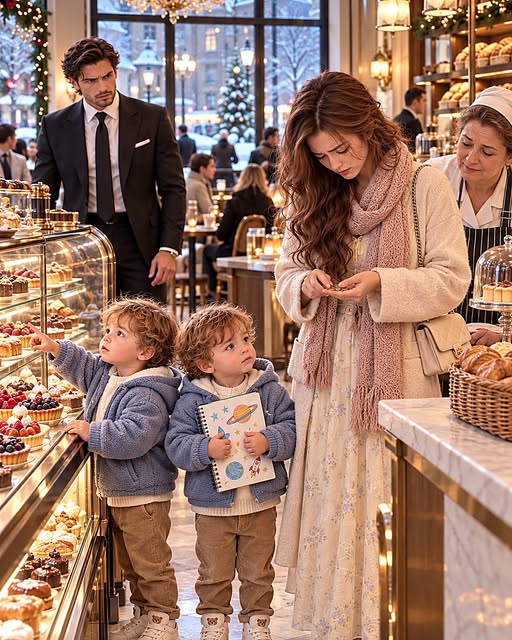
She made me wait eleven days.
I deserved every one of them, and I want that understood before anything else in this chapter. Eleven days of going to my office and staring at the unsigned Gold Coast contract — I had formally withdrawn from the acquisition, to the fury of two banks and a small army of investors — while Martin's investigators quietly pulled the Whitmore and Gale archive apart page by page. Eleven days of reading my sons' birth certificates so many times I memorized the weight of the paper they weren't printed on.
On the twelfth day, my phone lit up with a number I didn't know.
"Frank's bakery," Naomi said. "Thursday. Seven o'clock. He closes at seven." A pause. "Come alone, Preston. If I see a lawyer, a driver, or a man in a suit with a folder, I will walk out, and I will not call again."
"I'll be there," I said. "Alone."
"And Preston." Her voice flattened. "This is a conversation. It is not a door opening."
She hung up.
I arrived at six forty, in jeans I had to buy because I did not own any, and stood in the light rain outside the bakery like a schoolboy. Frank was sweeping the step. He looked me over with the comprehensive mistrust of a man who has fed a struggling mother for four years and just identified the reason she struggled.
"You're the husband," he said.
"Ex-husband."
"Mm." He leaned on his broom. "She cried in my storage room the day those boys were born early, because she couldn't afford the hospital taxi and wouldn't let me pay. You know what she said? She said, 'Everyone I trusted taught me the price of trusting.' So whatever you're here to do, son — do it gently."
He unlocked the door for me at seven exactly.
Naomi was already inside, at the small corner table, with two mugs of tea. The twins were not there — she had left them with a neighbor, Mrs. Alvarez, she told me, a woman who had been family to them in every way that mattered. Naomi's hands were wrapped around her mug like it was a rail on a ship.
I sat down. For a full minute, neither of us spoke. The bakery smelled of cinnamon and cooling ovens.
"You look well," I said, finally, because cowards reach for small talk.
"I look tired, Preston. You look expensive. Let's not." She took a breath. "You said you read my letter. All of it?"
"All of it. The firm's file had everything. Your letters — there were four, Naomi. Four. I never saw one of them."
Her eyes flickered. "Four. I sent three through the firm."
"The fourth was your letter to the house. The Lake Forest staff logs show it arriving. It was forwarded to my mother's office the same day." I made myself say it plainly, because she deserved plain. "She intercepted all of it. The authorization to Whitmore and Gale has her signature on it. I've seen it. My lawyer has it in a vault."
Naomi looked down at her tea. Her shoulders rose once, sharply, and came back down under control, like a wave she refused to let break.
"Five years," she said, "I have rehearsed what I would say if anyone ever believed me. And now I can't remember a word of it."
"Tell it anyway. In whatever order it comes. I have nowhere to be. I will never again have anywhere more important to be."
So she told me.
She told me about the sunroom, and Victoria's calm, tidy threat. She told me about the weeks afterward, watching my mother dismantle her marriage like a woman methodically clearing a table — the comments at dinners, the "concerns" planted with my friends' wives, the story that Naomi was unhappy, that Naomi resented my success, that Naomi would leave eventually and take half of everything with her. She told me about the night in the foyer, and how she had stood on the marble with her hand pressed low against her stomach — she had learned she was pregnant that morning — trying to decide whether telling me in that moment would save her marriage or simply hand my mother the weapon earlier.
"I chose wrong," she said quietly. "Or I chose right. I'll never know. If I'd told you that night, she would have had four more months to work on you. A pregnant schoolteacher, Preston. By the time the boys were born, she'd have had you convinced they weren't yours, or that I was trapping you. I told myself the paper trail would protect us. Lawyers keep records. I was so sure paper couldn't be argued with."
"Paper can be buried," I said.
"Paper can be buried," she agreed. "I know that now. I learned it in a hospital."
The twins had come seven weeks early, in the middle of the night, in a cab she paid for with the last of her savings because the ambulance quote terrified her more than the pain did. Eli first, small and furious. Theo twenty minutes later, quiet, watching the world with one eyebrow already raised. She had named them alone. She had filled in the birth certificate forms alone, staring at the line that said FATHER while a nurse waited with professional patience, and had finally left it blank — not out of spite, she said, but because she had written to the father four times and the silence had answered her.
And then she told me the part she had clearly decided, long ago, never to tell anyone — the part that made Frank go very quiet in the back of the bakery.
When the twins were five months old, colicky and thin and still wearing the monitors from the neonatal unit, she had taken two buses and a train to Lake Forest with a baby strapped to her chest and another in a secondhand carrier, and she had stood at the gates of my mother's estate — the estate where I was, that week, hosting a fundraiser — and rung the bell. She had rehearsed it the whole way: not begging, not accusing. Just: Your son has two sons. Here they are. That is all I came to say.
The housekeeper had come down the drive. An older woman, Greek, kind-eyed, whom Naomi had once helped carry groceries in from the rain. The woman had looked at the babies, and her face had done something Naomi said she would remember on her deathbed — delight first, real delight, and then, arriving like a shutter, fear.
"Miss Naomi," she had whispered, through the bars. "You must go. Mrs. Calloway said if you ever come, I am to say no one is home, and call Miss Voss. Please. I have grandchildren in the visa program the foundation sponsors. Please go."
So Naomi had gone. She had ridden two buses and a train home with the twins, and she had never tried again — not the house, not my office, not my phone. "Your mother didn't just bury my letters, Preston," she said. "She salted the earth. Every door I knocked on had already been spoken to. I stopped believing the doors were the problem. I started believing you were standing behind them, choosing not to open."
After that came the years she described the way other people describe weather — as conditions survived, not events. The divorce settlement, which Victoria's lawyers had structured to be technically fair and practically useless: a modest sum, gone within a year to the hospital bills the insurance hadn't covered and the deposit on the apartment. Teaching full-time, and tutoring at night, and cleaning the school science labs on weekends for a stipend because the stipend came with the health plan the boys needed. Mrs. Alvarez, the retired nurse across the hall, who had taken one look at a twenty-nine-year-old woman alone with two premature infants and simply moved her life over to make room. Frank, who let her pay for the boys' milk in lesson plans for his granddaughter. The boys' first words — Eli said "star," Theo said "more." The winter the boiler failed and she taught them the constellations on the ceiling with a flashlight and glow paint, because if they were going to be cold, they were at least going to be cold under Orion.
"I was not a tragedy, Preston," she said, almost fiercely. "Don't sit there arranging us into a tragedy. We were a family. We were poor, and we were a family, and some of it was wonderful. That's what makes it complicated. If it had all been misery, it would be simple, and you could just feel sorry for us and write a check. But Theo learned to read at four because I read to him every night whether the lights were paid or not. Eli knows the moons of Jupiter. We were not waiting to be rescued. We were living."
"He was never given the chance to answer," I said. My voice broke in the middle of it. "Naomi, I swear to you, on my father's name — the silence was manufactured. I never—"
"I know," she said, and I stopped breathing. "I know now. Martin Hayes's investigator came to my school, Preston. Very polite. Very discreet. He showed me the authorization. Your mother's signature." Her eyes filled, and she let them, and didn't wipe them, and it was the bravest thing I had ever seen. "Do you understand what it has been like? Four years believing the father of my children read my letters and chose silence. Four years of hating you at three in the morning while a baby screamed. And now a man in a gray suit tells me you never knew. I don't know where to put four years of hating you. It doesn't just — evaporate. You don't get to be innocent in my heart just because you were innocent in fact."
"I know," I said. "I'm not asking you to move it. I'm asking you to let me stand here while it's still there."
She was quiet for a long time. Frank, in the back, was stacking trays with great and deliberate noise, giving us the gift of not being overheard.
"Why are you here, Preston? Exactly. Not the letter. You."
"Because two little boys shared one croissant in front of me and called it enough," I said. "Because I have four years of birthdays to answer for, and 'my mother stole them' is an explanation, not an excuse — I chose to believe her about you long before she stole anything. Because I read your letter and the man you described — the one who would have wanted to know — I want to be him again. And because—" I stopped. The next part was the part that mattered, and it frightened me more than the boardroom ever had. "Because I never stopped loving the woman who taught me to make terrible pancakes and quizzed me on the periodic table for fun. I buried it. I did not kill it. That's not a demand, Naomi. You don't owe me anything for it. But you asked, so I'm not going to lie to you. I've lied by silence for five years. I'm done."
She stood up so abruptly her chair scraped.
"This is too much. This is— I have to go home. Mrs. Alvarez—"
"Naomi."
"What?"
"The boys." I kept my voice as steady as I could. "I'm not asking tonight. I'm not asking for anything tonight. But someday — when you've decided, if you decide — I would like to meet them. Not as their father. Not until you say. As your old friend from a long time ago. I'll earn the rest, or I won't, but I had to ask out loud."
She looked at me for a very long moment. Then she picked up her faded coat, and at the door she stopped.
"Their birthday is in March," she said. "Eli wants a telescope he believes costs forty dollars. It costs four hundred. Theo wants to know why the sky is blue with an answer that takes longer than his bath. They are afraid of thunder and loyal to the death." She pulled the door open; the little bell rang. "I'll think about it, Preston. That's more than I ever planned to give you."
I sat in the empty bakery until Frank told me, not unkindly, that a man can only nurse one tea for so long.
When I stepped outside, my phone was already ringing. Martin. His voice had the tight, flattened quality it gets when the news is bad in a way that has lawyers in it.
"Preston. The archive request. The trustee at Whitmore and Gale — an old man named Collier — he retired last year, but someone kept his notification settings." He exhaled. "An alert about the file access went out tonight to an email address at Voss Management."
Eleanor Voss. My mother's sister-in-law. The name on the Delaware holding entity. The woman who had managed Victoria's private office for twenty years.
"She knows we've opened the file," Martin said. "Which means by now, your mother knows too."
Across the street, under a streetlamp, a black sedan I had not noticed pulled slowly away from the curb in front of Naomi's apartment building — and I started to run.