The black sedan belonged to a process server.
I reached Naomi's building at a dead run, in the rain, in my new jeans, with my heart in my throat — and found, taped inside the lobby door in a waterproof envelope, a letter from a law firm I knew well. Harrow, Bland and Cole. My mother's firm. The firm that had thrown the galas, sponsored the tables, defended the family for thirty years.
Naomi came home twenty minutes later with a bag of groceries and two sleepy twins, and found me sitting on her building's front step like a man guarding a gate. Theo regarded me with the Calloway eyebrow. Eli, half-asleep against his mother's side, informed me solemnly that I was wet.
The letter, when Naomi opened it at her kitchen table with the boys asleep in the next room, was everything my mother is: elegant, reasonable, and built like a trap.
It expressed the Calloway family's "delight" at learning of the children. It proposed — proposed — a generous trust: two million dollars per boy, held until age twenty-five, plus a comfortable apartment, plus private school tuition, in exchange for a full and permanent confidentiality agreement, a release of all claims "of any nature," and Naomi's signed acknowledgment that the children's upbringing would be "guided by family consultation." In plain language: take the money, sign away your voice, and hand Victoria Calloway consultative rights over my sons' lives.
There was a forty-five-day deadline. Generous, the letter called itself. Time to consider.
Naomi read it twice. Then she set it down with extraordinary care, the way you set down something that might be carrying a disease.
"She still thinks I'm a price," she said. "Five years, and she has learned nothing except inflation."
"What do you want to do?" I asked.
"I want to frame it," she said, "and hang it over the boys' beds when they're old enough, so they know exactly what their dignity was appraised at." Her hands were trembling, but her voice was iron. "And then I want to say no, Preston. In writing. By the deadline. Politely."
I loved her so much in that moment that I had to look at the floor.
Two days later, my mother summoned me to Lake Forest.
She received me in the sunroom. Of course she did — the room where she had threatened Naomi six years ago, though I only understood the symmetry when I was standing in it. Tea had been laid out. Eleanor Voss sat in the corner with a leather folder, silent, gray, watchful — the woman whose Delaware holding company had eaten four point seven million dollars of schoolchildren's books.
"Preston," my mother said. "You look tired. Sit down."
"I'll stand."
"As you wish." She poured tea neither of us would drink. "I understand you've been… investigating. Old files. Old letters. I imagine you have questions, and I imagine that woman has provided you with answers that flatter her."
"Her answers came with documents," I said. "Yours, so far, have come with a process server and a two-million-dollar leash for my sons."
Victoria's face did not change. "The trust is a kindness. Those boys are Calloways. They should be raised as—"
"They are Vances," I said. "They were raised as loved. It's a higher standard than ours, apparently."
Eleanor's pen made a small sound against her folder. My mother set her cup down with a precision that in anyone else would have been slamming it.
"Listen to me very carefully," she said. "Because I am your mother, and I will have this conversation exactly once. Whatever irregularities may exist in the foundation's books — and I concede nothing — they are the untidiness of an office, nothing more. Eleanor is loyal but she is not a bookkeeper. If you drag this family into an audit, Preston, you will not be exposing a crime. You will be exposing your own wife's fabrication — because that is what it will become, in every record and every headline, before I am finished. A schoolteacher who cried fraud when she was divorced. A bitter woman who forged letters to—"
"The authorization has your signature on it," I said.
"Signatures can be contextualized."
"The holding company has Eleanor's name on it."
"Eleanor acts on her own initiative in many—"
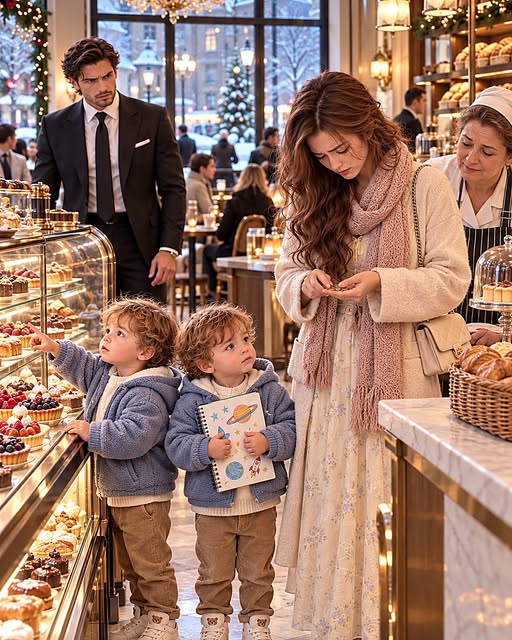
"Mother." I said it very quietly, and for the first time in the conversation, something flickered behind her eyes. "I have read Naomi's letter. All four of them. I have stood in a bakery and watched your grandsons share a croissant because their mother was eighty cents short — eighty cents, in a city where you spend that on the flowers for one lunch. Do not stand in this room and tell me about context."
She rose then, and she was magnificent and terrible, seventy-one years old and straight as a blade.
"Then hear the context," she said. "Your father built an empire and nearly gave it away to every sob story with a library card. I have spent thirty years protecting what he built from his own softness. The foundation was a vanity with a tax benefit, Preston. A rounding error in a real empire. And that girl — that girl found a discrepancy and came to me with her little invoices like a hall monitor, and she would have burned this family's name in the newspapers for the pleasure of being right. I removed her. I would remove her again. The boys were… regrettable. But empires are not run on regrets."
"Regrettable," I repeated. "Your grandsons are 'regrettable.'"
"I did not know about the pregnancy when I began." For one instant — one — her voice thinned. "When Eleanor brought me the first letter, I… the machine was already moving. Stopping it would have meant confessing. I chose the family."
"You chose yourself," I said. "You always have. The family is just the name you give the mirror."
I walked out of the sunroom, down the marble foyer — my foyer, the one where I had told my wife to disappear — and out of my mother's house, while Eleanor Voss, behind me, began to speak very quickly and quietly into a telephone.
The audit began that week, though Victoria did everything in her considerable power to strangle it. Martin brought in a forensic accounting firm from New York — outsiders, immune to Chicago society. Two foundation board members resigned within days, citing health. A third called me personally to suggest that I was "unwell" and "grieving inappropriately," which is boardroom language for: your mother has been making calls.
And in the middle of that cold war, Naomi kept her word.
She had thought about it, as promised, and her answer came with conditions, read aloud to me in Frank's bakery like treaty terms: I would meet the boys as Mr. Calloway, an old friend of Mommy's. I would not buy them anything larger than a sandwich. I would not say the word father, or let anyone else say it, until she decided. I would come when invited and leave when asked, without argument, sulking, orCalloway theatrics — her phrase, and she meant it.
"Agreed," I said. "All of it. Where?"
"Saturday," she said. "The planetarium. Eli has been saving questions about Saturn's rings for someone whose ears he hasn't exhausted, and God knows mine are exhausted." She almost smiled. "Don't be late, Preston. They notice everything."
I was forty minutes early. I stood in the planetarium lobby with a paper coffee, rehearsing the names of Saturn's moons under my breath like a man cramming for the only exam of his life.
They came through the door at eleven — Theo first, scanning the room with the eyebrow, Eli behind him clutching the planet notebook, both of them in matching jackets Naomi had clearly bought a size too big so they'd last two winters. She introduced me with a composure I knew was costing her everything.
"Boys, this is Mr. Calloway. He was Mommy's friend a long time ago, before you were born. He's going to look at the stars with us."
Theo studied me for a long, unnerving moment. "You have a sad face," he announced.
"Theo," Naomi said.
"It's okay," I managed. "He's not wrong."
"Eli has questions," Theo continued, "but I get a question first. That's the rule. Mommy said." He planted his feet. "Why are you sad?"
"Because," I said, kneeling down so that we were level, and telling the purest truth I had ever told, "I missed a lot of important things. And I'm hoping I can be around for the next ones."
He considered this with the gravity of a judge. Then he nodded once, and took my hand — my hand, with his small, warm, croissant-crumb fingers — and pulled me toward the first exhibit, because apparently I had passed.
I spent three hours being interrogated about Saturn. Eli asked questions I could answer and questions no one can answer, and wrote my responses — my responses — in the battered notebook in wobbly letters, under a heading he told me was "STAR EXPERTS WE KNOW." Theo, discovering that I could name the moons in order, appointed me a rank: "Assistant Sky Boss," which he explained was probationary.
When Naomi finally said it was time to go, Eli pressed the notebook into my hands. "You keep it till next time," he said, "so you can practice."
"Next time?" I asked, carefully, not looking at Naomi.
"There's always a next time at the planetarium," said Eli, like a philosopher. "That's the whole point of the sky."
Three days before that Saturday, Eleanor Voss had telephoned Martin's office from a number that did not trace anywhere, and asked to meet — not me. Him. A lawyer. "Because lawyers keep records," she said, in the diner on Cermak where she arrived twenty minutes early and sat facing the door like a woman in a film she no longer believed she was the heroine of.
Martin told me about it afterward, in detail, because it was the moment the war changed shape.
Eleanor had not come to confess. She had come, at sixty-eight, to negotiate with the future. Victoria, it transpired, had begun preparing her own defense before there was even an accusation — and her defense, elegantly, was Eleanor. Draft statements existed. Talking points existed. In each of them, the foundation's "irregularities" were the unauthorized improvisations of a trusted secretary who had grown greedy and senile, and Victoria Calloway was a grieving widow betrayed by the help.
"Twenty years," Eleanor told Martin, stirring coffee she never drank. "I forged nothing on my own initiative. I married no one, I buried a husband, I have no children. I made that woman my whole life because she told me loyalty was a kind of family. And she is going to feed me to the prosecutors like table scraps, and call it grief."
"What do you want, Miss Voss?" Martin asked her.
"I want it on a record somewhere that I was not the author of my own instructions." She was quiet a moment. "And I want you to tell the teacher something. Tell her I read every one of her letters. The one with the picture of the babies' heartbeats — I held that one a long time before I filed it. I have no defense for that. I only have the copies. Everything she said is true, and I can prove the half she couldn't."
She would not yet say what the copies covered. She was, even in defection, a creature of sequence — first the insurance, then the betrayal, like courses. But she confirmed the thing that mattered most, and then she paid for her coffee in exact change and walked out into the rain.
That night, Martin called. I was sitting in my empty office with the planet notebook open on my desk, and his voice had lost its lawyer's polish entirely.
"Preston. The forensic team found the codicil."
"My father's will?"
"Your father's will left the foundation and the family voting trust in joint control — you and an independent trustee, when you turned thirty-five. The codicil that changed it — the one that gave your mother sole control in 2016, three weeks before Daniel died — the signature on it—" He stopped.
"Tell me."
"The signature is a forgery, Preston. A good one. But the notary who supposedly witnessed it was in a hospital in Arizona on the date it was signed. And guess whose office arranged the notarization."
I looked at the photograph of my parents on my desk — young, laughing, at the lake house.
"Eleanor Voss," I said.
"Eleanor Voss," Martin confirmed. "Your mother never had legal control of the foundation at all. Every dollar that moved, moved under a forged document. And Preston — the foundation gala is in nine days. She's scheduled to give the keynote. In your father's name."