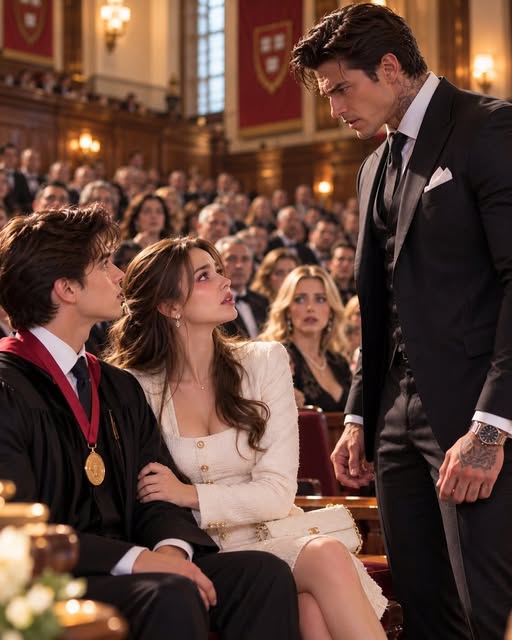
The auditorium smelled of polished wood, fresh flowers, and other people's certainty. I sat in the third row with my hands folded so tightly in my lap that my knuckles had gone white, and I told myself, the way I had told myself a thousand times in eighteen years, that I could get through one more public moment without falling apart.
Then they said his name.
"Noah Bennett."
The applause rose like weather. My son stood from his seat two rows ahead of me — tall, dark-haired, wearing the only suit we owned between us, the one I had taken in at the waist with my own needle the night before — and walked toward the stage with the unhurried calm of a boy who had never once been handed anything and had learned to carry himself accordingly.
Eighteen years old. The highest distinction in Harvard's incoming-student assessment. A room full of deans and donors and proud, wealthy families rising to applaud a kid who had done his homework at a kitchen table with a wobble in one leg, in an apartment where the radiator clanked like a tired drummer all winter.
I was so proud I could barely breathe.
I did not know, sitting there, that three rows behind me and slightly to the left sat the one man on earth I had built my entire life around avoiding.
Let me tell you what I knew in that moment, and only that.
Eighteen years ago, my name was Claire Moretti. I was twenty-six years old, a bookkeeper's daughter from Cicero, and I was married to Vincent Moretti — a man whose name made Chicago police detectives lower their voices and Chicago politicians raise their glasses. I had loved him with the whole, stupid, unguarded heart of a girl who believed that a man's tenderness behind closed doors was the truest thing about him. He kept my hand warm inside his coat pocket when we walked. He learned how I took my coffee. He stood in our kitchen at midnight, the feared Vincent Moretti, and asked me to show him again how to fold a fitted sheet because it made me laugh, and my laughter — he said — was the only sound in his life nobody was trying to buy.
Our marriage ended the week I learned about Ethan.
Vincent had a son with another woman. Sophia Reynolds — elegant, patient, and woven into his family's world long before I arrived in it. Their boy was two years old, beautiful, and already being raised in a house Vincent paid for across the city, with a nanny Vincent had chosen and a future Vincent had planned, all of it behind my back, all of it while I was setting a table for two and believing my husband's late nights were the price of the life he'd been born into.
I didn't scream. I want that understood. I didn't compete with Sophia, and I didn't beg, and I didn't throw his ring into the river the way women do in films. I sat across from him in his study, in the chair where his lawyers sat, and I asked for a divorce in the same level voice I would have used to read him a weather report. Because I knew, down to my bones, that I could not stay married to a man who had built an entire second family in the dark and still come home and hold my hand inside his coat pocket.
How I learned about Ethan is almost embarrassingly ordinary, and I have never forgiven the ordinariness of it. I kept the household books in those years — Vincent trusted no accountant the way he trusted me — and in the spring I found a line in the family ledger I could not make behave: a house on Kenilworth Avenue that appeared in no portfolio, a salary for a nanny I had never hired, a tuition deposit for a school I had never heard of. I told myself it was a safe house, a cousin, a debt of his father's. I told myself that for six weeks, because a person can tell herself anything for exactly as long as she refuses to drive across the city.
On a Tuesday I drove. The house had a garden and a low iron gate, and through the gate I saw a little boy — two years old, dark-haired, laughing — riding high on the shoulders of my husband, who was walking him around a rose bed with a care I recognized in my marrow, because I had watched that care aimed at me and believed it was mine alone. On the porch, with a cup of tea, sat Sophia Reynolds, watching them the way a woman watches her own life: without surprise.
I did not get out of the car. I sat there for one hour with my hands at ten and two on the wheel like a student driver, and then I drove home, and I hung up my coat, and I made Vincent's dinner, and I listened to him tell me about his day. I watched him eat. I watched him ask, with real interest, whether the foundation's books were balancing. The following week I sat down across from him in his study and asked for the divorce — because the books, in the end, had balanced perfectly. They had simply never been only mine.
What Vincent never knew — what I carried out of Chicago in a two-year-old sedan with everything I owned in the trunk — was that I was pregnant too.
I gave birth to Noah in a county hospital in Ohio with a nurse named Delia holding my hand because there was no one else. The first time they laid him on my chest, red and furious and perfect, I made him a promise out loud, like a vow in a church: You will never have to compete for your father's love. You will never stand in a doorway wondering why another boy was chosen. You will have less of almost everything in this world, but you will never, ever have to wonder if you are enough.
So I raised him alone. I worked as a bookkeeper for a dental practice, then for two. I cleaned offices at night for one brutal year when the transmission died and the rent went up in the same month. I learned which grocery stores marked down bread at eight in the evening. I learned to make a celebration out of a library card. And Noah — Noah made it easy to believe the universe had a sense of mercy. He loved mathematics the way other children love dogs. He devoured books whole. By fourteen he was working through problems that made his teachers call me at work just to say, Mrs. Bennett, do you understand what you have here?
I did. I had always understood.
People imagine that raising a gifted child alone is a montage of proud moments. It is mostly logistics wearing a brave face. When Noah was seven he asked me, with the terrible directness of seven, why other children's fathers came to soccer games, and I — who had played one season of softball in 1998 and retained nothing — coached his team for two years with a whistle, a rulebook from the library, and absolutely no shame, because my son was not going to stand on a sideline scanning the fence for a face that wasn't coming. He knew better than to ask twice. That was the part that cost me sleep: not what he asked, but how quickly he learned what not to ask.
When he was twelve he won the regional mathematics bee, and the trophy lived for years on a shelf I built from a fruit crate and optimism. During the night-cleaning year I would come home at four in the morning with my shoes in my hand so as not to wake him, and check his homework at the kitchen table in my coat, in the dark-adjacent glow of the stove light, because a boy whose mother works all night still deserves to have his long division witnessed. Our landlord, Mr. Petrakis, fixed our radiator twice without billing me after Noah started tutoring his granddaughter in algebra at that same table. "The boy pays the rent his own way," he said, and would not discuss it further.
The Christmas Noah was ten, I wrapped a secondhand telescope in the Sunday comics and he cried — not because it was secondhand, but because I had remembered, across three jobs and a hundred small emergencies, a thing he had mentioned once, in September, in passing. Children do not keep accounts of what things cost. They keep accounts of being remembered.
The afternoon he opened his Harvard acceptance letter at our kitchen table, he read it twice in silence, and then he looked up at me with his father's dark eyes and whispered, "Mom. I got in." I cried so hard he had to make the tea.
Weeks later, Harvard invited him to this symposium to receive his honor. Neither of us knew that the Moretti family — donors, now, patrons of some new institute — would be seated in the same hall. Neither of us knew that Vincent would be there beside Sophia, with Ethan, grown and confident at twenty, in the row behind me.
Noah reached the podium. He accepted the award with both hands and a small, embarrassed nod, the way he accepts everything, as if praise were a package he ought to sign for politely. Then he stepped to the microphone, and the hall quieted.
"Success isn't just intelligence," he said. "It's continuing when nobody is watching. When nobody is applauding. When the outcome is uncertain, and the only person who knows you're still trying is you."
He paused. His voice changed — softened, the way it does when he's made a decision he's nervous about.
"There's one person who deserves to share this with me."
My throat closed.
"My mom."
He looked out over the lights, found me, and smiled. "Mom, please come up here."
I stood on legs that did not feel like mine. The applause came again, generous and warm, and I walked toward the stage the way you walk in a dream — slowly, and with the terrible sense that the floor might be altered at any moment. I passed rows of strangers. I did not look left. If I had looked left, three rows back, I would have seen a man go as still as a held breath.
Noah took my hand and pulled me gently into the light. The host, a kind-faced woman with silver hair, beamed at us both.
"Ms. Bennett," she said, "raising such an accomplished young man must have been an extraordinary journey. Was your husband also able to support you along the way?"
It was an innocent question. A kind question. The kind of question that assumes a life shaped like other people's lives.
I looked at my son. Noah squeezed my hand — he knew this terrain; he'd navigated questions about his father since he was six years old, with a grace that used to break my heart in the school parking lot.
Then, God help me, I looked out at the audience.
And I saw him.
Vincent Moretti was sitting on the aisle, eighteen years older and somehow exactly the same, his hair silvered at the temples, his face — that face I had once known better than my own — utterly rigid. Beside him, Sophia Reynolds had gone the color of paper. Between them sat a young man with Vincent's jaw and Sophia's eyes, staring at the stage, at Noah, with the first flicker of arithmetic dawning in his expression.
Vincent's eyes moved from my face to Noah's face. Back to mine. I watched him do the math that eighteen years of distance could not protect me from. Noah was eighteen. Our divorce had been eighteen years ago. And the resemblance — the dark hair, the set of the jaw, the way my son stood with his weight slightly on one foot, exactly as his father stood — was impossible to unsee.
I lifted the microphone. My voice, when it came, was quiet and perfectly steady.
"My husband died the day my son was born."
The room fell silent in that particular way rooms do when a sentence lands heavier than anyone expected.
The host touched my arm. "I'm so sorry," she whispered.
I gave her a small smile. Beside me, Noah took my hand properly then, threading his fingers through mine, eighteen years old and still, in front of all those people, my boy.
But across the auditorium, something was happening that the applause, when it finally rose again, could not cover. Vincent's hands had closed into fists on his knees. His knuckles were white as bone. His eyes were bloodshot, fixed on Noah with an expression I had never seen on that man's face in all the years I had known him — not when rivals threatened him, not when the police took his brother in, not when his own father died in his arms.
For eighteen years, Vincent Moretti had believed I simply vanished from his life.
Now he was sitting twenty feet from the son he had never held, never raised, never known existed.
And for the first time since I had met him, the most powerful man in Chicago looked completely, helplessly powerless.