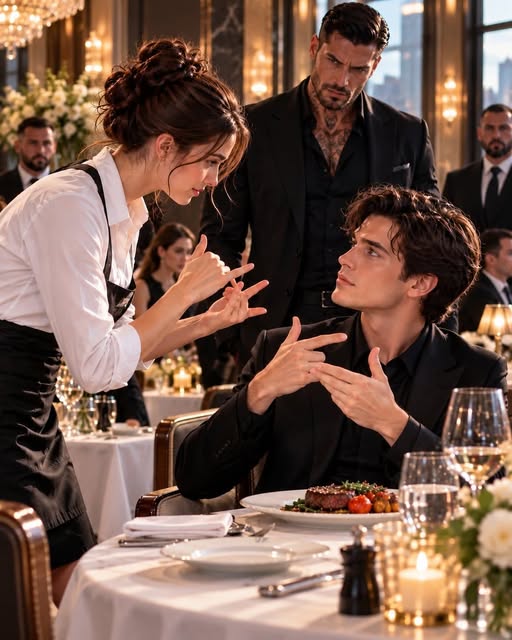
One year to the week after the worst night of my working life, Dominic Vale rented the whole of Bellamy's Steakhouse.
A Tuesday in February. Snow coming down sideways off the lake, sidewalks like black glass, half the city canceling its plans — the same weather, the same room, the same long white tablecloths. But this time, I came in through the front door on Caleb's arm, wearing a dress that had never met an apron, and Priya — Priya, working the floor in my old section, because the world keeps its sense of humor — met us with two glasses of champagne and an expression of purest, most unprofessional delight.
"You are a guest," she whispered at me, scandalized and thrilled. "In table twelve's room. Hannah. Sit down before I cry on the mayor."
Raymond, the manager — Raymond, who had run his floor like an air-traffic controller for six years and had never once used my first name — came out of the kitchen in a suit I didn't know he owned, shook Caleb's hand with both of his, and said, "Miss Mercer. Mr. Vale. Your room is ready." Then he'd turned to the assembled staff and done something I'd never seen in six years of Tuesday nights: he'd lined them up. Cooks, servers, Dana from the host stand. A year ago I'd stood in that line in an apron, invisible as furniture. That night the line stood for us, and as we passed, Dana — Dana, who'd whispered "Vale. He didn't call ahead" like a death sentence — signed welcome with the careful, wobbling hands of a woman who'd been taught by a coworker in a pass-through over months of slow shifts, and half the line signed it with her.
In the car on the way there, Caleb had asked me if I was nervous. I'd signed back, You? — and he'd considered it with the gravity he brought to all intelligence questions.
Not nervous, he'd decided. Located. For fourteen years every room in my father's world had me in the wrong place in it — the corner, the chair, the edge of the photograph. Tonight I'm in the right place. It's a new feeling. I'm thinking of keeping it.
I'd thought about Evan then — Evan, who never got a room like that, whose whole life had been other people deciding where he fit in theirs. And I'd understood, with the champagne still an hour away and the snow coming down, whose name was going to be over the door of everything Caleb built. Some people you lose all at once, in a February. Some people you get back by inches, in other people's rooms, for the rest of your life.
The room filled the way it had filled a year before — power first, then family. Captains and lawyers. Agnes Brennan at the place of honor, a year older and no softer. Doyle, who now signed weather and wine and a total of perhaps forty words, all deployed with the confidence of a man who'd learned them under fire. Sam Delgado in a wheelchair by the window, dressed like a bridegroom, with a nurse dismissed to the bar and a glass he was not supposed to have in his hand. Walt at the door — some posts a man doesn't surrender — with Rosa beside him in her good coat, because the housekeeper of River Forest was, by then, family in every sense the word survives translation.
And Dominic, at the head of table twelve, in the seat where he'd sat a year ago and ordered me to mock his son.
He'd had a year of Tuesdays and Thursdays in a kitchen in Evanston. A year of flashcards Rosa made him — colored paper, the way Elena once made them for a boy in a hospital bed, a fact that had undone everyone in that kitchen at least once. A year of being bad at something in front of witnesses, which for Dominic Vale was a more radical act than any violence he'd ever ordered.
When the room had settled, he stood.
He did not speak. He raised his hands, and in the sudden, total quiet of Bellamy's Steakhouse, the most feared man in Chicago signed his toast — slowly, carefully, and correctly — to his son, in front of everyone who mattered in his world.
A year ago, he signed, I brought my son to this room and made a joke of him. I did it because it was easier than learning how to talk to him. Easier is the most expensive word in our family. It cost my wife her life. It cost my son fourteen years. It nearly cost me both of them.
He paused. His hands — the stiff, impatient hands — found the next words the way you find a step in the dark.
Tonight the joke is retired. This family has an heir. He is not broken. He never was. The broken thing was us — and we're under repair.
Then, because he was Dominic Vale and some part of every room he stood in belonged to him, he did speak — aloud, for the hearing, while Caleb watched his mouth the way he'd watched mouths all his life.
"One more announcement. As of this spring, the Vale Foundation endows the Evan Mercer Program." He looked down the table at me, and something in his face was almost gentle. "Interpreters. Free ones, certified ones — in every hospital, courthouse, and school in this city that needs them, for every deaf kid who's ever sat in a room while the room talked over his head. Scholarships for the deaf students. Training for the hearing ones. It carries the name of a young man I never met — a young man whose sister taught this family what a language is for." His mouth did something complicated. "Her brother's name was Evan Mercer. The program is his. The debt is ours."
I don't remember deciding to cry. I remember Caleb's hand finding mine under the table and holding on like a sentence he meant, and Priya, at the service station, signing applause — hands up, fingers waving, the way the deaf applaud, because she'd been practicing too, all year, in the pass-through, for exactly this — and one by one around that room, captains and lawyers and one silver-haired crime matriarch, the whole hearing world raising its hands and waving them in silent, glittering applause for a boy most of them had never met.
When it settled, Caleb stood.
He signed his acceptance the way he did everything — precisely, completely, with the full weight of the room's attention a thing he no longer had to armor against. His father stays as chairman. The legitimate businesses come under his hand. The docks would run clean — he'd redrawn them already. And there would be interpreters at every family table from this night forward, not because the heir required one, but because, as he put it, a family that can't hear all its members isn't a family. It's an audience.
Then he turned to me, and the room changed temperature one more time.
This part, I am told, I should have seen coming. Dominic claims he saw it coming in August. Caleb signed it slowly, the way you sign things you have rehearsed in a mirror and a car and a bookshop and a cemetery:
Hannah Mercer. A year ago, in this room, my father ordered you to mock me, and you refused — the first person in fourteen years who ever said no for me. You gave me back my voice by refusing to steal it. Then you gave me back my family by teaching it my language. I have one more thing to ask you to translate for the rest of our lives. Marry me.
He went down on one knee — the heir of the Vale family, at table twelve, in front of the captains and the Brennans and his father and God — with a ring that had been his mother's, resized by a jeweler who'd been told, in writing, that his life was easier if he asked no questions.
And before I could answer, there was a voice from the head of the table — Dominic's voice, loud, wet, and absolutely delighted, translating his son aloud for the room. All of it. Word for word, no softening, exactly as signed — the first time in his life Dominic Vale had ever interpreted for Caleb, and he did it like a man ringing a church bell.
A year ago he had demanded of a terrified waitress: What did he say?
Now he couldn't say it fast enough.
"Yes," I signed, because my voice was nowhere to be found, and then I found it, and said it aloud too, for the room, for the record, in both his languages at once. "Yes. In every language there is."
The applause — the hearing kind and the waving kind, both, together — went up like weather. Sam Delgado laughed into his forbidden champagne. Rosa cried without any attempt at dignity whatsoever.
Later, when the room had loosened into dinner and music and the kind of warmth that only comes into rooms where nobody is performing anymore, Sam caught Caleb's sleeve and pressed something into his palm — a smooth, flat lake stone, gray as the water it came from. "Your mother's," Sam said, while I gave his words hands for Caleb. "Kept it in the boathouse, in the ledger drawer. Said it was the finest skip her boy ever threw — eight, that day, she counted them. Told me if I ever got the chance—" the old man's voice thinned out "—I was to give it back to you proper. I'm fourteen years late, son. Add it to the list of my sorries. It's the last one. The list is closed."
Caleb turned the stone over in his fingers for a long time. Then he did the thing Elena must have done a hundred times at that lake: he weighed it, smiled, and pocketed it — a man keeping his mother's luck where his hands could find it.
And later still — near the end of the night, when the candles were low — Dominic found me alone by the window with the snow coming down over Chicago the way it had the night everything started. He didn't speak. He raised his hands and signed, with enormous, deliberate care, the newest word in his vocabulary.
Daughter.
"Okafor charged me double for that one," he said aloud, gruff, blinking hard at the snow. "Said some words cost more because of what you owe on them. He's an extortionist. I've put him on retainer."
I signed it back to him — father — because some words cost more because of what you owe on them, and some cost more because of what you've been given, and the arithmetic of that night was beyond me entirely.
And Dominic, standing at the head of table twelve with his son's ring on my hand and his family — all of it, every last member — finally in one language, turned to Caleb with his hands up and his grin wide, and signed the question he'd been saving, I later learned, for months. He asked it purely for the pleasure of the answer:
And what, exactly, does the heir want for dinner?
Caleb looked at his father. He looked at me. Fourteen years of silence and one year of noise arranged themselves into an expression I hope I remember on my deathbed.
Ribeye, he signed. Medium rare. Potatoes. Coffee.
A beat. The grin.
And a quieter father.
Dominic translated it himself, at full volume, laughing so hard he had to sit down — the big, warm laugh from a year ago, finally meaning what it had always pretended to mean. A room full of dangerous people laughed with him, and under the table, where only I could see, Caleb's hand found mine and finished the sentence his father had interrupted a year before, in this room, at this table, when a frightened waitress had lied to a mafia boss to protect a stranger's secret:
Thank you, he signed, for hearing me.
He hadn't spoken to his father in years, Dominic once told me — the night he tried to make a joke of his own son, in a restaurant full of people who laughed because objecting might not be free.
He speaks every day now.
With his hands. Out loud. In front of everyone.
And everyone — everyone — has learned how to listen.