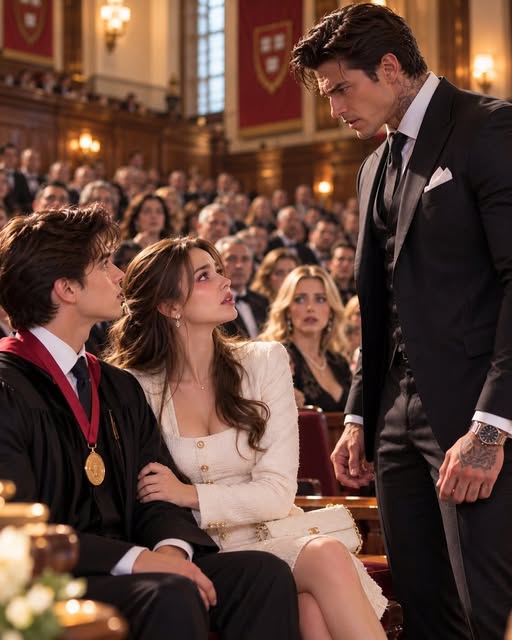
I told Noah the truth at our kitchen table, the night after the symposium, in the same chairs where he had opened his Harvard letter. I told him all of it — the marriage, the fitted sheets, the second family I had discovered like a second skeleton in a house I'd thought I knew, the divorce, the pregnancy I had hidden, and why. Especially why. I made myself say the why out loud, all of it, including the part where my protection of him had also, somewhere along the years, become my protection of myself.
He listened the way he does mathematics: completely, and without interrupting, his hands flat on the table.
When I finished, the kitchen clock was ticking so loudly it seemed impolite. Noah looked at the table for a long time.
"You let me think he didn't want me," he said at last. Not loud. Worse than loud. "Every Father's Day at school. Every time some kid asked. I had a whole story in my head — he knew about me and he just… didn't come. I built myself around that, Mom. I decided I didn't need a father because my father had decided he didn't need me."
"I know." My voice was threadbare. "I told myself I was giving you a clean wound instead of a messy one. A father who was gone entirely instead of a father who chose another boy's school play over yours, every time, in person, where you could watch. I still believe that second childhood would have broken something in you. But I won't lie to you now, Noah — not even to be kind. Part of it was me. If you'd known, you might have gone looking for him. And I could not have survived handing you over to that house, to her, and watching you come home smaller."
Noah stood up and went to the window. Our street was dark and ordinary; somebody's television flickered blue behind a curtain.
"I need a while," he said. "Not to decide if I forgive you. To figure out what I even think." He turned around, and his eyes were wet, and he was still, somehow, gentle with me. "You should have trusted me with it at sixteen. At least at sixteen."
"You're right," I said. "I know you're right. I was a coward about exactly one thing in my life, and it was the biggest thing. I'm sorry, Noah. Down to the ground, I'm sorry."
It took eleven days for my son to come all the way back to me.
For the first three days, Noah ran. My son, who had never run anywhere in his life except toward a library closing time, began going out at dawn in his oldest shoes, and coming back an hour later wrung out and silent, as if the truth were a distance he could wear down. And each evening he asked me exactly one question, precisely framed, like a man drawing lots he had numbered in advance. On the first night: "Did you ever almost tell me?" I said, "Every birthday. I rehearsed it every birthday, all the way through, standing at that counter — and then I baked the cake instead and told myself next year you would be older, and I would be braver." On the second night: "Does he know now? About the offices, and the hospital, and all of it?" I said, "He knows. He found out standing in a marble hall in front of me, and I watched it cost him something real, and I will not pretend I was sorry." On the third night he asked the question I had been dreading for eighteen years, quietly, to his plate: "Was there ever a version of your plan where I got to meet him?" And I answered with the whole, unvarnished truth: "In the version where you asked. You never asked, Noah. You were eight years old and you had already decided which questions would hurt me, and you stopped asking them. You were guarding me. That is the part your mother cannot forgive herself for — that my protection of you taught you to protect me back, in silence, at eight."
He was quiet a long time after that. Then he got up, and washed both our plates, and said, "Okay. That's a real answer," and it was — I could feel it in the room — the first stitch. It took one courier, arriving on the fourth of those days, to show me what kind of man Vincent Moretti intended to be about it.
The envelope contained no check. I want that recorded, because a check is what the world would have expected, and what I would have burned in the sink. It contained two things: the name and address of an independent genetics clinic in Boston, with a note that a sample kit was available there in Noah's name if — only if — he ever wanted documentary certainty, for his own records; and a letter, in Vincent's hand, addressed to Noah, which Noah let me read a week later, standing in this same kitchen, because by then we had agreed: no more secrets in this house, in any direction.
The letter was four lines long.
*Noah — I am not writing to ask you for anything. A man who missed eighteen years has no standing to ask. If you want proof of what you are, it exists and it is yours whenever you want it. What I am to you is yours to decide, and whatever you decide, I will abide by it. — V.M.*
Noah read it three times. "For the record," he said finally. "Not for him. For me. I want the paper."
The result came back in nine days, in a white envelope: 99.99 percent probability of paternity. Noah looked at it for a long moment, folded it once, and put it in the drawer with his birth certificate and his Harvard letter — the drawer of documents that proved who he was. Then he said, in a voice he tried to make offhand and didn't, "Okay. So that's true too."
He had had one more day than that to absorb all of it when his brother came to Boston to threaten him.
It was late afternoon, golden, the quad full of students, and Ethan Moretti stood in front of Noah's dormitory with his father's jaw and his mother's mission, and he said what such boys say when they've been handed a script by someone they love: that my son was a fraud, that I was a blackmailer with an eighteen-year con, that Noah would get nothing — not money, not the name, not the father — if Ethan had anything to say about it.
Noah set down his groceries. He set down his books. Three separate witnesses used the same word for what he did next: nothing. He did nothing at all for a moment; he just looked at Ethan, at this furious stranger who shared his eyes, with an expression one girl described as "like he was sad for both of them."
"My mother mopped the floors of an office building on Cermak Road for two years so I could have braces," Noah said quietly. "She paid my hospital bill in monthly pieces until I was eleven. If there's hush money, Ethan, I've never seen it, and neither has she. But that's not why you're here."
"Don't tell me why I'm here."
"You're here because you're scared." Noah's voice didn't rise at all. "So am I. I found out my father was a living man nine days ago. I found out I had a brother eight days ago. You've known about me for — what, a week? — and everything you know, your mother told you." He took one step closer, and his voice dropped. "Ask yourself why the woman who's been lying to my father for eighteen years" — Ethan flinched; Noah had not known, officially, about the money, but he had his father's gift for the shape of things — "why she needed you to come here and hate me before you'd ever heard my voice."
Ethan's hands opened and closed. "You don't know anything about my mother."
"Then show me I'm wrong." Noah picked up his groceries — discount bread, store-brand pasta, the makings of a meal for one in a dorm room — and held the door of his building with his shoulder. "I'm not going anywhere, Ethan. I've been not going anywhere for eighteen years. When you want to talk instead of warn, you know my name. It's in the papers. Your father paid for the institute that put it there.
The door closed. The quad went on being golden and indifferent around him. A girl passing with her friend slowed, did the now-famous double-take at his face, and said, perfectly audibly, "Was that his brother?" before her friend shushed her into silence. Ethan sat down on the low wall by the path with his hands hanging between his knees, and out of twenty years of habit he called his mother. She answered on the second ring, warm and ordinary, asking if he'd eaten, whether Boston was cold — and Ethan heard, as if from the bottom of a well, his brother's voice: *before you'd ever heard my voice.* He hung up in the middle of her sentence and sat staring at his phone as though it had bitten him.
He did not drive home. He drove to the river and sat until full dark, and he thought about a bag of groceries: store-brand pasta, discount bread, a single chicken breast in marked-down wrapping. The same brands, he realized with a slow, cold clarity, that his own family's housekeeper bought for the staff kitchen — food his mother had once wrinkled her nose at in a supermarket when he was fourteen. *Poor people perform poverty, darling,* she had said. *It photographs well. Remember that.* He sat by the river and wondered, for the first time in his life, what his mother actually knew about how poverty photographs, and why her knowledge of it had the polish of long practice — the practice, though he could not yet say it, of a woman who had spent eighteen years signing another woman's name."
He went inside. Ethan stood on the path for a long time, in the golden light, being looked at by passing students who had all seen the famous photograph of the symposium by now and were doing, quietly, the same arithmetic the whole world was doing.
Ethan drove back to Chicago that night without calling his mother.
What he did, two nights later — and this, too, I know only because he told me himself, much later, sitting on my porch steps like a penitent — was go looking for a phone charger in his mother's study, because his had died and hers was the room with the drawer of cables. The drawer stuck. He pulled harder. Under the cables were bank statements, bound with a rubber band, in an envelope from First Mercantile Bank, addressed to a trust. And the top statement, which he read standing there with the drawer hanging open like a mouth, showed a deposit — five thousand dollars, from a Moretti family account — and, four days later, a withdrawal, and the name typed in the memo line, in harmless banking type, as if it were nothing at all:
*For: C. Moretti — Bennett.*
Ethan stood in his mother's study and understood that the deposit had been made in the name of a woman who had mopped floors on Cermak Road — and that his mother had been the one to take it out.
He took a photograph of it with his phone. He put the drawer back exactly as he had found it. And he sat in his car in the driveway of the house he had grown up in for almost an hour, while the windows lit up one by one and his mother moved through the kitchen making dinner, before he finally unlocked his phone with shaking hands and scrolled to a number he had no earthly reason to have — the number of a brother he had threatened five days before.
"Noah," he said, when the line picked up. "Don't hang up. I need to ask you something. About my mother."