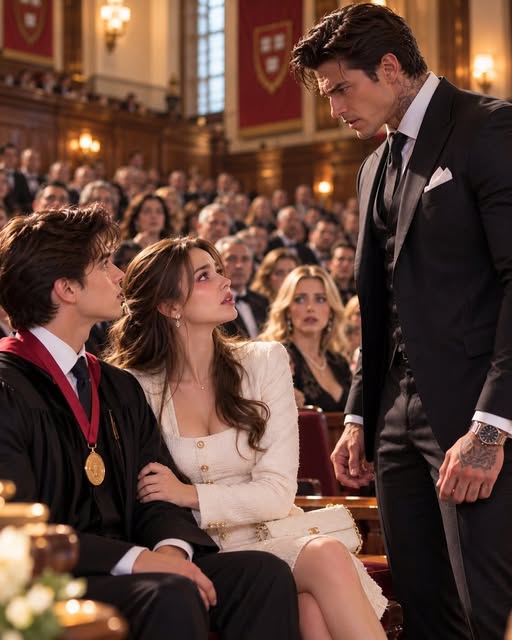
Sophia Reynolds made her last move eleven days later, and she made it in the only arena she had ever truly understood: other people's opinion.
An anonymous dossier arrived at Harvard's honors office on a Tuesday. It arrived, the same morning, at the education desk of a Chicago newspaper. It contained the forged First Mercantile receipts — the ones with my traced signature — arranged to tell a story: that Claire Bennett had been maintained for eighteen years as a paid mistress of the Moretti organization; that her son's sudden appearance was a financial operation; and that Noah's celebrated assessment distinction, at an institution where the Moretti family had just endowed a chair, smelled strongly of purchase.
By Thursday, Harvard had placed Noah's distinction "under administrative review" — a phrase Noah read aloud in our kitchen in a voice so carefully neutral that I had to sit down. The university was not accusing him of anything. The university wanted the matter "clarified." The university, in other words, had hung a small, polite, devastating cloud over the purest thing my son had ever earned, and every news alert on my phone wanted to know what the mafia's secret son had to say about it.
The week that followed had a texture I remember as wet wool. A tabloid reporter came to my door with flowers and a recorder in the same hand, smiling with all his teeth; I closed the door on both. A woman from a television station called four times, each time kinder and each time worse. Noah's faculty advisor — a decent, frightened man with a mortgage — counseled him in a low voice that the university protected its processes and that he should say nothing to anyone at all, which Noah did, perfectly, while his distinction sat in a drawer marked pending and his classmates read about him over breakfast. He fought the only way he had ever fought: with rigor. He filled notebooks. He attended every lecture and sat in the front. If the world intended to call his life's one clean achievement dirty, it would have to do it while watching him earn it again, daily, in public.
It was Ethan who called that week — the brothers' second conversation, and the first one Ethan had initiated as anything other than a warning. I heard only Noah's side of it, from the doorway, and I have treasured it ever since. "For what it's worth," Ethan said down the line, "and it may not be worth much: nobody who was actually in that hall believes it." There was a pause. Noah said, "You were in that hall." A longer pause. "Yeah," Ethan said at last. "I'm starting to notice what I believe." Noah sat for a while after he hung up, looking at nothing, and then he said to me, almost surprised: "He sounds like he's doing arithmetic too. Like it's costing him something real." I said, "It is, baby. It is. That's how you can tell it's the truth arriving. It never comes free for anybody.
Noah said nothing. He went to his classes. He ate the food I made and thanked me for it. At night I heard him at the table, working through problem sets with the same furious orderliness he had had at nine years old, as if rigor itself were a place he could live until the world became honest again.
Vincent called me — the first time we had spoken since the hallway — and his voice was doing that dangerous quiet thing. "I can make this disappear in a day," he said. "The newspaper. The dossier. All of it."
"No."
"Claire—"
"Vincent. Listen to me." I stood in my kitchen where my son had fought for his life with a pencil for eighteen years and I said the truest thing I knew. "If you bury this in the dark, she owns the dark. She will spend the rest of her life in it, whispering. My son's name was put in doubt in the light, and it will be cleared in the light, in front of everyone, with paper. All of it. Or not at all."
There was a long silence. Then the man I had once been married to said, with something in his voice that I had not heard since I was twenty-six years old, "Tell me what you need."
Nine days later, the Moretti Foundation held its annual gala in Chicago — six hundred guests, the mayor's office, two senators' wives, the board of the new institute, and, because Vincent had quietly ensured it, a press pool. Sophia attended on Ethan's arm, in midnight blue, in her accustomed place: the family's public face for twenty years, seated at the first table, beneath the lights, exactly where she most loved to be believed in.
Noah almost didn't come. "I don't do stages for them," he said. But Ethan called him — the brothers had been circling each other by phone for a week by then, two boys comparing the shapes of their stolen childhoods — and Ethan said, "She's going to sit in the front row and be honored. If you're not there, the story is whatever she wore. Come." And my son, who had inherited his father's spine along with his jaw, put on the suit I had taken in with my own needle, and came.
We drove to Chicago in my car, because I wanted my hands on a wheel and my son beside me rather than above the weather in one of Vincent's airplanes. Noah was silent for the first hour, watching the fields give way to suburbs, and then he said, "If this goes wrong, Mom, it goes wrong in front of six hundred people." I said, "Then it will go wrong honestly, in the light, with paper — which is still better than going right in the dark, by purchase. Your whole life is the proof of that sentence. We are not starting to lie at the finish line." He considered this with his father's gravity and his own mercy, and nodded, and slept the last forty minutes with his head against the window like a boy of nine, and I drove through three states of toll roads memorizing him.
At the hotel, Vincent was waiting in the lobby. Alone — no driver, no lawyers, no architecture of power, just a man in a dark suit standing by the elevators with his hands clasped in front of him like an usher. Ethan stood beside him, and when we came through the doors, both of them rose at the same moment, the way men rise for someone they honor, and I watched my son stop walking entirely. It was such an ordinary thing. That was what undid him, I think: not a stage or a speech, just a father and a brother, standing up when he came into the room. Vincent took my coat. "Whatever happens tonight," he said, "no one in that room will ever be able to say they didn't see it." And Noah, hoarsely, said: "Okay. Let's go be seen, then.
Vincent took the stage after the first course. He did not read from the teleprompter. What follows is from the transcript, which I have read so many times I no longer need the paper.
"Twenty years ago I made an arrangement at this foundation that I have not spoken of publicly. Tonight I am going to correct the record, because a young man's name has been put in question, and the question rests on a lie that was told with my money and in my house."
The room went still in the way of the Harvard auditorium — the way of sentences landing heavier than expected.
He told it all. The monthly payments. The forged account. The shell trust. He named Marcus Webb. He named the Halden Trust. And then — because I had asked him for paper, in the light — Daniel Reyes walked to the second microphone, gray-faced and steady, and walked six hundred people through eighteen years of statements, while behind them, on the gala's own projection screen, the forensic examiner's report appeared: the signature cards, side by side. My real signature, with its little hook on the C. And the traced one, patient and false.
"The court-appointed examiner's conclusion," Daniel said, "is that Mrs. Bennett — Mrs. Moretti — never signed for, received, or knew of these funds. The funds were diverted, in full, by the trustee of the Halden Trust, acting with the knowledge of his sister."
Every face in the room turned, as faces do, toward the first table.
Sophia rose. She was magnificent, I will grant her that even now; she rose like a queen being interrupted at dinner. "This is a performance," she said, clearly, for the microphones. "This is what this family does to women who inconvenience it. Ask Claire Bennett where she was for eighteen years—"
"I was cleaning offices on Cermak Road," I said. I was not at a microphone. I didn't need one. Six hundred people were quiet enough to hear a woman who had waited eighteen years to answer that question. "I was paying a hospital in installments. I was marking down bread at eight in the evening so my son could eat fresh. That's where I was, Sophia. While you were spending his childhood."
And then Ethan stood up.
He was twenty years old, and he had his father's height, and his hand — I watched it, the whole room watched it — shook only slightly as he took his phone from his pocket and held it out toward the foundation's own technician, the way you hand someone evidence at a trial.
"There's a photograph," Ethan said, into the silence, in a voice that carried further than he expected. "I took it in my mother's study. It's a First Mercantile statement. It shows the deposit — in Claire Bennett's name — and the withdrawal, four days later." He looked at his mother then, for a long time, and what he said next was not loud at all. "Mom. Tell me it's fake. I'll believe you if you can just tell me it's fake."
Sophia Reynolds looked at her son — the son she had built her entire life around, the reason, she would say forever after, for everything — and she could not say it.
The detectives were not theatrical about it. There were three of them, and they had been standing at the back since the second course, because Vincent — whatever else he was, and he was a great many things — had understood my condition precisely: not vengeance in a cellar, but the law, in the light, with paper. They arrested Sophia Reynolds at the first table of the Moretti Foundation gala, on charges of embezzlement, forgery, and wire fraud, in front of six hundred witnesses and a press pool. Marcus Webb was arrested the same night in Cicero, where investigators had questions about a storage fire.
As they walked her past the tables, Sophia stopped. She looked at Ethan — not at Vincent, not at me, at Ethan — and she said, with her whole heart in it, because I believe in her way it was true: "I did it for you. Everything I did, I did for you."
Ethan's face was wet. He didn't look away from her. "You did it to me," he said.
Vincent came down from the stage then, and crossed the floor to where Noah stood at the edge of the lights in his mended suit, and he did the thing I had asked myself, in the dark, for eighteen years whether he would ever do. In front of the mayor's office and the senators' wives and the press pool, Vincent Moretti put out his hand to my son — and when Noah took it, Vincent turned, deliberately, to face the room, and said, "This is my son Noah. He was kept from me, and I will spend whatever years I have left being kept from nothing." He looked at Noah. "If he'll allow it."
Noah said, so quietly that only the front rows and the microphones caught it: "We'll start with dinner. All of us. Even Ethan."
Harvard reinstated his distinction within the week, with a letter of apology that Noah keeps in the drawer with the other papers that prove who he is.