We were married on a Saturday in June, in the garden of the little house with the porch, with forty guests and no security detail that I was permitted to know about.
Noah walked me down the aisle, if an aisle is what you call twenty feet of grass between two rows of folding chairs, and he did it with his arm crooked formally and his face doing a terrible job of being solemn. "You sure about this one?" he murmured, out of the side of his mouth, at the halfway point. "I hear he has a past."
"I've seen his papers," I murmured back. "He checks out."
Ethan stood beside his father as best man — the only Moretti son, the world would once have said, now simply the elder of two brothers, a title he wore like a good coat. He had insisted on handling the rings, and then, in the great tradition of best men, had spent the entire morning convinced he had lost them, and the entire ceremony with them exactly where he had put them: in his breast pocket, over his heart, where, he said afterward with some embarrassment, he had been able to feel them the whole time.
Vincent cried. I want that in the record, because no one who feared him in four decades of Chicago winters would believe it, and everyone who loved him by then already knew. When I reached him across the grass, in a plain dress that cost less than the flowers at his first wedding to me — a fact I had pointed out at breakfast, to his loud and theatrical offense — Vincent Moretti took my hands in his burned, scarred, careful ones, and wept openly in front of forty people and one string quartet, and did not care who saw it.
"I have been married to you twice now," he said, when it came to the vows, in front of everyone, in the light, with paper nowhere in sight, "and I intend to spend the second marriage earning the first one back. Not with money. With mornings. With showing up. With the ordinary holy work of being present, which you taught our son, alone, in a kitchen with a wobbling table, while I sat in a big house not knowing what I'd lost. Claire. I will never be absent from this family again. Not for a day. Not for an hour I can help."
Ethan made a sound that was not dignified. Noah, beside me, said "Dad, seriously," in a voice thick enough to spread on toast. And I said my vows with my hand inside his, the way he used to keep it in his coat pocket on winter walks, when I was twenty-six and believed his tenderness was the truest thing about him. I was forty-five years old, and I believed it again — not because I was a girl who didn't know better, but because I was a woman who had audited the man, in the light, with paper, for over a year, and the books, at last, balanced.
The reception was held in that same garden, under strings of plain lights Ethan had insisted on rigging himself, on principle, from a ladder, in his best suit. There was a string quartet — the same quartet, I chose to believe, that had sawn away unknowing in a marble hall in Boston while my life changed — and there was dancing, and Ethan, as best man, rose with his glass and performed the office with a gravity that kept collapsing into a grin.
"I grew up believing I was an only son," he said, "because a story needed me to be. I want to correct the record — I seem to come from a family that is finally in the correcting business. My brother is the least stealable person I have ever met. You cannot rob a man who was raised by Claire Bennett, because there is nothing in him that was not earned, itemized, and paid for in full." Laughter, and Noah's ears going red. "To Noah: you were never the other one. There was never an order, never a first and a spare. There were just two kids and a lot of missing years — and we're done missing them." Then Noah stood, and said, to me, in front of everyone: "To my mother, who was the entire audience for eighteen years. Every performance. Front row. She never missed one. Turns out the rest of the audience was just late."
And then Vincent — who had not been scheduled to speak, because we had agreed he had done enough public speaking for one marriage — cleared his throat, and produced from behind his back, with the ceremony of a magician, a fitted sheet. He folded it. Perfectly. Corners crisp as envelopes, while the garden made a sound I can only describe as forty people losing their composure in harmony, and Ethan shouted "Nineteen years!" like a man announcing a boxing result. "Practice," Vincent said mildly, setting the folded sheet on the gift table like an offering. "A man can learn anything, given the right teacher and sufficient terror." And I laughed — I laughed the laugh he used to cross rooms for, at forty-five years old, in my own garden, with my whole life watching, and it did not hurt anywhere at all.
The year that followed was not a fairy tale. Fairy tales don't have trust administration, or a young man learning to say "my brother" without flinching, or a father teaching himself a messaging application so he can send his sons articles about bridge engineering at six in the morning. Vincent had spent that first year — the year of my conditions — doing the other work too, the work nobody at the wedding mentioned and everybody understood: the slow, lawyered, irreversible business of taking the Moretti name entirely into the light, selling off or shuttering the last of the gray enterprises his grandfather had built, so that when his sons inherited, they would inherit ledgers that could be read aloud in any room on earth.
His first examination of that promise came at Christmas, in my little house, with a tree Ethan had selected by the infallible method of choosing the largest one on the lot and then looking betrayed by geometry — it bent against my ceiling like a question mark. Ethan commanded the lights with military seriousness. Noah beat his father at chess in eleven moves, at the wobbling kitchen table I had refused for nineteen years to replace and now refused on grounds of seniority, and Vincent demanded a rematch "best of three, for the honor of the family name," and lost again, more slowly, while Ethan provided sports commentary from the doorway and filmed the whole disgrace for posterity. My sons' father, the most feared man in Chicago, sat in my kitchen in shirtsleeves eating my pie off a plate he had washed himself, and demanded, with crumbs on his chin, to know whether the boy had been studying openings, and Noah said, "Since I was ten, Dad. Mom bought me the book at a yard sale," and the room did that thing it had learned to do that year — it let the word Dad land, and ring, and settle, like a bell that had finally been hung in the right tower.
After dinner we walked, the two of us, while the boys argued about a film in the warm house behind us. Snow was coming down in the slow, unserious way it does when the whole sky is in a good mood, and somewhere along the second block my hand found its way into Vincent's coat pocket, the way it had when I was twenty-six — except that nothing about it was the same. Then, it had been a girl's faith. Now it was a woman's audit, concluded. "I think about the other version sometimes," he said. "The one where you stayed." I shook my head against his shoulder. "Don't. That woman had hard years too — just different ones, in a bigger house. I like my version, Vincent. I got him. And in the end—" I looked back at my lit windows, where two tall shadows were crossing and recrossing the glass, laughing at something I would hear about at breakfast — "in the end, against every odd the world offered, I got all of this too.
The following July, on a Saturday with heat shimmering off the driveway of the big house, my sons finished the climbing frame. It had stood in Ethan's garden for fourteen years — one platform complete, one frame begun and abandoned, a rope bridge strung between a childhood and a question. Ethan had ordered lumber without telling anyone. Noah drove down with his grandfather's level in the trunk of my car — a tool that had outlived two marriages and one empire — and the two of them worked all day in shirtsleeves while their father, in defiance of six decades of self-image, held boards, fetched screws, and was twice sent back to the garage for the wrong drill bit by his elder son, with a sergeant's intolerance for error. I brought lemonade at four o'clock and found all three of them sitting on the finished platform, legs dangling like schoolboys, saying nothing, looking at the garden.
"Fourteen years late," Vincent said at last.
"It's finished now," Noah said. "That's the whole sentence."
Ethan, who had waited ten years to ask when it would be done, lay back on the new wood with his hands behind his head and delivered the verdict of the younger generation upon the older, in the tone of a judge who has waited his whole life for the case: "It holds," he said. "It'll hold all of us. That's kind of the point of a platform, Dad." " "Your mother's conditions," he told the boys, at my table. "She's a hard negotiator. It's genetic. Check your own spines if you doubt me."
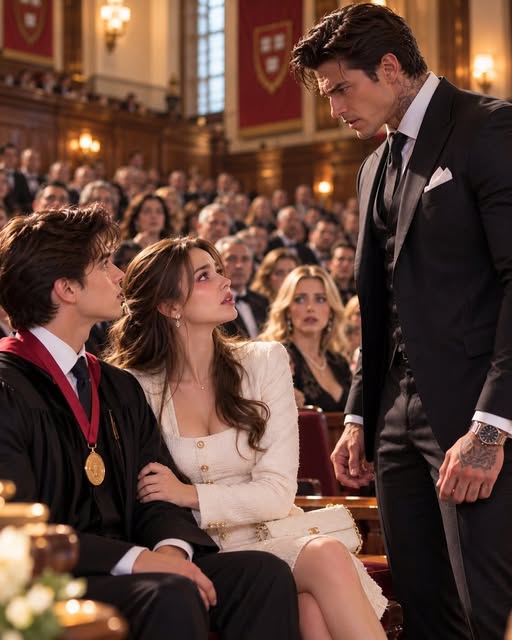
And then, in the autumn, Harvard invited Noah back to the symposium — this time to speak, as the returning scholar, to the new incoming class.
I sat in the front row this time. Vincent sat on one side of me, in a suit he'd had Noah approve by photograph beforehand, like a schoolboy. Ethan sat on my other side with his long legs folded under the seat in front, home from law school interviews, eating the program with his eyes, bursting with a pride he no longer had any reason to ration. The three of us took up the whole row's heart, and when the lights went down I felt Vincent's hand find mine in the dark, and keep it, the whole time, like a man holding on to the one true thing in a room full of applause.
"This is my second year standing here," Noah said, from the podium, eighteen months older and somehow already a man. "Last year I told you that success is continuing when nobody is watching. I was wrong about one thing. Somebody was watching. Somebody was always watching — at a kitchen table, at a night job, at every ordinary unglamorous hour of my life. I just couldn't see the whole audience yet."
He looked down at our row. He smiled the smile I had earned and the smile two other people had had to cross eighteen years and a courtroom of the heart to earn.
"Let me introduce you to my family," he said. "All of them. It took us a while to get everyone into the same room — " the hall laughed, because by then everyone knew the story, it had been in all the papers — "but I'd like the record to show that we got here."
The applause rose like weather. I sat in the middle of it with my husband's hand in mine and my sons on either side of me, and I thought about the sentence I had spoken into a microphone in this very hall, in what felt like another woman's life: *My husband died the day my son was born.*
It wasn't true. It had never been true — it was just the only shape my grief had known how to wear in public. The truth, the whole truth, the truth in the light with paper, was this:
My husband was lost the day my son was born. He was lost to pride, and to cowardice in installments, and to a woman who fed on the dark between us. He stayed lost for eighteen years, in a big house, with money arriving in his accounts and a son growing up three rooms away who could not save him, while across the country a woman he had failed raised his other son on marked-down bread and an unbreakable promise.
And then a boy with his father's jaw walked onto a stage at Harvard, and asked for his mother to come up and stand in the light — and the light, as it turns out, is very hard to hide from, once somebody you love is standing in it.
He found his way back the only way the lost ever do. One present, accounted-for, ordinary day at a time.
He has not missed one since.