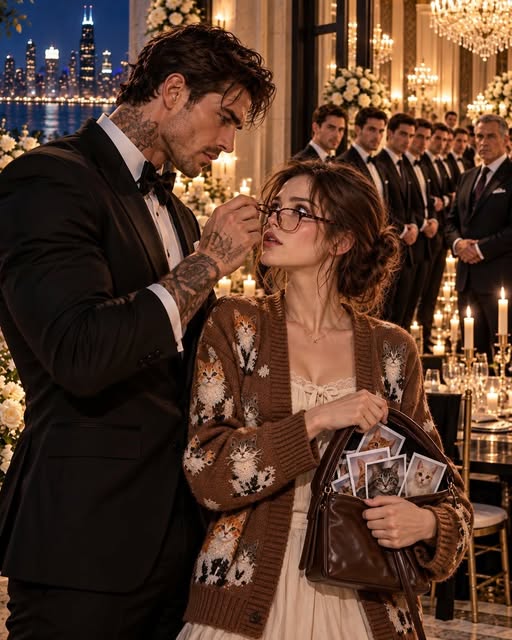
Three weeks later I walked into the great hall of Halston House on Ethan Romano's arm, wearing an emerald gown, a cardigan with cats on it, and my plain-glass glasses, while two hundred of the most powerful people in Chicago applauded the engagement of the season.
That is not a sentence I ever expected to say about myself, but the whole night was built of sentences nobody expected. My father was there — thinner, upright, in the suit he'd been married in, with Marco DeLuca two feet behind him wearing an earpiece and the expression of a man who had opinions about everyone's security and had shared most of them. The signing table stood on the low stage at the end of the ballroom, dressed like an altar: the partnership documents, two silver pens, the leather folder. Victor Romano presided over his end of the room like weather.
Ethan, beside me, murmured through a smile that didn't reach anywhere: "You look very… committed to the theme."
"Kevin helped me choose the cardigan," I said. "He has an eye."
"Grace." His voice dropped out of performance entirely, and I glanced up, startled. Ethan Romano had spent three weeks being the fiancé — flowers, lunches, one ghastly photoshoot — and had never once dropped the performance, which is how I knew, suddenly, that he had one. "Whatever you're planning. My father's people counted your father's security twice this week. Be— just be finished before the pens come out. That's all I can say."
He walked me to the stage steps and let go of my arm like a man setting down something hot, and I understood that Ethan Romano had found the accounts in his father's safe, or the photographs, or some corner of the machine with his own name being fitted into it — and that whatever his family's sins were, the son had started, quietly, to choose.
Victor made the speech. Alliances. Families. The future of Chicago hospitality. He used the word legacy eleven times. Then he invited the happy couple forward, and my father's name, and the pens gleamed, and Walter Briggs stood at the side of the stage holding the leather folder like a priest holding a missal, and smiled at me with the smile of the man who taught me fractions.
"Before we sign," I said, into the little microphone, in my bright, silly voice, while my heart tried to climb out of my body, "can the bride say something? It's good luck. Probably. Kevin says—"
Laughter, fond and dismissive. Victor indulged me with a gesture. Of course. The little fool wants to make a speech about cats. There is all the time in the world.
I took off my glasses.
I folded them, slowly, and set them on the signing table next to the silver pens, and I straightened my back, and two hundred people watched the helpless fiancée they'd been laughing at for three years stand up inside her own skin like a building settling onto its real foundations.
"My name is Grace Mercer," I said, in my own voice, which is lower than the other one and considerably less interested in being liked. "I hold a master's degree in finance. For three years I have run a consulting firm called Wren, which audits hotels — including, two years ago, one of yours, Victor, where we found your favorite trick. Stabilized occupancy, ninety-one percent. Convention calendar, double-counted. Year two, covenants clearing on numbers that do not exist." I let the room hear the silence change texture. "The projections in that folder are the same lie. And the lie has a bookkeeper."
The great screen behind the stage — arranged by Sofia DeLuca, who had spent three weeks becoming the ball's audiovisual volunteer and had been underestimated by professionals — lit up with the ledger. Four years of Bluewater Services. The Pierce's phantom banquets. The countersignatures, and beside them, blown up to the size of a door, the two original transfer authorizations from a deposit box at First Chicago, signed in full by Walter Briggs.
"My father countersigned under duress, with photographs of me on Victor Romano's desk. He has already given his statement. The prosecutor —" and here the doors at the back of the hall opened, quietly, the way doors open when the people opening them have badges and no need of drama— "has the originals, the drive, and Mr. Briggs's own ledger. The complete one. The one he kept to insure himself against exactly this evening."
The screen changed. Sofia, at her volunteer console with her chin in her hand like a girl at a recital, advanced the deck with the tenderness of a headsman.
Photographs now. Me at the Denver conference. Me leaving the Loop tower at midnight, three years younger, laughing at something Priya had said into my earpiece — laughing, in a photograph taken from a car, by men who had then carried my face into Victor Romano's office and laid it in front of my father like a hand of cards.
"This is the part where you explain the countersignature," I said to the room. "My father signed transfers for four years. The man who made him sign is standing at his table tonight drinking his champagne. Every time my father's hand shook over one of those documents, Victor, you made sure he could see my face. That's not banking. That's a man holding a photograph instead of a gun because the photograph doesn't make noise."
Victor Romano stood. Seventy-one years old, tailored like a cathedral, with a voice that had closed a thousand rooms. "This is a hysterical girl," he said pleasantly, "performing for a room that has indulged her family too long. Richard — control your daughter, or I will assume this theater is yours."
"Victor." My father's voice came from the floor, not the stage, and it was not loud, and it did what it had done in boardrooms for forty years: it made men sit down to listen. "I have been controlled by you for six years. It has been the great education of my life, and I am done with the curriculum." He turned, slowly, in his chair, and looked up at me on the stage — past the pens, past the folder, past three years of cat photographs — with his heart ticking its warnings somewhere under his ribs and his eyes completely steady. "Miss Mercer has the floor," my father said. "Let her finish."
"The projections were prepared outside my father's company," I said, "by a firm called Harrowgate Advisory — the same preparer whose habits my firm documented in Milwaukee two years ago. The same double-counted calendar. The same wishes dressed as numbers. Harrowgate dissolved eighteen months ago. Its two partners now draw salaries from a Romano holding company." I looked at the side of the stage. "Walter. You've been very quiet for a man whose ledger this is. You taught me to read a balance sheet when I was nine years old, at your kitchen table, with cocoa. You used to tap the page and say: the numbers never lie, Gracie. People lie around them." I let the room hear my voice do the thing it does when I stop spending it on theater. "Stand up and tell the room which you are."
And that — not the agents, not the screen, not the photographs — that is what did it. Being asked, in public, in front of everyone he had ever impressed, to account for himself in the language he had taught me. Some men run when the floor opens. Walter Briggs was never a runner. Walter Briggs was a man who had arranged his whole life so that he would always, always be holding the folder.
Walter Briggs moved. I will give him this: at sixty-one, with his whole architecture collapsing on a screen behind him, he was fast. The gun came out of the folder side of his jacket — I never did see where it had been — and the room made a sound like the lake in March, and Lucas DeLuca, who had been standing at the edge of the stage all evening doing nothing but watch my hands, stepped in front of me with the unhurried certainty of a man stepping in front of a photograph.
The shot was not loud. That is the thing nobody tells you. It was a handclap in a big room. Lucas went down against the signing table; the silver pens scattered; and Walter Briggs stood frozen with the gun still raised, staring at what he had done as if the gun had done it without consulting him — and Ethan Romano, of all the people on God's earth, walked up the stage steps in full view of his father and two hundred witnesses and took his family's bookkeeper gently by the wrist and lowered his arm and said, "Enough. It's finished. It's been finished for weeks; we just hadn't said it out loud."
Agents crossed the floor. Victor Romano was read his rights in front of the silent auction. My father stood up — I saw him stand — and Marco caught his elbow and held him upright with a hand that looked like it had been designed for exactly that task, and my father watched me across the ruin of the evening and mouthed, clear as speech: That's my girl.
I was on my knees on the stage with both hands pressed to Lucas DeLuca's shoulder and his blood coming through my fingers in a rhythm I could count, and he was looking up at me with an expression of outrageous calm.
"You planned to be shot at, I hope," I said. My voice was not steady. "Tell me there was a vest."
"There was a vest in the plan," he said. "The plan changed when he aimed at you."
"Lucas—"
"Grace." Blood, ballroom, badges, and he was smiling. Actually smiling, the real one, the one from the terrace. "Tell me the truth. Just once, on the record. Is Kevin real?"
"Kevin," I said, pressing down hard while the room blurred at the edges, "is a complete fabrication. This is not. Do you understand me? This is not."
"Good," said Lucas DeLuca, and closed his eyes, and let the paramedics take over, "because I'm going to hold you to that."
I rode in the ambulance because I refused, with some volume, to be separated from him, and a paramedic with the calm of a woman who has argued with mafia families before decided I was a medical necessity. At the hospital they took him through the double doors at a run, and I stood in the corridor in an emerald gown with his blood drying on my hands in the shape of my own grip, and discovered that I had been holding my breath for approximately six minutes.
In the ballroom, they told me later, Victor Romano had been permitted to finish his champagne before he was handcuffed, because the lead agent had a sense of theater and wanted the photographs to be perfect. As he passed the signing table on his way out — past the scattered silver pens, the folder, my folded glasses sitting exactly where I had laid them — Victor stopped, and looked at the glasses, and said to no one, in the tone of a man reviewing a restaurant he will not return to: "Three years. At my own table. Eating my food." He shook his head slowly, almost admiring. "Richard Mercer raised a closer."
Ethan had watched his father be taken out of the ballroom where his engagement had been announced forty minutes earlier. Then he had walked, alone, to the lake side of Halston House, and stood on the terrace in the November cold in his dinner jacket — on the same stones where Lucas had taken off my glasses — until Marco, of all people, went out and stood with him, saying nothing, the way men in their world sit shiva for a man's whole former life. Ethan told me later that Marco said exactly one thing in twenty minutes. He said: "Your sister's a good kid. She'll need one brother who isn't in prison or in hiding. Choose quickly." And Ethan said, "I already did. It just took me thirty-four years to say it at full volume."
At four in the morning a surgeon with kind eyes told me the word stable, and I sat down on the corridor floor in my ruined dress, among the vending machines Lucas had tried to intimidate on another night in another wing of the same building, and laughed and cried at the same time in a way that alarmed no one, because hospitals have seen everything, and because Marco — who had materialized again, the way he does, like weather with a driver's license — simply sat down on the floor beside me in a three-thousand-dollar suit and said, "He's going to be insufferable about this for decades. The scar. The story. You understand what you've done, marrying into this family eventually? There will be toasts."
"I haven't agreed to marry into anything," I said, from the floor.
"No," Marco agreed, passing me a coffee like a sacrament. "But my brother took a bullet at the exact angle a man takes one for a wife. The family has done its arithmetic, Miss Mercer. We're simply waiting for you to check the figures."