My father did not die. I want to say that first, the way I had to keep saying it in the hospital corridor, to Rosa, to Marco — who had appeared at Northwestern Memorial as if conjured, and who stationed himself outside my father's room all night with the stillness of furniture and the eyes of a lighthouse.
Severe angina, the cardiologist said. A warning shot from a sixty-three-year-old heart that had been carrying Victor Romano for six years. He would live, if he stopped. Men like my father hear if he stopped as a rumor about other people, but he was alive, grey in a white bed with a monitor ticking beside him like a small patient animal, and when he woke at four in the morning I was asleep in the chair with my head on the rail of his bed and Lucas's coat still around my shoulders.
"You corrected Ethan Romano's family's occupancy figures at the table," my father said. His voice was a thread. "In front of God and the DeLucas. I heard you. Three chairs away, with the mousse."
I lifted my head. "You heard that?"
"I've been hearing you for years, Grace." He turned his head on the pillow, and the smile that moved across his face was tired and real and twenty years younger. "Second suitor. What was his name — the shipping one. He told the table his company's EBITDA was up forty percent, and my daughter, my helpless daughter, whispered, 'Only if you count the port sale twice,' and then asked him — asked him, out loud, in her little voice — what a bond was." A breath that was almost a laugh. "I raised you. I taught you to swim. Did you think I couldn't tell when you were splashing on purpose?"
The monitor ticked. Down the corridor a cart went past.
"Why didn't you say anything?" I whispered.
"Because every man you scared off bought me a month." He said it simply, the way you'd confess the weather. "Romano wanted the marriage settled. Every failed dinner was a month he had to wait for the next one, and I spent those months looking for a door that didn't exist. You were buying me time with humidifiers and cat bedding, and I let you, because it was the only weapon in the house. I am sorry, Grace. It should never have been yours to carry."
I took his hand. It was the hand that had signed in our kitchen, three weeks after we buried my mother, because a twenty-three-year-old girl had just finished her degree and the company was her grandfather's name and he couldn't see another door.
"Tell me all of it," I said. "No more protecting me. It's my turn anyway."
So he told me, in the ticking dark, with his cardiologist's warnings stacked up like sandbags around every word. The loan. The fishhook clauses. The two hotels, and the morning two years ago when his own internal audit — a good man named Osei, who resigned within the month and moved to Oregon — showed him cash moving through the Marigold that had no weather, no season, no source. The visit to Romano. The photographs on Romano's desk: Grace at a conference in Denver. Grace leaving an office tower in the Loop at midnight — Wren's office, which Romano's people had found within a year of its founding, the way water finds a crack.
"He said: 'Richard, you have such a talented daughter. It would be a shame if her little company had an accident.'" My father's hand tightened around mine with shocking strength. "After that I signed what they put in front of me. The countersignatures on Briggs's transfers — yes. Mine. Under duress means nothing on paper, I know that. I know what it looks like. It looks like a man laundering money, because that is what a man laundering money looks like, even when he's doing it with photographs of his daughter facedown on the desk in front of him."
"Did Briggs know about the photographs?"
"Briggs brought the photographs." His eyes closed. "Walter has been Romano's man since before the loan, Grace. I believe now — I believe the loan itself was his design. He steered me to that door. My oldest friend." The monitor ticked on. "There's a deposit box at First Chicago, in my name, box 114. Two transfer authorizations — the originals, with Briggs's full signature and the Bluewater stamp. I don't know why I kept them. A drowning man keeps strange things in his pockets."
I sat with all of it while the sky went grey over the lake.
At nine that morning, while my father slept the grey sleep of the medicated, Marco drove me to First Chicago in a car so quiet it felt upholstered in money, and walked me past the vault door with the ease of a man whose family has boxes in every bank in the Midwest.
Box 114. The bank officer left us alone with it, the way bank officers do when the customer is a DeLuca, and I opened a drowning man's pockets.
There were two transfer authorizations, as promised — originals, blue ink, Walter Briggs's signature in full, unhurried and elegant, the signature of a man who had never once imagined a stage and a screen. Beneath them was a cashier's envelope of the kind banks stopped using a decade ago. Inside it: a photograph of me at fourteen, gap-toothed, holding a book in a parking garage — the loading dock at Mercer Tower, my old hiding place. On the back, in my father's handwriting: She reads everything. God help whoever hides a book from her.
And beneath that, folded small, the thing that broke me in a vault on a Tuesday: a single page torn from a legal pad, covered in my father's handwriting, dated three years and two months ago. It was a list of names. Suitor number one, with a date. Suitor number two, with a date. Each of the six men, each failed dinner, recorded in the hand of a man doing arithmetic at midnight — and beside each name, the same column, filled in one month at a time: TIME BOUGHT. And at the bottom, underlined twice: She doesn't know she's doing it. Let her keep doing it. Whatever it costs me, it costs less than her.
Marco, who had been studying the vault wall with great dedication, said, "Your father is a strategist, Miss Mercer. In my family we respect that."
"He let me think he was ashamed of me," I said. The page shook. Everything in that box shook, briefly, because my hands were its weather. "For three years I performed at his table and he let me believe it embarrassed him, because if I'd known I was the strategy, I would have stopped. Or worse — I would have done it on purpose, and Romano would have seen the purpose."
"Yes," Marco said. "That's how you protect an asset. You let her think she's the embarrassment." He took the box from my hands, gently, the way you'd take a live shell. "My brother learned everything he knows about this from men like your father. Don't tell him I said so. He believes he invented it."
I photographed every page twice. I put the originals in a courier pouch that Marco produced from inside his coat like a magician with better tailoring, addressed in his hand to a federal prosecutor whose name I was not told, and I watched it leave the bank in the hands of a man who looked like an accountant and moved like weather. Then I bought two vending-machine coffees' worth of courage in the form of actual coffee, and I went back up the lake shore to the hospital, where my father was awake and asking the nurses whether hospitals observed visiting hours for daughters with evidence.
Then I went down the corridor to where Lucas DeLuca was standing at the vending machines in his shirtsleeves, holding two coffees — still there, hours later, because Lucas DeLuca does not abandon a post, and having apparently decided that hospital vending machines were a problem he intended to intimidate personally.
"He'll live," I said. "And he's told me everything."
"I know," Lucas said. "The courier reached the prosecutor an hour ago. Marco reports that you were very calm in the vault, which frightened everyone. You think out loud when you're exhausted, Grace — you've been dictating your father's confession to this corridor since dawn." He handed me a coffee. "The drive, Grace. Priya finished an hour ago."
I had forgotten the drive existed. "And?"
"The full map. Four years, both hotels, every vendor, every account. Briggs built the door I predicted — the ledger is constructed to hang the whole scheme on your father's countersignature if it's ever found. Romanos insulated. Briggs insulated. One name holding the bag." He drank his terrible coffee without flinching, which told me more about him than the garage had. "It's a beautiful machine. It has one defect."
"Which is?"
"It assumes your father never kept originals, and it assumes his daughter can't read." He set the cup down. "I have a federal prosecutor who owes me a marker I have been saving for nine years. Original authorizations, plus Briggs's own ledger, plus a countersigning victim who walked into a hospital rather than onto an airplane — that's a trade she'll make. Immunity for your father. Testimony against Briggs and Romano. But it only works, Grace, if Victor still believes the signing is happening. He has to walk into the Founders' Ball expecting a wedding and a merger. He has to be holding the folder when the floor opens."
"Three weeks," I said. "The engagement announcement. The signing. On a stage."
"On a stage," Lucas agreed. "In the same ballroom. In front of everyone who watched you talk about cats."
I thought about Ethan's face at the word twelve. I thought about my father's hand trembling on a coffee cup, and Walter Briggs teaching a nine-year-old to read a balance sheet, and a black drive with tape on its spine, waiting four years in the dark like a held breath.
We planned it over the following two days in the private dining room of Lucas's flagship hotel, with the door locked and Sofia in charge of the seating chart like a general with a grudge against topography. Marco walked the ballroom twice with a laser measure and the face of a man defusing something. Priya, on a speakerphone from an office she still wasn't allowed to describe, laid out the evidence chain the way she lays out everything — in order, without decoration. My father, by telephone from a hospital bed he was attempting to be discharged from by force of personality, insisted on attending.
"Absolutely not," I said.
"Grace." His voice on the speaker was thin and immovable. "Victor Romano took six years of my life at a table. He does not get to keep me from the one where he gives them back. My cardiologist has been informed of my position. He has described it as 'a data point in a pattern.' I am attending, and I am sitting where Victor can see my face when the screen lights up. That is the whole ballgame, as your grandfather used to say about things that were not ballgames at all."
Sofia, who had been annotating the seating chart, looked up with an expression I can only call professional admiration. "I like him," she announced. "Marco, the old man sits at table one, with two of ours behind him and the exit at his back. Non-negotiable. I don't care what the fire code says, the fire code hasn't met our family."
"And me?" I asked. "Where does the fiancée sit in this arrangement?"
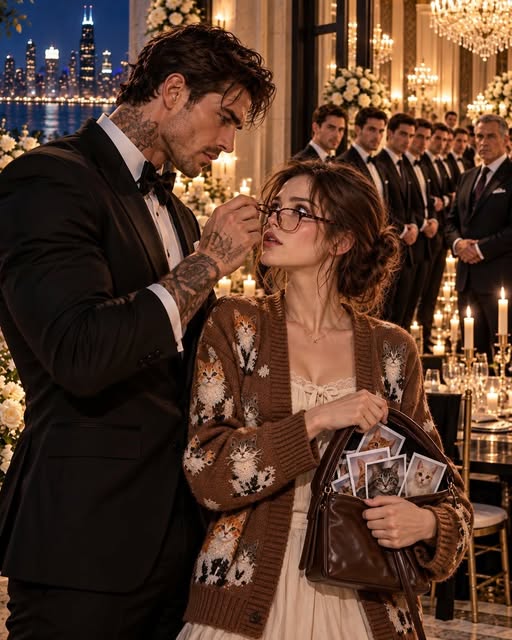
Sofia smiled the smile of a woman who has been waiting three weeks to be asked exactly that. "Center stage, sweetheart. On his arm, in the cardigan, under the lights — the most harmless girl in Chicago, right up until the moment you aren't." She capped her pen. "I've already volunteered to run the audiovisuals. Nobody questions the boss's sister. It's the family version of your glasses."
"Then I need a new performance," I said. "The last one. The fiancée." I looked up at him. "Can your people keep my father alive for three weeks?"
"Marco has already moved into your father's guest room," Lucas said. "He's telling Rosa it's for the food." Something moved in his face that on another man would have been a smile warming up. "And Grace — when this is done, and you're standing in that ballroom with the glasses off, in front of all of them — I want you to remember that you don't owe any of them the small version of you. Not even me. Especially not me."
"I corrected your occupancy once too, you know," I said. "At the table. Under my breath. The Lakeview numbers were yours before they were my father's — your auditors took six weeks because you let them."
"I know," said Lucas DeLuca. "That's when I decided."