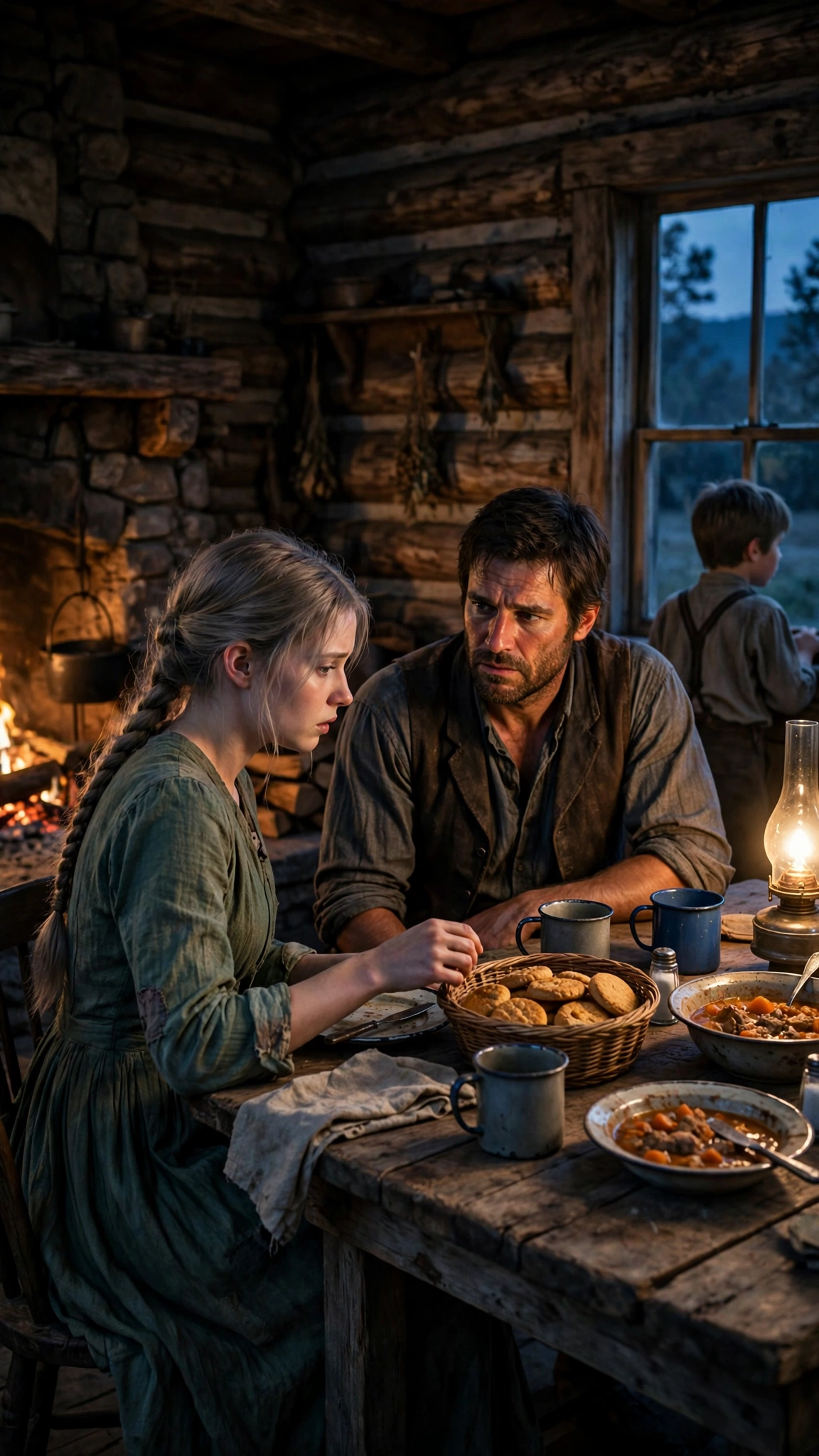
Saturday came up clear and cold, with frost on the grass and a wind coming down off the mountains, and Cole was up before dawn, and he had the rifle cleaned and loaded and standing by the door, not because he wanted to use it, but because Elias Brooks had told him, in his own letter, that he would bring trouble, and Cole Turner had never been a man to meet trouble unprepared.
Hannah was up too. She had not slept. Cole had heard her moving in her room in the night, the floorboards creaking, and he knew she had been awake, and afraid, and he had not gone to her, because he did not know if she wanted him to, and because there are some fears a person has to carry alone until morning.
She came downstairs in her faded green dress, her braid neat down her back, her face pale but composed, and she ate breakfast — a full breakfast, porridge and bread and coffee, without asking, without hiding anything — and Cole watched her, and he thought about how far she had come in six days, from a girl who would not touch a biscuit to a woman who could sit at his table and eat, and he thought about what it would cost her if Elias Brooks took her back to Kansas.
"We'll be ready," he said.
"I know," she said. "I'm ready too."
Grant Mercer rode in at mid-morning, and Sheriff Hayes rode in behind him, and the two men dismounted in the yard, and the sheriff looked at the house, and at the barn, and at the road, and he said, "He'll come from the east road, most likely. He'll want to be seen coming. A man like Elias likes an audience."
They waited. Noah fed the chickens. Hannah washed the breakfast dishes. Cole stood on the porch, watching the road. The sun climbed. The frost melted. The wind moved through the cottonwoods.
He came at noon.
There were three of them. Elias Brooks rode in front, on a gray horse, in his black coat, his gray hair neat, his face composed, the very picture of a respectable father come to claim his runaway daughter. Behind him rode Silas Creed, lean and scarred, in his long coat, his hand resting near his hip, his eyes moving over the yard the way a wolf's eyes move over a sheep pen. And behind Creed rode a third man, younger, in a deputy's badge, with a face Cole did not know, and a hand that kept touching his own gun, as if he were not sure it was still there.
Elias reined in his horse in the middle of the yard. He looked at the porch. He looked at Cole. He looked at the sheriff. And he smiled.
"Sheriff Hayes," he said. "I'm glad you're here. It saves me the trouble of fetching you. I am Elias Brooks, of Topeka, Kansas, and I have come for my daughter, Hannah Brooks, who stole four hundred dollars from my strongbox and ran away to marry this man under false pretenses. I have a paper here — a warrant, signed by a judge in Kansas — and I ask you to enforce it."
He held up a folded paper. The sheriff took it. He unfolded it. He read it. His face did not change.
"This is a Kansas warrant," the sheriff said. "It has no standing in Montana Territory unless a Montana judge honors it. And I have reason to believe this warrant was got by fraud."
"Fraud?" Elias said, and his voice rose, smooth and injured, the voice of a man who has practiced being wronged. "I am a respectable man, Sheriff. I am a churchgoing man. My daughter is a thief, and this man has harbored her, and I demand that you do your duty."
"Your daughter is a married woman," the sheriff said, "and she is standing on her husband's land, and she has told me, and Judge Harlan, that you starved her, and beat her, and stole her inheritance. So before I do anything, Mr. Brooks, I want to hear from her. Hannah, is this man your father?"
Hannah stepped out onto the porch. She was pale, but she was standing straight, and her hands were at her sides, and her voice, when she spoke, was clear.
"Yes," she said. "He is my father. And everything the sheriff said is true."
Elias's face changed. The smile went away. For a moment, the respectable father was gone, and something else was looking out of his eyes — something cold, and mean, and used to being obeyed.
"Hannah," he said, and his voice was low now, and it was the voice she remembered from the house in Kansas, the voice that came before the belt. "You will come down here. You will come home with me. And you will stop telling lies about your own father."
"No," she said.
It was a small word. It was the smallest word in the language. But she said it standing on a porch in Montana, in front of a sheriff and a rancher and a boy of nine, and it was the first time in her life she had ever said it to her father, and it hung in the air between them like a gunshot.
Elias's face went red. He swung down off his horse, and he took two steps toward the porch, and Silas Creed swung down behind him, and the young deputy put his hand on his gun.
"She is my daughter," Elias said. "She is my property. She stole my money, and she will come home, and she will be punished, and no one in this territory is going to stop me."
Cole stepped forward. He put himself between Elias and the porch. He was unarmed — the rifle was inside, by the door, and he had left it there on purpose, because he did not want this to be a gunfight — but he was bigger than Elias, and broader, and he had spent twenty years working cattle in country where a man learns to stand his ground.
"She is my wife," Cole said. "She is not your property. She is not your daughter anymore, not in any way that matters. She is a free woman, and she has said no, and that is the end of it."
"She stole four hundred dollars," Elias said.
"She stole nothing," Cole said. "You stole twelve hundred dollars from her, and forty acres of land, and you starved her, and you beat her, and you have the gall to stand in my yard and call her a thief."
Elias's hand went to his coat. For a moment, Cole thought he was reaching for a gun. But he was reaching for a paper — a second paper, folded, yellowed — and he held it up, and his voice shook with something that might have been rage, or might have been fear.
"This is her mother's will," he said. "The true will. It leaves everything to me. The girl's will is a forgery. Grant Mercer forged it. I can prove it. I have witnesses in Kansas who will swear to it."
Grant Mercer stepped forward. He was fifty, and gray, and careful, and he had never raised his voice in his life, but he raised it now, and it carried across the yard.
"You are a liar, Elias Brooks," he said. "I witnessed Willa's will with my own eyes. I signed it with my own hand. The Reverend Amos Hale signed it beside me. You burned the clerk's copy, and you paid a man to lose the record, and you forged a second will, and you have lived on a dead woman's money for fifteen years. And I have the true copy in my satchel, and Judge Harlan will see it on Monday, and you know it, and that is why you are here today, trying to frighten a girl into silence before she can speak."
The yard went very quiet. The wind moved through the cottonwoods. Silas Creed's hand rested near his hip, and his eyes moved from Cole to the sheriff to Grant, and back to Cole, and Cole could see him calculating — three men against two, a sheriff with a gun, a rancher with a rifle inside the house, a girl on a porch who was not afraid anymore, or who was afraid and standing anyway.
And then Hannah spoke. She spoke from the porch, and her voice was not loud, but it carried, and every person in the yard heard it, and every person in the yard stopped to listen.
"Father," she said. "I want to tell them about the pantry."
Elias turned. His face was white now, and his mouth was open, and he looked at his daughter the way a man looks at a door he thought was locked, swinging open.
"The pantry had a padlock on it," Hannah said, and her voice was steady, and it was clear, and it did not shake. "You carried the key around your neck. You opened it twice a day. You measured my food with your own hands. A spoonful of cornmeal. A piece of bread the size of my palm. And when I did something wrong — when a shirt was not pressed, or a floor was not swept — there was no supper at all. You ate your supper in front of me, and you told me a woman who cannot do her work does not deserve to eat."
"Hannah—" Elias said.
"And the ledger," she said. "The black book. You wrote down everything I ate, and everything it cost, and you showed me the total at the end of every month, and you told me I was in your debt, and that I would be paying you back for the rest of my life. And the beatings. Once a month. Sometimes twice. A belt, across the shoulders, where the bruises would not show. For taking a piece of bread without asking. For eating too quickly. For looking hungry."
She stopped. The yard was silent. The young deputy had taken his hand off his gun. He was looking at Elias the way a man looks at something he has just realized is rotten.
"And the money," Hannah said. "My mother's money. Twelve hundred dollars. And forty acres. You told me she left me nothing. You lied. She left me everything. And you took it, and you drank it, and you sold it, piece by piece, while I went hungry in your house. And I am not a thief, Father. I never stole anything from you. You stole everything from me."
Elias Brooks stood in the yard, and his face was the color of ash, and his mouth opened and closed, and no words came out. And Silas Creed, who had been hired to frighten a girl, looked at the girl on the porch, and at the sheriff, and at the rancher, and at the old man with the will in his satchel, and he did something no one expected: he laughed, a short, ugly laugh, and he swung up onto his horse, and he said, "I don't work for liars, Brooks. You didn't tell me the girl was telling the truth. Find yourself another man."
And he rode away, slow, down the road toward Red Creek, and he did not look back.
The young deputy took off his badge. He put it in his pocket. "I was told this was a lawful arrest," he said to the sheriff. "I was told the girl was a thief. I won't be part of this." And he rode away too, behind Creed, and he did not look back either.
Elias Brooks stood alone in the yard, with his forged will in his hand, and his gray horse, and his black coat, and his respectable face, and there was no one left to stand behind him. He looked at Hannah on the porch. He looked at Cole. He looked at the sheriff. And he understood, at last, that he had lost — not on Monday, in a courthouse, but here, in a yard in Montana, in front of a girl he had spent fifteen years trying to break, who had refused, finally, to break.
"This isn't over," he said, and his voice was thin, and it shook. "I'll see you in court on Monday. I'll see you all in court."
He mounted his horse. He rode away. And Hannah Brooks stood on the porch of the house that was hers, and watched her father ride away, and she did not cry, and she did not shake, and she did not apologize. She stood, and she breathed, and she was free — not yet by law, but by something older than law, and stronger: the truth, spoken out loud, in front of witnesses, in the daylight, where everyone could hear it.