The courthouse at Red Creek was a two-story building of brick and timber, with a bell on the roof and a flag on a pole out front, and on Monday morning it was full — not because the case was famous, but because Red Creek was a small town, and news travels fast in a small town, and by Sunday evening everyone in the valley knew that Elias Brooks had come to take his daughter, and that his daughter had stood on a porch and called him a thief, and that a judge would decide on Monday who was telling the truth.
Hannah wore her best dress — the faded green one, washed and mended, because it was the only dress she owned — and she had braided her hair neatly down her back, and she had tied it with a ribbon Noah had given her, a blue ribbon he had found in a drawer, and she sat in the front row of the courtroom, between Cole and Grant, and she held her hands folded in her lap, and she waited, the way she had waited all her life, for someone to decide what would happen to her.
Judge Harlan was a big man, sixty years old, with white hair and a voice that filled the room without shouting, and he had known Cole Turner for twenty years, and he had known Willa Brooks, once, a long time ago, when she was a young woman in Kansas. He looked at Hannah, and he looked at Elias, and he looked at the papers on his desk, and he said, "This court is in session. Mr. Brooks, you claim that your daughter stole four hundred dollars from you, and that her marriage is invalid, and that she must be returned to your custody. Mrs. Turner, you claim that your father stole your inheritance — twelve hundred dollars and forty acres of land — and that you are a married woman, living lawfully with your husband. We will hear the evidence. Mrs. Turner, you will speak first."
Hannah stood up. The courtroom was quiet. There were perhaps thirty people in it — ranchers, and shopkeepers, and their wives, and a reporter from the Cheyenne paper, and Noah, sitting in the back row with his feet not quite touching the floor — and they were all looking at her, and she had never been looked at by so many people in her life, and her hands were shaking, and her mouth was dry.
But she had spoken on the porch on Saturday, in front of her father, and she had not broken then, and she would not break now.
She told them about the pantry. She told them about the padlock, and the key on the string around her father's neck, and the measured portions, and the days without supper. She told them about the ledger, the black book, and the monthly totals, and the debt she had been told she owed. She told them about the beatings — the belt, across the shoulders, where the bruises would not show — and she told them about the day she ran away, when she was fifteen, and the boarding house, and the three days of full meals, and her father's lie, and the two days with the pantry locked.
She told them about the bread. About the Sundays, and the visitors, and the good slices for the guests, and the burnt ends and the broken pieces for her. About her father saying, in front of everyone, "Hannah gets the pieces nobody wants. That is what she is good for." She told them that she had believed him, for fifteen years, that she had believed she was only good for the broken pieces, and that she had come to Montana believing it still, and that it had taken a man sliding a basket of biscuits across a table, and a boy of nine putting his hand on her arm, to teach her otherwise.
When she finished, the courtroom was silent. Judge Harlan looked at her for a long moment, and then he said, quietly, "Thank you, Mrs. Turner. You may sit down."
Grant Mercer stood next. He was fifty, and gray, and careful, and he had carried a promise for fifteen years, and now, at last, he was keeping it. He told the court about Willa Brooks, and about the winter before she died, and about the will she had written, and about his signature on it, and the Reverend Amos Hale's signature beside it. He told them about the two copies, and about Elias burning the clerk's copy, and about the copy he had kept, wrapped in oilcloth, in his satchel, for fifteen years. And he laid the will on the judge's desk, and the judge read it, and the courtroom held its breath.
Then Mr. Abbott, the banker, stood, and he told the court about the entry in his ledger — twelve hundred dollars, in Willa Brooks's name, to be released to her daughter upon marriage or majority — and about the later note, "Withdrawn, in full, by E. Brooks, trustee, 1872," and about the forged paper Elias had shown him, a paper claiming the girl was dead, and about the regret he had carried for fifteen years.
Then Elias Brooks stood.
He was composed. He was smooth. He was reasonable. He told the court that his daughter was a liar, and a thief, and that she had been a difficult child, and that the pantry had a lock on it because she stole food, and that the ledger was a record of household expenses, and that the beatings had never happened, and that the will Grant Mercer had produced was a forgery, and that the true will — the one he held in his hand — left everything to him.
He produced his paper. Judge Harlan took it. He read it. He held it up beside Grant's copy. And he asked the courtroom a question.
"Does anyone here know the handwriting of Willa Brooks?"
An old woman stood up in the back of the courtroom. She was seventy, and bent, and she had been Willa Brooks's neighbor in Kansas, before she moved west to live with her son. Her name was Mrs. Abigail Foster, and she had known Willa for thirty years, and she had received letters from her, and she knew her handwriting the way a person knows a face.
She came forward. She looked at Grant's copy. She looked at Elias's paper. She pointed at Grant's copy, and she said, in a voice that shook a little, but did not waver, "This is Willa's hand. I would know it anywhere. I have her letters at home, in a box. This is her hand."
And she pointed at Elias's paper, and she said, "This is not. This is a man's hand, trying to write like a woman. The letters lean the wrong way. Willa never leaned her letters. She wrote them straight up, like fence posts."
Elias's lawyer — a thin man from Cheyenne, hired with money that had once belonged to a dead woman — tried to object. He tried to say that the old woman was mistaken, that the handwriting could not be judged by memory, that the will was a private matter. But Judge Harlan held up his hand, and the lawyer sat down.
Then the judge asked Elias a question. "Mr. Brooks," he said, "where is the ledger? The black book your daughter described. The book in which you recorded everything she ate."
Elias hesitated. It was a small hesitation — barely a pause — but the courtroom saw it, and the judge saw it, and Hannah saw it, and it was enough.
"I don't know what she's talking about," Elias said. "There is no such book."
"There is," Hannah said, and she stood up, and her voice was clear. "It is in the drawer of his desk, in the house in Kansas. The top drawer, on the left. It is a small black book, with a broken spine, and my name is written on the first page, in his hand. Hannah Brooks. And underneath it, the words: 'Owes.'"
Judge Harlan looked at Elias. "Mr. Brooks," he said, "this court will send for that book. And if it is where your daughter says it is, and if it says what she says it says, then this court will know who is telling the truth."
Elias Brooks sat down. His face was gray. His hands were shaking. And in the back row, Noah — who had been sitting very still, with his feet not quite touching the floor — kicked his legs once, twice, and then sat still again, because he was nine, and he was trying very hard to be a man, and he was doing a good job of it.
Judge Harlan recessed the court until the following morning, when a deputy would return from Kansas with the ledger, or with word that there was no ledger. And Hannah walked out of the courthouse between Cole and Grant, and the sun was shining on Red Creek, and the street was full of people, and a woman she did not know came up to her, and took her hand, and said, "I believed you, dear. Every word. My own mother used to lock the pantry, too."
And Hannah Brooks, who had spent her whole life being told she was worth nothing, stood in the street in Red Creek, Montana, and held a stranger's hand, and understood, for the first time, that she was not alone, and that she had never been alone — she had only been told that she was.
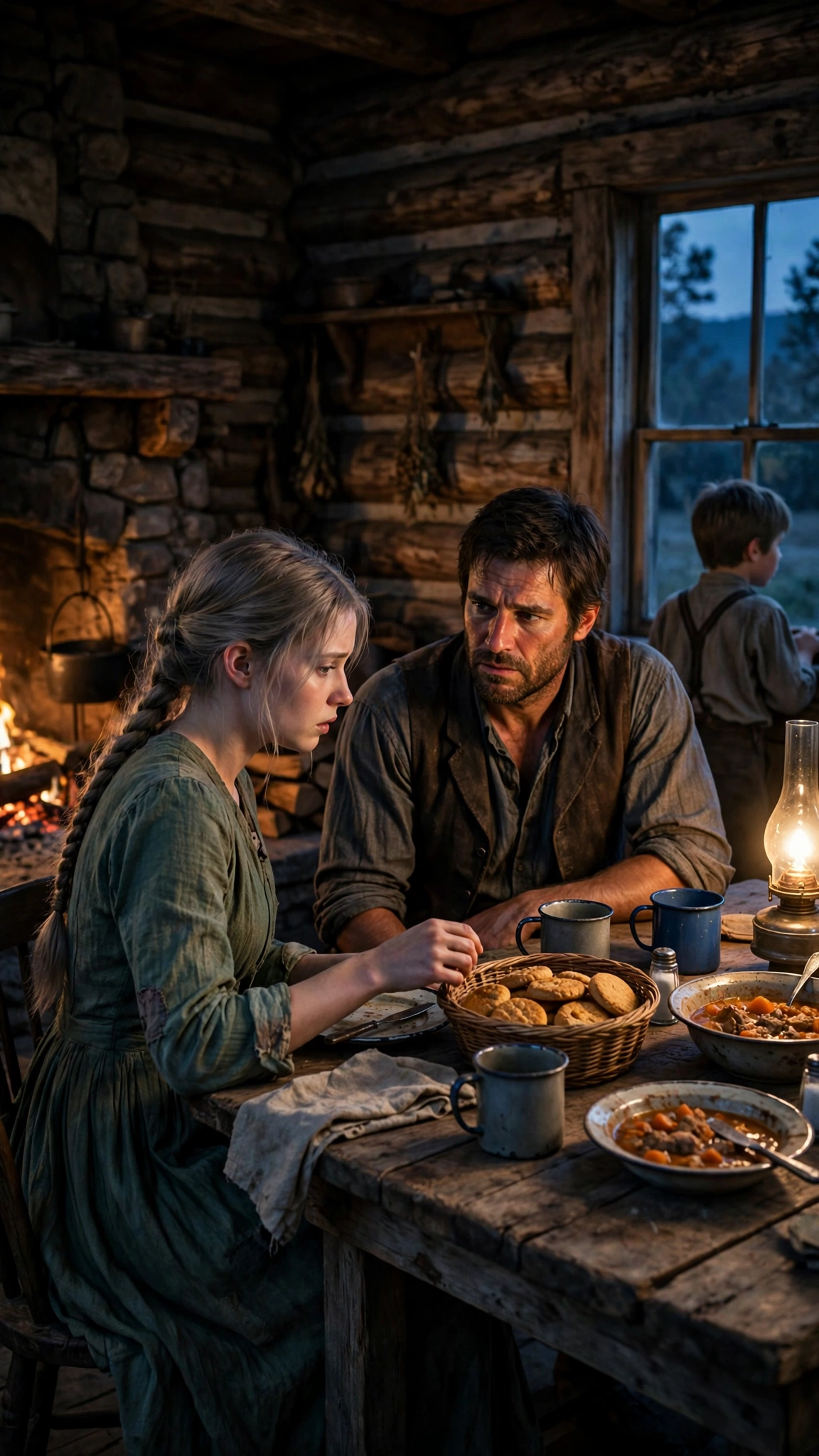
That night, at the supper table, she ate without asking. She ate stew, and potatoes, and a whole biscuit — both halves — and she did not hide anything, and she did not apologize, and when Noah asked her if she was afraid of tomorrow, she said, "Yes. But I'm going anyway."
And Cole, who had been watching her from across the table, the way he had watched her every night since she came to Red Creek, said, "We'll all go. Together."
And that was the truest thing anyone had said to her in her whole life.
But the night after the first day in court was the hardest night of all, because the court had recessed, and the deputy had ridden to Kansas, and no one knew what he would find, and Hannah lay awake in her room, listening to the wind, and thinking about the black book.
"What if it's not there?" she whispered to Cole, when he came to check on her, the way he had taken to doing, standing in the doorway with the lamp, not coming in, just making sure she was all right. "What if he burned it? What if he moved it? What if the deputy comes back with nothing, and the judge believes him, and not me?"
"Then we still have the will," Cole said. "And the bank records. And Grant. And Mrs. Foster. And thirty people in that courtroom who heard you tell the truth. A book is a piece of paper, Hannah. The truth doesn't live in a book. It lives in you. And you spoke it today, in front of everyone, and no one can un-speak it."
She was quiet for a moment. Then she said, "When his lawyer questioned me — when he asked me if I was sure about the beatings, if I was sure about the dates, if I was sure I hadn't imagined it — I wanted to run. I wanted to get up and walk out of that courtroom and keep walking until I reached the mountains. But I didn't. I stayed. I answered him. And do you know what I was thinking, while he was asking me those questions?"
"What?"
"I was thinking about the supper table," she said. "The first night. The basket. The folded cloth. And I was thinking: I have already done the hardest thing. I have already sat at a table full of food and been afraid to eat. I have already hidden half a biscuit. I have already said 'I'm sorry' for something I did not do. And if I could survive that, I can survive a lawyer asking me questions in a courtroom."
Cole nodded. He set the lamp down on the washstand. He did not come in. He did not touch her. He just stood in the doorway, and he said, "You don't have to survive anything alone anymore, Hannah. That's what a husband is for. That's what a family is for. You go to sleep now. I'll be right down the hall. And if you need me in the night, you call out. I'll hear you."
She slept. Not well — she dreamed of the pantry, and the padlock, and the black book — but she slept, and in the morning, she woke to the smell of coffee, and the sound of Noah feeding the chickens, and the sun coming up over the mountains, and she went downstairs, and she ate breakfast, and she put on her faded green dress, and she braided her hair, and she went back to the courthouse, because the deputy was coming back from Kansas, and whatever he brought with him, she would face it. She had faced everything else. She could face this, too.