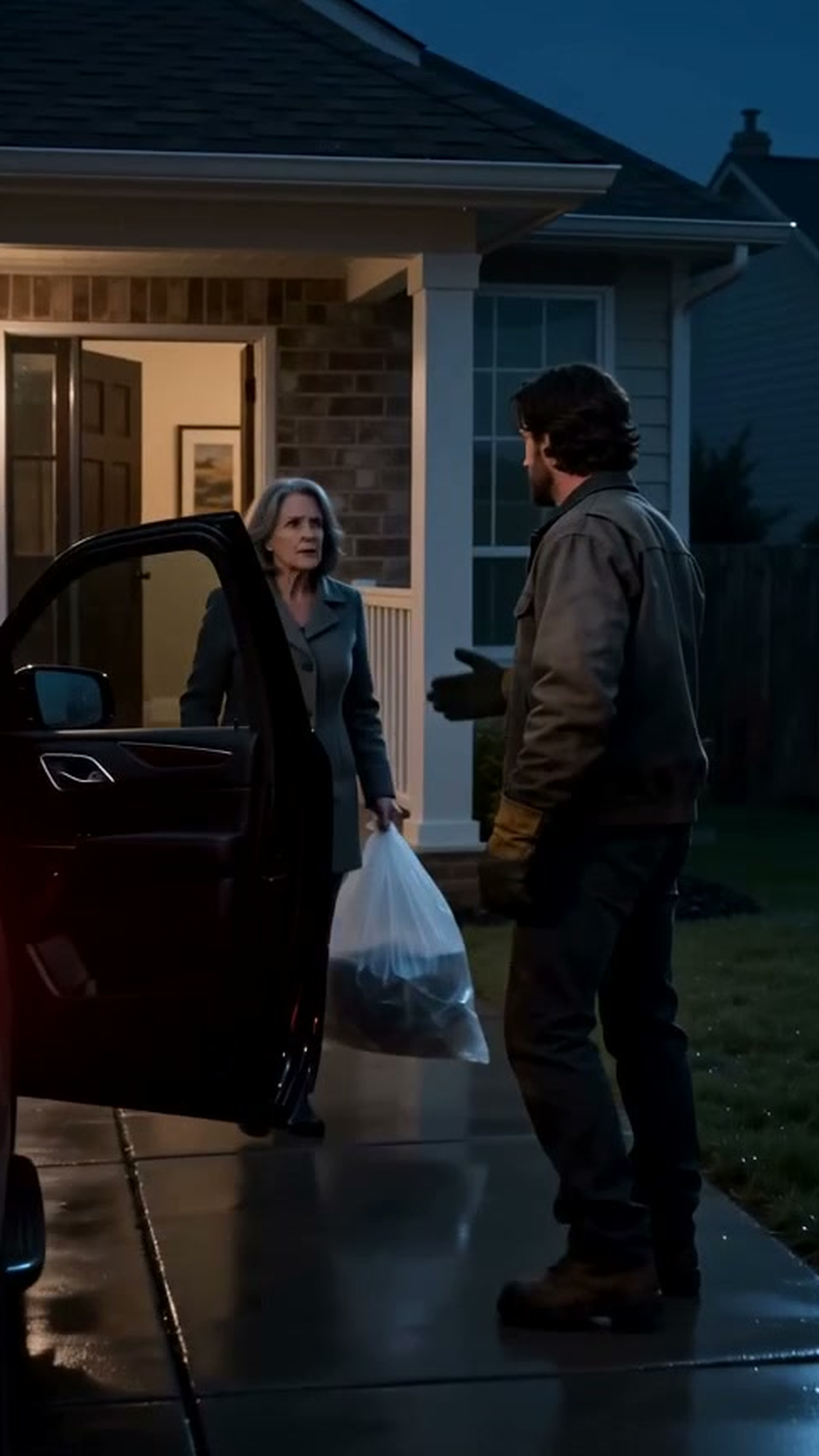
Tuesday came up gray and drowning.
The rain started before dawn, a warm Houston rain that turned the subdivision streets to black glass, and I was already awake to hear it arrive. I had slept perhaps ninety minutes. At five I stood in Lily's doorway watching her sleep with one arm flung over the stuffed fox and her mouth open, memorizing her the way you memorize an address you're about to give to a dispatcher you trust: precisely, and against the worst. Then I moved through the house completing the choreography of an ordinary morning, because ordinary was my camouflage and I intended to wear it perfectly. Lunchbox. Braids — I did Lily's hair in two braids with her still half-asleep at the kitchen table, her head tipping against my stomach between sections, and if my hands lingered it was because braiding your daughter's hair on the morning her father means to kill her concentrates the mind in ways I do not have words for. Phone charged. USB in my purse. Location sharing live — Dana's icon a small steady green eye on my screen. And at the door, one last ordinary thing: I locked up behind us and stood a moment with my palm flat against the front door of my house, and I made it a promise too. I'll be back for the truth of you, I told it. Whatever he turned you into, I'll be back to say what you were.
Mark stood in our kitchen at six o'clock in his charcoal suit with his coffee going cold, watching the weather through the window over the sink like a general watching a front move in — pleased with it, I realized. Rain was good weather for Mark. Rain kept people indoors. Rain kept windows closed. Rain explained a closed-up house with the heat running high.
"Roads'll be slick," he said. "Take your time coming home."
"You too," I said. "Fly safe."
Lily ate nothing. She sat at the table in her yellow floral dress — she'd picked it herself, her favorite, the one with the little white flowers — with her backpack on the floor between her feet like a sandbag, and she watched her father butter toast with the flat, exhausted attention of a hostage negotiator's kid. I had dressed that morning with a strange care, the pale-yellow dress with the puff sleeves, my pearl earrings, my hair braided up the way Mark liked it. I wanted to look like a woman dressing for a goodbye kiss at an airport. I wanted nothing about me to ring a single alarm in him.
The goodbye at the front door deserves its own paragraph in the record, because it was the last time all three of us stood in that house as its family, and because of what he said to her.
Mark had packed a suitcase — a real suitcase, which he loaded into the back of the SUV with a husband's practiced swing, a suitcase I would learn later was full of old work clothes and a Denver guidebook bought at the airport gift shop the week before, ballast for a story. On the porch he knelt to Lily's height in the rain-damp doorway, in his good suit, and took both her hands, and said, "Almost over, Lilypad." She went very still. He must have felt it — I watched him feel it — but whatever he felt, he filed it where he filed everything that didn't fit the schedule. "After this week, everything's different," he told her. "No more scary dreams. Daddy promises." He kissed the top of her head, between the braids I had made at dawn with my hands in her hair like a blessing, and stood, and caught me watching, and smiled the smile I had been eating across the dinner table from all week. "Don't look so worried, Laura. It's just Denver."
Mrs. Abernathy was on her porch across the street in her rain jacket, deadheading her hanging baskets in the wet like a woman who feared no weather, and she called over, "Safe travels, Mark!" and waved, and he waved back, big and easy, the neighbor, the builder, the man. A witness. He had collected one without even trying, the way he'd collected the flight number and the guidebook — the scenery of an ordinary Tuesday, arranged by a man who believed the world only ever looks at the surface of a morning. He had no way to know that the same instinct was working against him from inside his own car. I told Mrs. Abernathy to have a good day. I put my daughter in the back seat, and her backpack between her feet like a sandbag, and I backed out of the driveway of the house whose furnace was already breathing poison into its attic, and I watched it shrink in the mirror — the porch, the door, my whole narrated life — and I thought: if I never see it standing again, so be it. Houses can be rebuilt. I had married a builder. I knew the difference between a structure and what makes it a home, even if he had forgotten.
The drive to Intercontinental took fifty minutes in the rain. Mark talked the whole way — the Harper Group, the walk-through, the dinner he'd have with the project manager Thursday, the bonus structure, the deck he was going to build me off the back patio when the money came in. Deck. He said the word deck while the crowbar's receipt sat folded in a plastic sleeve in my purse, and I made the appropriate sounds, and my daughter sat in the back seat silent as a held breath.
The freeway gave me one last gift, and it was Mark's own thoroughness. Halfway to the airport, performing the devoted husband at cruising speed, he walked me through his itinerary like a man building an alibi out loud: the United flight, out at 9:40, landing Denver at 11:20; the rental car counter; the Harper Group's project manager, a man named Calloway; the hotel by the airport where he'd text me from the room. I repeated the details back with a wife's bright interest — 9:40, Denver at 11:20, Calloway, got it — and I watched his shoulders settle at being believed, and I filed every word, because a man who invents a flight invents a flight number too, and an invented flight number is a thread with a loose end. Somewhere in a prosecutor's file there is now a page with those details in my handwriting, written that night in Dana's kitchen, and beside them the airline's own record that no Mark Bennett was booked, checked in, or manifested on any flight out of Houston that day — and that the 9:40 to Denver was, in fact, a flight to Chicago. He hadn't even bothered to make the lie internally true. He had never expected anyone to be alive to check it. That, the prosecutor told me later, was the detail the jury hated most. Not the gas. Not the money. The laziness of it. The arithmetic that assumed my daughter and I would be a smoke stain and a foundation report, and that arithmetic never lies awake.
In the back seat, Lily watched the rain-streaked window and hummed, very softly, the song from her school concert, and stopped, and started, and stopped — and I understood she was keeping time with her own courage, winding it like a watch.
At the terminal he got out into the rain and came around to my window, and I rolled it down, and he leaned in and kissed me on the cheek with his hand cupped warm around the back of my neck.
"Go straight home," he said. "Put the heat on. Rest." Then, to the back seat, bright and easy: "Be good for Mommy, Lilypad. Daddy'll bring you a snow globe from Denver."
The doors took him. The crowd took him. I sat at that curb with the wipers slapping and watched the glass until he was fully and completely gone, and only then did I turn around in my seat to my daughter.
"Lily. We're going to wait here just a little while—"
I never finished. That's when her hands came around my arm. That's when my eight-year-old, who had kept a grown man's murder secret for two days because she didn't want to make Mommy cry, pulled me toward her with all the strength in her body and whispered the words that beat every other sound in the world:
"Mom, don't go home. Daddy said it's a gas leak."
What happened next I have already told you — the promise, the parking garage, the eleven longest minutes of my life. But this is the part I haven't said: in the garage, with the rain drumming the concrete and the flight boards flickering beyond the doors, I made the second decision, the one that mattered more than the first.
I could drive away. I could take Lily and drive to Dana's, to a police station, to Ruiz's office, and be safe, and let whatever was going to happen at that house happen in my absence — to an empty house, to a staged fire, to a man whose story would then be his word against a frightened woman's instincts.
Or I could watch. I could follow. I could be the witness the truth was going to need.
Lily's hand was still locked around my wrist like a cuff. "Are we going home?" she whispered.
"No, baby."
"Are we running away?"
I looked at my daughter — at her braided hair coming loose, at her eyes too old for her face, at the daughter of a 911 dispatcher who had already, at eight years old, done the single hardest thing a person can do: she had broken a promise to protect the person who made her keep it.
"No," I said. "We're doing our job. Somebody has to watch the door, Lily. Today that's us."
While we waited I did one more piece of the job, sitting in the garage with the engine ticking cool. I took out my phone and I pulled up the departures board for Intercontinental, the public one, the one any wife might idly check to track her husband's flight. United. 9:40. I scrolled it twice with my thumb going slower each time. There was a 9:40 United flight on that board. It was going to Chicago. There was no 9:40 to Denver, no Denver departure within the hour, no flight in that whole gray morning that landed anywhere at 11:20 with Mark's invented itinerary folded inside it like a note in a lunchbox. I sat with the little glowing lie of it in my hand and felt the last alternate explanation — the affair, the gambling, the dozen smaller ruins a wife rehearses in the dark, every one of them survivable — close its door quietly and go away. What was left was the furnace. What was left was the thermostat. What was left was a man who had invented a flight the way he'd invented a gas leak: carelessly, completely, in the confidence that the inspector of his story would be dead by the second act.
"What's that face, Mom?" Lily whispered from beside me. I'd forgotten she was watching my face the way she'd learned to watch all faces that year — for weather.
"That's my working face, baby," I said, and put the phone away, and fixed my eyes on the terminal doors. "That's the face that means somebody's about to get caught."
Lily considered this with enormous seriousness, and then, because she was eight and because terror and boredom share a border in a child's mind, she began quietly counting the airplanes that lifted off beyond the glass — one, a white one; two, a blue one — whispering the numbers like a rosary, her small hand still threaded through the crook of my arm. I let her count. I have thought since that we were both doing the same thing in that garage: assigning numbers to the minutes so the minutes would behave. Hers went up to eleven. Mine stopped at 08:04, when the doors opened on the eleventh minute and her father came out of them carrying nothing at all.
At 08:04 the doors of Terminal C slid open, and my husband walked out into the rain without his bag, without his suitcase, without a single thing a man takes to Denver — and looked left, and looked right, and raised his hand for a taxi, like a man coming home early from a trip he had never intended to take.