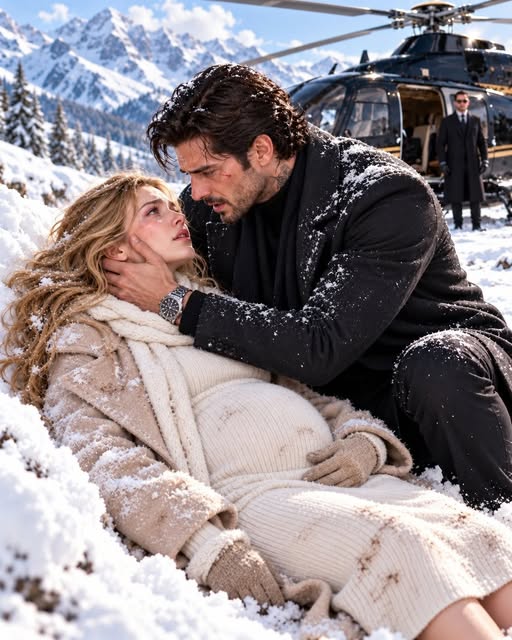
I thought my husband had found the perfect way to erase me forever.
By the time everyone gathered for the funeral they believed was mine, he was already standing beside the woman he'd been hiding, convinced he was about to collect fifty million dollars. The coffin they lowered into the frozen Colorado ground was empty. The widow's tears on Michael Carter's face were worth every penny of the performance.
The only thing he never imagined was that I was still alive.
And the first person to find me looked more like a ruthless mafia boss than a rescuer.
Hours earlier, Michael and I had been arguing at a remote overlook in Rocky Mountain National Park, and I did not yet know I was a dead woman.
The trip had been his idea. That should have told me everything.
For three weeks he had been strangely gentle. He brought me tea in bed. He rubbed my swollen ankles without being asked. He talked about the baby — our daughter, due in seven weeks — with a softness I hadn't heard from him since before the distance started, before the late nights at the office, before his assistant Ashley began answering his phone with that bright, territorial voice and he'd begun calling me paranoid for noticing.
"A weekend in the mountains," he'd said. "Just us. Before everything changes. We used to love it up there, Sarah."
We had. That was the cruelest part. In the beginning, Michael Carter had loved me in a way that felt like shelter. He was a wealth manager with a downtown office and a smile that made clients hand him their life savings. I was a pediatric nurse who fell for him in four months and married him in nine. For six years I believed the soft parts of him were the real ones.
We met in my emergency room. He'd cut his hand on a broken bottle at a charity gala — he was there as a sponsor, all cufflinks and apology — and I'd stitched him up while he asked me questions like he was afraid I'd stop talking. He sent flowers to the ward every day for two weeks. Not to me, officially. To the nurses' station. "For the woman who saved my pitching hand." He took me to dinner in a place with no menus, and when I laughed at the wrong moment he looked at me the way a man looks at a door opening. He proposed at the lake house his firm used for retreats, on one knee in wet grass, and my father — my wonderful, watchful father, dead three years by then — would have checked the man's references and his soul, and I have wondered a thousand times since that day on the mountain whether Thomas Reynolds would have seen something in Michael Carter that I was too loved-up and lonely to see.
Then came the year of locked doors. The second phone. The business trips that left no hotel receipts. And the papers — six months ago, a thick stack of papers he'd slid across the kitchen island with a pen and a kiss.
"Just insurance," he'd said. "For the baby. Standard stuff, now that we're a family. Sign where the tabs are, babe."
I signed where the tabs were. I want that on the record of my own stupidity: I signed, and I never read a word.
The drive up into the park that Friday had started well enough. Snow was coming, they said — a fast storm off the Divide — but the morning was bright, the peaks white and indifferent, the air thin and clean. Michael hummed along to the radio. He held my hand across the console the way he used to.
It was at the overlook that the mask came off. I don't even remember what started it. Ashley's name. A text lighting up his phone on the dashboard. The word liar, his or mine. What I remember is the wind, and the wooden railing, and the drop beyond it going down and down into pine and rock and snow, and Michael's face suddenly tired of pretending.
"You want to know what you are, Sarah?" he said. "You're a weight. You've always been a weight."
I was cold, exhausted, and done fighting. My hand went to my belly without thinking, the way it had a hundred times a day since the baby started moving — a shield made of instinct.
"Michael, enough." I rested my palm over my daughter. "I'm going home."
He moved toward me.
For one second, I thought he might apologize. His face did something complicated. His hand came up, and I actually leaned toward it like a fool, like a wife.
Instead, he shoved me.
Hard.
Both hands, flat against my shoulders, with his whole weight behind it and seven years of marriage behind that.
My feet slipped on the icy gravel. The railing caught me for half a heartbeat — I heard the wood crack, or thought I did — and then the edge disappeared beneath me, and I plunged down the cliff.
The world became noise and white and pain. I hit a narrow ledge partway down with enough force to steal my breath entirely. My wrist twisted beneath me. Something tore through my ribs, a bright wire of agony. Snow packed against my cheek. For a moment I couldn't move, couldn't breathe, couldn't think past the roaring in my ears.
But my hands went straight to my stomach.
"Stay with me, baby," I whispered. "We're getting out of this."
The ledge was barely wider than my body — a shelf of rock and ice jutting out of the cliff face, maybe twenty feet below the overlook. Above me, the sky. Below me, a fall I did not let myself look at twice.
Then I heard voices above.
Michael was still there.
So was Ashley. His assistant. The same woman he'd insisted I was crazy for suspecting, in the bright sing-song voice she'd used to answer his phone. She had been in the car behind us, or waiting at the trailhead — later I would understand that she had been part of every hour of this. She was part of the view.
"Is she dead?" Ashley called.
Michael's answer chilled me more than the snow.
"For fifty million dollars, she'd better be."
I stopped breathing.
Fifty million.
The insurance policy. The stack of papers and the little colored tabs. This isolated trip. His sudden tenderness. His insistence that we come up here, to this deserted overlook, in the week a storm was forecast, while I was seven months pregnant and clumsy and slow.
It hadn't been rage. The shove hadn't been a moment of passion he would spend his life regretting.
It was a plan.
And later — much later, in a warm room with a lawyer reading the policy aloud in a stunned voice — I would learn the worst of it. The policy paid double if our unborn child died with me. One hundred million dollars. My daughter's life had a price tag on it, and her father had done the arithmetic and found it acceptable.
"I'm freezing," Ashley snapped, from the world above my grave. "Let's go. If anyone asks, she wandered off while you were getting the camera bag. You called and called. There was a storm."
"She'd better not be on that ledge when the rangers sweep," Michael said.
"Then they'd better not find a ledge," Ashley said, and laughed — actually laughed — and their footsteps faded into the gravel and the wind.
I lay motionless until silence swallowed the mountain.
Snow gathered around my legs in a soft, patient drift. The cold moved into me like water into a wreck. My wrist throbbed in time with my pulse. Every breath felt sharper than the last, a knife sliding between my ribs, and I began to do the math of dying: how long until the cold took my fingers, how long until it took my mind, whether anyone would ever look over that railing and see the shape of me against the rock.
Then my baby kicked.
Not a flutter. A kick — hard, indignant, alive, a small foot connecting with the inside of me like she was pounding on a door.
I pressed my palm against the movement and felt her do it again.
"Good," I whispered through cracked lips. "Good girl. Keep fighting. So will I."
I tried to shift my weight and nearly blacked out from the pain in my ribs. I dragged myself — an inch, then another — until my back was against the cliff face and the wind had something solid to fight instead of me. I pulled my coat open and then closed it around my belly. I sang, I think. I don't remember the song. I remember my mother's voice from a kitchen thirty years gone, and I remember thinking that if I stopped making sound, the snow would win.
I tried my phone. It was in my coat pocket, which was a miracle, and the screen lit, which was a bigger one — spiderwebbed, but lit. No signal. Of course there was no signal. Michael had chosen this overlook the way a sniper chooses a field of fire. I held the phone up anyway, waving it at the sky like a flare, until my arm shook and the cold made my fingers stupid and the battery, at fourteen percent, gave up and went black.
So I talked. I talked to my daughter the way I'd talked to her through every night of the pregnancy, one hand spread over the hard curve of her. I told her about her grandmother, who died believing the world was mostly kind. I told her about her grandfather, who drove a truck full of other people's money for twenty years and never lost a dime of it, and who taught me that a person is what they do when the road is empty and nobody would ever know. I told her she was not going to be born on a rock in a storm. I told her she was not going to be a line in an insurance file.
Once — I will swear this on whatever is left of my soul — I heard a helicopter, far off, and I screamed until my throat tore, and the sound thinned and went away over the ridge, and the silence afterward was the worst sound I have ever heard.
The light was going. The storm was arriving in earnest — fat, fast flakes out of a bruising sky.
And then, a brilliant beam sliced through the storm.
Helicopter blades thundered overhead, so loud the ledge seemed to vibrate under me. Snow whipped into the air in a white cyclone. A cable dropped out of the chaos toward my ledge, and on the end of it, descending like something out of a nightmare or a prayer, came a massive man dressed in black.
When his boots touched the rock beside me, I stared.
Tattoos climbed out of his gloves and covered his hands — dark, intricate work, knuckles and fingers inked like weapons. A scar cut across his jaw, pale against weathered skin. He was enormous — shoulders like a doorframe, easily two hundred and fifty pounds of him — and his gray eyes had the cold authority of a man accustomed to being feared, not questioned.
He didn't look like search and rescue.
He looked like the kind of man search and rescue might warn you about.
He crouched beside me on the narrow rock, perfectly balanced over the drop, and studied my face. Snow melted on his black coat. He looked at my face for a long moment, and then at my belly, and back at my face.
Then something shifted in his expression.
Recognition.
"So," he murmured, in a voice like gravel under a boot. "I finally found you."
My pulse jumped. "I don't know you."
"No," he said, and began fastening a rescue harness around me with surprising care — those tattooed hands gentle as a nurse's, easing the straps around my pregnant belly with a precision that told me he'd done this before, or had rehearsed it. "But I know exactly who you are, Sarah Reynolds."
He knew my name. Not my married name. My father's name. The name I was born with, that I had buried under Carter for seven years.
"Who are you?" My voice shook, from cold or fear I couldn't say. "How do you know my name?"
"Later," he said. "First, we get you off this mountain."
The cable tightened. His arm locked around me — secure as iron, careful as glass — and his other hand came to rest, deliberate and protective, over mine where it clutched my belly.
"You're not dying on this mountain," he said, as the winch began to lift us both off the ledge and into the screaming white heart of the storm. "Not while I'm still breathing."
As we rose, I looked into the face of a stranger who had somehow been searching for me.
Michael believed I was dead. The world would soon believe it too.
But I was alive.
And the man holding me had apparently been searching for me long before my husband tried to kill me.