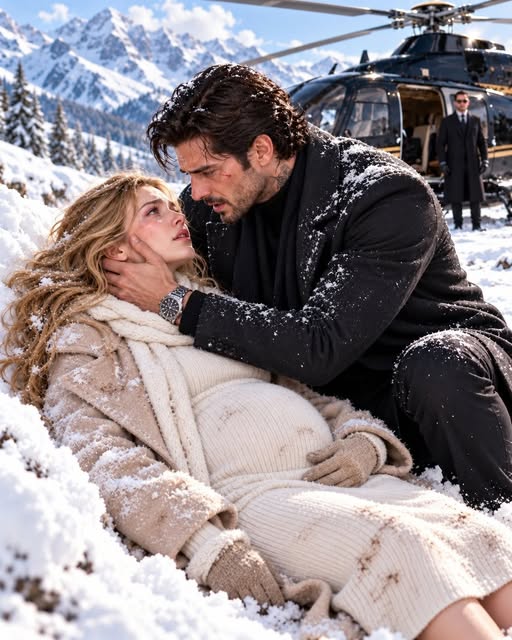
I woke to white light and the smell of antiseptic and the sound of a machine counting my daughter's heartbeat.
It was fast and steady and the most beautiful sound in the world. I lay still for a moment, afraid that moving would break the spell, and let it fill me: lub-dub, lub-dub, a hundred and forty beats a minute of pure refusal.
"She's strong," said a woman's voice. "Like her mother."
The room was not a hospital room. It was too beautiful for that — wood panels, a real fireplace with a real fire, windows looking out over snow-drowned pines. But there was a hospital bed, and a fetal monitor, and an IV in the back of my hand, and a doctor — gray-haired, calm-eyed, name stitched on her coat: DR. ALMEIDA — sitting beside me like she'd been there for hours.
Because she had.
"You've been out for most of a day," she said. "Two cracked ribs. A sprained wrist — here, don't test it. Mild hypothermia, which we have corrected. Bruising that will be spectacular and entirely survivable." Her hand rested lightly over mine. "And the baby, Sarah. The baby is unhurt. The placenta is intact. Her heartbeat never wavered. Whatever you did on that ledge, you did it right."
I cried then, in a way I had not let myself cry on the mountain. Dr. Almeida let me. She had clearly cried with strangers before.
When I could breathe, I asked the question. "Where am I?"
"A private clinic," she said. "On Mr. Sokolov's estate, outside Estes Park. You were brought here rather than a hospital because—" she glanced toward the door, "—because a hospital would have required a name. And at the moment, your name is a complicated thing."
The door opened and he came in.
In the light of the room, without the storm, the rescuer was somehow more intimidating, not less. Enormous still. The tattoos climbed from his hands up under the cuffs of a black shirt. The scar on his jaw was an old, white seam. He moved like a man who owns every room he enters and is tired of it.
"Nikolai Sokolov," he said. "You're safe here. No one knows you survived. Yet."
"Why?" It came out hoarse. "Who are you? How did you know my name — my real name? How did you know where I'd be? There was no signal. Nobody knew—"
"Many questions." He pulled a chair to the bedside with one hand, the way other men move a glass of water, and sat, and for a moment something almost like grief crossed his face and was gone. "I will answer all of them. But first, you eat. You drink. The doctor insists, and in this house, on medical matters, she outranks me."
They fed me broth and bread and tea so sweet it made my eyes water, and the whole time he sat there like a mountain that had learned patience, and when the bowl was empty he said, "Your father."
I went still.
"Thomas Reynolds," Nikolai said. "Driver and bookkeeper for my father's organization for twenty-two years. The most honest man in a dishonest business — my father used to say God put him among thieves as an experiment." A ghost of a smile. "Fifteen years ago, Sarah, there was an ambush in a warehouse in Brighton Beach. Men who wanted my father's routes, and wanted me dead as a message. I was twenty-three years old and very certain I could not die."
My father's face rose up in me — the laugh lines, the calloused hands, the way he sang off-key in the truck.
"Your father was driving that night because my regular driver was sick. He was not a soldier. He was a man with a ledger and a lunchbox. When the shooting started, he put himself between me and the door." Nikolai's gray eyes were fixed on some point fifteen years away. "Three bullets. He took three bullets that had my name on them, and he held on long enough in my arms to make me promise one thing. He said: 'My girl. Sarah. If anything happens to me — she's got no mother, she's got nobody watching. Promise me somebody watches.'"
The room was very quiet except for the heartbeat monitor, counting away.
"I promised," Nikolai said. "And I have kept it badly, and I have kept it late, and I am sorry for both. Your father died when you were seventeen. I was in a hospital, then in a war of succession — it took four years to bury my father and take his chair and make it safe to keep a promise. By then you had graduated, moved, married. You changed your name. You changed your city. You disappeared into an ordinary life, Sarah — which is what your father wanted for you — and ordinary lives are the hardest of all to find."
"You found me anyway," I whispered.
"Eight months ago. One of my people cross-referenced a trust your father left — he was careful, your father, he left you money in a place Michael Carter could never touch, which tells me he had your husband's measure before you did." He let that land. He took a phone from his pocket — not new, I noticed, an old one, scarred — and turned it toward me. On the screen was a photograph I had never seen. A warehouse yard, winter light. My father, younger than I ever knew him, laughing with his head back, one arm around a tall, skinny young man with gray eyes and no scar and his whole life still in front of him.
"I keep it," Nikolai said, "to remember what honesty looked like."
I touched the screen with two fingers, the way you'd touch a face. My father had driven me to my first day of nursing school in that jacket. He had cried at my wedding in the third row and told me, dancing, that Michael seemed like a man who loved the sound of his own life. I had laughed at him. God forgive me, I had laughed, and told him he was being a father about it.
"Did he know?" I asked. "About Michael. You said the trust—"
"Your father knew Michael Carter for two years before he died. He never said a word against him to you, I think, because you were happy and he would not poison it. But he built that trust where Carter could not reach it, and he made my father its guardian, and mine. A careful man, Thomas Reynolds. He prepared for a storm he hoped would never come." Nikolai's eyes were not unkind. "It came, Sarah. That is not your failure. That is only weather."
"I watched you, from a distance, for a while. You seemed… happy. Pregnant. Held. I decided the promise was kept by staying away." His jaw tightened. "Three weeks ago, my people in another family's house heard a name in the wrong conversation. Michael Carter. Debts. A laundry business run through his firm for the Orlov syndicate — and a question he had asked a broker who asks no questions. He wanted to know how fast an accidental-death policy pays out when there's no body."
I felt the room tilt.
"The policy he made you sign paid fifty million dollars on your death," Nikolai said, gently, like a man laying a blade down. "One hundred million if the child died with you. He took it out six months ago. He has owed the Orlovs twelve million for two years, and lately they have stopped accepting promises. So he built you a grave with a view, Sarah. And I put a helicopter within ten minutes of that mountain, and men on the roads, and I waited and prayed your husband was only fantasizing." His voice dropped. "He was not fantasizing. When his rental car stopped at that overlook in a storm, we launched. We were over the ridge when Ashley's car turned back down. If we had been four minutes later—" He stopped. "We were not four minutes later."
On the television mounted in the corner — muted, subtitled — a news anchor stood in front of a photo of me. SARAH CARTER, 32, MISSING, PRESUMED DEAD IN PARK ACCIDENT. Below it, a clip played in a loop: Michael at a podium of microphones, wrecked and handsome in grief, a bandage on his forehead I knew he'd given himself or had Ashley give him.
"My wife is the kindest soul God ever made," the subtitles said. "If anyone has seen anything — please. Please. I just want to bring her home."
Ashley stood behind him, in black, holding his elbow. Supporting him. The grieving widow's understudy, already in costume.
Later, when I asked about the search — because some stubborn, decent part of me still needed to know whether anyone had stood at that railing and called my name — Nikolai told me the truth without dressing it.
Michael had given his statement at the trailhead with tears in his eyes: his wife had felt unwell; he had gone to the car for the camera bag and her water; when he came back, she was gone; perhaps she had wandered toward the trees, confused; the storm, the cold — he had searched for an hour before calling it in, which was a lie by fifty-eight minutes, because Ashley's car had been logged by a park camera leaving the area eleven minutes after the shove. The rangers had searched until the storm made it suicide to continue, and found nothing. They found nothing, Nikolai explained, because at dawn, in the whiteout, two of his men had gone back down to my ledge on ropes and cleaned it the way you clean a room where a crime has been committed in reverse. My blood. My phone. The scuff of my boots in the snow. All of it, gone.
"If the rangers had found signs that you survived that fall," he said, "your husband would not have grieved, Sarah. He would have come back up the mountain to finish his work. Your death is currently the only armor you own. My men made sure it fits."
And Megan — my Megan, my best friend since we were nineteen, the maid of honor who had cried harder at my wedding than I did — Megan was calling hospitals. Megan was calling morgues. Megan was, at that moment, sitting in my kitchen telling a detective that Michael Carter was a liar about something, she didn't know what, she'd never liked his hands. I put my face in my own hands and shook, because I could not call her, because every person I loved had to go on believing I was dead and frozen on a mountainside, and that was the price of the front-row seat.
I watched my husband perform my death for the cameras, and something in me that had been broken on the ledge quietly set itself, like a bone.
"He thinks he's won," I said.
"Yes," said Nikolai.
"How long until the money?"
"The policy pays on a legal declaration of death. With no body, that normally takes years — but he has lawyers, and a cooperative coroner in his pocket, and a storm, and a cliff. He will push for an expedited hearing. My attorney estimates ten days to three weeks." The gray eyes held mine. "Until then, Sarah Reynolds, you have a choice that few people in history have been offered. You can walk into a police station tonight and destroy him with your survival. Or—"
"Or I can stay dead," I said slowly, "and watch him bury himself."
"Or you can stay dead," Nikolai agreed, "and let him walk, smiling, all the way to the moment he reaches for the money — with every camera in Colorado watching — and then you can stand up in your grave clothes and take it all away from him in front of everyone."
The fire popped. The monitor counted my daughter's heartbeat, steady as a metronome, steady as a promise.
"Your husband is about to bury an empty coffin," Nikolai said. "Tell me what you want, Sarah."
I looked at the man who had carried my father's dying wish for fifteen years, who had flown into a storm because of it, whose tattooed hand rested, careful and enormous, on the arm of a chair beside my bed.
My hand had found my belly again, the way it had on the ledge. Under my palm, my daughter rolled over, slow and dreaming, alive in a way that made every other fact in the world feel like paperwork. Michael had priced her at fifty million dollars. He had stood over a cliff and done sums on her. Whatever I had been before the mountain — the trusting wife, the woman who signed where the tabs were — she had not climbed down off that ledge with me.
"A front-row seat," I said.