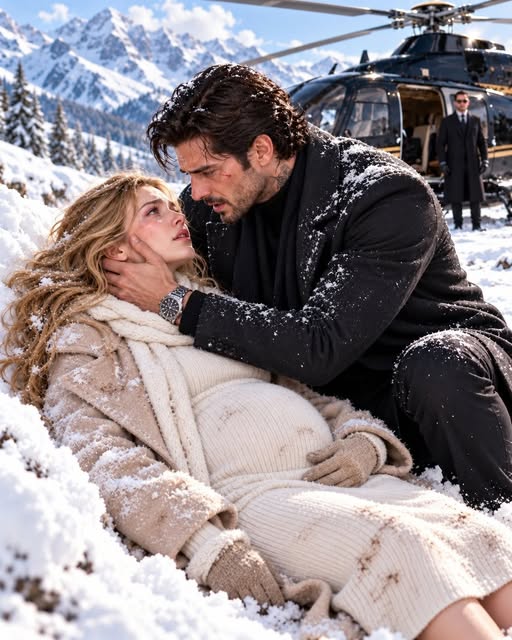
On the fifth night of my death, I couldn't sleep, and I found him in the kitchen at three in the morning, standing at the stove in the dark, making tea in a pot the size of a bucket.
"You too," I said from the doorway.
"Me always." He poured without asking, into two mugs big as soup bowls, and set one at the place across from him as if I'd been expected for years. The estate was silent around us — snow against the windows, the tick of cooling pipes, a house full of armed men sleeping in shifts. In the yellow kitchen light, with his sleeves up and the tattoos running dark along his forearms, Nikolai Sokolov looked less like a crime boss and more like what he also was: a man who had been awake at three in the morning for most of his life.
"Does it get quieter?" I asked. "The — everything. Does it get quieter, or do you just get better at carrying it at this hour?"
"You get better at carrying it at this hour," he said. "Quieter is a lie people sell in books."
"My father," I said. "Tell me all of it. Not the short version you give a patient. I have nine — eight now — days of being dead, and I want to spend one of them knowing how my father died. The real shape of it."
So he told me.
Thomas Reynolds came to the Sokolov family in 1987 with an Army discharge, a head for figures, and a reputation earned in exactly one bar fight: he had once returned a wallet with four thousand dollars in it to a man who'd threatened to kill him over it, because, he said, it wasn't his wallet. Old man Sokolov — Ilya, Nikolai's father, a butcher's son who built an empire of trucks and warehouses and fear — hired him on the spot and spent twenty-two years saying that Thomas was the control group in his experiment about whether honest men could survive his world.
"He drove for my father," Nikolai said. "He kept the books that could be kept on paper. He never carried a gun. He carried a thermos and a crossword. When I was a boy he taught me bookkeeping at the kitchen table of our house, and he would rap my knuckles with a pencil when I tried to round a number into a lie. 'Figures don't care about your feelings, Kolya,' he'd say. 'That's why you can trust them.'"
"Kolya," I repeated, softly.
"Nobody has called me that in fifteen years." He turned his mug in his hands. "The ambush was meant for my father, but my father was delayed by a snowstorm in Albany, and so it was me in the car, me who was the message. A warehouse on the Brighton Beach side. They had the manifest — someone had sold the manifest. Thomas was driving because the regular man had a new baby and your father had traded him the shift as a gift." His voice went very even, the way voices do when they are walking through a minefield they've crossed a hundred times. "He got me out of the car. He got me behind the engine block. When the man came around the side with the shotgun, your father stood up out of cover and walked into it. Not ran. Walked. Like a man crossing a room to answer a door. He took the first load in the chest, and he stayed standing — God knows how — long enough to pull me down by my coat when the second shot came over his shoulder for my head."
I was crying without any sound at all. The tea went cold between my hands.
"He lived forty minutes. The ambulance was slow because of the snow. He held my hand — I think he thought I was you, at the end, because he kept saying your name and 'homework,' and then he was clear again, one last time, clear as a bell, and he said: 'Kolya. My girl has nobody. Promise me somebody watches.' And I said it. In Russian and then in English, so God would have it in both languages. 'I promise. Somebody watches.'"
"And then?" I managed.
"And then I was in a hospital, and my father died two years later with the war for his chair already started, and I buried him with stitches in my side and a gun under my coat, because grief in my family always had an escort. I won the war. It took four years. And in the fourth year I sat in this kitchen, in this chair, and I made a list of my debts, and at the top of it in capital letters was your name — and you were gone, Sarah. Married. Moved. A new name, a new state, a life with the curtains drawn. It took my people four more years, on and off, to find a pediatric nurse named Sarah Carter in Denver and be certain she was Thomas Reynolds' daughter."
"You came to my wedding," I said suddenly, because I could see it in his face. "Didn't you. Eight months ago you found me — I was married seven years ago. When you found me, you looked at the wedding."
"I looked at everything." He didn't apologize for it, which I respected more than an apology. "Photographs. You smiled in all of them. He held you—" a pause, chosen carefully, "—like a man holding something he had acquired. I told myself it was the photograph. I told myself a promise to watch is not a license to interfere with a happy woman's life. I have thought about those photographs every day since the storm, Sarah. A man who had acquired you would take out a policy. A man who loved you would take out the garbage and learn to fold a fitted sheet. I should have interfered."
"You interfered in time," I said. "You were over the ridge. You were in the storm. My father would call that keeping a promise, Kolya."
He went very still at the name. "Careful," he said, after a moment, and there was something in his voice I'd never heard there. "No one alive gets to call me that. It would be a hard habit to lose you to."
On the sixth day, his attorney came up the mountain — Miriam Kessler, seventy if she was a day, with white braids and a mind like a sprung trap — and over lunch she laid out the hearing the way generals lay out maps. Michael would testify first. That was essential. He had to stand in a courtroom, under oath, before a judge and a stenographer, and say the words my wife is dead, I saw the storm take her — say them as the foundation of his claim. Every word would be perjury the moment I breathed in the same building, but it had to be his rope, tied by his own hands, on the record.
"Then," Miriam said, "before the court rules, the doors open. You walk in. Not before he testifies — a smart lawyer could call it confusion, grief, a hoax, a double. After he testifies, the same lawyer has nothing. The sequence is everything, Mrs. Carter."
"Mrs. Reynolds," I said.
She smiled for the first time. "Mrs. Reynolds," she agreed. "The insurer's investigator has been… assisted." A copy of the drone footage and the policy documents had reached Dana Whitfield of the insurer's Special Investigations Unit by anonymous courier two days earlier, along with Ashley's car on a park camera and the claim filed before the search closed. "Ms. Whitfield will be in the courtroom. So will two detectives from the state police, as observers. They do not know you are alive. They believe they are attending a fraud hearing. It is important that everyone in that room learns the truth at the same moment, so that no one — no one — has time to make a phone call to your husband's friends in the Orlov organization before he is in handcuffs."
"And Ashley?"
"Ashley," said Miriam delicately, "has retained her own lawyer, which your husband does not know. Draw your own conclusions, my dear. Women in her position usually do."
Miriam also made me write it all down. Not type — write, in my own hand, on legal paper, because, she said, judges and juries believe ink. My right wrist was still in its brace, so I wrote left-handed, in a child's crooked scrawl, six pages at the kitchen table while the snow came down outside: the trip, the tea, the argument, the text on his phone, the shove. The eleven seconds at the railing. The ledge. Ashley's voice asking if I was dead. My husband's voice answering with a number. When I got to that line my left hand shook so badly the words swam, and Nikolai, passing behind my chair with the teapot, put one tattooed hand flat on the page to hold it still — not on my hand. On the paper. He never once touched me without it being necessary, that whole winter of my death, and I noticed it every single time, the way you notice a man holding a door in a burning building.
"Sign it," Miriam said gently. "Full name. Your father's name."
I signed: Sarah Reynolds. It was the first time I had written it in seven years, and it looked like a signature I had been practicing in secret all along.
Then I wrote one more letter, shorter, and gave it to Yuri with instructions that it be delivered by hand on the morning of the hearing, not one hour before: Megan, by the time you read this you'll have seen the news and you'll be furious, and you should be. I'm alive. I was alive the whole time and I couldn't tell you and it was the worst part. Worse than the cliff. You stood up at my funeral and said my name like a person knocking on a door. I heard you. I was behind the glass. I'll spend the rest of my life making this up to you. Forty dollars, I know. I haven't forgotten. — S.
That night Yuri brought the last report. Michael had sold my car. Michael had listed the lake house. Michael's firm had quietly booked a ballroom in Aspen for the second Saturday in June, and the deposit — fifty thousand dollars, a number he apparently enjoyed — had been paid from an account in Ashley Brooks's name.
"A wedding," I said. "He's planning his wedding at my death hearing. There's a kind of purity to it. Like a figure that doesn't care about your feelings."
"That's why you can trust them," Nikolai said from the doorway, and despite everything — the snow, the grave, the ballroom in Aspen — I laughed, standing in my dead woman's borrowed kitchen, with my father's best student watching me like the laugh was a thing he'd been waiting fifteen years to hear.
And because Miriam believed in rehearsal the way my father believed in arithmetic, we practiced. On the eighth night, in the long hall of the estate, Nikolai stood at the far end by doors Yuri held, and I walked the length of that hall as I would walk the length of the courtroom — slowly, because the ribs were still a bright wire when I breathed deep, and because a woman seven months pregnant cannot hurry toward her own resurrection. Halfway down the hall my voice gave out on the second sentence of the three Miriam had drilled into me, and I stood there shaking in a dead woman's composure.
"Again," Nikolai said, not unkindly. "From the doors. What will you say?"
"My name is Sarah Reynolds," I said. "I am not dead. On the twenty-first of November, my husband pushed me off a cliff in Rocky Mountain National Park to collect an insurance policy on my life and my daughter's." The words came stronger the second time. By the fourth walk they came like a verdict. "Will it be enough?"
"It will be more than enough," Nikolai said. "He has built his whole freedom on the world believing one thing. You only have to stand in a doorway and be the other thing."
Nine days became three. And I stopped practicing how to be a ghost, and started practicing how to walk through a door.