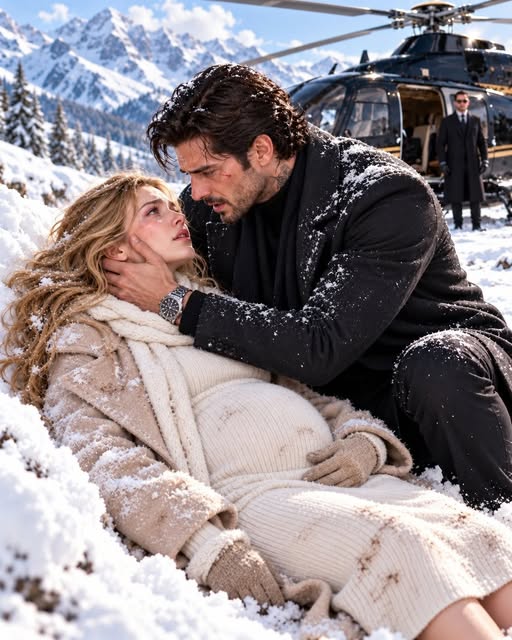
My funeral was on a Tuesday, because Michael had always been efficient, and even God, apparently, kept his schedule.
I watched it from the back seat of a black SUV parked across the road from the cemetery gates, behind glass so dark the world looked like it was happening underwater. Beside me, Nikolai sat motionless, saying nothing, which I would learn was his way of being kind. In the front seat, his man Yuri monitored a tablet showing a closer view — a camera in the lapel of a mourner I didn't know, one of Nikolai's people, standing close enough to hear my husband eulogize me.
"She walks well," Yuri said approvingly of Ashley, on the screen, as she crossed the frozen grass on Michael's arm in a black dress someone had plainly bought for the occasion. "The dress still has the fold lines from the box. She bought it after. Not before. After."
"After the storm," I said. "She went shopping for my funeral."
Snow had stopped, but the cold hadn't. They'd dug my grave through frost. There were more people than I expected — nurses from my old unit in their good coats, women from my book club, couples from the neighborhood who'd eaten at my table. People I had fed and laughed with, standing in the wind to say goodbye to an empty box, because the box was all Michael would give them.
His mother sat in the front row in a wheelchair, wrapped in blankets, her face collapsed. Whatever else was true, Eleanor Carter had loved me in her way, and her grief was real, and it was the only real thing in the front row. Michael kept one hand on her shoulder for the cameras. Ashley kept one hand on Michael.
The minister said the things ministers say. Someone had set a photograph of me on an easel beside the coffin — me at twenty-nine, at a firm's summer party, in a blue dress, laughing at something off-camera. I remembered that night. I remembered that Michael had chosen the photograph, and I understood with a small, cold clarity that he had chosen it the way he chose everything about me in public: the version where I looked best standing next to him.
My old charge nurse, Delia, read the psalm. Delia, who had held my hand in a hospital corridor twelve years earlier when the call came about my father, who had taught me that you can grieve and chart at the same time. Her voice shook. Beside the coffin were more flowers than the greenhouse of a small town — white lilies from the firm, white roses from Michael's golf club, an arrangement shaped like a heart from a client whose pension Michael managed. I stood behind my black glass and did arithmetic on my own funeral: everyone in that freezing crowd had been given a Sarah to mourn, and every one of them had been given the wrong one.
Then Michael stood up to speak, and the lapel camera turned with its wearer, and my husband's face filled the tablet screen — haggard, handsome, perfectly lit by the gray day.
"Sarah was the light of my life," he said. His voice broke in exactly the places a voice should break. He'd rehearsed. I could hear the rehearsal in it, the way you can hear a piano student's counting. "She loved these mountains. She used to say the air up there made her feel close to God. If she has to be anywhere—" a pause, a swallow, masterful — "I'm glad she's somewhere she loved."
In the SUV, my hands had curled into fists so tight my sprained wrist sang.
"He is good," Nikolai observed, in the tone of a man grading a vintage. "I see why people give him their money."
Then Megan stood up.
My Megan. Nineteen years of friendship stood up in a coat she'd borrowed because her good one was at the cleaners, with her face swollen and her hair coming down, and she looked at the coffin and she could not do it the way you're supposed to. She said my name three times like a person knocking on a door. She said, "Sarah taught me how to change a tire in a parking lot at midnight and she taught every kid on our unit how to not be scared of stitches and she owed me forty dollars from a bet about a cake and I don't—" and then she just stood there and wept, openly, unbeautifully, with her whole body, and two nurses held her up between them.
That was my funeral. The rest was choreography. That was the truth of it, standing in borrowed coat in the cold, grieving for a woman who was sitting forty yards away breathing behind black glass, forbidden by strategy and survival from running across that grass and taking her friend's face in her hands and saying I'm here, I'm here, I am not in the box.
I made a sound I didn't recognize. Nikolai's hand — enormous, tattooed, the hand of a man the newspapers called the Wolf of Brighton Beach — came to rest over both of mine in my lap. Not holding. Just covering. A roof, not a cage.
"Endure it," he said quietly. "It is the last thing he will ever make you watch."
They lowered the empty coffin. Michael threw the first handful of frozen earth, and it rattled on the lid like hail on a roof, and Ashley — I want this remembered, because I remember it every time I am tempted to mercy — Ashley checked her nails while the earth was still falling.
Then the receiving line formed, because in Michael's world even grief had a queue and a purpose. I watched him work it. There is no other word. He worked my funeral — hands clasped, head bowed at the practiced angle, murmuring gratitude — and twice, twice, I saw the mask slip into something warmer and more interested when the mourner was a client, a partner, a man whose money he held. For them the grief modulated into reassurance. The firm is steady. Your accounts are steady. I'm steady. A widow at work, selling continuity over his wife's empty grave. My wife's empty grave, on ground he had chosen in a cemetery whose plots, Yuri murmured from the front seat, had appreciated nine percent in a year. Michael had bought two. One for me. One, presumably, for whoever came next.
Eleanor was wheeled past our SUV on her way back to her car, close enough that I could see the tracks of tears frozen on her face, close enough to hear her say to no one, to the wind, to God: "He never let her rest. Even Sundays. My poor girl, he never let her rest." It was the truest eulogy of the day, and no one heard it but a dead woman and a mafia boss.
Afterward, in the car, riding back through the white hills with my grave behind me, Nikolai gave me the rest of it in his flat, factual voice, the way a doctor reads a chart.
"The insurance claim was filed at nine o'clock on the morning after the storm," he said. "Before the search was called off. Before your funeral was arranged. He filed the claim before he chose your coffin, Sarah."
"He has also," Yuri added from the front, without turning around, "established a memorial fund. The Sarah Carter Foundation. For mountain safety. It has taken in forty-one thousand dollars in donations from his clients in six days. The website has his photograph on it. Not yours. His."
"Of course he did," I said. My voice sounded very far away. "The coffin was for the audience. The claim was for him."
"His lawyers have petitioned for an expedited declaration of death — an emergency motion, citing the storm, the terrain, the absence of remains. There is a judge who golfs with his firm's senior partner. The hearing is set for nine days from now. If it is granted, the insurer must pay within thirty days. One hundred million dollars, because of the child clause."
"And if it isn't granted?"
"Then he waits seven years, and the Orlovs will not wait seven years, and he knows it. He is not merely greedy, Sarah. He is desperate. Desperate men with a plan and a deadline are the most dangerous animals on earth." He turned his gray eyes on me. "Which is why you will stay dead, and stay here, until the morning of that hearing. After that — the plan proceeds."
That night, in the clinic room that had become my whole world, Yuri brought a laptop and set it on my tray table and said, "You don't have to watch this."
"Yes," I said. "I do."
A sixteen-year-old boy from Boulder had been flying a camera drone that Friday, filming the river gorge for a school project, three hundred yards down the canyon from our overlook. His parents, proud, had posted the pretty parts online. Nikolai's people had found the unpretty parts in the raw card and purchased the boy's entire memory card for an amount of money that would shortly put him through his first year of college, along with a lawyer to explain to his parents why the footage was now evidence.
The image was distant and grainy and unsteady. Two figures on the overlook. The smaller one backing toward the rail, hands up, then one hand going to her belly. The taller one closing the distance.
I watched my husband put both hands on my shoulders and drive me backward off the edge of the world.
I watched myself disappear.
I watched him stand at the railing for eleven full seconds — the counter ran in the corner of the frame — looking down. Eleven seconds. Long enough to see me on the ledge. Long enough to know exactly where I had landed and that I had survived the fall. And then I watched him turn, unhurried, and walk back to his car to fetch his girlfriend and his camera bag and his story, leaving me there for the snow to finish.
"He saw me," I said, and my voice was steady, which surprised us all. "He looked down and he saw I was alive on that ledge, and he left anyway. Not panic. Not a moment of madness he regretted. He looked at me alive, and he chose the money, and he went to get Ashley."
"Yes," said Nikolai.
"Play it again," I said.
He did not argue. We watched it twice more. The third time, I didn't shake. The third time, I memorized it — the way you memorize a scar, so that your hand will never again forget the shape of the thing that made it.
"And Ashley?" I asked at last. "When it falls apart — because you keep saying when, not if — what happens to Ashley?"
"That depends on Ashley," Nikolai said. "She is guilty of everything he is, except the push itself. But women who run with men like your husband usually keep a knife of their own, Sarah — a recording, a message, a copy of something — because they know, even while they are smiling at funerals, exactly what he is capable of when a woman becomes a weight. If he frightens her at the right moment, or offers her up to save himself, she will use it. They always do. It is the one reliable law of his world."
I thought about my daughter then, the way I thought about her a hundred times a day — as a person I would someday have to explain the world to. Someday she would ask about her father, and I would not lie to her, and I would not poison her either. I would tell her: he was a man who was offered everything and chose money, and other people loved you enough to stand between. I would tell her the truth in the order it could be borne. But that was someday. Today she only needed to grow, and kick, and be warm, and she was doing all three in a dead woman's body in a hidden room, and it was enough.
"Yes," said Nikolai Sokolov, and closed the laptop with great care, like a man closing the door of a room where something holy and terrible is sleeping. "Nine days, Sarah Reynolds. And then we give you back your name."