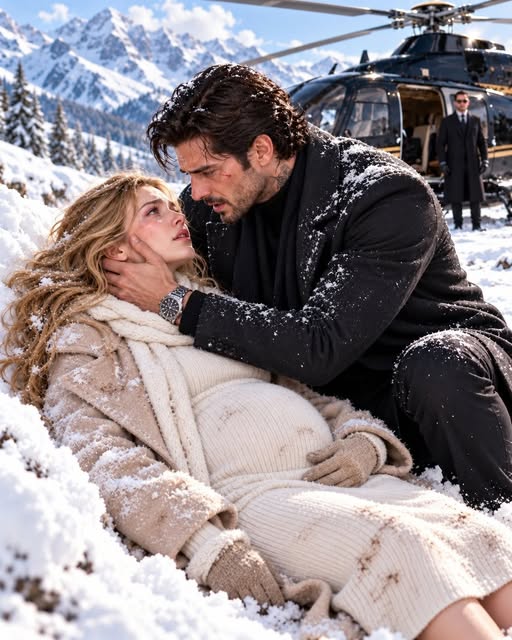
The strange thing about coming back from the dead is the paperwork.
Michael's was more dramatic, of course. Denied bail in a hearing that lasted eleven minutes — the judge used the phrase flight risk with what the newspapers called evident relish. Charged in two jurisdictions, because mountains and money answer to different flags. The firm's offices were sealed by federal agents within the week, after the state police finished copying the servers and found what Michael, my father's spiritual opposite, had kept as carefully as Thomas Reynolds ever kept a ledger: everything. Routes, names, accounts. Twelve million dollars of Orlov money washed clean through the pensions of schoolteachers, and every drop of it documented in a spreadsheet in a folder labeled, with an accountant's touching faith in camouflage, TAXES_FINAL_v9.
The Orlovs discovered, shortly afterward, that their Colorado operation had become very interesting to federal prosecutors, and the men who might once have come looking for the woman who ruined their laundry discovered instead that they had trains to catch. I asked Nikolai once — only once — whether his hands were entirely clean of that outcome.
"My hands," he said, "delivered an anonymous package to a federal building. Paper, Sarah. Your father is fifteen years dead and he is still improving my methods." He considered. "Also, I may have mentioned to an Orlov cousin at a funeral — a real one — that the next Sokolov package would not be paper. Families understand condolences."
Ashley pleaded guilty to conspiracy in March and agreed to testify in full, and the papers said six years, and I found, to my own surprise, that I felt almost nothing — a flat, tired pity, the way you feel about weather that has passed. She wrote me a letter from custody that I read once and burned, not out of hatred, but because I had decided my daughter's house would not contain it. It said she had never touched me. As if that were the part that mattered. As if the ledge had asked for her hands.
My own resurrection was a clerk's office on a gray afternoon, where a kind woman with reading glasses undid my death with three forms and a stamp, crying quietly the whole time in a way she kept apologizing for. "We don't get this direction often," she said. Bank accounts unfroze. My nursing license — still valid; death, it turns out, does not lapse a license if it is rescinded quickly enough. The divorce took eleven days, which Miriam said was a land speed record for the dissolution of a marriage in the state of Colorado, and owed something to the fact that one party was in custody awaiting trial for attempting to murder the other. I signed the decree at the cottage kitchen table on a morning in late March, with the sun coming through the window and the baby hiccupping against my ribs. Michael's signature was already on it — from the jail, in exchange for nothing but his lawyer's advice that juries hate a man who fights a divorce from the woman he pushed. His handwriting looked exactly as it always had. That was the worst of it, somehow. The hand hadn't changed at all. It had signed our marriage license, and our mortgage, and my death policy, and my freedom, all in the same round, confident script.
"Well," said Miriam, blotting the ink. "You are a single woman, Mrs. Reynolds."
"I've been a single woman," I said, "since a man looked at me on a ledge and did arithmetic." And I made tea, and we drank it, and the baby's hiccups stopped, and that was the entire ceremony of my un-marrying — which is to say, it was exactly enough.
The house I had shared with Michael I never entered again. Megan packed it for me in two weekends, with a playlist and a bottle of wine and a ruthlessness about his belongings that she described as "curatorial." What came out of it that mattered fit in six boxes. One of them was my father's photograph. One of them was the blue dress.
I would not live in the clinic room, and I would not live in Megan's spare bed, and when Nikolai — at a careful distance, through Miriam, because he had learned my borders the way he'd learned my father's figures — offered the gatehouse cottage on the estate, I set terms like a woman signing a treaty. Rent: paid. Amount: real. He countered through Miriam at one dollar a month, with a lease, notarized, "because a contract makes you feel safe, and your feeling safe is the whole of my position." I signed where the tabs were. Some sentences you get to live twice, better.
The cottage was small and sunlit and had a second bedroom the size of a postage stamp, and one morning in my thirty-fifth week I came home from a checkup to find the smell of paint and Yuri on a ladder in that little room, singing to himself in Russian, rolling the walls a pale, soft green.
"Boss's orders," he said, unrepentant, from the ladder. "He asked Miss Megan what color your room was when you were little. She said green, like the inside of an apple. He made the paint store mix it three times." He nodded at a crib — unassembled, solid oak, plainly expensive, plainly chosen by a man who had interrogated a salesperson for two hours about safety standards. "He said to tell you it is a loan from the house. He said you can argue with him about it yourself, he is not paid enough to argue with pregnant women, those were his exact words, I am only the messenger."
I stood in the doorway of my daughter's green room and put my hand on the wall, over the fresh paint, over the ladder and the singing and the oak, and I cried for the second time since the courthouse — but differently. The first time had been grief coming out. This was something coming in.
There was one more piece of paperwork that winter, and it was the only one that felt like a gift. Miriam came up the mountain in late March with the final accounting of my father's trust — the money Thomas Reynolds had hidden from Michael Carter in the care of two generations of Sokolovs. Fifteen years of careful, boring, honest growth, in funds my father had chosen the way he chose everything: patiently, and with the long road in mind. It was not fifty million dollars. It was better than that. It was clean.
I sat with the statement for a long time. Then I gave a third of it away before lunch — a third endowed, in my father's name, to the volunteer mountain rescue teams of Colorado, the people who climb down to ledges in storms for strangers. "He would have wanted to be on that rope team," I told Miriam. "This is the closest I can get him." Another portion went to the nursing scholarship at my old hospital, for students with no one watching out for them. The rest I kept, plainly and without apology, for Rose: a house someday, an education, a life with the curtains open. My father had spent twenty years preparing for a storm he hoped would never come. The storm had come, and his preparation had held, and spending his care on mountain ropes and fatherless nurses felt less like grief than like finally answering a letter.
It held Michael's baby pictures. Also — and she must have fought him for these, at some point I never knew about — my wedding ring, which I had left in a dish by the sink on the last morning of my life, and a photograph of Thomas Reynolds at a company picnic in 1994, holding a paper plate and somebody else's laughing toddler.
"I won't ask you to forgive me," Eleanor said, with her hands folded tight, eighty years old and holding herself together with etiquette. "I made him. Somewhere in the making I left out a piece, and I spent thirty years not looking at the gap. He was always — when he was small, he loved money the way other children love dogs. I thought it was ambition. I decorated it." She looked at my belly, enormous now, a month from term. "Your girl will never know him. I have made my peace with being the grandmother who sends birthday cards that get screened by lawyers. But I wanted you to have his baby pictures. So that when she asks what he was, before — you can show her he was once just a fat baby in a blanket, like anyone. It isn't an excuse. I just didn't want him to be only the ledge, in the story. For her sake."
"For her sake," I said, "I'll keep them. And Eleanor — she'll know she had a grandmother who stood up in a courtroom and told the truth with her face. That will be in the story too."
Megan moved into the cottage's front room for the last month, on the stated grounds that I was "a flight risk in reverse" and somebody sane had to be present when the baby came. She organized the kitchen by a system known only to her. She interviewed Nikolai at the cottage table one Sunday with a notebook, for forty-five minutes, while he submitted to it with the air of a man being processed at a border he respected. Afterward she reported to me, in the pantry, in a whisper: "He has read three books. About birth. He has highlighted them. With tabs. Sarah. The mafia boss has a tabbed binder about dilation."
"He asked me last week," I said, "whether the breathing was the kind from the chest or the kind from the belly. He took notes."
"He's terrified," Megan said with deep satisfaction. "Good. Terrified is honest. Michael was never terrified of anything, that was the whole problem in a sentence."
We chose the baby's name on that same Sunday, the three of us and a cooling pie: Rose, for my mother, who had grown roses in Cicero in defiance of the soil, the winter, and my father's opinion that flowers were an inefficient use of a yard. Nikolai, consulted because he was there and because the pie was his cook's, said only: "A strong name. It has thorns and it is not sorry." Then he asked, very carefully, whether the naming of children in my family was a matter he was permitted an opinion on in future — in future, he repeated, hypothetically, as a friend of the family — and Megan kicked me under the table hard enough to leave a mark, and I said, "Hypothetically, Kolya, opinions will be considered," and the most powerful man in Colorado went pink at the ears like a schoolboy and busied himself with the pie.
In my thirty-sixth week the baby staged a rehearsal.
It was two in the morning and the pains came tidy and regular and six minutes apart, and I sat on the edge of the bed counting them against the second hand of the cottage clock with a nurse's cool appraisal, and then a pain came that folded the cool appraisal in half, and I knocked on the wall that the cottage shared with nothing at all and shouted for nobody, and then — because dead women learn their resources — I called the main house.
He drove me himself. Of course he drove me himself — one hand white on the wheel, the SUV doing things on mountain roads that its engineers never intended, while I breathed through a contraction in the passenger seat and informed the most feared man in three states, at the top of a contraction, that he was going too slowly and also too fast.
The maternity ward at the hospital in Estes Park had one chair in the corridor built for a normal human, and Nikolai sat in it for three hours like a gargoyle assigned to a cathedral, terrifying two orderlies and one insurance salesman in a tracksuit, while Dr. Almeida — summoned, unhurried, drinking coffee — monitored the baby and then came out and gave him, personally, the verdict, because she said he was clearly the emergency contact whether the form said so or not.
"False alarm," she said. "Braxton Hicks. She is practicing. The baby is well. The mother is well. You may unclench, Mr. Sokolov."
On the drive home, in the dark, with the mountains going by like slow water, he said, "When the time comes — the real time — I would like, if you permit it, to be the one who drives."
"You already are," I said, and fell asleep against the window with my coat folded under my head, and did not dream of falling at all.