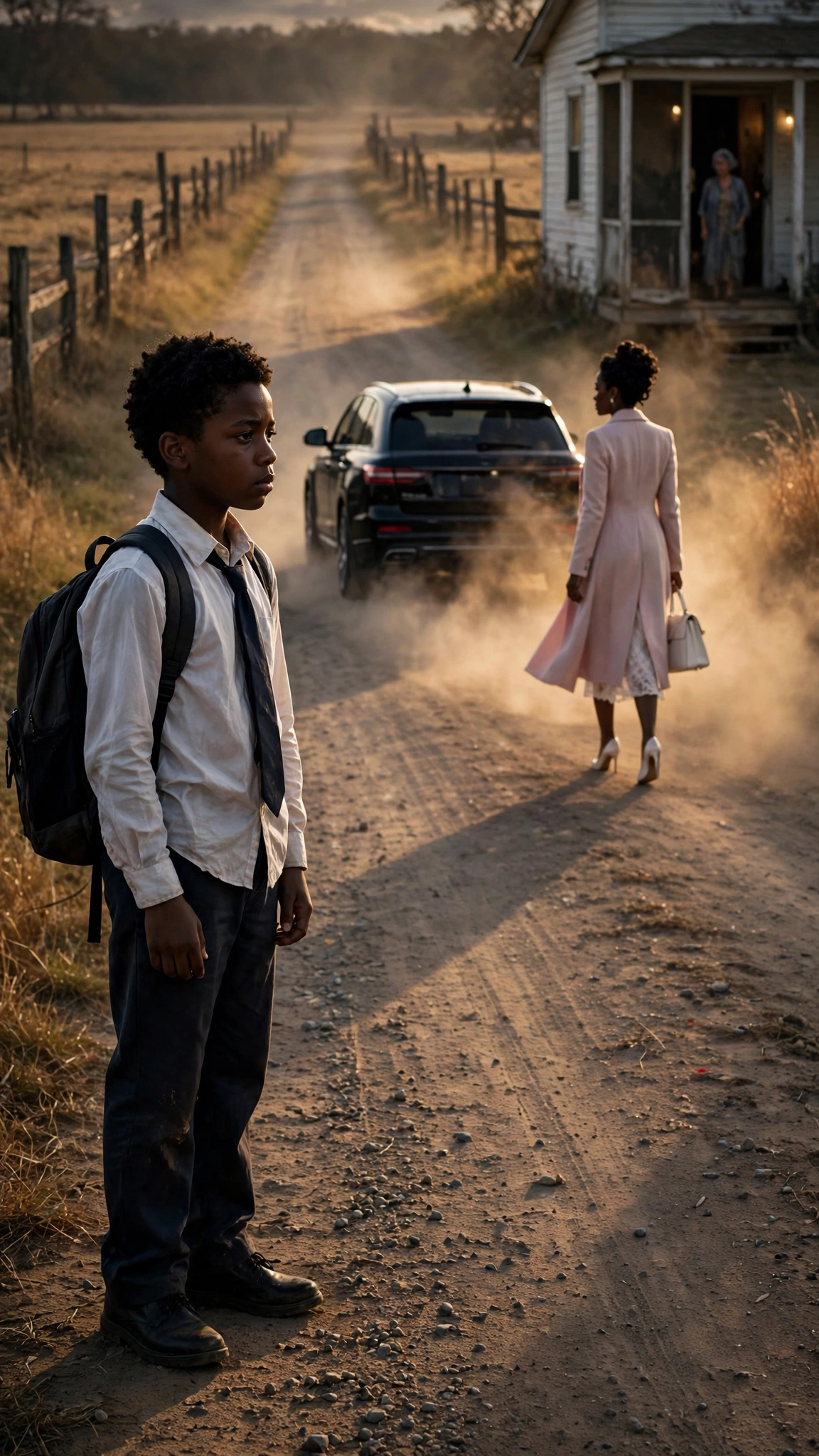
Matthew walked for a long time.
He did not know how far it was to anywhere. The road ran straight ahead of him, gravel crunching under his black leather shoes, and on either side of it there were fences and fields of dry yellow grass, and every now and then a stand of trees, and nothing else. No houses. No cars. No people. Just the road, and the sun, and the sound of his own breathing.
The heat was brutal. It came down out of a clear blue sky and bounced off the gravel and wrapped around him like a blanket, and his white shirt, which had already been damp at the funeral, was soaked through now, sticking to his back and his chest. His tie felt like a rope around his neck. His shoes were covered in dust, the black leather gone gray at the toes. His backpack, which had seemed light that morning, grew heavier with every step, until it felt like he was carrying a bag of stones.
He stopped twice to rest. The first time he sat on a fence post and took off one shoe and shook the gravel out of it, and his sock was damp with sweat, and there was a blister rising on his heel. The second time he simply stood in the thin shade of a single oak tree and leaned against the trunk and closed his eyes, and for a moment he thought about sitting down in the grass and never getting up again. But then he thought about the paper in his pocket, and he thought about his father's voice, and he opened his eyes and started walking again.
He was thirsty. His mouth was dry, and his tongue felt thick, and every time he swallowed it hurt a little. He had not eaten anything since the morning, and his stomach had gone past hungry into a hollow, shaky feeling that made his hands tremble. He kept his hand in his pocket, wrapped around the folded paper, because holding it made him feel less alone. It was the only thing his father had ever given him that nobody else knew about, and that made it the most important thing he owned.
The sun began to go down. It slid toward the trees in the west, turning the sky the color of pale gold, and the shadows stretched long across the road, and the air cooled just a little, just enough to make walking bearable again. Matthew's legs ached. His feet ached. His head ached. But he kept walking, because there was nothing else to do, and because somewhere ahead of him, if he was lucky, there would be a house.
He saw it just as the light was starting to fail. A small white-sided house, set back from the road behind a low fence, with a front porch and a screen door and a doormat that said WELCOME in faded letters. There was a light on inside, warm and yellow, and there was a garden beside the house with tomatoes and beans, and a clothesline with sheets on it, flapping gently in the evening air. It was the kind of house that looked like somebody lived in it on purpose, the kind of house where somebody might open the door.
Matthew stopped at the gate. He stood there for a long time, staring at the house, and he felt something he had not felt all day: fear, but a different kind of fear. Not the fear of being left alone on a road. The fear of knocking on a stranger's door and being turned away. He was ten years old, and he was dusty and sweaty and crying, and he had no money and no phone and nobody in the world, and he was about to ask a stranger for help. His hands were shaking so hard he had to press them together to make them stop.
But then he thought about his father, and he thought about the paper, and he thought about the fact that his father had told him to use the number only if he had no one else, and he had no one else, and so he pushed the gate open — it creaked, a small, ordinary sound — and he walked up the path to the porch, and he raised his hand, and he knocked.
Nothing happened for a moment. Then he heard footsteps inside, and the light in the hallway came on, and the inner door opened, and a woman stood behind the screen door, looking out at him.
She was older, in her late fifties, with dark hair streaked with gray, pulled back from her face, and gentle brown eyes, and she was wearing a beige blouse and a brown skirt and an apron with flour on it, as if she had been in the middle of making dinner. She looked at him — at his dusty funeral clothes, at his tear-streaked face, at his backpack hanging crooked off one shoulder — and her expression changed in an instant, from curiosity to alarm, the way a person's face changes when they see a child who has been hurt.
"Oh, my goodness," she said. "Oh, child. What happened to you?"
Matthew opened his mouth, and for a second nothing came out, because his throat was so dry and his chest was so tight, and then the words came out all at once, in a whisper that broke in the middle.
"My dad died today."
The woman froze. Her hand went to her mouth. Her eyes filled with tears, and she pushed the screen door open and stepped out onto the porch, and she knelt down slightly so that she was at his eye level, the way good teachers do, and she put one gentle hand on his shoulder.
"Oh, baby," she said softly. "Oh, baby, I'm so sorry. Come inside. Come inside right now."
She led him into the house, and the house smelled like bread and soap and something green, and there was a small living room with a couch and a bookshelf and a television, and a kitchen with a table and chairs, and she sat him down at the table and put a glass of water into his shaking hands, and he drank it so fast that some of it spilled down his chin and onto his shirt, and she filled it again, and he drank that too, and then she put a plate in front of him — bread and cheese and slices of cold chicken, simple food, the kind of food you make when someone is hungry and you do not want to waste time — and he ate it with both hands, fast, like a starving animal, and she did not tell him to slow down. She just watched him, her eyes wet, her hands folded on the table.
"My name is Rosa," she said, when he had finished eating. "Rosa Bennett. I teach at the elementary school down the road. What's your name, sweetheart?"
"Matthew," he said. "Matthew Carter."
"Matthew," she repeated, as if she were trying the name on. "That's a good name. A strong name. Now, Matthew, I want you to tell me what happened today. All of it. From the beginning. Take your time. I'm not going anywhere."
And so he told her. He told her about the hospital, and the funeral, and the church full of flowers, and Veronica sitting in the front row without crying, and the burial, and the long drive, and the gravel road, and the words — "You're not coming home" — and the door slam, and the dust, and the long walk. He told her all of it, his voice shaking, his hands wrapped around the empty glass, and Rosa listened without interrupting, without looking away, and when he finished, she was crying too, quietly, the way grown women cry when they are trying not to frighten a child.
"That woman," Rosa said, and her voice was low and steady, and there was something hard underneath the softness, "that woman left a ten-year-old boy on a country road the day his father died. I want you to know something, Matthew. That was not your fault. None of this is your fault. Do you understand me?"
Matthew nodded, although he was not sure he understood. He had spent the whole day believing, somewhere deep down, that it must be his fault. That he must have done something wrong. That if he had been better, or quieter, or smarter, Veronica would have taken him home. It was a relief, and a shock, to hear someone say it was not his fault.
"Now," Rosa said, and she stood up, and she wiped her eyes with the corner of her apron, "you are going to take a bath, and you are going to put on some clean clothes — I have some old things of my nephew's that might fit you — and then you are going to sleep in the spare room, in a real bed, with the door open and the light on in the hall, and tomorrow morning we are going to figure out what to do. Is that all right?"
Matthew nodded again. He was so tired that he could barely keep his eyes open. The food and the water and the safety of the house had undone him all at once, and his whole body felt heavy, as if he were made of wet sand.
Later, in the bath, with the warm water up to his chin and the sound of Rosa moving around in the kitchen, he reached into the pocket of his trousers, which were folded on the chair beside the tub, and he took out the folded paper. He looked at it for a long time. The number was still there, in his father's big, careful handwriting. He folded it again and put it in the pocket of the clean shirt Rosa had left for him, and he thought about what his father had said — "He'll help you, son" — and he wondered who "he" was, and whether "he" would answer the phone, and whether "he" would believe a ten-year-old boy who had been left on the side of the road.
He did not tell Rosa about the paper. Not yet. It was his father's secret, and it was the only thing he had left that was truly his, and he was not ready to share it. He would tell her when he was ready. Or maybe he would call the number himself. He did not know yet.
Rosa tucked him into bed that night, in a small room with a window that looked out over the garden, and she left the hall light on, just as she had promised, and she said goodnight, and she said that she would be right down the hall if he needed anything, and Matthew lay in the dark listening to the crickets outside and the soft sounds of the house settling, and for the first time that day, he did not feel alone.
But down the hall, in her own kitchen, Rosa sat at the table with a cup of tea going cold in front of her, and she thought about the boy asleep in her spare room, and about the woman who had left him on the road, and about the paper she had seen him clutching in the bath — she had glimpsed it, just for a second, a folded white square with numbers on it — and she made a decision.
Tomorrow morning, she would call that number. Whatever it was, whoever it belonged to, she would call it. Because a child who had been abandoned on the day of his father's funeral deserved at least one person in the world who would pick up the phone.
She sat there for a while longer, listening to the house. The refrigerator hummed. The clock on the wall ticked. Outside, the crickets sang in the dark, and somewhere far off a dog barked once and then was quiet. Rosa thought about her own life — about the husband she had lost ten years earlier, a good man named Earl who had loved her the way Alexander had loved his son, and about the fact that she had never had children of her own, and about how the spare room had been empty for a decade, holding nothing but an old bed and a quilt her mother had made and a box of her nephew's outgrown clothes. She had always told herself that the room was for guests, but the truth was that there had never been any guests, and the room had simply been waiting. Waiting for a boy who needed a bed, and a meal, and a door that would open.
She got up, finally, and she went to the door of the spare room, and she opened it just a crack, and she looked in. Matthew was asleep, curled on his side, one hand tucked under his cheek, the other hand resting on top of the blanket, still curled around nothing, as if he were still holding the paper even in his sleep. His breathing was slow and even. His face, in the light from the hall, looked younger than ten — looked like the face of a child who had finally, after the longest day of his life, been allowed to rest. Rosa stood there for a long time, watching him breathe, and she whispered a prayer — not a fancy prayer, just a few plain words, the kind you say when you do not know what else to say — and then she closed the door, softly, and went to bed herself, and she slept, at last, because she had made her decision, and the decision was good, and tomorrow morning she would keep it.