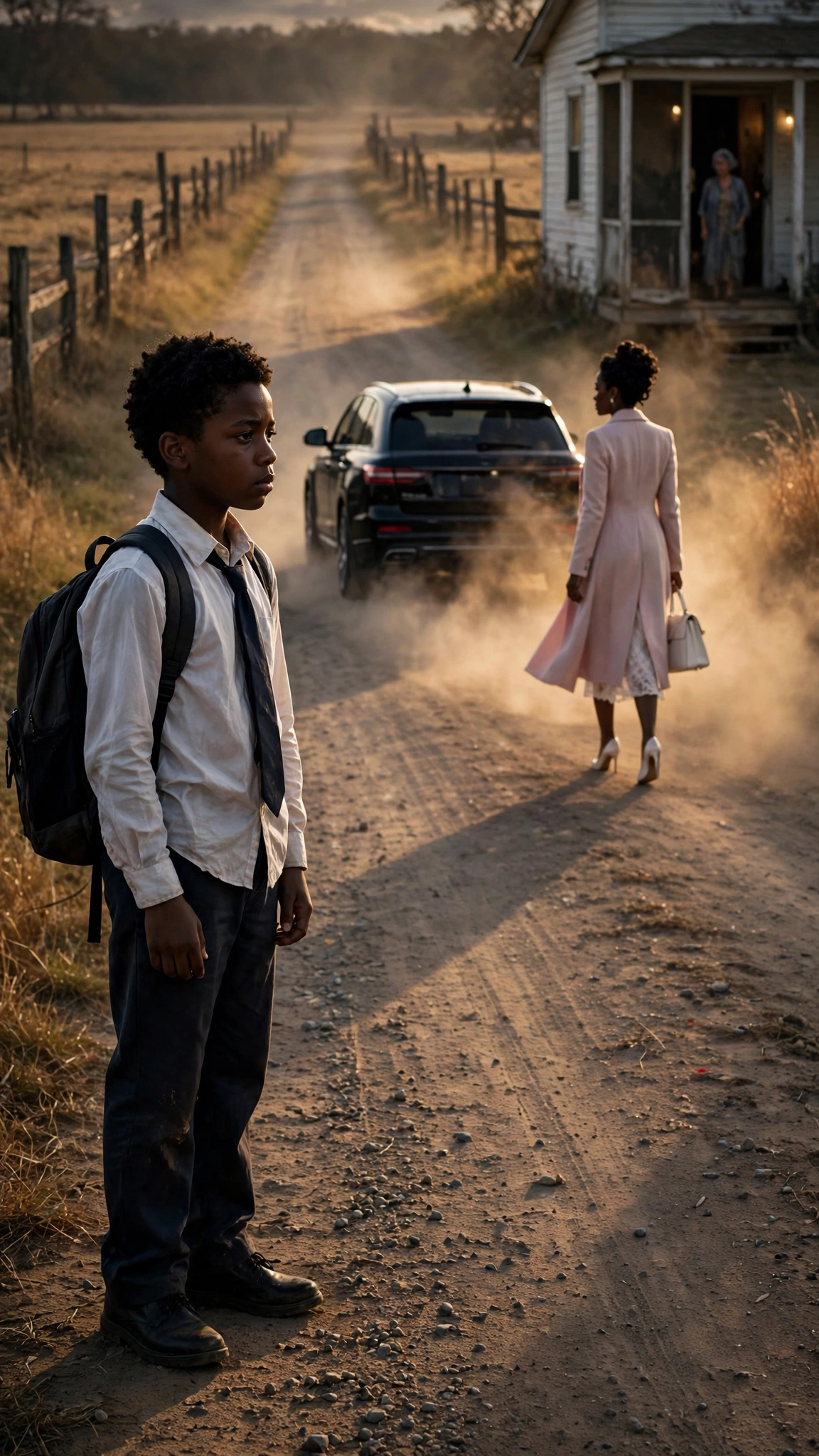
The two days passed slowly.
Matthew stayed in Rosa's house, and Rosa took care of him the way she had taken care of a hundred children in her classroom over thirty-four years — with food, and patience, and rules that made sense, and a bed that was made every morning, and a kind word at exactly the right moment. She did not ask him about the paper again. She did not ask him about Gabriel. She let him be a child for two days, and it was the kindest thing anyone had done for him in a very long time.
He helped her in the garden. He picked tomatoes and put them in a basket, and he learned the names of the beans, and he sat on the porch in the evenings and watched the sun go down over the fields, and he thought about his father, and he thought about Gabriel, and he wondered what would happen next. He was afraid, but it was a different kind of afraid now — not the sharp, panicked fear of the roadside, but the low, steady fear of a person waiting for news. He kept the paper in his pocket, and he touched it a dozen times a day, and every time he touched it, he felt a little braver.
Rosa, meanwhile, was afraid too, although she did not show it. She was afraid that Veronica would come looking for the boy. She was afraid that the police would come, and that she would have to explain why a ten-year-old child was sleeping in her spare room. She was afraid that Gabriel would not come, or that he would come and turn out to be someone else entirely — another Veronica, another person who saw Matthew as a problem to be solved rather than a child to be loved. She had made a promise to a voice on the telephone, and she was keeping it, but she did not know what she had promised, not really, and the not knowing was the hardest part.
On the morning of the second day, she called the school and told them she was sick. It was a lie, and Rosa Bennett did not like lying, but she told herself that some lies are really just a way of protecting someone, and she went back to the kitchen and made pancakes, and Matthew ate three of them, and for a little while, everything felt almost normal.
It was just after lunch when they heard the car.
It was not a loud car. It was not a fast car. It was a dark sedan, the kind of car a lawyer drives, and it came down the gravel road slowly, and it stopped in front of Rosa's house, and the engine went off, and for a moment there was silence, and then the door opened, and a man stepped out.
He was tall. That was the first thing Matthew noticed. He was tall, and he was wearing a dark tailored suit, and he had short salt-and-pepper hair, and serious dark eyes, and he was carrying a thick folder beneath his arm. He stood beside the car for a moment, looking at the house, looking at the porch, looking at the garden, and then he saw Matthew — standing on the porch, frozen, one hand on the railing — and he stopped. He stopped the way a person stops when they see something they have been looking for for a very long time.
"Matthew…"
He said it quietly. Just the name. Just one word. But he said it the way a man says the name of someone he has been thinking about for twelve years without knowing it, and Matthew heard everything in that one word — the shock, and the grief, and the love, and the determination, all held back by a tremendous effort, the way Gabriel held everything back.
Rosa came out onto the porch, wiping her hands on her apron, and she looked at the man, and the man looked at her, and for a moment nobody said anything.
"Mrs. Bennett," the man said, finally. "My name is Gabriel Carter. We spoke on the telephone."
"Yes," Rosa said. "Yes, we did. Come in, Mr. Carter. Come in, please."
They went into the house, into the small living room, and Gabriel sat down on the couch, and he put the folder on the coffee table in front of him, and he did not open it. Not yet. He looked at Matthew, who was sitting in the armchair across from him, his hands folded in his lap, his eyes wide, and Gabriel looked at him for a long time, as if he were trying to memorize his face.
"You look like him," Gabriel said, at last, and his voice was rough. "You look like your father did when he was your age. The same eyes. The same chin. I used to tease him about that chin. I told him it made him look stubborn. He was stubborn. God help me, he was the most stubborn person I ever knew."
Matthew did not know what to say. He had never met this man. He had never even known this man existed. And yet here he was, sitting in Rosa's living room, talking about his father as if he had known him yesterday, and Matthew felt something he had not felt since the hospital: that his father was still, somehow, in the room.
"Mr. Carter," Rosa said, and she sat down beside Matthew, and she put a hand on his shoulder, "I need to ask you something, and I need you to answer me honestly. Are you here to help Matthew? Or are you here to take him away?"
Gabriel looked at her, and he understood the question, and he respected it, and he answered it the way an honest man answers a hard question: directly.
"I am here to help him," he said. "I am his uncle. His father was my brother. I did not know Matthew existed until you called me, Mrs. Bennett, and that is my shame, and I will carry it. But I am here now, and I am not leaving without him, and I am not leaving him with the woman who left him on the side of a road. That is not going to happen. Not while I am alive."
Rosa studied his face. She had been a teacher for thirty-four years, and she had learned to read people the way other people read books — quickly, and accurately, and without being fooled by a nice suit or a smooth voice. She looked at Gabriel Carter, and she saw a man who was telling the truth. She saw a man who was angry, but whose anger was under control. She saw a man who had come a long way to do the right thing.
"All right," she said. "Then show me. Show me what you brought."
Gabriel nodded. He reached out, slowly, and he opened the folder.
Inside the folder were papers. Many papers, neatly organized, each one in a clear plastic sleeve, each one labeled. He took them out one at a time, and he laid them on the coffee table, and he explained them, in a calm, clear voice, the way a lawyer explains things to a person who needs to understand.
"This," he said, and he held up the first paper, "is my brother's revised will. It was executed six months ago, by a lawyer in Savannah named Douglas Pryce. It revokes all prior wills. It places the house, the money, and the business into a trust for Matthew, to be held until he is twenty-one. I am named as the trustee and the guardian. Veronica Carter is named as a beneficiary of nothing — except a small sum, as the law requires, which she has already been offered and refused."
He put the paper down, and he took out the second.
"This is the trust agreement. It is signed by Alexander, and by Mr. Pryce, and by two witnesses. It is legal. It is binding. It has already been filed with the court."
He took out the third. His voice did not change, but his eyes went harder.
"And this," he said, "is why I am not only here as Matthew's uncle. I am here as a man who knows what Veronica tried to do. This is a copy of a document she had prepared — a codicil, a change to the old will, that would have left everything to her and nothing to Matthew. It is dated three weeks before Alexander died. It bears what appears to be Alexander's signature. It is a forgery. Mr. Pryce has a handwriting expert's report, and a copy of Alexander's medical records showing that he was too ill to have signed anything on that date, and a statement from the notary whose stamp was used, saying that she never saw Alexander sign it."
Rosa stared at the papers. Matthew stared at the papers. Neither of them spoke.
"And this," Gabriel said, and he took out the last paper, "is a bank statement. It shows that in the week before Alexander died, Veronica moved a large sum of money out of their joint account and into an account in her name only. She believed she was stealing from a dead man. She did not know that the account she emptied was not the account that mattered. The real money — the business, the house, the trust — was already protected. She stole from an empty room, Mrs. Bennett. And she left a paper trail a mile wide."
He closed the folder, gently, and he put his hands flat on top of it, and he looked at Matthew.
"Your father knew, Matthew," he said. "He knew what she was. He knew what she would do. And he prepared for it. He prepared the will. He prepared the trust. He wrote to me. He gave you the number. He did all of it while he was dying, because that is the kind of father he was. He was protecting you, even at the very end. He was making sure that no matter what happened, you would not be alone."
Matthew looked at the folder, and he looked at Gabriel, and he thought about his father, and he thought about the hospital, and he thought about the paper in his pocket, and he understood, finally, what the paper had been. It had not been a telephone number. It had been a door. His father had given him a door, and Rosa had opened it, and Gabriel had walked through it, and now here they were, all three of them, sitting in a small living room in Georgia, with a folder full of papers on the coffee table, and a woman in Atlanta who believed she had won, and who was about to find out that she had lost everything.
"Is she going to come here?" Matthew asked, in a very small voice. "Veronica? Is she going to come and take me back?"
Gabriel looked at him, and his eyes were steady, and his voice was calm, and he said the words that Matthew would remember for the rest of his life.
"No, Matthew," he said. "She is not going to take you anywhere. Because tomorrow morning, I am going to go to her, and I am going to show her these papers, and I am going to tell her exactly what the law says, and she is going to understand that she has lost. And you are going to stay right here, with Mrs. Bennett, where you are safe, until I come back for you. That is a promise. And I do not break promises. Not anymore. Not to family."
Matthew nodded. He believed him. He did not know why he believed him — he had only just met this man, this stranger who was his uncle — but he believed him, the way he had believed his father, because Gabriel spoke the way his father had spoken: slowly, and clearly, and as if every word mattered.
That night, Matthew slept in the spare room again, and Rosa left the hall light on again, and Gabriel slept on the couch in the living room, with the folder on the coffee table beside him, and the house was quiet, and the crickets were loud outside, and for the first time since his father had died, Matthew did not dream about the road.
He dreamed about his father. His father was smiling. His father was standing in the kitchen, making pancakes, and the sun was coming through the window, and everything was all right. And when Matthew woke up in the morning, the dream stayed with him, warm and close, like a hand on his shoulder, and he knew that whatever happened next, he would not face it alone.