Gabriel drove to Atlanta the next morning, early, before the heat had settled over the city.
He did not go alone. He had called Douglas Pryce in Savannah the night before, and Pryce had driven up through the night, and they met at a diner off the highway, and they sat in a booth with coffee going cold between them, and Pryce laid out the plan, in the calm, precise way that lawyers lay out plans when the stakes are high and the margin for error is small.
"We go to her house," Pryce said. "We do not go to her lawyer's office. We go to the house, where she feels safe, and we show her the papers, and we give her a choice. She can accept the revised will, and take the small sum the law requires, and walk away. Or she can contest it, and we will go to court, and we will show the judge the forged codicil, and the handwriting report, and the bank statements, and the notary's statement, and she will lose, and she will lose publicly, and she will lose everything, including whatever is left of her reputation. Those are her choices. There is no third choice."
"And Matthew?" Gabriel asked.
"Matthew stays with Mrs. Bennett until the guardianship is formalized," Pryce said. "I have already filed the papers. The court will grant it. It is a formality, given the will. But Veronica must be told, and she must be told in person, and she must understand that the law is not on her side. That is why we are going to her house. That is why we are going together. And that is why I have asked Deputy Sheriff Annie Cole to meet us there. She will be a witness. If Veronica does anything — anything at all — there will be a law officer in the room."
Gabriel nodded. He had not wanted to bring a deputy. He had wanted to handle it himself, man to man, or rather man to woman, the way his brother would have handled it — quietly, and firmly, and without an audience. But Pryce was right. Veronica was the kind of person who lied when she was cornered, and who threatened when she was frightened, and Gabriel did not want there to be any question, later, about what had been said in that room.
They drove to the house in two cars — Gabriel in his dark sedan, Pryce in his own car, the deputy in a sheriff's cruiser behind them — and they parked on the street, and they walked up the driveway together, and Gabriel rang the doorbell.
The house was the house Alexander had built. It was a good house, a solid house, with blue shutters and a wide front porch and a garden that Alexander had planted himself, and Gabriel stood on the porch and looked at it, and he thought about his brother, and about the last time he had seen this house, twelve years ago, when he had come for their father's funeral and left without speaking to Alexander, and he thought about how much time had been wasted, and how much could never be gotten back, and then the door opened, and Veronica was standing there.
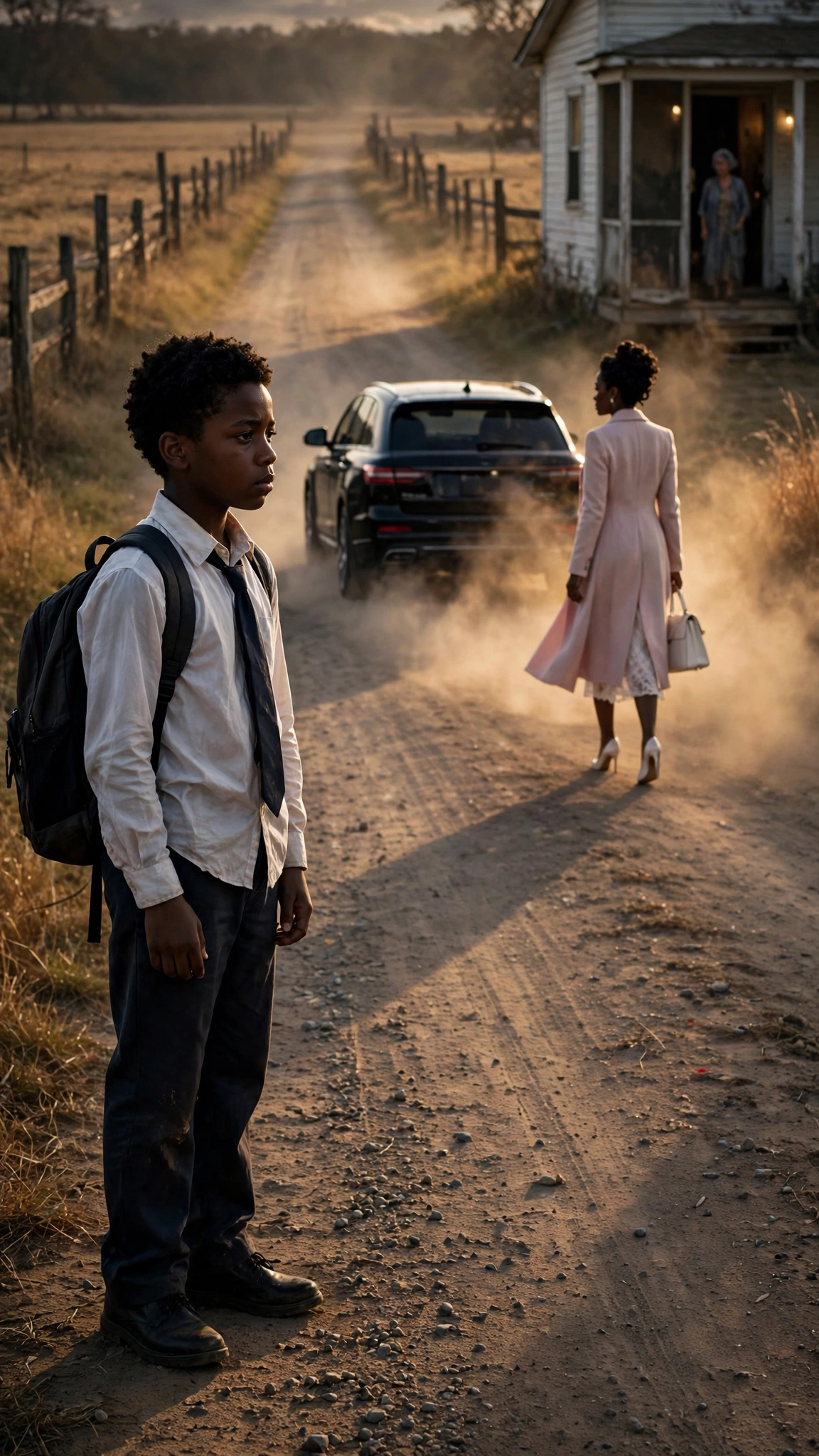
She was wearing a white dress and her pale-pink coat, even though it was morning and hot, and her hair was piled high in its voluminous updo, and her makeup was perfect, and she looked at the three men on her porch — Gabriel, Pryce, and the deputy in her uniform — and her face went very still.
"Who are you?" she asked, and her voice was cold, but there was a tremor underneath it, the smallest tremor, like a crack in ice.
"My name is Gabriel Carter," Gabriel said. "I am Alexander's brother. I am Matthew's uncle. May we come in? We have something to show you."
Veronica did not move. She stood in the doorway, her hand on the door, and she looked at Gabriel, and she looked at Pryce, and she looked at the deputy, and she understood, in that instant, that the world she had believed in — the world in which she had inherited everything, and the boy had disappeared, and there were no consequences — that world was over.
"No," she said. "You may not come in. This is my house. You have no right to be here."
"This is not your house, Mrs. Carter," Pryce said, and his voice was calm, and precise, and utterly without mercy. "This house belonged to Alexander Carter before your marriage, and it is now held in trust for his son. You are living in a house that belongs to a ten-year-old boy. I would advise you to let us in, because what we have to show you will be much easier to discuss inside than on the porch, in front of your neighbors."
Veronica stared at him. Then she stepped back, slowly, and she let them in.
They sat in the living room — the living room where Alexander had read to Matthew on winter evenings, where Matthew had done his homework at the kitchen table, where the family had lived, once, before Veronica had come — and Gabriel put the folder on the coffee table, and he opened it, and he laid the papers out, one at a time, the way he had laid them out for Rosa, and he explained them, in the same calm, clear voice.
The revised will. The trust agreement. The forged codicil, with the handwriting expert's report. The bank statements. The notary's statement.
Veronica listened. She did not interrupt. She sat in the armchair with her back straight and her hands folded in her lap, and she listened to every word, and her face did not change, and when Gabriel finished, she was silent for a long time.
And then she laughed. It was a short, sharp laugh, with no humor in it at all.
"You think this changes anything," she said. "You think a piece of paper changes anything. I was his wife. I lived in this house for seven years. I cooked his meals. I went to his business dinners. I was there. You —" and she looked at Gabriel, and her eyes were cold — "you were not there. You did not speak to him for twelve years. You did not come to his funeral. You have no right to his son. You have no right to any of this."
"I did not come to his funeral," Gabriel said, and his voice was steady, "because I did not know he was dead until three days ago, when a teacher in Georgia called me about a boy on the side of a road. I did not speak to him for twelve years because we were both too proud and too stupid, and that is the greatest regret of my life, and I will carry it to my grave. But none of that changes what is in this folder, Mrs. Carter. None of that changes the law. Alexander made his wishes clear. He made them in writing, with witnesses, six months before he died. And you tried to undo them with a forgery. That is not a family disagreement. That is a crime."
Veronica's face went white. "You cannot prove that," she said, but her voice had lost its certainty.
"I do not need to prove it in this room," Gabriel said. "I need to prove it in court, and I can, and I will, if you force me to. But I am not here to destroy you, Mrs. Carter. I am here to give you a choice. You can accept the revised will. You can take the sum the law requires — it is not nothing, and it is more than you deserve — and you can leave this house, and you can leave Matthew alone, and this will be over. Or you can contest it, and we will go to court, and the judge will see the forged codicil, and the bank statements, and the notary's statement, and you will lose, and you will lose publicly, and you may face criminal charges for the forgery. Those are your choices. There is no third choice."
Veronica looked at the papers on the coffee table. She looked at Pryce, who was watching her with the patient, impassive face of a man who had seen this moment a hundred times before. She looked at Deputy Cole, who was standing by the door, her arms crossed, her expression unreadable. And she looked at Gabriel, who was sitting across from her, calm and still, his hands flat on the folder, his eyes steady, and she understood, finally, that she had lost. Not because Gabriel was stronger than her. Not because he was louder than her. But because he had the truth, and the truth was in the folder, and the folder was on the table, and there was nothing she could say that would make it go away.
"I want my lawyer," she said, and her voice was very small.
"Call him," Gabriel said. "Call him now. He will tell you the same thing I am telling you. The will is valid. The trust is valid. The guardianship will be granted. You have lost, Mrs. Carter. The only question left is how much more you want to lose."
She did not call her lawyer. She sat in the armchair for a long time, staring at the papers, and then she stood up, slowly, and she walked to the window, and she looked out at the garden — the garden Alexander had planted, the garden Matthew had played in — and she said, very quietly, "He knew. All along, he knew. He knew what I was, and he never said a word. He just… prepared. He just waited."
"Yes," Gabriel said. "He knew. And he loved his son enough to protect him, even when he was dying. That is the kind of man my brother was."
Veronica turned from the window, and for a moment — just a moment — Gabriel saw something in her face that he had not expected: not anger, not defiance, but grief. Real grief, for the first time since Alexander had died. Grief for a man she had married for the wrong reasons, and who had known it, and who had loved his son more than he had ever loved her, and who had been right to do so.
"I'll go," she said, and her voice was flat and tired. "I'll take the sum. I'll leave the house by the end of the week. I don't want to go to court. I don't want any of this in public. Just —" and she stopped, and she looked at Gabriel, and she said, very quietly, "just tell the boy — tell Matthew — that I am sorry. Not for the money. For the road. Tell him I am sorry for the road."
Gabriel looked at her, and he nodded, slowly.
"I'll tell him," he said. "But you should know something, Mrs. Carter. An apology is not a door. It does not open anything. It does not undo anything. Matthew will hear it, because I will tell him, because he deserves to hear it. But what he does with it — that is his choice. Not yours. Not anymore."
They left the house then — Gabriel, and Pryce, and the deputy — and they drove back down the driveway, and Gabriel did not look back, because there was nothing behind him that he needed to see. There was only the road ahead, and the small house in Georgia, and the boy waiting on the porch, and the future that Alexander had prepared for him, one careful step at a time, even as he was dying.
On the way back, Gabriel stopped at a diner off the highway and called Rosa from the pay phone by the door, and told her it was done — that Veronica had agreed, that the house would be Matthew's, that no one would come for the boy. Rosa listened without a word, and then she said, "Then come home, Mr. Carter. Come home and eat supper. The boy has been watching the road all afternoon." Gabriel hung up the phone and stood for a moment in the parking lot, looking at the sun going down over the highway, and he thought about his brother, and about the letter in his jacket pocket, and about the twelve years that were gone and could never come back, and about the boy who was waiting for him, and he understood that this — this drive, this phone call, this promise kept — was the beginning of the rest of his life.
Veronica stood in the window and watched them go, and the house was quiet around her, and the garden was bright in the morning sun, and she understood, at last, what she had done, and what it had cost her, and that understanding would stay with her for the rest of her life, long after the house was gone and the money was gone and the name was gone.
She had believed she had inherited everything. She had inherited nothing. And the boy she had left on the side of the road had inherited everything she had ever wanted, because his father had loved him, and had planned for him, and had made sure — even at the very end — that his son would be safe.