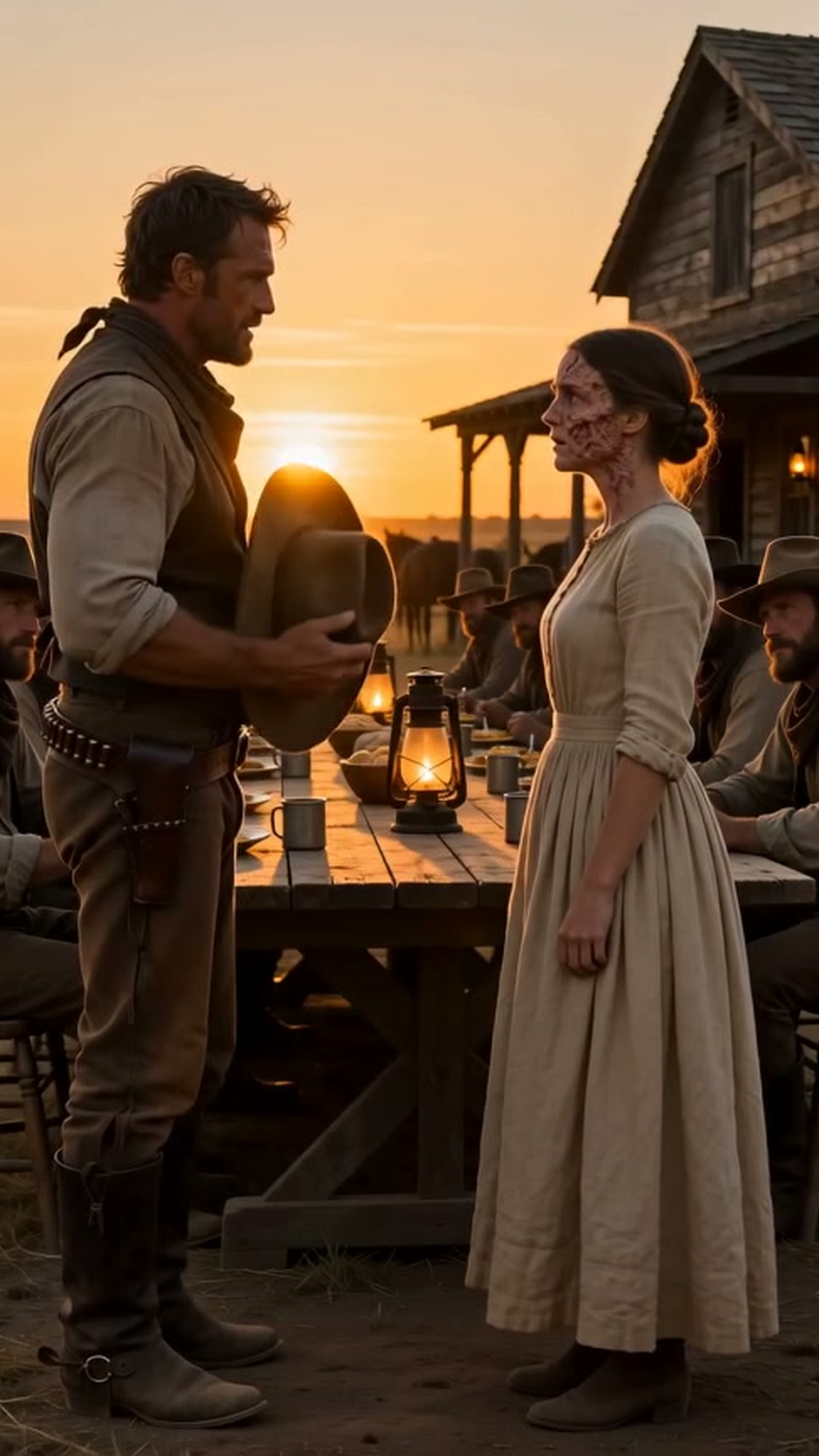
The first thing Edith Mayburn heard at Grady Ranch was laughter.
It was not loud. That would have been easier. It was the other kind — the kind men do behind a hand, the kind that travels sideways through a group and comes out through the nose. She stood beside the dusty wagon with her battered suitcase in both hands, and thirteen ranch hands looked at the left side of her face, and one of them laughed into his fist, and another did not bother with the fist at all.
The scars were old. Ten years old. They had healed the way deep burns heal, in uneven ropes and shining patches that pulled the corner of her mouth a fraction downward and turned one cheek into a map of somewhere terrible. She had stopped covering them at nineteen, because a scarf in a Missouri summer was its own kind of confession. But she had never stopped seeing them in other people's eyes.
Her fingers tightened on the suitcase handle. She made herself breathe.
Then the tall one came out from beside the barn.
Coulter Grady was broad through the shoulders and weathered the way fence posts are weathered, by years of standing in all weathers. He stopped several feet from her, and his eyes went to her face the way all eyes went — and then, unlike all eyes, they stayed level and did not slide away.
Edith struggled to meet them. The wind worried at the loose strands of her pinned-back hair.
"No one marries a scarred girl, sir," she said quietly, because it was better to say it herself than to hear it later. A chuckle moved through the men behind her. She swallowed. "But… I can cook."
Coulter Grady did not laugh. He looked at the suitcase. He looked at the wagon. He said, "Can you feed fourteen?"
"Yes, sir."
"Then we'll see."
By sundown she had proved the only thing she had ever been able to prove. In the ranch kitchen she rolled her sleeves to the elbow and put flour under her nails; biscuits rose golden in the wood-fired oven, potatoes and onions sizzled in the iron skillet, and salt pork went under a gravy thick enough to stand a spoon in. The dinner bell rang, and thirteen hungry men sat down at the long table in the yard and fell, bite by bite, into a silence none of them had planned.
One of the laughers — the young one, Judd, all grin and elbows — reached sheepishly for a third biscuit and said, to his plate more than to her, "Ma'am… that's the best meal I've had in years."
Edith gave him a tiny, uncertain smile and served herself last, the way she had been raised to, and Coulter watched her from the far end of the table with an expression that had moved, somewhere between the gravy and the lantern-light, from observation toward something else.
She worked the yard the way she had worked the kitchen, without being asked and without announcement. She went down the table with the platter a second time before she had taken a bite of her own supper. When the youngest hand — Ben, sixteen, all wrists and gratitude — gashed his palm open on the pump handle and tried to hide it so as not to be a bother, she sat him down on the kitchen step, washed the cut clean, and bound it with a strip of flour-sack cloth and a knot as neat as a seam. "Keep it dry till morning," she said. "A hand's no use to anybody septic." When Judd and Pierce began to square up over the last of the coffee — a stupid argument, the kind tired men have with their chests — she stepped between them carrying the pot, mild as Sunday, and said, "There's more on the stove, gentlemen, if either of you can be bothered to fetch it like Christians," and the laugh that followed was with her, not at her, and the fight went out of both men like air from a bellows.
Coulter saw all of it. He saw that she took the smallest portion and the last seat. He saw that the men had begun, without noticing it themselves, to say ma'am and mean it. He had buried a wife and run a ranch six years on beans and stubbornness, and he had a foreman's eye for the thing a person did when they believed no one was watching. Edith Mayburn, believing exactly that, fed everyone before herself.
Later, when the light went the color of copper and she was carrying plates, Judd's friend Pierce looked up at her scarred cheek from the bench and said something low about sending to Missouri for a cook and getting sent a Halloween mask.
She froze. Her eyes dropped the way they had dropped ten thousand times.
Boots crossed the dirt. Coulter stepped between the bench and Edith — not fast, not loud, just there, the way a gate is there.
"You've got something to say about Edith?" His voice was controlled enough to make the whole table careful. "Say it so the table hears it."
Pierce's smile went out like a lamp. "No, boss."
"She feeds you. She cares for you." Coulter took one measured step closer. "You'll show her respect."
Thirteen men studied their plates. Edith looked up at Coulter Grady, stunned to her bones, because no one — not in ten years, not once — had ever stood between her and that look before.
Then, in the gold of the sunset, with the table and the lanterns and the silent cowboys behind them, Coulter slowly took off his worn hat and held it against his chest. He came toward her until only a few feet of warm dust stood between them, and Edith looked straight into his eyes, frightened and hoping in equal measure, and her heart was so loud she was sure the table could hear it.
"Edith," he said softly, "this morning you told me something." A breath. "You said—"
"No one marries a scarred girl…"
Her fragile smile disappeared. Her eyes filled with uncertainty. Coulter took one final step toward her, and—
— — —
SIX MONTHS EARLIER — HERRON'S FERRY, MISSOURI
The scars were ten years old, and Edith still dreamed in smoke.
She had been fourteen the winter the chimney caught. It was not a big fire, the way big fires get told about afterward. It was a small house and a cold night and a stovepipe joint her father, Elias, had meant to fix since October. She woke to her little brother Sam screaming in the room they shared a wall with, and she remembered the rest of her life in pieces: the curtain alight like a flag, her mother's arms, then her mother's voice telling her to take Sam and go out the window, go, go. She went through the burning doorway instead, because Sam was six and frozen in the corner and the window was painted shut. She got her arms around him and ran, and the fire, cheated of the boy, took its price off the left side of her face as she passed.
Her mother did not come out of the house.
After that there was a long year of salves and silence, and then her father, who graded lumber and grieved in the same steady way, married Ruth, a widow from two farms over who had looked at Edith's face once and said, in the tone of a woman pricing damaged goods, "Well. She can still work." Ruth worked her for nine years. Edith cooked, cleaned, laundered, kept the accounts her father was too tired to keep, and raised Sam from a frightened six-year-old into a tall sixteen — and every year the mirror and Ruth agreed with each other: no man marries a scarred girl. Ruth said it at the table. Ruth said it at church socials, in the bright voice people use for weather. By the time Elias died of the winter fever, in January of that year, Edith had heard it so often that she said it in her sleep.
Ruth planned to be rid of her by spring. There was a widower over in Calloway County, sixty-one years old, who had buried two wives and needed a third pair of hands, and Ruth spoke of him the way she spoke of selling a mule.
Edith found the advertisement in February, in a St. Louis paper Sam had wrapped around a sack of nails at the hardware store and brought home not knowing it was a door.
WANTED, the notice said, IN NEBRASKA. A WIFE. MUST BE ABLE TO COOK FOR FOURTEEN MEN. AGE AND APPEARANCE OF NO IMPORTANCE. APPLY BY LETTER TO C. GRADY, GRADY RANCH, ALDER CREEK.
She read it eleven times by lantern light, with her heart going like a hammer. Appearance of no importance. She had never in her life seen those four words arranged in that order.
It was Sam who found her still sitting at the table at midnight with the paper smoothed flat beside the cold stove.
"You're going to answer it," he said. It was not a question. He was sixteen and tall enough now to fill a doorway, and there was flour on her hands and ink on her fingers and nine years of Ruth between them like a held breath. "Edie. Nebraska."
"It's that or Mr. Hartwell over in Calloway," she said, "and his two graves." She tried to smile. "At least this one put in writing that appearance is of no importance."
Sam sat down across from her the way he had when he was six and the nightmares were new. "Then write it all," he said quietly. "Even the—" He stopped. Brother and sister looked at each other across the scarred fact of her face, which he had caused by being six years old and frozen in a corner, and which he had never once, in ten years, flinched at. "Edie. If you don't write it, you'll spend the whole train ride wondering when to say it."
"I'll say it when I get there," she said. "With my own mouth. That's honest enough."
He let it go, the way people who love her had learned to let things go, and three weeks later he stood on the platform at Herron's Ferry with his hat in his hands and watched the train take his sister west, both of them pretending not to cry, while Ruth stayed home and counted it good riddance.
She wrote her letter at the kitchen table after Ruth was asleep. She wrote that she was twenty-four, strong, honest, that she could cook for a harvest crew and keep a house and a set of books, that she was not afraid of work or weather. She wrote everything true she could think of. She sealed the letter with her hands shaking.
There was one thing she did not write. Not a lie, exactly. An omission — the size and shape of a face.
She told herself a man who wrote appearance of no importance would not care. She told herself she would tell him with her own mouth the moment she arrived, before he had spent a cent or a promise on her, and take the consequences standing up.
The journey west took four days and rearranged her understanding of the size of the world. Missouri unrolled green and then gave up; Kansas went the color of old paper; and then Nebraska came up flat and enormous under a sky so wide it made her dizzy, a country with no edges to hide behind. A drummer across the aisle stared at her face for a full minute somewhere west of Grand Island, and Edith, who had four days of practice at being a woman traveling toward her one chance, stared back until he found his newspaper interesting. She ate bread and cheese from her bundle. She read Coulter's single reply — eleven lines, in a hand like a fence, all business: the wage until marriage could be discussed, the train fare advanced against it, a wagon to meet the Tuesday stage — so many times that the paper went soft at the folds. There was no kindness in it and no cruelty either, and she had decided, somewhere in Kansas, that she preferred that. Kindness in letters was how traps were baited. Business, she understood.
She told herself many things, all the way west. But on the last night of the journey, in a room over a rail depot with the train smoke still in her hair, Edith Mayburn stood before a spotted mirror and looked at ten years of other people's laughter, and understood that she had built her whole one chance of escape on a sentence she had been too afraid to write:
I am scarred, sir. Down one whole side. If that matters, burn this letter.
She arrived at Grady Ranch the next afternoon, in a dusty wagon, with a battered suitcase — and said the truth out loud to thirteen watching men before she said anything else.