The sheriff of Alder Creek was named Doyle and was not a brave man, but he was a careful one, and Pierce's statement — taken at the bunkhouse table with Amos standing behind the chair like a second signature — was the kind of document that makes careful men move. Arson was a hanging word in a dry country. By the time the sun was fully up, Pierce was in the town jail, the Bar B horse was in the town corral with its saddle inventoried, and Doyle was telling Coulter, in the careful voice, that as for Beck — as for arresting Harlan Beck on the word of a caught arsonist — that would require, ah, corroboration, and time, and the circuit judge.
"Time's the one thing he's arranged for me not to have," Coulter said.
"Then we'd best not spend it talking," said Edith, from the doorway, with her grandfather's calm and her account book under her arm. "Sheriff, you'll have your corroboration in a prettier form than Mr. Pierce. Paper. Men hang for arson in this county, but they fall for paper. I've watched it happen to accounts all my life."
The plan was hers, and it was built the way she built everything: in columns, in order, with nothing wasted.
Column one: the money. The note — now Beck's note — was nine hundred dollars and the crept-in interest, due June the first. They did not have it. What they had was three hundred head of beeves in summer condition and a railroad buyer who had been writing Coulter since April wanting sixty head delivered at the railhead in July. Edith's books said what pride had kept Coulter from calculating: sold now, sold early, at the June price instead of the July one, sixty head would clear the note with eleven dollars to spare and leave the breeding herd untouched. It would cost them the summer's profit. It would not cost them the ranch. "A man can make another profit," she said at the study table, turning the ledger so he could read the column himself, slowly, in his own time, the way she'd learned to let him. "He can't make another 1851."
Column two: the paper. Amos rode to Lincoln — three days in the saddle at sixty, and he went like a boy — to the territorial water commissioner's office, where a clerk named after a president found, in a vault that smelled of mouse and glory, the duplicate filing of 1851: Thomas Grady's senior right, recorded in the territory before there was a state to record it in, certified copy issued under seal. Whitlock's deed book in Alder Creek made two. Pierce's confession made three. Edith's hand-copies, posted to the commissioner before the fire — before the fire, because she had copied them the last evening of May and one set had gone out on the morning stage while Pierce was still pouring his coal oil — made four.
Column three, said Edith, is the audience. "Beck does his work in offices, Coulter. In summaries not read aloud. In calendars arranged. Men like that are not afraid of the law. They're afraid of a room." She closed the ledger. "So we give him a room. The whole town, if we can manage it. Everything he did, read aloud, in order, in daylight."
Beck came once more before the money was raised, because men like Beck always knock once more before they break a window. He found Edith alone in the yard hanging laundry — Coulter and the crew were two miles off, gathering the sixty head — and he did not bother with the hat-in-hand this time.
"You keep his books, I'm told," he said. "Then you'll know there's no road out of this, Miss Mayburn. Sheriff Doyle won't move against me on a tramp cowhand's word. The commissioner is a hundred miles of paperwork. And June first is June first." He watched her pin a shirt with great steadiness. "I'm prepared to be generous one last time. The note torn up, in exchange for the water filing, signed over peaceable. He keeps the land. I keep the creek. A land-poor man with no debt — there are worse lives. Tell him so. A woman in your position ought to think about security."
"In my position," Edith said, "I've buried a mother, been a servant in my father's house, and crossed half a continent on eleven lines of somebody else's handwriting. Security is not a thing men have ever handed me, Mr. Beck. It's a thing I cook, and keep books for, and stand in doorways about." She took the last clothespin out of her apron. "The note comes due June first. We'll be at the bank at ten. Bring a bag for your money — it'll be heavy — and leave room in it for your hearing, because you'll be carrying that home too."
He looked at her for a long moment, the way the drummer on the train had, and she let him, the way she had learned to let them, and it was Harlan Beck who found his buggy interesting first.
The sixty head went to the railhead on the twenty-ninth of May, with Judd riding drag and singing, off-key and entirely unashamed, the whole nine miles. The railroad's agent counted them twice and paid in a draft that Edith verified against the contract to the cent before she let Coulter sign the receipt, because she had read, in her four evenings with the ledgers, what a signature could cost when a man with a pen was in a hurry. The agent — a Mr. Okafor out of Omaha, who ate railroad food eleven months a year — looked at the column of figures in her clean hand and said, "Madam, the Union Pacific would pay money for a bookkeeper like you," and Coulter said, "The Union Pacific can't afford her," with an air of finality that made Amos, holding the horses, study the sky very hard indeed.
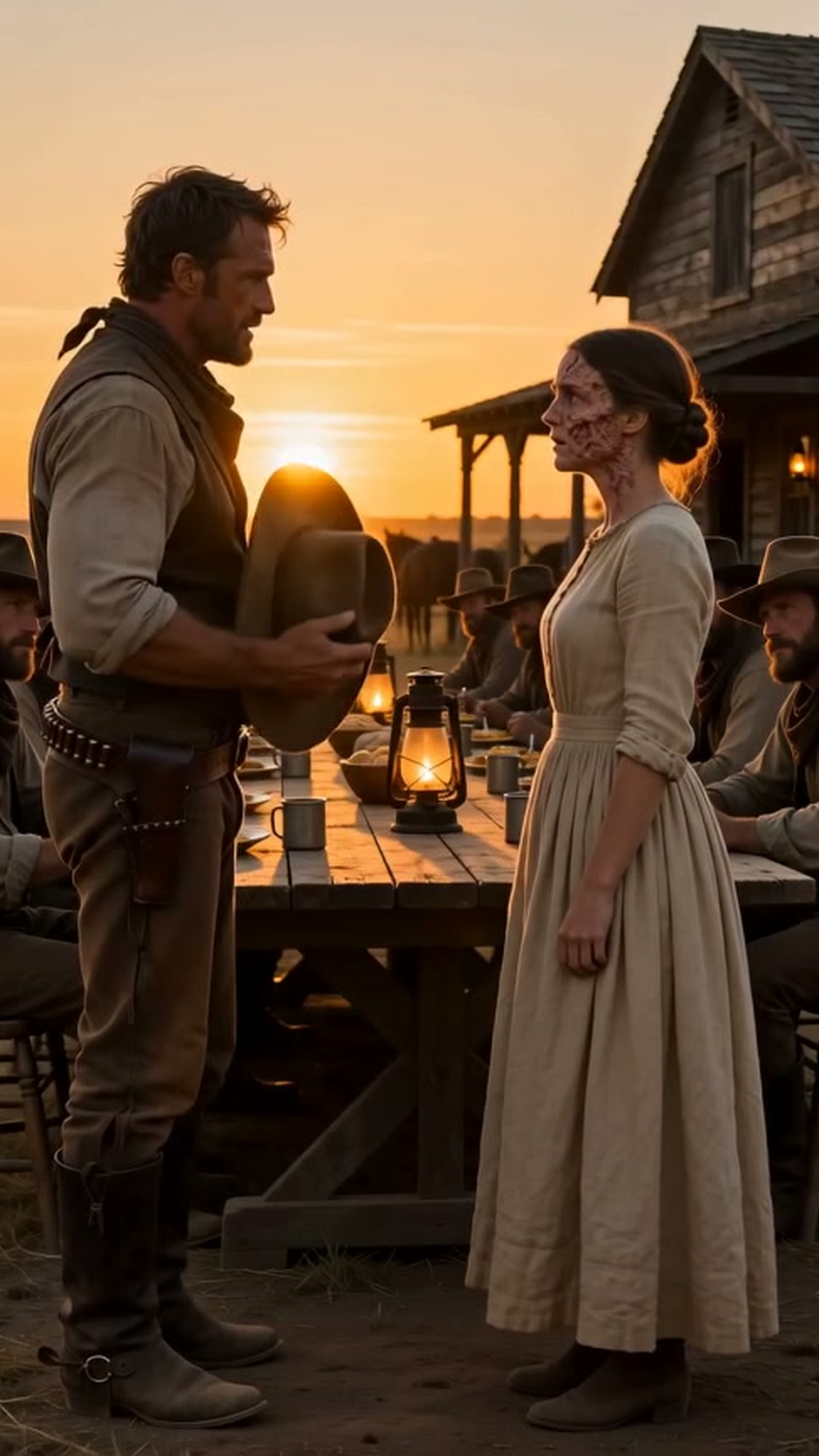
On the first of June, at ten o'clock in the morning, Coulter Grady walked into the First Bank of Alder Creek with Edith on his arm — her good dress, her hair pinned, the left side of her face offered to the room without apology — and Amos behind them carrying a canvas sack, and laid down on the president's desk, in front of two directors and a gathering crowd that had somehow heard, the full amount of the note, principal and interest to the day, in coin and currency, counted twice.
"Beck holds the paper now, I'm told," Coulter said, into the silence. "Then Beck can come collect his money off your desk, Mr. Halloway. The Grady note is paid. In full. In public." He turned the receipt so the room could see it. "Whatever else he thinks he's bought this spring, he hasn't bought this ranch."
Harlan Beck arrived at eleven, summoned by a bank boy, in the buggy too good for ranch visiting, and found his sixty days expired into a receipt. He was a man who had made a life out of other people's hurry, and he stood in his emptied trap with his hat in his hand and did the arithmetic of the crowd, the coin, the woman on Coulter's arm with the scarred face and the straight back, and arrived — a beat too late, for once — at the correct sum.
"Coulter," he said, recovering, smiling the second set of teeth. "You've hurt yourself selling early. And for what? The water hearing's Thursday week. Paper can still—"
"Paper," said Edith pleasantly, "is exactly what Thursday is for, Mr. Beck. Do bring yours. We'll bring ours." And because she was, in all things, a person who paid attention, she had noted — and filed where it would do the most good, in the memory of every woman on that boardwalk — that Harlan Beck had gone, for one unguarded second at the sight of the paid receipt, the exact color of old gravy.
The hearing was held in the courthouse because the territorial commissioner, an old surveyor named Hale with no patience for weather of any kind, refused Beck's lawyers' request to move it to Lincoln. It took one hour and eleven minutes. The certified duplicate from the vault. The recorder's great book, carried in by Whitlock like a christening. The statement of a cowhand named Pierce, who appeared in irons and read his confession aloud in a voice that got steadier as it went, and who did not once look at the man in the good suit who had paid him. And at the end of it, Commissioner Hale looked over his glasses at Beck's attorneys and said that in forty years he had seen claims slept on, claims sold, claims fought over and claims drowned, but this was his first claim stolen out of a man's deed box by the claimant's own spy, and he did not propose to reward the paperwork of arson.
The petition was dismissed with costs. The water of Alder Creek was, and remained, Grady water, senior to every claim in the county.
The sheriff arrested Harlan Beck on the courthouse steps, in front of the whole town, on charges of suborning theft and arson — Pierce's horse, Pierce's boots, and Pierce's tongue being, in the end, corroboration enough for a careful man with a crowd watching. Beck went into the cell Pierce had warmed for him with his suit still perfect and his face still doing arithmetic that no longer came out in his favor. His lawyers would get him out by fall, probably. Men like Beck are weather. But the Bar B's credit in Alder Creek was finished by suppertime, and the railroad, which had been courting his water, sent its agent to Coulter instead — to the man whose cook had saved his filing four ways and whose herd grazed the senior right. The agent stayed to supper. He ate two helpings of everything and asked, as a man will, who kept the ranch's books, and Coulter said, "The woman who saved it," in a tone that ended the subject.
It was Edith, of all of them, who spoke for Pierce at his sentencing in July — not for mercy exactly, but for the record: that he had set a fire but not the one that penned the boy in, that the falling beam was the fire's own work, that he had talked when talking could still do some good, and that a man bought at twenty-six might yet be worth more than his buyer. The judge gave him three years instead of ten. Coulter thought it over for a day and then said, "You defend people in this house who've done you harm, and you feed people in this yard who laughed at you in it. I believe it's the same muscle, Edith," and she said, "It's called a spine, Mr. Grady. I grew it in Missouri," and he laughed — out loud, in the yard, a sound the men had not heard in six years, so that Ben dropped a bucket and three horses looked up.
That night the house was quiet in the new way it had learned — not the quiet of grief held at arm's length, but of work done. Edith found Coulter standing in the hall, at the end of it, in front of the shut door.
"Amos told me once it would open when it opens," she said.
"I've decided the ceremony," Coulter said. He did not look at her; he looked at the door the way he'd looked at the horizon the morning she arrived. "It's not a shrine, Edith. It was a room where the worst thing happened, and I shut it because I didn't know what else a man does with a room like that. Mary's been dead six years. She'd have a few things to say about me keeping a tomb in a working house, and none of them would be kind." He set his hand flat on the door. "I want it to be a room again. Yours, if you'll have the house with me. Ours." The hand stayed. "I'm asking wrong. I know I'm asking wrong. I asked in a yard in front of thirteen men and never finished the question, and then I asked it in pieces all summer like a coward with a ledger. So here it is whole, Edith Mayburn. Will you marry me — not off a newspaper, not for the cooking, not for the books. For the rest of it. All the rest of it."
She had imagined this moment, in defiance of all her training, perhaps forty times since May. In none of the versions had she been standing in a hall with flour still under one thumbnail and a black foal unnamed in the corral.
"When the foal has a name," she said gently, "and that door stands open of a morning like any other door — ask me then, Coulter Grady. A woman likes to be asked into a whole house."
And she went down the hall to the kitchen, and left him standing there with his hand on the door, smiling like a man who had been given, at last, a set of instructions he was glad to follow.