The foal was named on a Tuesday, in the end, and he was named by acclamation, which on Grady Ranch meant Amos proposed it at breakfast and nobody argued.
"Ember," Amos said. "For where he was foaled, and what he come through, and the fact that an ember's the part of the fire that survives it." He looked at Edith down the table with his kind hatchet face carefully not smiling. "There's a deal of that going around this place lately."
"Ember it is," said Coulter, and wrote it in the stock book in his fence-post hand, in the column Edith had ruled for foals, and underneath, without being asked, he wrote the date and SURVIVED THE FIRE beside it in capitals, which was the closest thing to poetry any of them had ever seen him produce.
The door took longer, because doors do.
He did it on a Sunday, with Amos's help and Edith expressly not helping — that had been his condition, delivered with the air of a man setting fence posts in his own ground: some work a man does with his hands while the person it's for sits on the porch and darns, or else it isn't the same work. They carried the sheeted furniture out into the light. The cradle — Mary's cradle, Coulter's father's making, maple, with the initials of a boy who had lived eleven hours burned small into the headboard — Amos wrapped in a quilt and set, without discussion, in the wagon.
"Widow Ansley's daughter over on the Platte is expecting in October," Amos said, to the air, hitching the team. "First one. They've nothing. A cradle that's been waiting six years for a child might take kindly to being used by one."
"Take it with my blessing," Coulter said, after a moment, and his voice worked on the word blessing and got it out. "And Amos—" The old man waited. "Tell her the child's welcome to the name too, if it's a boy and she's short one. It was Thomas. For my father." He stood in the yard a while after the wagon left, and then he went back into the house and hung Mary's portrait — the tintype from the deed box, ink-smiled and twenty-two forever — in the front room where portraits belong, among the living furniture, and that night, for the first time in six years, the door at the end of the hall stood open on an ordinary room with a bed in it, and a chair, and a window looking west.
Edith found the room the next morning with her arms full of clean linen, and stopped in the doorway, because a woman likes to be asked into a whole house and here, all of a sudden, was the wholeness of it, plain as daylight.
"Well, Mr. Grady," she said at last. "The foal has a name."
"So I've heard."
"And the door stands open of a morning."
"It does."
She set the linen down on the made bed with great precision. "Then I believe you had a question to finish, sir. You've had since May to practice the end of it."
* * *
Samuel Mayburn arrived on the Thursday stage with a carpetbag, a mule's worth of opinions, and six years of growth on him, and stood in the yard at Grady Ranch looking at his sister — at the house behind her with its windows open, at the table being set for fourteen under the sky, at the tall weathered man who had come out of the barn and stopped, respectfully, several feet away, the way he had stopped that first morning in the yard.
"Sam," Edith said, and then nothing else would come, and the boy — the tall boy who filled a doorway now — crossed the yard and picked her up clean off the ground, scars and all, in front of God and fourteen cowboys, and said into her hair, "You never wrote me you were happy, Edie. You wrote about the books and the bank and a foal. You might've mentioned."
"I was getting to it," she said, laughing, with her feet dangling. "It was in the next letter."
Coulter shook the boy's hand and read it the way he read hands, and Sam read his right back, the way brothers do, one long look that covered the scars, the yard, the whole arrangement. "She says you stood between her and a roomful of laughing men the first night," Sam said. "Before the food, even."
"After the food," Coulter said. "I'm not a saint, son. It was during the plates."
"Well," said Sam, and grinned the grin that had gotten him out of every scrape in Missouri, "I guess you'll do, Mr. Grady. She fed you before she defended you back. That's her order of operations too."
The wedding was set for the last Saturday of July, because Edith said a cook does not marry in the middle of haying, and Coulter said a rancher does not marry in the middle of haying either, and Amos said, with the weariness of a man who has refereed this courtship from a wagon seat, that it was the first thing they'd agreed on without a negotiation and he proposed to write it in the stock book.
The week before the wedding, Edith wrote two letters at the kitchen table after supper, in her clean hand.
The first was to Pearl's mother in Herron's Ferry, because Sam had asked her to, and a sister who has been raised by a fire and a stepmother knows what an introduction from a respectable married woman is worth to a girl with a beau arriving by train. It was warm and short and correct.
The second was to Ruth.
She wrote it three times. The first draft was an accounting — nine years, itemized, with the widower in Calloway County entered in a column of his own — and she burned it in the stove, because a ledger is for money and she was done being owed. The second was forgiveness, and she burned that too, because it rang false even in her own hand and she had made a religion of not serving anything she hadn't honestly cooked. The third letter was four sentences long, and she sent it.
Ruth — I am to be married on Saturday to Mr. Coulter Grady of Alder Creek, Nebraska, a man of property and good report, at his ranch, at sunset, at a table of fourteen. Sam is here and well and standing up with the groom. You told me for nine years that no one marries a scarred girl. You were misinformed, and I thought you would want the record corrected. — Edith Mayburn
"That's not kind," Sam said, reading it over her shoulder, "and it's not unkind either. What is it?"
"It's the record," Edith said, sealing it, "corrected. She kept the accounts of this family wrong for nine years, Sam. A person who pays attention fixes the books. Even hers."
On the morning of the wedding she was up before the bell, out of pure habit, and stood a while in the front room in her wrapper looking at the tintype Amos had hung — Mary, twenty-two, ink on her fingers, somebody else's whole beginning. "I won't be a replacement," Edith said to the portrait, quietly, in the empty room. "He isn't asking for one and I'm not built for it. But I'll keep his house the way you'd have kept it, and I'll leave your picture where the light is. That's the arrangement, if you've no objection." The house was silent in the new way, the way of work done and doors open, and she took it, as she took most things now, as consent.
* * *
She was forbidden the kitchen on her wedding day. It took all thirteen of them and Amos to enforce it, and the record — kept by Ben, in the copybook, because Ben had become the ranch's historian without anyone appointing him — should be preserved entire: that Judd and Rafe, under the direction of Gus's recipe card which Edith had reconstructed from memory and written out fair, produced biscuits that were only somewhat like bedding; that Amos made the gravy and made it without lumps, standing over the skillet like a man defusing ordnance, saying to the pan, to himself, to the memory of a Missouri kitchen he had never seen, "It's where you can tell if a cook is paying attention," and that it was, by the verdict of the bride, who was given the first spoonful like a judge: paying attention.
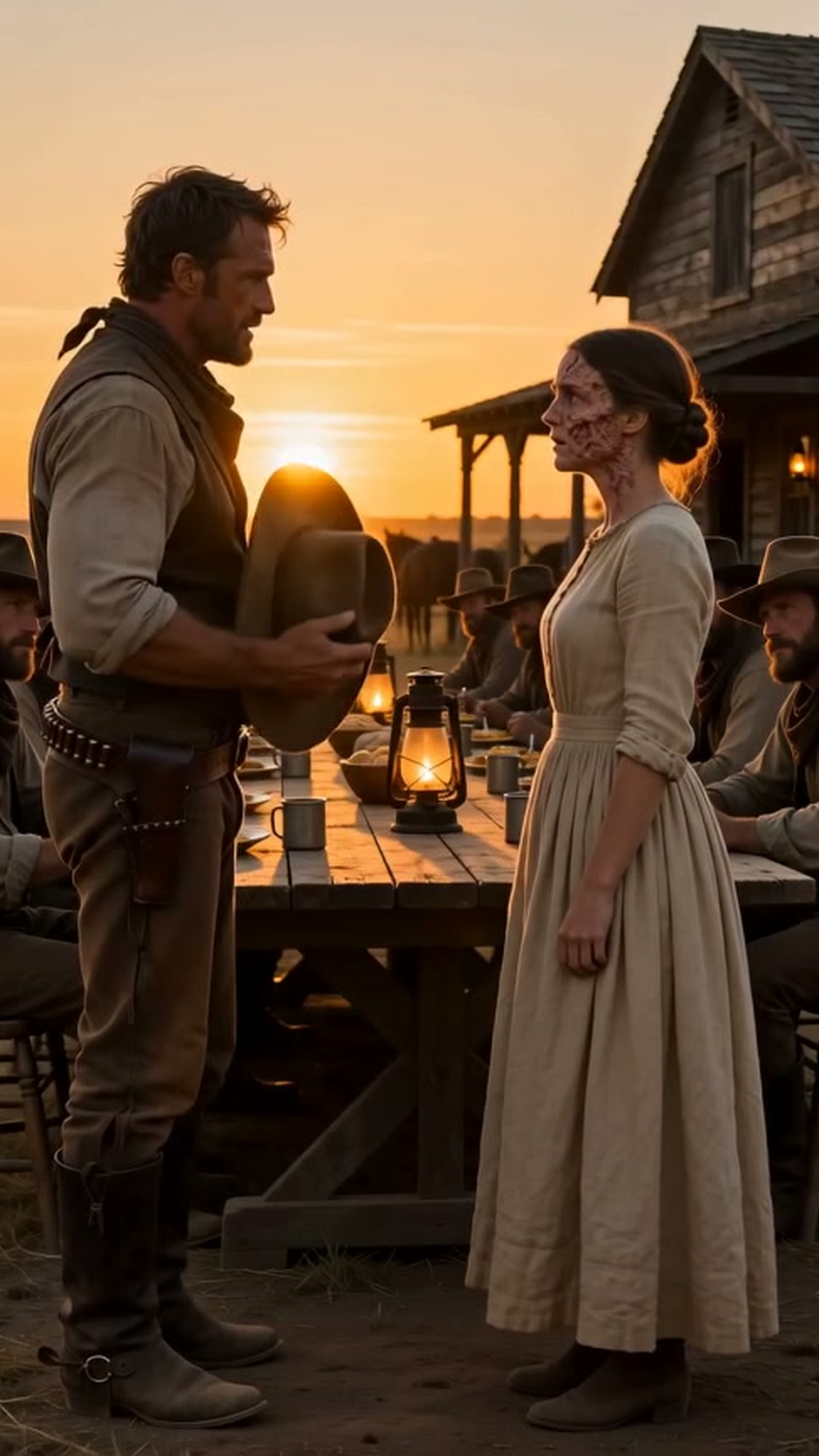
She wore her cream dress — the traveling dress, washed and pressed and mended at the cuff where the fire had kissed it, because she had refused a new one on grounds that this one had the better references. Coulter wore his father's coat. The minister from Alder Creek performed the ceremony at the long table at sunset, because Edith had said that was where the whole thing had happened, all of it, and she intended to be married in the scene of the crime. The hands wore clean shirts. Sam stood up with Coulter, and Amos stood up with Edith, and gave her away in a voice that only cracked once, at the very end, where nobody minded.
And afterward, when the feast had been eaten and the toasts drunk — Judd's toast, which began "I laughed the first day, and I've been apologizing in carpentry ever since," and was voted, by acclamation, the finest speech ever made on the place — afterward, in the copper light, with the lanterns coming on down the table and the dishes cleared by other hands than hers for once, Coulter Grady rose from his place and came around the table to where his wife sat, and took off his hat, and held it against his chest.
The whole table went quiet, because thirteen men and a brother knew a ceremony when they were inside one.
"Edith," he said. "This morning — a morning some weeks back — you told me something, standing right about here. You said: No one marries a scarred girl."
"So I did," said Edith Grady, and her eyes were shining and her chin was up.
"I've had the whole summer to finish answering it," Coulter said, "and I find I need help from the company." He turned, just slightly, to the table — to Judd who had laughed, to Rafe who had asked for grace, to Ben who she had carried out of the fire, to Amos who had never bet a nickel on any human being — and every man there, on cue they had arranged among themselves like the bucket line, like something drilled by love and long practice, said it with him, ragged and certain and loud enough to scare the horses:
"Missouri was wrong."
Coulter turned back to her and took the last step, the step he had taken in the lantern light in May, and bent his head to hers, forehead to forehead, hat over his heart.
"Marry the woman who walks through fire for your household," he said, just for her, finishing it at last, all the way to the end of the sentence. "Marry the woman who feeds you before herself and reads your whole life out of a ledger and hands it back to you saved. That's the Nebraska version, Edith. That's the only version there's ever going to be at this table."
For the record — because Ben kept it, in the copybook, in the round school hand that had once recorded bets against her — the day's entries read: Bride forbidden kitchen, held. Biscuits, Judd & Rafe, edible (bride's word, witnessed). Gravy, Amos, no lumps. Ceremony, sunset, table. Toast, Judd, fined nothing. Foal Ember presented to company wearing a ribbon (Ben's doing, bride laughed). Boss cried once (denied). Cook sat at head of table and was served first, house law, permanent now, amended in the stock book in two hands.
Later, much later, when the lanterns were low and Ember the foal was asleep standing in the corral with his mother and the door at the end of the hall stood open on the lamplit room where the bed was turned down, Edith stood a moment in the yard where she had arrived in a dusty wagon with a battered suitcase, believing she was a sentence other people had written.
She had been wrong about a number of things, as it turned out. She had been wrong about the advertisement, which had been exactly as plain as it looked. She had been wrong about the train, and the troupe of her own fears. She had been wrong about what the left side of her face had to say about the rest of her life.
The scars were ten years old. They would be eleven, and twenty, and fifty, and they would fade no further than they had faded, and it did not matter — it had, in the end, mattered so much less than the gravy, and the books, and the walking through fire, and the sitting down at the table in her own place, in her own house, with her name in the stock book in two hands now: his, like a fence, and hers, like print.
No one marries a scarred girl, Missouri had said.
Missouri, the record will show, had never once been to dinner at Grady Ranch.
THE END